Tag Archives: Love

The Dementia Dossier: Listening

How Can I Really Help the Poor? - Third Hour

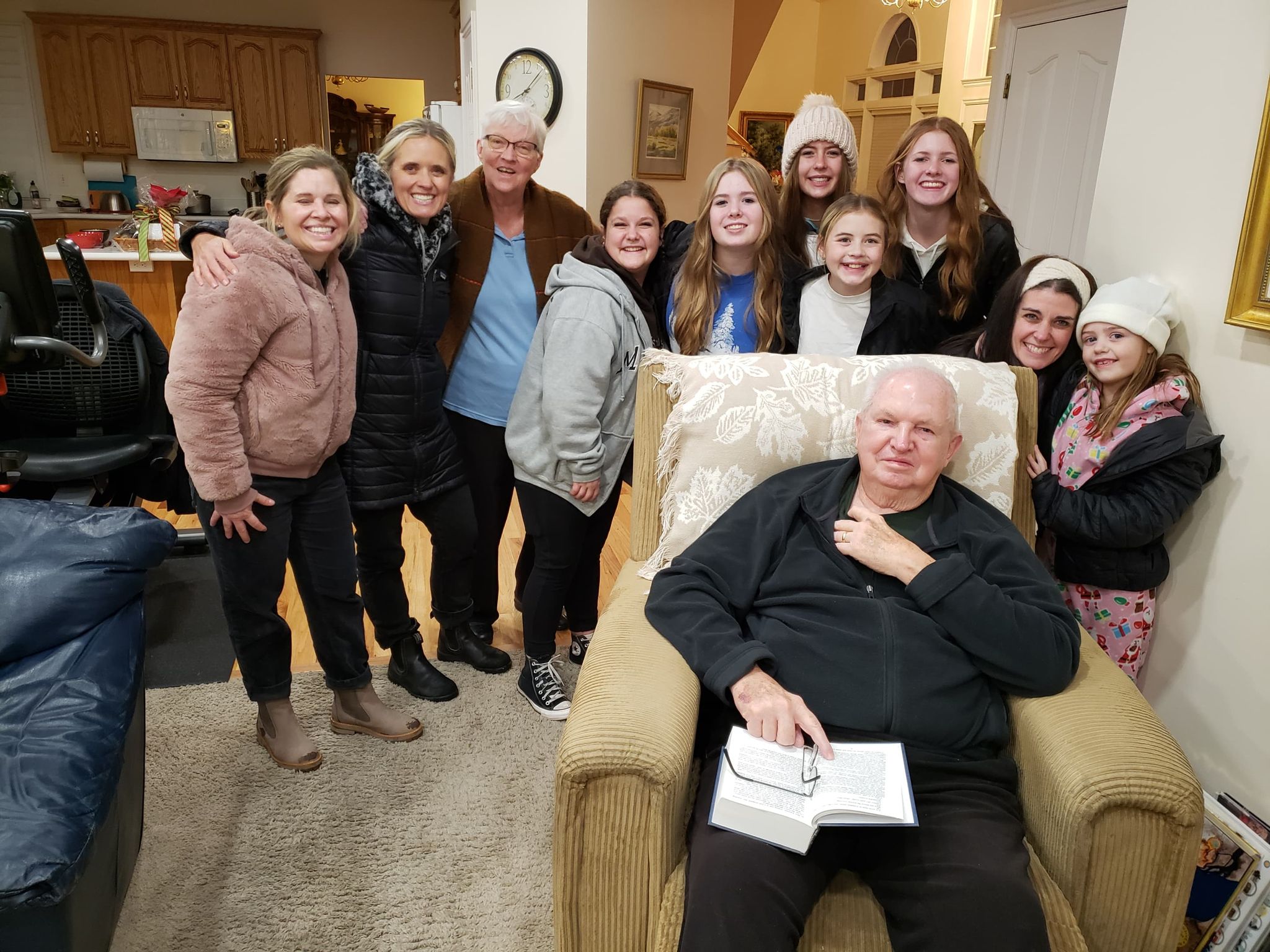
Two men from the church came to visit Mom, one a teenager and one recently retired. In addition to the box of Crumbl cookies, they brought their love and interest and supportive smiles.  And Mom gave them each her big bouncy full-bodied hugs, and they laughed, even as I cringed.  I had set holding chairs out for them, in front of Mom and her recliner, and I listened from the kitchen, wanting Mom to have their full attention.  Stewart and Brendan had come just a few days before Dad passed away, and here they came again to minister to Mom with words of comfort and love (and with cookies).  The subject of death has been tender and frequently on our minds.  Mom asked about Stewart’s son who died, long ago, of meningitis at age 10, and Stewart was coming to the crux of the terrible story, about how even in death he had felt profound love and peace and a divine Presence.  As Stewart stopped for a breath, Mom looked at Brendan and asked him about his favorite subject in school.  The sudden change of subject, at such a dramatic and touching moment, left me feeling jarred.  What mental mechanism of Mom’s caused that? I wondered.  I know she loves and cares about people.  I wondered if she even heard the story, or felt the emotion in it, or if she just couldn’t focus on one subject or story line for long, no matter how poignant.  Steward took the jolt in stride, understanding and not judging, loving her notwithstanding.  Still, as I escorted the men out through the front door, I made a point of thanking Stewart for sharing his story, and of standing with him for a moment in his resurgent pain.

(Photo from Pinterest, used under Fair Use.)

Courage at Twilight: The After Words (Loneliness)

We, my brother and sisters and I, navigated a week of days too filled with tasks to feel much grief—writing an obituary that attempted to summarize in two pages the long life of a great man—preparing a funeral program involving dozens of family members—writing a funeral talk I did not want to write—the mortuary checklists—settling affairs of estate—hundreds of texts and emails and messages to and from those who knew and loved him—the trickles and gushes of people through the house—all the standard tasks, which we were determined to perform in an exceptional manner.  Mom will be lonelier now, without her husband and friend of 65 years.  She will not hear him say as she sidles past his hospital bed, “You’re just the most wonderful wife, Lucille.  I love you.  We’ve been married 62 years.  When you walk by, I’ll give you a hug.”  I will not hear him exclaim “Roger!  Welcome home!” and “What a gorgeous dinner, Rog!  I just love steamed vechtables!”  Walking the grocery store aisles, I passed the zero sugar mint patties, the deluxe mixed nuts, the lidocaine foot lotion, the Brussels sprouts (Mom hates them), and no longer put them in the cart.  And, I felt the wrench of good-byes anew when I handed to the thrift store attendant the bags stuffed full of shoes and socks and shirts and sweats and suit coats and hoodies.  But our grinding struggle is over, and Mom will experience her widow’s aloneness with a new measure of calm.  A neighbor asked Mom how she was feeling, and she declared, “I’m so happy for my husband.  He’s not paralyzed or sick anymore.  He can run and jump and play.  He’s with Sarah, and with his mother, his father, his sister Louise, and all the rest.”

Courage at Twilight: Missionary Choir

How different this funeral from the funeral of our father’s daughter 370 before, a funeral marked by tragedy and despair and anger, the wrongness of it all bound up in rightness of faith and family love.  Now, we basked in the power of our father’s life and legacy, trusting in our convictions about the goodness of this life and reality and betterness of the life to come.  We retold old stories, and told new stories, unknown to most, stories of love and service and faith.  And we wept.  In a powerful funerial moment, Mom called to the front of the chapel all of Dad’s former missionaries from Brazil.  These 30 men and women, all in their early 20s during their missionary service with Dad, now brought their 70-something gray hair and aching knees and backs to the front, and sang Israel, Israel God Is Calling, in parts, in Portuguese: Israel Jesus Te Chama.  My Portuguese-speaking sons and I joined the choir, and we felt the power of love and conviction and camaraderie echo within the chapel walls.

Courage at Twilight: I Will Not Let Him Drown

For two days family members have trickled in to visit with each other and to tell my father they love and admire and appreciate him, and to say good-bye.  Those living farther away video called to do the same.  But my father has been in a coma.  Today he has begun to show the signs of death: a rising core temperature (at times 104 degrees F); cooling extremities; sweating and clamminess; inability to swallow (he has not eaten or drunk for six days); healthy color fading to cadaver gray; producing very little, very dark urine; not registering pain or reacting to any stimuli; gurgling on liquid in his lungs; no bowel movements.  The day was calm and filled with tender expressions, and I imagined he would slip away quietly into death, his body and mind finally shutting down.  The rattling and gurgling in his ragged breathing seemed to worsen.  I learned later this breathing is called the “death rattle.”  Finishing the hundredth phone call of the day, I could hear from across the house a concerning increase in the raggedness of his breathing, and hurried to his side, where I was horrified to find his mouth filled with a thick creamy liquid.  How is he even breathing through all this goo? was my first thought, quickly followed by a frantic He’s going to drown!”  I remembered seeing a rubber bulb used to suck a sick baby’s nose, and ran to retrieve it.  He might be on the verge of death, but he would not meet his death by drowning, not while I was here to do something about it.  Please, God, help me know what to do.  Somehow, my father was managing to convulsively breath despite the liquid, and I set to sucking it out with the bulb, squeezing the contents out onto a sheet.  Please, God, help me to keep him alive until Steven gets here.  Ten panicked squeezes, twenty frantic squeezes, fifty fearful squeezes with the bulb.  My hand began to ache, and the phlegm piled up on the sheet.  His mouth now clear, I called the on-call hospice nurse, who explained the goop was a normal accumulation of mucous in an unconscious person with congestive heart failure who could no longer swallow.  I felt chagrined, that this were so normal, why did a hospice nurse not tell me to watch for it, prepare me to deal with it?  She ordered the delivery of a suction machine.  The motor suction wand helped me remove more mucous, though much of the underwater gurgling lay deeper in his throat where I was afraid to jam the wand.  While he could no longer swallow, he could also no longer gag, and I probed as aggressively as I dared to clear his throat of phlegm.  I did not want to injury him or cause him pain.  My sister Carolyn took over suction duty while I raced to the airport to get my brother Steven, about to arrive from North Carolina on a trip planned months previous.  I apprised him of the condition in which he would see his father, hoping to soften the experience.  He stood over Dad, offering his silent and whispered good-byes.  Carolyn, Steven, and I began to plan the night, resolving on hourly suction shifts.  I would take 11 p.m., midnight, and 1 a.m.; Carolyn would take 2, 3, and 4 a.m.; Steven 5, 6, and 7 a.m.; and I would resume at 8:00.  At 11:01 p.m., as I wrote this entry, pushing one minute past my shift start-time (what harm could one measly minute do?), Carolyn came to my room and whispered that our father’s breathing had changed, had calmed and slowed.  We descended the stairs and found our father not breathing at all.  I cleaned his face of the last thrown-up mucous and felt for breath and stared for a moving chest, but all I saw were slack muscles and a ghostly greening face.  I ran for Steven, and Carolyn ran for Mom, who descended the staircase slowly on the lift in her long white cotton nightgown.  We stood around our father and husband, not quite believing he was gone, his body still hot, his body unmoving, his body covered with a white flannel sheet stenciled with blue sheep.  Peace and tenderness and loss and relief and sadness permeated our own bodies, together with the one last unexpected trauma of preventing his drowning, and we said nothing until I somehow knew I need to say something, not just anything, but something sublime and holy and apropos, so I offered to pray, and I thanked God for this great man, this powerful intellect, this generous heart, thanked God for giving him to us, thanked God for having each other, thanked God for ending my father’s years of daily suffering, thanked God for a family filled with love and devotion for one another.  And we let him go.

Courage at Twilight: Sweet Moments

The family starting calling and coming over, and undeniably sweet moments began to surround Dad and to fill the house.  My sister Megan leaned over him, in tears, and gently wiped his cheeks and chin and brow, talking sweetly to him, and he awoke enough for several lucid minutes of whispered conversation as she related old memories of growing up in New Jersey.  When he slipped back into unconsciousness, she summarized to him some of the more interesting stories in the day’s New York Times.  Niece Afton stood by and rubbed his arms for an hour and sang to him his favorite family song, “Sweetheart of the Rockies.”  My son Caleb spoke out with “Love you, Grandpa!” and Dad’s eyes fluttered and he whispered back, “Love you, too.”  Caleb joined his siblings on a Messenger call, and they all took turns saying good-bye, or to wave and cry.  Rosie and Veronica, two CNAs, deftly rolled him over and back in order to install a draw sheet, disposable chucks (pads), and a new brief, and swabbed his mouth with a wet sponge, and installed pillows beneath his calves to keep his heels off the mattress to avoid pressure sores.  My daughter Erin expressed her love and sadness from the other side of planet Earth, and my sister Jeanette and her husband Craig and Dad’s brother Bill called me to tell me they loved me and appreciated my efforts and pledged their support.  Friends Ana and Solange sang Brazilian lullabies to him, and Ana told me how she had the strongest impression when entering the house that Sarah, who died exactly a year before, was there in the house with us, with Dad, along with other loving spirits—Ana could feel their presence so strongly—and how their presence remained until just after the CNAs had finished caring for Dad and Dad had finished crying out in pain as they rolled him to and fro and we had given him more lorazepam and morphine to ease his pain and anxiety and he slipped into soft snores—then Sarah left.  And I told Ana I was glad she could feel such beautiful mystical things and tell me about them because I am both utterly empty and completely saturated and can feel nothing but only flow from one task to the next to the next—there are so many tasks—and in between I can but withdraw into myself and sit curled up in an emotional corner unable and unwilling and unready to feel.  The last person awake in the house, I looked at Dad in the nightlight glow and knew he was dying and would be dead within hours and saw his passing as just another fact among an infinity of sterile facts, like the ripening of the green bananas, like making mashed potatoes and sausages so I had something useful to do, like the glow of the reading lamp and the squeak of the rocking chair, and Megan’s teary eyes, and Mom’s veneer of cheer thinly covering a universe of grief and fear, and the stars shining coldly in the winter sky.

Courage at Twilight: I Do

The gurgling in my intestines sounded underwater like wall hangings clanging to the floor and wandering off wounded. Lying sick in the tiny tub, my legs stood straight up against the tiled wall.  Only half of my body fits in the tub at one time.  My head underwater but for my nose, I relaxed into the soft heat of the Epsom water cradling my face and head, awash in the experiences of yesterday.  Dad wanted to attend the wedding, and I agreed: the three of us should go.  I have avoided taking Dad anywhere, for the strain on us both, but loading him into the high front seat of the Mighty V8 proved a simple execution of our detailed loading routine.  I guess we could do this more often, after all, I mused.  Turning the key brought only the click click click of a failed starter.  “Not to worry!” I preempted Mom’s panic.  “I’ll have us jumped and on the way in five minutes!”  And it was so.  But I did not tell Mom and Dad how when I jump start a car battery I am terrified of blowing up the cars and killing everyone within a city block.  Perhaps with good reason: I read the instructions three times and still connected the cables backwards.  A lurking dyslexia?  We rejoiced to see my cousin David and his wonderful family at his son McKay’s wedding.  The officiator was a tall slender fetching tatted woman in a sleeveless summer dress, her hair a pleasing mess of multi-colored dreads running four feet down her back.  The men read their vows, both sweet, and the colorful woman pronounced them “Husband and Husband,” words I had not heard before.  I always feel happy and wistful when two people find love and each other in this vast complicated world.  It is quite a miracle, really.  May their loving union long endure.  Leaving the venue, I helped raise Dad from his wheelchair.  Weak and shaky after three hours in his chair, he grasped the handholds and struggled to straighten.  But his left foot was positioned under the running board, and his right foot too close to the left, and his feet stuck to the asphalt as if with buckets of cured epoxy.  He could not lift his legs to shift his feet, and hung grunting from the handholds, his whole body trembling.  I could not move his feet either: all my effort was devoted to keeping him from collapsing to the parking lot.  Dad surprised me with a move he had never made before: “Help me lift my right leg!”  I capitulated, to tired to argue, but his right foot on the running board created an impossible tangle of legs and feet and hanging arms and belly and arthritic artificial knees that wouldn’t bend but were bending anyway to his howls.  In a last desperate move with my remaining ounce of energy, I pulled the chair to him with my left hand and yanked him backwards by the waistband with my right.  With some luck, backside and seat met squarely.  Parched and panting and sick, I pulled David and Jason from the wedding lunch with a plea for help, and with four strong arms and legs they hoisted Dad handily into his seat like he were a feather duster.  Relieved to be on our way to the sanctuary of home, I turned the key and heard only a click click click.

(Image by MasterTux from Pixabay.)

Courage at Twilight: A Pat on the Butt

Dad is mildly delighted, in the way only a crippled 88-year-old former marathoner could be, with his new used walker, painted racing red. Leaving work early to hunt for a walker, I mentioned my mission to my legal secretaries, and one reported her family had a walker they weren’t using and didn’t need, and within the hour I was driving home with the walker in my Outback hatch.  With the walker cleaned and sanitized, and with the handles raised to their full height, I introduce it to Dad.  “What a great-looking walker!” he chortled.  “It’s a miracle!” Mom exclaimed.  Well, if not a miracle, certainly a convenience and a grace.  Past midnight, I stumbled to the toilet and heard Dad droning uninterrupted in his gravelly aged monotone.  He seems to talk like this past midnight every night (as I stumble to the toilet), and I wondered whether he kept Mom awake or whether she simply slept through it, acclimatized by decades of droning.  Back in bed for only a moment, I heard Mom utter a strange squeal, and I jumped out of bed to investigate.  I stood in the dark hallway in my undergarments, poked only my head through the doorway into their bedroom, and piped up, loud enough to be heard, “Is everything okay in there?”  “Oh yes,” they both called back, and Mom explained that Dad had just finished praying for them, and it was such a marvelous prayer, and show he reached over and “patted him on the butt.”  She giggled over having squealed.  Well, I chuckled to myself, good for you for praying and praising and being cute and cuddly and coquettish.  At 4:00 a.m. when I stumbled yet again to the toilet, I looked in on Mom and Dad, lying under their blankets, back to back and softly snoring.  And I remembered what kind, generous, loving, devoted people and parents they are, and how I am blessed to be theirs.

Courage at Twilight: Good-bye, Love

The texts tumbled in just as City Council meeting began. “911!  Please call right away!”  “It’s an emergency!”  “Can you excuse yourself?”  I needed to know more before I walked out on the City Council and Mayor, but I got more than I bargained for: “Sarah just died in a snowmobile accident.”  My sister.  My beautiful, energetic, ambitious, kind, and loving sister.  My sister who saw me and loved me just as I am.  “What the hell is going on?” I barked when he answered the phone, barked out of terror, not anger.  Indeed, his wife, my sister, had passed away after a freak accident.  In the previous months, she had led her teams of nursing directors and therapy directors to new levels of excellence, surpassing company aspirations, and the boss had treated them to a mountain lodge retreat where, after the celebratory gathering, the twentyish directors chose between three company-provided activities: snowmobiling, four-wheeling, or massaging.  Sarah chose a massage, then ran to join her boss and co-workers on snowmobiles: why settle for one fun activity when you can cram in two?  She zoomed across snowy trails with her boss and five colleagues.  She missed a turn and flew over an embankment.  She hit a tree.  Her helmet broke open.  She died on impact.  My sister.  Sarah.  My sweet, accepting, no-nonsense, intensely fun, forgiving, and loving sister.  And the bottom of my world abruptly dropped away and I began a freefall of terror and panic and deadening dread.  This could not be!  This was not possible!  Never a crier, I sat at my desk and sobbed.  As the older brother, I knew what I had to do.  I rushed home, had Mom and Dad sit together, and began the impossible: Something terrible has happened.  Something terrible has happened to Sarah.  Through heaving sobs, I related what little I knew.  To my stunned parents.  To my only brother.  To my three weeping sisters.  To my seven adoring children.  To my far-flung nieces and nephews.  One by one.  And with each telling I bawled anew.  I am not a crier, but I cried more during that night than I had in my previous 59 years combined.  This simply could not be!  But it was.  She was gone.  Everyone experiences grief differently, in their own ways and times, and every grieving is genuine.  To Mom (so far), the tragedy seemed like just another random fact, like running out of milk.  Dad moaned for hours: “I don’t know if I can survive this.  Truly.  I’m 88 years old!  I’m already frail, and I can feel what little strength I have left breaking and melting away.”  But with visitors and talking through his shocked incredulity again and again and again he survived the evening and the night and the next day.  I retreated to a dark room and cried in convulsing waves.  Not Sarah!  Her story was not supposed to end this way.

Courage at Twilight: Turn Up the Heat

“Is it cold in here?” Dad lobbed the question into the middle of the family room.  Mom and I looked at each other and shrugged.  Dad pulled his favorite soft burgundy fleece up around his neck.  I moved to Mom’s kitchen desk to affix a return label to their quarterly tax return envelope, leaving the kitchen can lights in the non-blaring off position.  Mom, bless her, struggled to her feet and tottered over to the kitchen, switching on the blare: “Don’t you want more light?”  This is what I heard: “I know better, son, and I love you, so I’m turning on the lights you don’t think you need.”  And I decided to try drawing a teeny-tiny itty-bitty boundary: “Thank you, Mom, but please don’t hover.  I know how to turn the lights on, and if I wanted more light, I would turn the lights on.”  “Alright, dear,” she bit, her face shrouding, and she tottered back to her chair with that arthritic hip-knee-ankle stagger.  I know she had acted from a place of love, but perhaps love could have observed that I was happy in the daytime dim and trust that I will act in my own best interest, and let me be.  “I’m cold.  Should we turn on the fireplace?” Dad ventured from his chair.  Brother-in-law Mike had come to repair the wound to the bathroom tile resulting from installing a wider door, prompting me to get in gear and calk around the door molding and frame and fill the nail holes.  After two months, the project is nearly finished.  “I think maybe I’ll turn on the fireplace,” said Dad, the hint growing more apparent.  The night before snow fell and the temperature dipped.  Dad had emailed me at work: “Roger, the weather report says a strong storm will come through this afternoon.  Snow, wind, white-out conditions.  They recommend persons leave work early.  Dad.”  It’s nice to be loved and cared for and worried over.  But I am 59 years old, and am always cautious driving in snow.  And, yes, when snow is coming, I leave work early.  “Yep, I’m going turn on the fireplace,” and I finally took the hint and flipped the switch to ignite the gas so he could warm up.  Before he had ridden down the stair lift that morning, I had heard him scream, “Owieow!!” from his shower.  Mom had started the dishwasher, which diverted alternatingly scalding and freezing water from his shower stream.  “I’m scalded,” he complained an hour later.  “My skin is still red and sore.”  And mom promised not to run the dishwasher in the mornings anymore.  Sometimes it can be hard to get the temperature of things just right.  The fireplace burned with yellow flame, and the fan coursed hot air into the family room.  “Is it hot in here?” Dad lobbed.

Courage at Twilight: Kiss Me, Dear


Columnist David Brooks posits in his Second Mountain that conversation is critically foundational to successful marriage.  If so, I am doomed.  Conversation has always come hard: I expend so much energy measuring my audience and tailoring my comments for self-safety that talking is exhausting.  I did not chat much in marriage, and after eight years living alone, I sometimes wonder if I can converse at all.  Draper Rehab held a resident Thanksgiving dinner. Mom and I were Dad’s guest quota, and we sat quietly at our table watching all the other residents with their respective disabilities and guests, waiting for more than 150 people to be served their turkey and potatoes and stuffing and yams and green beans and gravy, all meted with ice cream scoops.  We had little to say to one another.  Dad drooped and seemed so old.  But we were there, giving quiet loving support.  As I knew he would, Dad eyed my cranberry-sprite cocktail and wondered if he could have some.  Too much sugar, Dad.  But when José brought the cart around, Dad motioned for a cup.  I said nothing.  Various residents rolled by: Mark the mechanic who loves all things cars; Mitch from Brooklyn with whom we felt an affinity as an east coaster; others who could not speak or could not move and had daughters feed them and grandchildren wipe their mouths with white towels.  “The food is wonderful,” I ventured, and I might as well have commented on the weather: rain was in the forecast.  The next day, Mom and I asked Dad for a report on his physical therapy—he had walked “a hundred feet” to the exercise room and practiced standing up and sitting down six times, and was thoroughly wasted.  I showed him how to operate the television remote—hold the remote in your left hand and push the channel up or down button with your right index finger, like this.  We talked about springing powers of attorney and how they needed durable powers of attorney because I did not want to have to testify in Mom’s and Dad’s presence to a doctor about their future incompetence to make decisions for themselves—they agreed.  And I had Dad sign a letter I wrote to Bank of America asking to reverse late fees and interest charged on the same day his payment posted.  “We’ll see you tomorrow, Dad,” I reassured him.  That is the hardest part of living in a rehabilitation center: not the briefs and bed pans, not the food you don’t like, not the lack of interesting television, but the utter loneliness of living alone in viewless room away from your beloved home and sweetheart.  “I’m not leaving without a kiss!” Mom exclaimed, juggling a smile from his smooched face.

Courage at Twilight: Recharged

Dad has tired of ham-onion-Swiss sandwiches, and Mom has had to get creative with his lunches. A plate of mixed nuts, applesauce, a slice of cheddar, carrot sticks, celery and cream cheese, and a peach cup—do not forget the diet Coke, on the rocks—have been this week’s fare.  And the bag of kettle-fried potato chips on the floor by his recliner.  Mom assembles Dad’s lunches simply because Dad cannot.  He seems to enjoy ordering her around a bit, e.g., “Lucille, get me some crackers.”  While they munched, I dug out the Subaru owner’s manual and read the jumper cable instructions carefully, three times, connected the jumper cables, carefully, to Mom’s Legacy and the Mighty V8, rechecked the instructions twice, started the Mighty V8’s engine, then turned the key to Mom’s Legacy.  Dad’s faithful Suburban soon began to falter, then died, and smoke curled up from both batteries.  Mom’s car never started.  Continue reading

Courage at Twilight: Spicy Dumplings

I made Mom cry twice in one day. And I feel terrible.  For dinner I served Korean dumplings with fresh steamed asparagus and zucchini.  After serving Mom and Dad, while fetching my own plate, I heard Mom erupt into gagging coughs and turned to see her surprised and red-faced.  “These dumplings are HOT!”  Oh no, I thought, running for the bag, which revealed the dumplings to be Spicy Pork & Vegetable Dumplings, the word “Spicy” in conspicuous red letters which I had missed at the store for my focus on the photo of the yummy-looking dumplings.  Indeed, the dumplings were very spicy and burned my tongue and my lips unpleasantly for an hour.  After dinner I stood to clear the TV tables and clean the kitchen when Mom asked me to tell her one thing about my work day.  I sighed and rolled my eyes.  I literally rolled my eyes!  I wanted to move on with my day and rush to the next task to be checked off the to-do list.  And I am not good at shifting mental gears once moving in a mental direction.  And I spent six years utterly alone with no one to talk to after work about my work day.  And I spent three decades not talking about my work at home because my work was overwhelming to me and uninteresting to others and I wanted less to do with work, not more.  And I have never been much of a talker.  And I run all day from task to task to task and after dozens of tasks I struggle to remember what I even did that day.  And those are my excuses, anyway.  Weak ones.  And as I rolled my eyes Mom coughed strangely and I looked to see her moving to cover her reddened face and tearing eyes with her soft blue fleece, her cough in reality a choking cry.  My heart sank.  I had hurt my sweet octogenarian mother.  And I could not unhurt her.  “Let me think,” I said, looking at the ceiling and not at her, to avoid her feeling self-conscious, “if I can remember what happened today.”  I told her about finishing the book Just Mercy about a young Harvard lawyer who founded the Equal Justice Initiative in the deep South and fought for the freedom of Black men who had been wrongfully arrested and maliciously prosecuted and who spent years in solitary confinement on death row before their executions, or, for the lucky ones, their exonerations.  I told her about working with my friend Paul the engineer to resolve difficult problems with real estate developers.  I told her about the high-pressure 14-inch natural gas pipeline embedded in the bank of a flood channel and how the bank is eroding and how the gas company and the property owner want the City to fix the problem at taxpayer expense.  And I told her about my commute home and the high winds that tried to blow me off I-80 and the clouds of dust and fog and snow and how heavy the traffic was.  And I feel terrible, but I cannot un-ring the bell, or reverse time, or breath back in my words, or undo any of the other things I wish I could undo after I have done them.  I am thinking tonight about how blessed I am that my mother loves me and is devoted to me and is interested in my day.  I am thinking tonight about Mom announcing to me, “You will be so proud of me: I rode the bike today!” and about how she needs me to be proud of her, and about how I am proud of her, and need to tell her.  I am thinking tonight about the responsibility I have to buttress her self-esteem, to affirm her, and to return love and devotion and interest.  I am thinking tonight about how tomorrow night she will not need to ask me to tell her one thing about my day because I will have two or three already lined up.

Courage at Twilight: As If They Belonged

The March afternoon shone sunny and warm, and after struggling to help Dad transfer from his recliner to his power wheelchair, I asked him if he would like to take a “walk” to the end of the street and back, thinking he would enjoy a change of scenery and the fresh air. “What I’d really like,” he replied, was to ride his mower, set low, to pull up winter’s dead grass thatch.  I sighed.  I told him I respected his desire to ride the mower and prep the lawn, but if he was having so much difficulty climbing into the chair, I did not think he could safely mount the mower.  He sighed.  And he yielded.  And I suggested the alternative of riding in his power chair to inspect the yard in preparation for riding the mower next week.  He nodded, and I walked after him as he rode his chair out the front door, down the ramps, and onto the lawn.  In the back yard, we found the grass saturated and squishy, and I urged him toward the higher ground.  But he felt afraid to tip the chair on the incline and stuck to the lowland valley, filling the wheel treads with dead grass and mud.  I sighed again.  Back in the house, I parked the chair on the hardwood floor and let the mess dry, and in the evening picked the treads clean with chop sticks and vacuumed up the detritus.  For dinner I cooked Tieghan Gerard’s delectable garlic lemon shrimp, to Mom’s delight: “I love shrimp!”  I did not know but was pleased to discover her “favorite.”  Sarah came over and, with the hospital bed gone, helped Steven and me reestablish Dad’s office—he had invited us to bring back his grandfather Nelson’s solid oak desk, but to orient the furniture so he could see out the window while using the computer.  We grunted and strained in moving the desks and shelves and cabinets and books and endless computer chords into a simple configuration we thought best utilized the space.  Dad ambled in and disapproved, but struggled to express what he wanted.  I had lazily resisted trying other configurations—the stuff was heavy and awkward, after all—but dug into my shallow reservoir of patience, breathed deeply, and acquiesced.  He finally announced his great pleasure in the outcome, and I felt compelled to confess his configuration, indeed, was the best, and to acknowledge the office was his and should be organized as he wanted.  But my reservoir was dry, and I felt exhausted and desperate for time in a dark cave.  Recovered by the next day, I enlisted Steven to help me select and plant juniper trees in place of the fallen spruce.  We measured and drew the space and planned the tree spacing and earth sloping.  At Glover nursery, we texted photos to Dad of seemingly acceptable replacements—we were not about to bring home trees he did not like—and he selected an emerald arborvitae.  Four would occupy nicely the space yet leave room for them to fill out.  As we dug the holes, Dad tooled out in his power chair and watched the entire two-hour process, contributing his encouragements: “Don’t dig the hole too deep.”  “Are you sure it’s okay to bury the balls in their burlap?”  Mom watched from the warmth of the kitchen window.  Having approached the project carefully and technically, and having involved Dad in every decision (Mom was happy with whatever we did), the result pleased us all, and we had four new friends marshalled together under the falling spring snow, standing as if they had always been there, as if they belonged.

Pictured above: four new emerald arborvitae.

Nursery staff expertly stuffing four 7-foot-tall trees into my Subaru.

Dad’s “new” office.

Courage at Twilight: Drying the Dishes

Home from work, I cleared the countertops and sinks of cups and bowls and spoons, loading them in precise fashion in the dish washer—I know exactly how each piece fits in its space. For decades I have taken great offense [hear my self-pitying sigh] at finding a dish in the sink after I have used copious quantities of my time and energy to empty the sink, and since I am the one that empties the sink, leaving a dish in the empty sink implies an unfair presumption that I am the family dishwasher servant [more self-pity].  When Mom takes these random dishes out of the sink and puts them in the dishwasher, I thank her, and am grateful for her courtesy to me.  But it was time to stop ruminating and to load Dad into the Faithful Suburban so the dermatologist could examine this tag and that mole and this scab that will not heal, the skin doctor who is smiley and polite but profoundly disinterested.  “Hello!  How are you!”  Three minutes of examination, and a declination to remove this or that because it is harmless even if Dad does not want this or that attached to his body because it does not belong and asks to have it removed.  “Good-bye!  Have a great afternoon!”  I had terrible trouble getting Dad into the car, both times, succeeding only with an ungainly combination of pushing and lifting and shoving until he was on the seat and my muscles quivered and my lumbar complained.  I had wondered what I would do if he could not rise from his wheelchair or if he collapsed once risen, and I had no answer—the only answer was getting him in somehow.  “That was our last trip to Dr. Jensen,” I whispered to mom, distressed.  And that distress and my tweaked back stalked me through making dinner and eating dinner and cleaning up after dinner and up the stairs and down the weeks and months of wakings.  But Mom is sweet, and recently has taken to putting aside her needlepoint and shuffling over to the kitchen sink to towel dry and put away the pots and pans I have just washed, and I appreciate her effort to say thank you with a towel and an empty sink.

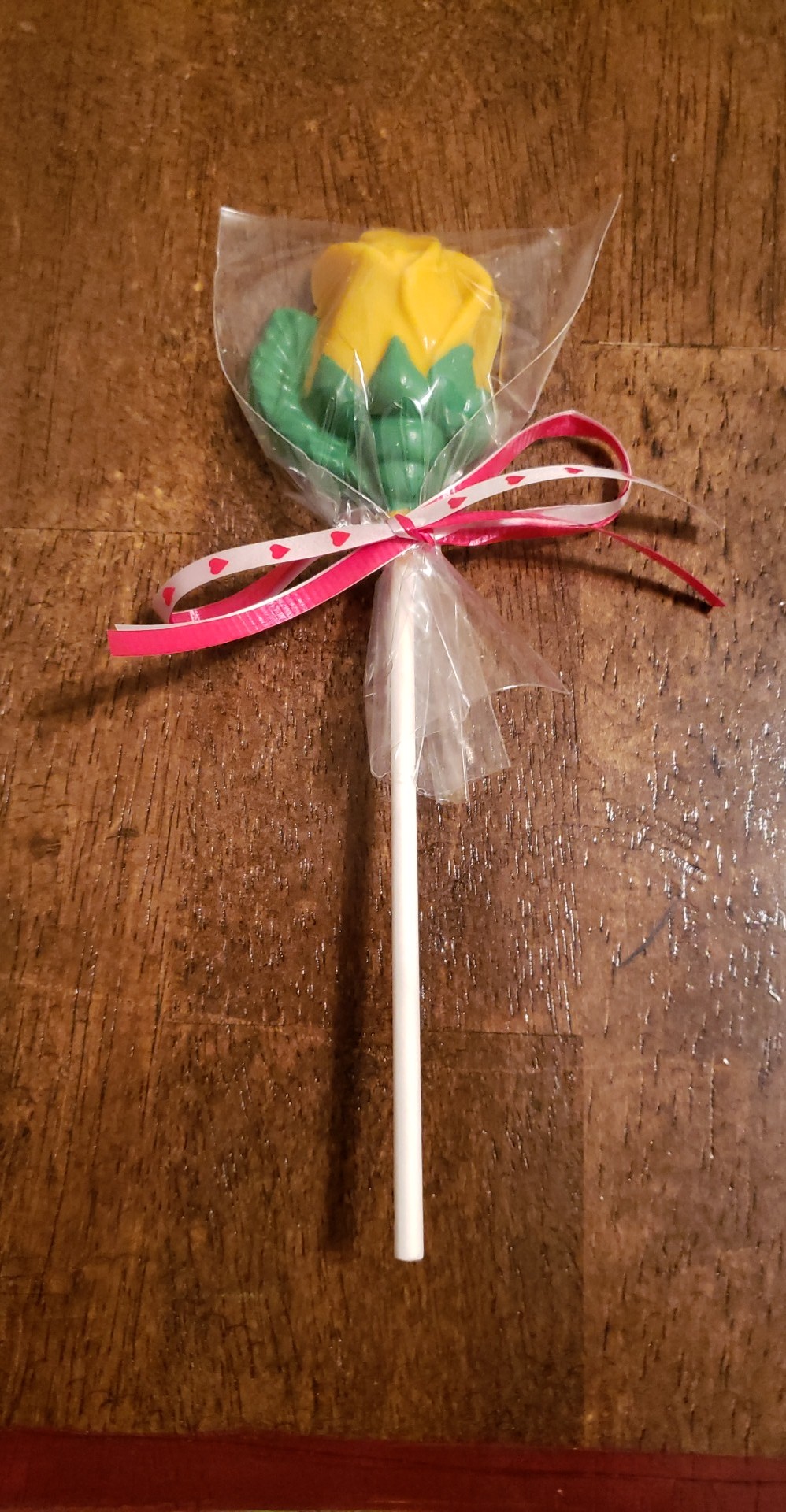
(Pictured above: felt rose craft I made for Valentine’s Day.)

(Pictured below: my valentine from my sweet granddaughter Lila.)

Courage at Twilight: Members of the Tribe

My ears are attuned to every little sound: the clicks of the break release handles on Dad’s downstairs walker; Mom’s syncopated shuffle; the single beep as the stair lift arrives at the end of the track, upstairs or down; cursing from the bathroom. This morning I awoke to the muscular sound of an industrial-strength vacuum in the master bedroom.  Through the doorway I saw Dad sitting on the walker seat and pushing the carpet cleaner forward and back next to the bed.  I did not ask, but I knew without asking.  His weekday CNA Cecilia—faithful, pleasant, and kind—came shortly after and helped him shower.  From my home office I could hear their one-way conversation: she said very little.  “Do you know how old the earth is?” he asked her.  “Four and a half billion years old!”  He knows and loves the Bible and its God, but informed Cecilia that “God did not make the earth in six days.”  Rather, He probably took billions of years to make our globe.  Dad explained to her about the sun burning hydrogen in nuclear fusion, with enough hydrogen still to burn brightly for billions of years more.  He told her that the only way we know how to use nuclear fusion reactions is with a hydrogen bomb, and referenced the atom bombs dropped on Japan.  He expounded about ocean currents, and about the hydrologic cycle of evaporation and precipitation and the rivers of water vapor coursing through the skies, and about Argentina’s defiant propensity to default on its international debts, and about the formation of galaxies and stars.  “I like to know things,” he summed up.  Cecilia, an excellent listener, interposed an occasional affirming “really?” and “oh.”  He told her about our family visiting an Indian tribe in Brazil in 1974, and how the tribal elders would not let us into their compound without being members of their tribe, and about how the tribal elders allowed us to become members of their tribe by following them on a course through the grounds and buildings, ending at a ceremonial tree, and about how we bought blow guns and bows and arrows from the indigenous women of the tribe.  This is a true story.  I know because I was ten and I was there.  Dad’s stories sometimes jump from one unconnected subject to another, shifting like an old car with a worn out clutch.  Dad lamented to Cecilia, “A few months ago I was a normal person.  I could walk.  I could do things.”  That is not true.  I know because I am 58 and I have been there with him, watching the insidiously steady downward degeneration culminating in painful undignified immobility and having to use the carpet cleaner in the mornings.  He is not untruthful—he just forgets.  And he cannot retrieve his books from his bookshelves or his checkbook from his desk or a glass of ice water, and has to ask Mom and me to fetch these and other things for him.  He asked me to bring him Mom’s youthful portrait from his desk, placing it on the end table by his recliner, where he can see it all day as he reads.  I remember seeing that portrait of Mom on his desk thirty years ago when I visited his New Brunswick office in the Johnson & Johnson tower.  He has gazed at Mom’s youthful portrait for more than six decades, and he tells Mom everyday what a wonderful person she is, and that he loves her.  And he steals hugs when she walks by, and she returns the hug and runs her fingers through his sparse wispy hair.

Courage at Twilight: Mangos for Lunch

Hyrum called me from Brazil, where two weeks ago he began his two years of missionary service for his Church. He was tired but happy, overwhelmed but enthusiastic, intimidated but feeling the Spirit of God, not knowing the language but still communicating, exactly what a new missionary would expect to feel.  I encouraged him to be patient and compassionate with himself, to not think about the long two years of days ahead, but about today, one intentional day at a time.  The burly tatted barber gave him a nice haircut.  And I talked with Brian in Tooele.  Poor Lila has another cold, and Owen is already laughing.  Avery’s business is looking up.  Brian’s Fiverr clientele is growing—he raised his prices because he was too busy with too many clients, but they all requested him anyway.  He and Avery are finding balance in the chaotic life of a young family.  And I talked with John in Idaho.  Their bathroom ceiling fell in while they were out of town.  Luckily, the leak from their upstairs neighbors was gray water (washing machine) not black water (toilet).  Their landlady put them in a hotel for a few nights, and hired a handyman to fix the ceiling and walls.  I fasted a Sunday to seek God’s help in their search for employment after graduation.  Henry is almost walking, and puckers and blows kisses.  And I talked with Caleb and Edie in Panama, who arrived safety despite cancelled flights and chaotic connections.  At church they rejoiced at seeing dear mission friends and converts.  The hammocks by the mangrove lagoon were nice, too.  Edie is a Marco Polo wiz.  And I talked with Hannah over lunch at Costa Vida.  This father is trying to find ways to connect with his teenage daughter.  We are writing in the pages of a daddy-daughter journal, passing it back and forth, sharing our dreams and goals and interests.  She drove herself to my office for the first time.  And I talked with Laura in Chicago.  I sent her pretty fabrics, and she is full of quilting ideas.  Connor is studying furiously in medical school.  William has four teeth and loves blackberries.  And I talked with Dad and Mom.  Dad’s CNAs help him bathe, dress, and get settled downstairs.  He has been sending them home early, but paying full price, partly from magnanimity, partly from disliking pampering.  Mom and I frequently do chores they could do, like vacuuming the floor of spilled food around his recliner.  They are sweet to him; they are his friends; they listen patiently to his stories and laugh at his jokes and sympathize with his pains and indignities, but also need to work the time for which they are paid.  He did not disagree.  And I talked with Chip at church, who said he would stop by to see Dad, and did.  He is a retired east coast cop who speaks his mind, and exclaimed, “Just put on a double diaper and come to church anyway!”  He was only partly kidding.  “We miss you.”  People do miss Dad at church, and inquire after him.  A few actually come over, walking the talk, practicing what they preach.  Terry brought over a bag of cold apples for Dad to enjoy; peaches are not in season.  In Patos de Minas, mangos are in season, and my missionary son’s church meetinghouse nurtures two enormous mango trees in the yard.  He is loving both the mangos and the mission.  He is feeling the truth of the Gospel message, sharing the good news of the restored Church.  He is feeling the presence of God through His Spirit, and love for the people and the place.  He says he is Brazilian at heart.  A father could not wish for more for his son.

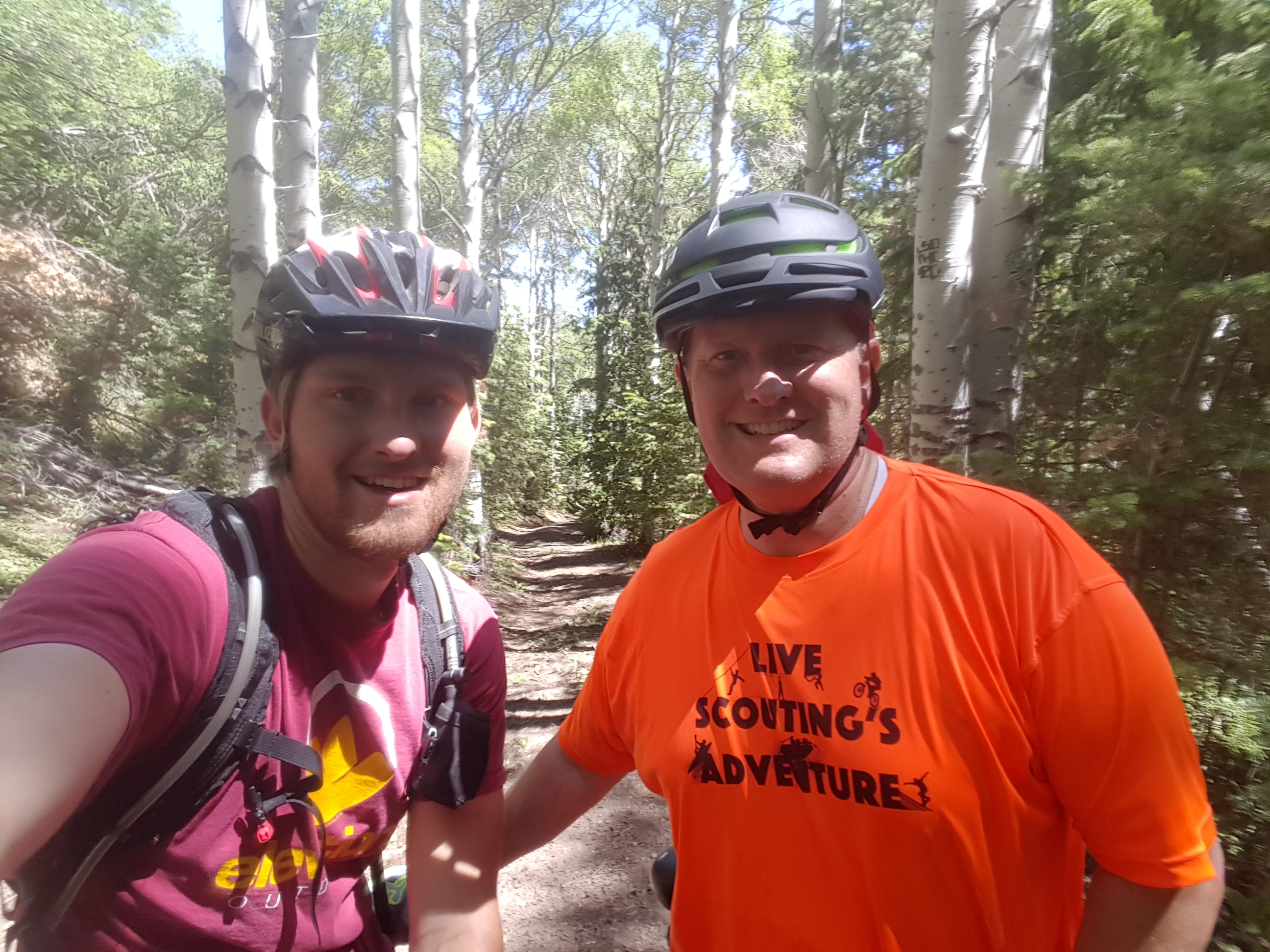
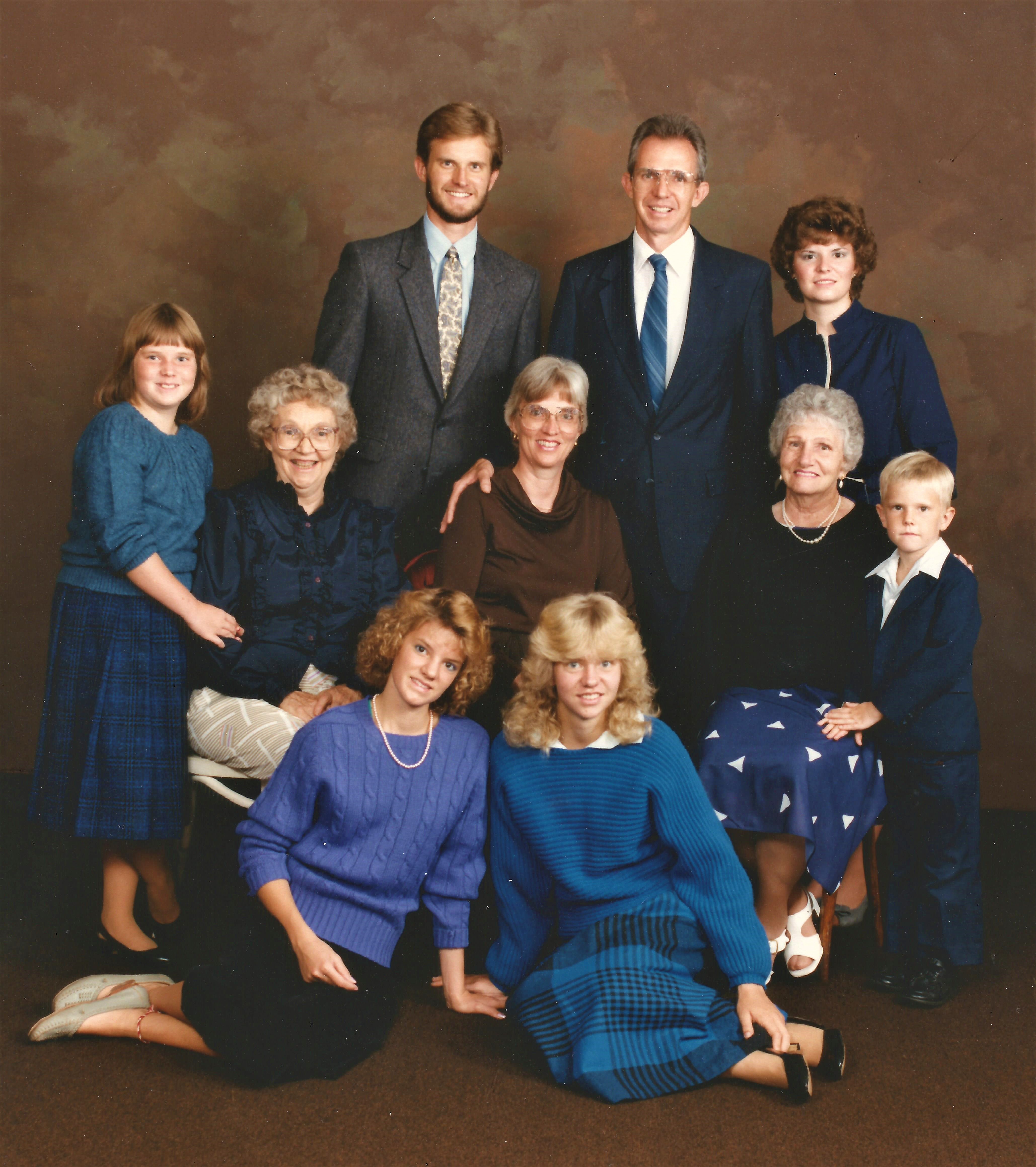
(Pictured above: Yours Truly with 6 of my 7 wonderful children, plus spouses (missing one), and my four beautiful grandchildren.)

Courage at Twilight: Sunset Deliveries

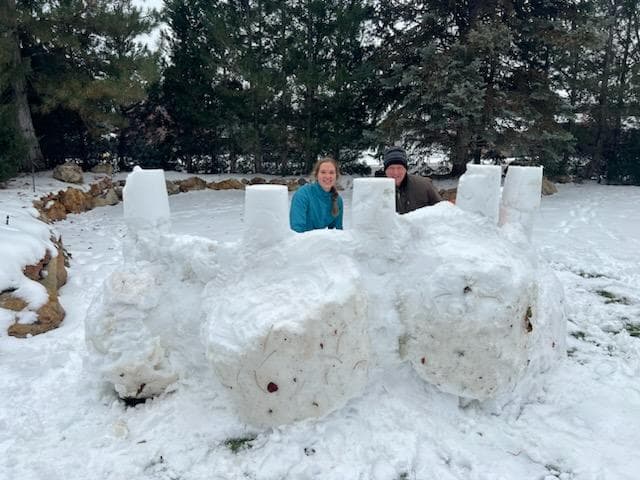
I thought they were cute.  Maybe others disagreed.  But the notion of old glass dressed up and repurposed appealed to me.  I made 78 of them, each unique, with patches and stripes and twists and belts in pastels and bright colors.  My children helped me as we sat around the kitchen table with our diluted white glue and our strips of colored tissue, inventing patterns on the fly.  I bought 78 plastic flowers from a dollar store and planted them in the jars, filled with gravel.  I sold some.  I gave some away as gifts.  I put electric candles in them and arranged them to form a colorful lantern lane at Laura’s wedding.  And I put the leftovers in boxes which I stored in the garage, which I brought with me to Mom’s and Dad’s house, and which have been sitting idle in their basement.  The time had come either to throw them away or to give them away.  Later this afternoon I would decide.  For now, Hannah was playing in the wet snow rolling and assembling snowman parts, using Austrian pine needles as whiskers and pine cones for eyes, and an Olaf stick for a tuft of hair on top.  And I knew this was my chance to play, to turn away from my infinite chores and to play, to play with my daughter making snowmen and a fort, a massive fort, founded with spheres of heavy wet snow too large for three adults to roll any farther, a five-gallon bucket making big cylindrical bricks for walls with battlements on top.  And my son Caleb loved me enough to leap from the house barefoot and giggling to run madly in the snow and to tackle me with laughter and glee and rolling in the snow and throwing wet snow in each other’s faces and laughing like little boys—he loved me that much.  When they left to spend Christmas elsewhere, I sank back into that dark lonely place, knowing that to claw my way out on this Christmas eve I would be wise to find a way to look outward from myself to someone else, and those dusty papier mâché mayonnaise and pickle jars in their basement boxes came to mind.  While Mom made a list, I rushed to a dollar store for fresh plastic winter flowers and a bag of cheap gravel, and made 20 homemade vases to deliver on Christmas eve.  Mom beamed when I asked her to come with me and to navigate to her 20 chosen homes, where in the orange wisps of sunset I set the vases on doorsteps to be found on the eve or on the day of Christmas.


Courage at Twilight: A Grimless Reaper

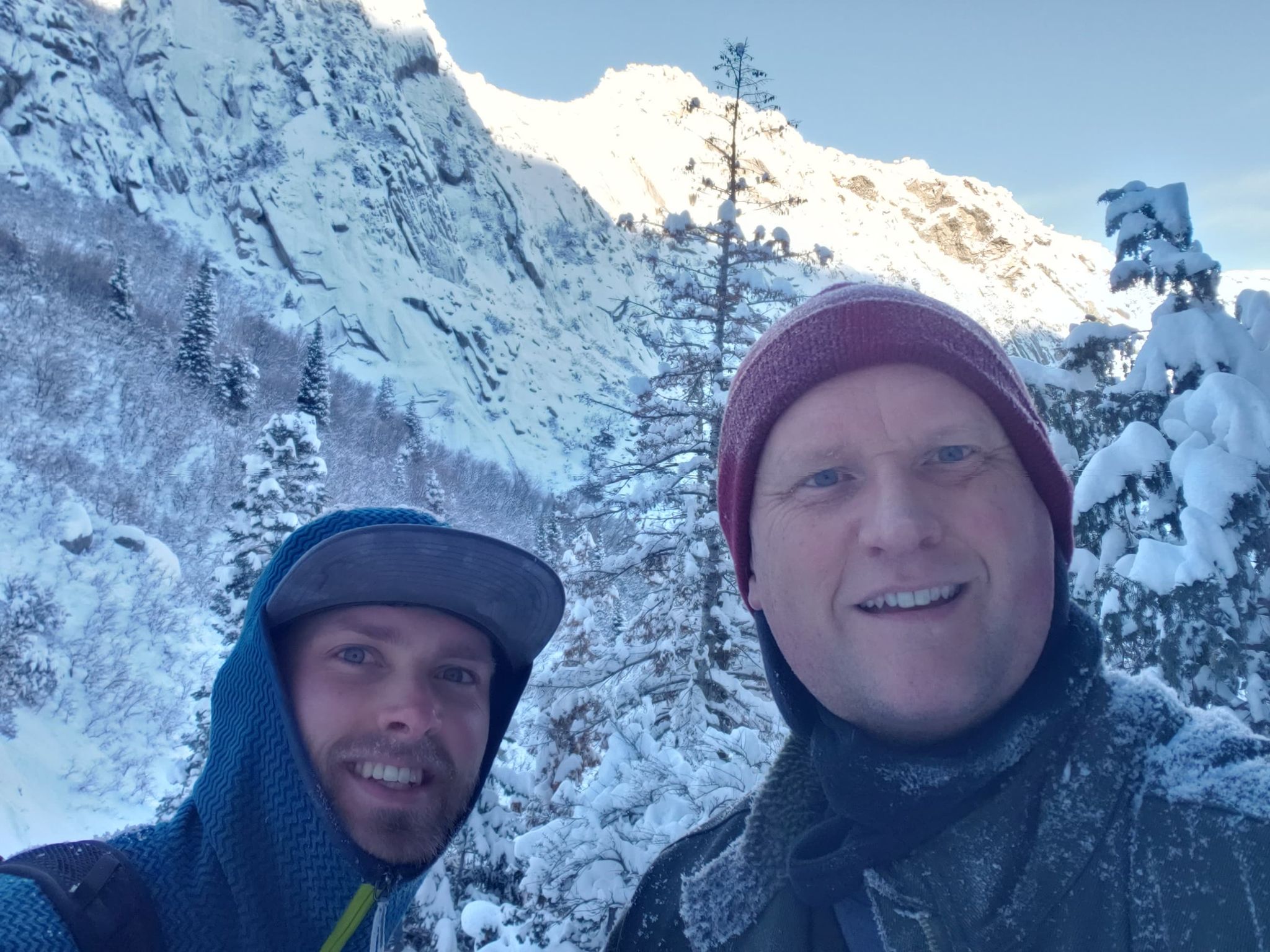
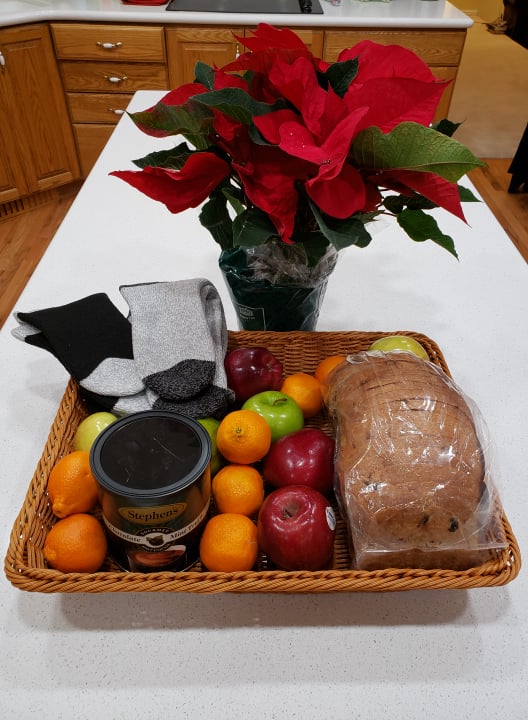
December 17.   Twelve degrees Fahrenheit.  I am hiking to Bell Canyon Falls.  But I am not alone this time.  My son John read about my December 4th loneliness and invited me to hike with him today.  Dad slept still when we left, but Mom asked his questions for him, about whether we had water, food, good boots, warm gloves, our hiking poles.  We pushed past where I had turned around two weeks before, pushed up to where the slow lay three feet deep beside the trampled trail.  We talked about life and love, relationships and challenges, joys and dreams, and I rejoiced quietly in his conversation and his character.  Cold in my bed two nights before, I had dreamt of death, a peaceful dream in which the presence of Death descended gently to touch those whose time had come to return—a soft, benign touch, not threatening, but caring and compassionate, possessing a perspective large as a universe about our journey through an eternity of time in an infinity of space.  Still, when I awoke in the dark, I felt compelled to check on Mom and Dad, to see if the dream had been prophetic or merely a macabre play on my anxieties.  As I stood in their bedroom doorway, the nightlight on the wall behind me cast an enormous human shadow on the wall before me, and I thought of the grim reaper, only I was grimless, and guileless, and I was not a messenger or a harbinger, but a steward and a servant and a son.  Dad snored calmly, and Mom’s sleep had sunk beneath his snores.  Throughout the week, groups of neighbors and church members had stopped by to wish Mom and Dad a merry Christmas.  A group of six young women and their adult advisors came to carol.  Dad had wanted to greet them in the formal living room, but he could not walk that far—he may never walk that far again.  So he smiled and joined in the singing from where he was, holding the large gift basket in which lay a loaf of cranberry walnut bread, wool-blend socks (even a pair for me), and mint truffle hot cocoa mix.  A bunch of boys with their adult advisors came to deliver a puzzle and oranges and blonde brownies and Andes mints.  Couples delivered a pineapple, whole wheat bread, peach freezer jam, a poinsettia, ornaments for the tree, and green bananas (because Mom told them Dad likes green bananas, not the brown blotchy sweet ones she enjoys), each gift an expression of love and regard and caring.  This is what I thought about as I slipped and rolled clumsily but harmlessly down the steep snowy mountainside, snow sticking to every inch of me, still with no spikes on my boots, still in the mountain’s cold shadow, my knees complaining loudly, the moisture from John’s breath frozen stiff on the whiskers of his mustache, my water bottle frozen in my coat pocket.  And then sunlight struck the tops of the snow-laden trees and worked its way warmly down to the snow-covered sagebrush and the deep snow drifts and the path and two hiking men with their poles swinging in easy rhythm.

Young ladies caroling to Mom and Dad.

John posing before the frozen Bell Canyon Falls.

Courage at Twilight: Bouquets of Yellow Roses

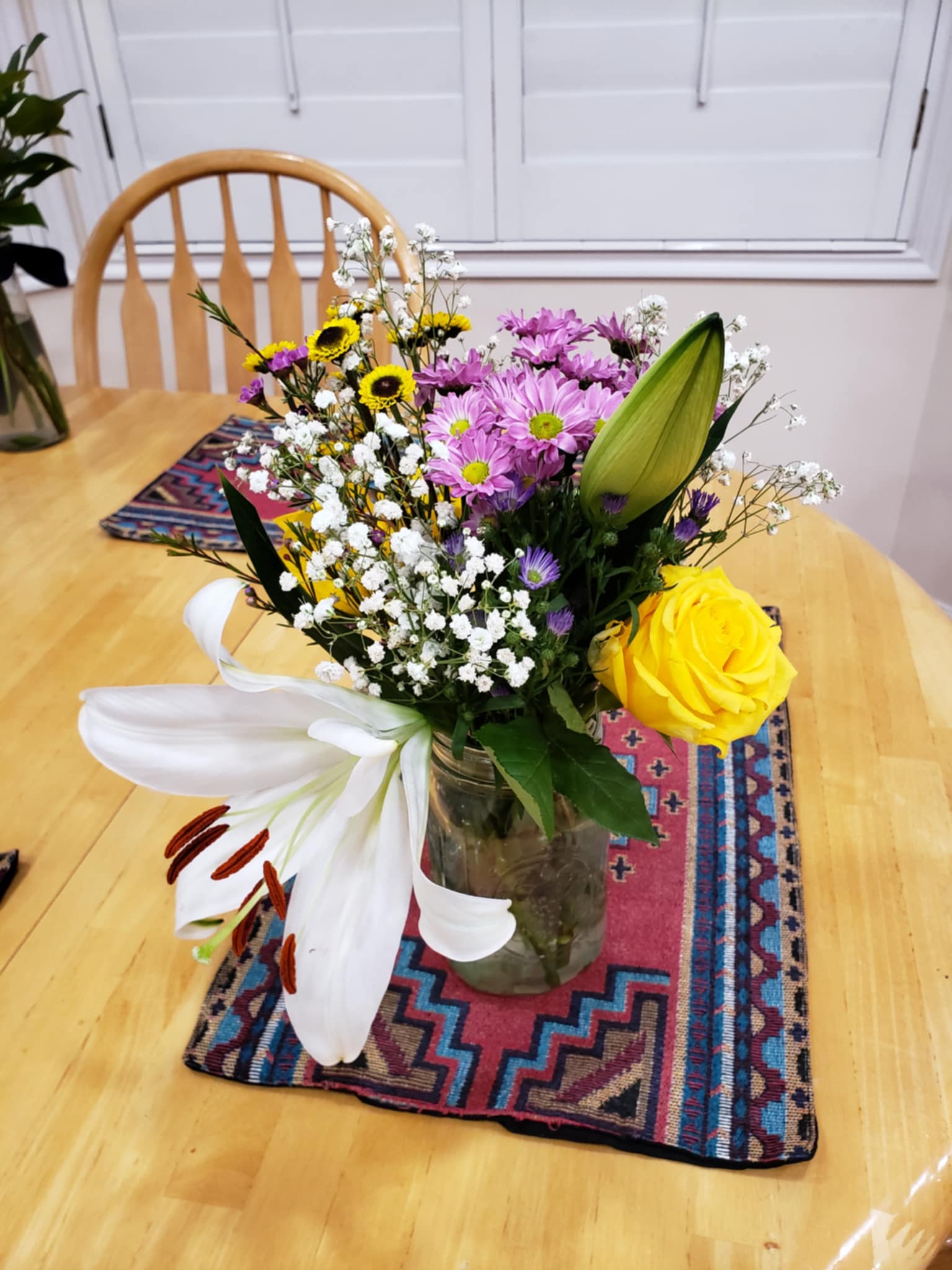
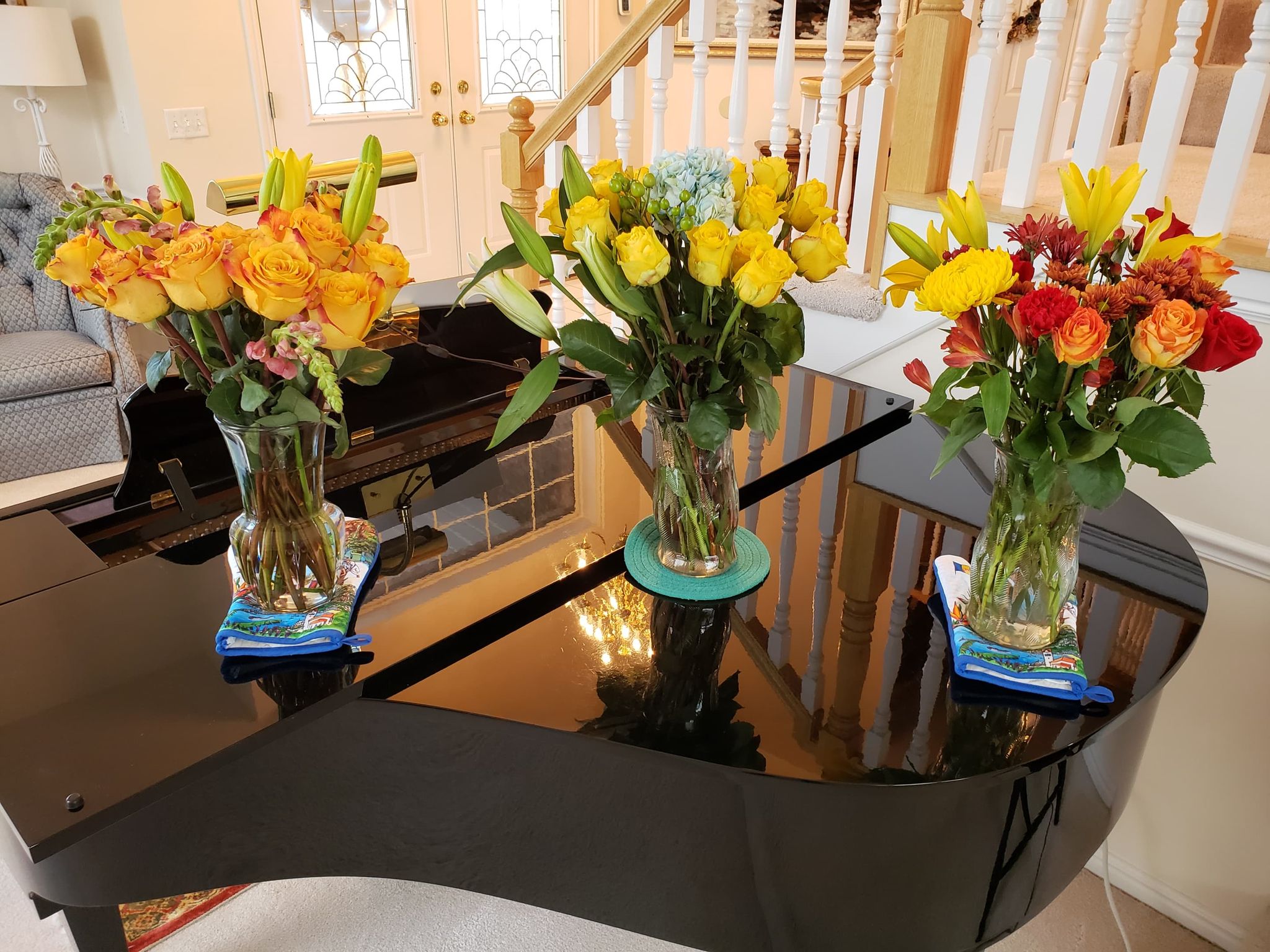
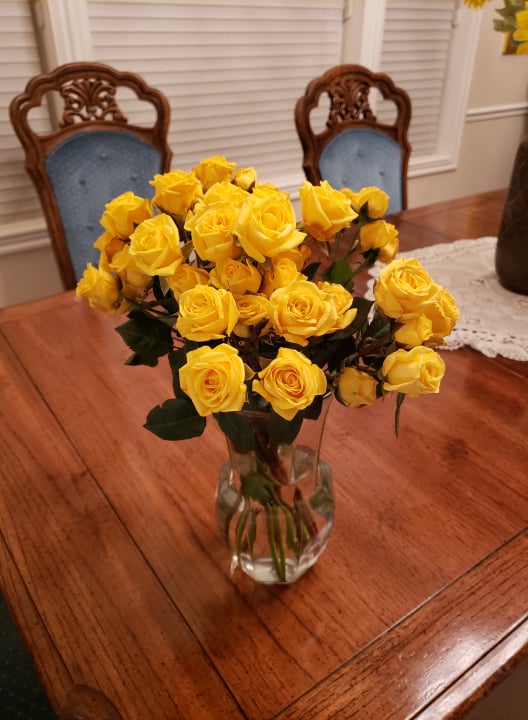
Mom’s favorite flower is the yellow rose, and on the most momentous of the year’s days (including Mother’s Day and Mom’s birthday), Dad brings home a big bouquet of yellow roses. “What do you think of that one, Rog?” he pointed from his power cart at a bouquet of 18 yellow roses.  “Let’s get it,” he encouraged without awaiting my affirmation, and I placed the flowers in the basket.  He asked me what I thought about a second bouquet of muti-colored flowers, and instructed me to add it to the basket.  Then a third, with roses the color of sweet aromatic ripe cantaloup, joined the other bouquets.  “Are all of these for Mom?” I wondered.  “Of course!  It’s her birthday!”  One 18-rose bouquet would tell her she is special, a second that she is very special.  But a third would make a definite statement about her being supremely special, especially to him.  Stuck in a chair he exits only with difficulty and pain, Dad often calls to Mom, “If you were to walk by, I would give you a hug.”  Or sometimes, the more direct, “I want to hug you.”  Just when I expect her to huff with the sentimentality and inconvenience, she sidles up to him, holds his hand, caresses his head, kisses his cheek, and reaffirms her love: “I love you, too, Dear.”  Mom at her most tender.  She held his hand today, too, in the radiology recovery room after the lumbar puncture that sucked from him two tablespoons of spinal fluid, sent to the Mayo Clinic with his blood for advanced diagnostics.  Dad is hopeful that a firm diagnosis can finally be had, with a corresponding treatment.  I am hopeful his fighting spirit can outlast the ticking months of decline without diagnosis.  Answers bring knowledge, and with knowledge, hope.  Having no answer to the mystery causes of his mystery disease is like waiting for the ice to melt in the arctic: a very long wait with an uncertain outcome of dubious value.  His head still rang with singing from Mom’s birthday party the night before, at which the family gathered and sang the old campfire songs—nearly the whole book of them—we have sung around real campfires through three decades of family reunions.  Old songs like “Springtime in the Rockies” (chorus lyrics below).  During their occasional moments of marital tension, I tell them “I can’t take it” and I leave the room, and Dad assures me later that he has never had an argument with my mother, has never even been angry with her, which is nonsense, of course.  But these are sentiments he honors and believes and embodies.  My father loves and honors my mother.  He seeks her counsel and her tender affections still, after 60 years of marriage.  And he gives her big bouquets of yellow roses.

When it’s springtime in the Rockies,
I’m coming back to you.
Little sweetheart of the mountains,
With your bonnie eyes of blue.
Once again, I’ll say I love you,
While the birds sing all the day.
When it’s springtime in the Rockies,
In the Rockies far away.

Courage at Twilight: How’s Your Dad?

At church I was besieged by men and women asking me “How’s your dad?” and asking Mom “How’s Nelson?” and the judgmental part of me—a too-big portion—wanted to say that if they really cared they would telephone personally (not text) or stop by the house, make some kind of effort, instead of waiting until we are sitting in church, preparing for the service, to dart in and nibble on the news like a tame piranha on a fried chicken leg. But I look into their eyes and see their love and sincerity, and I answer their questions—Dad is getting a little stronger and we hope to bring him home next weekend—and I ask my God and my Lord to both forgive me my trespasses.  After all, church is our social center, and our cultural conditioning makes us most comfortable making inquiries at church.  We tell them we have rearranged Dad’s office-library into a bedroom, and that the hospital bed is scheduled for delivery next Saturday morning, but we made room for one bookshelf with his favorite religion books and histories and biographies.  And I do not tell them (nor did I tell Mom or Dad) that the insurance company gave us notice they were going to release (evict) Dad yesterday, though he cannot yet care for himself at home, and that Sarah appealed the typical too-early discharge (eviction), and won the appeal and an extra week’s therapy and care.  I did not tell Mom and Dad because it would have upset them needlessly, what with the pending appeal becoming the approved appeal, mooting the whole question, the threatened early departure suddenly irrelevant.  Dad is still very unwell, and though he tells the world he is “marvelously well, thank you,” he whispers to us he is still so sick.  Mom will visit Dad today for the 18th consecutive day, and I am her driver, in her royal blue Subaru Legacy.  But first Burke has stopped by in his new BMW convertible to take Mom for a spin through the neighborhoods, the wind in her white hair, her hands raised high as they take off with a muscly roar down the street, and I feel grateful for the Burkes of the world, who look out for the little people, whether driving BMWs or Subarus or Fords.

(Pictured above, Dad’s office-library turned bedroom, awaiting the hospital bed, with room still for his computer desk and one very full bookshelf.)

Courage at Twilight: So Many Prayers

Dad tore the glossy page from the Church magazine (the Liahona) and had Mom tape it to the wall of Dad’s rehab center room.  But in the shadow of the armoire, the painting hung disappointingly obscured.  “I made a mistake, Rog,” he mourned.  “I can’t see Him.  I should have left the picture in the magazine.”  Without asking, I simply removed the picture from the wall and taped it to the armoire door, in the room’s full light, and Dad’s face lit up with pleasure and relief.  “That’s so much better.  Thank you, Rog.”  The picture was a reproduction of Dad’s favorite painting of Jesus, who Dad adores and knows as his personal Savior and Friend.  “You know, Dad, people are praying for you, in the name of Jesus, all over the world.”  I listed some of the locations where friends and families assured me they were praying for Dad, and for Mom, including in the Church’s sacred temples: Utah, New Jersey, Colorado, Nevada, Washington, Idaho, Wyoming, Illinois, Virginia, California, and Texas; Cardston, Alberta, Canada; Brazil and Portugal.  Next door and down the street.  Larry texted me: “I just paused and offered up a prayer for your dad, your mom, and you.  Please let them know we love them.”  And at church, numerous people have shown genuine concern, and have reassured us with, “Nelson is in our prayers.”   Hundreds of people are praying from the soul spaces of love and faith, in the name of the Divine, for Dad.  I have felt too fatigued to pray much formally, to kneel and bow and form words in the normal pattern.  Some would say I do not pray.  But I do.  I am a walking prayer, a driving prayer, a working prayer, a mealtime prayer, a mountain bike prayer, a hospital bedside prayer.  At night, too tired and heavy to remain vertical, I contemplate the ceiling from my bed and open my heart and mind to the Divine, casting my will upward, not really caring if I connect, but just opening myself and giving myself to Whoever orders the vast Universe, offering up what little I have to give, giving thanks that Christ’s Kingdom continues coming, giving thanks for the privilege of being a small part of the Kingdom’s growing, using no words, being simply a willing consciousness. “Prayer is the soul’s sincere desire / Uttered or unexpressed.”  (See Hymns of The Church of Jesus Christ of Latter-day Saints, #145.  Text by James Montgomery, 1771-1854.)

Courage at Twilight: So Many Cards

Cards have begun to pour in from the Church primary children, and from some of the men and women of the neighborhood, and from family members, and former missionaries, all with sincere and adorable and tender messages to Dad, including great-grandchild scribbles. We taped all the cards to Dad’s rehab room wall, where he must see them every day, to remind him that many people love him and hope for his healing and return home.

You Are the Best! 

Never Give Up! 

I want to play Legos at your house. 

Hurry up and get better.  We miss you at church!

I love you so much!

I hope you get well soon!

Please know you’re in our prayers and thoughts.

Your awesome!

I think about you every day!

I like to play outside and look for pinecones in your backyard. 

I hope you get better soon.

Hoping and praying for you every day.

Feel beder.

You are the goodest Baker in the world.

You’re cool!

We love you.

You can do this.  Never give up.

I love you Grandpa.

Courage at Twilight: Simple Gifts

Vases of aromatic garden flowers.  A gallon of two-percent milk.  Enormous sweet grapes on a plate.  Crayon-colored cards for dear Brother Baker from Church primary children who don’t know who he is but still care.  Burger King Whopper and fries: Mom’s favorite.  Rides to the hospital from women who know the way well—a beloved son with bacterial meningitis; a husband who fell from a second-story ladder; an amputation gone wrong—and visiting along the way.  Baked chicken salad wrapped in puff pastry.  Soups and a salad.  Giant chocolate chip muffins.  A man on a bicycle checks my sprinkler leak, and will get back to me.  Chocolate-caramel brownies—oh my.  Our names prayed over in temples across the world.  Smiles, and waves, and inquiries: How’s Nelson?  Well-wishes.  A quiet house.  Love, and hope for tomorrow.

Courage at Twilight: Visiting Hours

Visiting hours are 9 to 9, which seems quite generous. The other rule, however, is not.  Only two visitors at a time.    Despite the three-person couch and other chairs and the spacious room.  So, my saintly 83-year-old mother, who has gone to the hospital for eight days straight, must leave her sick husband’s side for two neighbors, or two siblings, or two children, or two grandchildren to visit.  Or Mom stays in the room and only one other visitor is permitted.  I had seen the rule on signs in the elevator, nursing station, and the patient room doors.  But since none of the staff had troubled us over three visitors, or four, for five consecutive days, and since we are quiet, peaceful, clean, and helpful people, I thought perhaps the hospital did not mind so much.  Not so.  On day six Big Meanie nurse instructed all but two family members to leave.  It’s IMC’s rule.  I did not argue or accuse or abuse, but I did inquire, in an effort to understand, and to explore flexibility.  Did it make a difference that I am Dad’s attorney in fact and have his advanced directive in my briefcase?  I’m sorry, but no.  Did it change things if I am the authorized physician contact for when the doctors stop by to explain their diagnostic and treatment efforts?  No.  What about the fact that we are all Covid-19 vaccinated and boosted?  No.  Did it make a difference if immediate family were gathered bedside to perform my Church’s religious ceremony of invoking the power of faith and pronouncing a blessing of health and healing on the sick?  No, and that isn’t the case here anyway.  Well, it was the case when Dad’s three siblings and their spouses, and my brother and sister and me, gathered around him to give him such a blessing.  A beautiful thing for loving, spiritual family to do, perhaps the last opportunity to do such a thing for Dad, to offer this expression of faith and hope and love, and perhaps of good-bye.  Did you know that we have been very helpful to the nursing and therapy staff, adjusting the bed angle and height, feeding Dad, sponging him off, helping slide him head-ward when he had slipped down the sloping mattress, brushing his teeth, shaving his chin, helping him stand, pivot, transfer, use the toilet, take a seated shower, stand, pivot, transfer back to the bed?  For all her strength and grace and experience, Heather could not have done it all without us, and thanked us for our contribution and learned expertise.  So, I left Dad’s room and walked down the hall to sit uselessly on a cracked and stained sofa, where I could not help or comfort or observe.  I felt angry at the rule, and thought it inhumane—a bureaucratic pronouncement out of context.  (I learned later that the two-visitor limitation was not IMC policy, which was, instead: Maximum number of visitors at the bedside is determined at the discretion of the care team.  Discretion was allowed, after all.)  I felt angry at Big Meanie nurse who enforced the rule so militantly.  And after two days she went off shift and the familiar smiling nursing staff welcomed us all back to be helpful and complimentary and appreciative.  To be present.  For our father.  For each other.


(Photo from intermountainhealthcare.org, use pursuant to the fair use doctrine.)

Courage at Twilight: The Young Come After

Lila has come to spend the weekend with Mom and Dad and me. Being only two (almost three), she brought her parents along.  I did not mind because I like them, too, in addition to her.  “Come play Legos, Gwumpa Waja,” she sing-songed, and I sat by her little pajamaed body while we pieced together the bricks and sorted marbles by color.  Lila dragged me over to the neighbor’s to push her on the swing with the blue seat.  My sweetest memories of the last year include visiting my three grandchildren in Kentucky, Arizona, and Texas, now in Utah, Idaho, and Illinois.  Their smiles and laughs and cuddles banish fear and distress and fill me with feelings of love and tenderness.  With Lila here, however, at Mom’s and Dad’s house where I live, I find the generations confused, or mixed, in that I am both a grandfather and a child, the “Grandpa” of my children’s babies but still my mother’s “Baby.”  “Are you tired, Baby?” Mom asks when I come home late from work.  She showed me her journal entry from January 26, 1965, when I was seven months old: “Roger is really a big boy.  He crawls all over the floor, coming after me.  He holds onto chairs and things, and stands up.  He also bumps his head plenty.  His favorite foods are applesauce and bananas.  He has a tooth now.”  Dad delights to tell visitors how enthusiastically I emptied the cabinets of their pots and pans and lids, that no sooner had he put them away, then I would take them out again.  And now here is Lila asking her grandpa to plant a garden with her, and to get the tiny shovels.  We dig holes behind the shrubs, and plant rocks.  And she jabbers in two languages, English and Spanish, as we dig and look for rocks to plant, and cover them up “for squirrels to find,” and she runs to drop the blue and red beanbags in the cornhole goal.  Dad is 79 years older than Lila, and pointed out that when I am his age, Lila will be 30 years old.  And I want her to stay two forever.

Courage at Twilight: Cabin Fever

“I have cabin fever,” Mom sighed as we finished our Sunday dinner of baked pork chops with mustard-cream sauce and cumin-seed cabbage. “Then let’s go for a ride,” I offered.  Mom would have been satisfied with a brief ride around the neighborhoods, but I drove the Mighty V8 toward Little Cottonwood Canyon, glacier gouged and gorgeous, boasting pine forests, enormous slabs of granite, and a cascading river.  We commented on the incomparable beauty of these mountains as we drove up the narrow winding road, and expressed our gratitude at having these scenes so close to home.  “That’s enough for me,” Mom said as we passed the Snowbird resort.  “I’m ready to go home.  I don’t have cabin fever anymore.”  Back at home, I pointed out how multiple consecutive triple-digit days, and some active hummingbirds, had emptied the hummingbirds’ sugar water quickly, and the feeder hung empty.  We watched a tiny Black-chinned hovering, testing, and not finding liquid food.  Google says the correct mix is four parts water to one part sugar—and not to add red dye—so I refilled the feeder and brought back the birds.  The doorbell rang, and Carolyn D’s daughter delivered a white Afghan, crocheted with time and love and tenderness, for Dad had compiled her husband’s World War II recollections before they died with him, just in time.  Like Dad, Carolyn can no longer walk well, scooting along laboriously with a walker.  But she can crochet.  An hour later a violent summer thunderstorm blew and spat, teasing us unkindly with scant muddy drops that streaked the windows brown.  Dad sat in his kitchen chair, watching the wind whip the trees, and hazarded to Mom, “If you were to wander over here, I would give you a hug.”  In other words, I want to hug you, so please come to me, since I cannot come to you.  In his hoped-for embrace, he expressed to Mom, “You’re such a wonderful person.  I just love you.”

Courage at Twilight: Have I Done Any Good?

Dad hears better from the front church pew, which is cut out on one side to accommodate a wheelchair. Mom sits in the pew, and Dad sits in his wheelchair, the two holding hands with their faces lifted appreciatively toward the speakers.  One eighty-year-young friend of Dad’s observed, “It’s good to see you using a wheelchair, Nelson,” implying how awful it has been to see him leaning into his cane and hanging on my arm and still barely making it down the aisle.  In choir practice before church, we rehearsed the hymn “Have I done any good?” and at night I lay in my bed asking that question of myself, with dark and pressing doubts.  For today is day 365 since I left my life alone and moved into a life with Mom and Dad as an awkward caregiver in their waning—today is my first anniversary, our first anniversary.  Will there be any more anniversaries?  Even before moving into their house, I knew the experience would be intense and trying, not for any fault of theirs, but from the story’s inexorable ending, and from my own character flaws, and that I would tend to lose my sense of self, my sense of direction in life, my sense of fatherhood in my renewed sonhood, my sense of the future and self-purpose, and I knew I would need to write about my experience, daily, to work things through in my mind, to keep from being swallowed alive.  I felt compelled to write, and indeed I did write daily entries for 265 consecutive days before faltering in fog and fatigue.  This is essay #290: 290 shards of shattered glass through which to examine and strain to comprehend my experience in all its complex facets.  If I have not done much good, that failure has not been for lack of arduous effort.  If I have done some good after all, that good was worth the effort.  This post is not pandering for praise or angling for affirmation, and is not focused on self-flagellation.  This post simply poses the question, and makes a way for me to move on in the mission of doing what I can to bring comfort and safety to my parents as they careen toward their end, that the end may be comfortably and safely in their beloved home at the foot of the great snow-topped aspen-clad mountain.  But, still, and always, I shall ask myself that question, and sing the hymn quietly in the darkness to myself at night.


Have I done any good in the world today?

Have I helped anyone in need?

Have I cheered up the sad and made someone feel glad?

If not, I have failed indeed.


Has anyone’s burden been lighter today

Because I was willing to share?

Have the sick and the weary been helped on their way?

When they needed my help was I there?


Then wake up and do something more

Thank dream of your mansion above.

Doing good is a pleasure, a joy beyond measure,

A blessing of duty and love.

Courage at Twilight: Crêpes Frangipane

They did not know what to say, so they said nothing, and I suffered alone.  When I separated and divorced almost seven years ago, not one neighbor, not one congregation member, not one ministerial leader approached me with friendship or compassion or support.  They did not know what to say, apparently, so they stayed away and said nothing at all, and I anguished utterly alone.  (Thank God, Mom and Dad and Sarah and Jeanette and Carl and Paul and Megan and Don and Carolyn and Steven—parents, siblings, and three friends—they loved me through.)  I think that “I don’t know what to say” is a hideous excuse for pretending not to see, and for withdrawing and withholding, and for saying nothing.  I reject it.  How easy it would have been for anyone to say, “I am so sorry!” or “What can I do to support you?” or “You will get through this, and I want to be there with you as you do.”  I reject it: actually, we do know what to say, but we are reluctant to feel another’s pain, afraid to do the emotional work of empathy.  Just: say anything kind.  That ought to be easy.  When our neighbor’s infant grandson died in his crib in their house this week, constricted by a blanket laid there to warm and comfort the baby boy, dozens of men and women rushed to the house and kept coming every day for weeks, with meals, with hugs, with encouragement, with loving silence, with tears, and with other assurances of love and hope.  I did not know what to say, and I did not go, right away.  But I had rejected that justification, and I had determined never to stay away for the lack of the right words.  Instead of words, I took over a plate of hot crêpes stuffed with chocolate almond frangipane (French pudding) and handed the goodie plate over with a smile and said the words “You might want to use a fork—they are a bit messy” and “This is an authentic French dessert” and “I don’t know what words to say” and “So many people love you and care for you and mourn with you and have hope for your healing and happiness.”  And he embraced me and said, “Thank you.  I can’t wait to give them a try.”  After church today, a group of women surrounded the grieving grandmother and talked and cried and hugged and counseled—they loved.  Dad observed to me, “That is more than just a group of women talking.  Christ is there with them, healing.”  And I knew Dad spoke truth.

Courage at Twilight: A Turtle and a Grebe

I waltzed up the river with strong strokes. Pull-rest-rest.  Pull-rest-rest.  The hen and her ducklings huddled tight against the bank looking every bit the bunch of muddy roots.  How do ducklings love their father drake? I wonder.  He has flown this stretch of river.  “Happy Father’s Day, Dad!” came the texts.  Is that how it is done, I wonder: four small typed words with a diminutive exclamation mark?  I handed Dad a thick old book, yellowed, wrapped in newspaper, in a red paper sack, to thank him for being my father.  Fiorello LaGuardia: the Italian Mayor of New York City who took on the Tammany Hall political machine, and won.  A black-crowned night heron rose from the riverbank with five-foot wings barred black and white, as silent as my waltzing river pondering.  How do his chicks say Happy Father’s Day? I wonder.  With urgent shrieks for regurgitated fish, no doubt, and by leaving the nest!  What a magnificent beautiful creature.  I imagine the carp fingerlings say nothing at all, glad not to be gobbled.  And I baked a pesto chicken orzo casserole and a sticky pudding cake full of dates and walnuts dribbled with hot toffee-cream syrup.  Oh, and first dibs to Dad on my book by Beryl Markham, an early pilot who flew single-props with open cockpits, who flew so intimately with planet earth, skimming the tall tree tops—she could see the waves and smiles of the farmers and they could see hers.  I have reached my three-mile turn-around too soon—I feel I could paddle up this river forever, relaxed and calm, not having the answers, and at peace with that unknowing.  My two youngest played cello-piano duets to Mom and Dad and me, moving us with their beauty and the music’s beauty.  “Rafting the river . . . I remember you naming every single type of butterfly we saw.  You knew everything about them.  And the trees and birds and wildflowers, too.  You taught me to look for the small and simple things, and remember the value they add to our lives.”  Thank you, son.  (I’ll have you write my epitaph.)  Maybe Bullock’s orioles chitter cheerfully to celebrate their fathers, flashing their oranges blacks and whites in their excitement.  I don’t know that little turtles thank their big-shell papas, sunning exclusively on fallen tree trunks, necks and legs stretched out pleasurably, imperiously, a knot of dried algae on one’s back.  I sent my sons-turned-fathers a handmade card with a personal note of admiration and encouragement and a token ten-dollar bill.  Does that count?  Yes, that counts—every sincere expression counts.  “Oh, my dear Daddy.  How I love and honor you and appreciate with deep gratitude all that you do for me.”  Thank you, sweet daughter of mine.  A Clark’s grebe with white face and black crown and piercing yellow beak and piercing scarlet eye dove and dove as I approached, then appeared twenty-five yards behind me.  What a magnificent beautiful creature!  His chicks would easily admire him.  “I love you Daddy!”  That’s how it’s done: with love.  I love you, too.


Pictures above and below: scenes from the Jordan River, in Utah, today.

Courage at Twilight: Ah…Weddings

My nephew’s wedding day had finally come. I had worked many hours over several days to make Mom’s and Dad’s back yard—the wedding venue—look beautiful.  But as I sat at my circular blue-clothed table listening to the couple exchange their self-customized vows, I wondered at the irony and futility of my work.  In other words: not one living soul would have cared if the grass edges had not been string trimmed or if a weed or two had been missed—these would not have dampened anyone’s excited happiness.  My parents and my sister appreciated my effort more for the sacrifice and love it expressed than for the merits of the landscaping, and rightly so.  For the next event, will I target the same energy toward the venue appearance, or will I focus on weightier matters, like visiting with distant cousins and playing with the grandchildren and preparing heartfelt messages for the celebrants and lessening family burdens?  The temperature plunged from 92 degrees the evening before to 53 degrees on the morning of the wedding day, with rain falling all night and all morning.  But we tumbled the table cloths in the dryer and the clouds broke in time to warm and brighten the ceremony.  Poor Dad could not walk—he could merely lean heavily with both hands on his front-and-center cane and drag each foot forward a few inches, with screwed face and suppressed groans.  And that “walking” presupposed an ability to stand from his chair, which he could not.  I turned around to see a very-former son-in-law vaunting mock magnanimity by grabbing Dad by limbs and joints and hoisting with humble hubris.  But Dad preferred to wait for me, because the two of us together know just how to get the job done, with a heave of my elbow under his armpit to slowly stand, then his arm pretzeled heavily in mine to move across the grass toward the house.  The bride looked lovely and confident and serene, despite the morning’s rain and the morning’s drama by some guests who were invited to stay home.  And my nephew looked a naturally boyish nervous though he knew the marriage was right and good, and that his bride was the right bride and friend and life companion.  Little Gabe, almost four, came jaunting proudly down the center aisle carpet holding up as if for royalty a pillow to which were tied the bouncing rings, lifting them high toward the couple, his uncle and brother, his aunt and sister, who read to him and bathe him and feed him and play games with him before his tired mother returns late from work, for she pays the bills, and the bills must be paid.  Before the wedding, he fell and bonked his head and cried more from insult than from pain, wanting the comfort of love over a bag of ice, so I held him in my rocking chair and listened to his very big small-person sadness and fear—he was worried the new couple now would move to a house of their own and leave him alone and lonely.  But they will keep their comfortable niche in the family house and continue to be Gabe’s protectors and nurturers until his mom and dad come home from work.  Gabe’s head and heart felt better and soothed and he laughed at being tickled and dressed in a three-piece suit and praised.  Weddings are not my favorite occasions because I know how much is at stake and how much trouble and pain lie ahead and how awry things can go, and I hope they will make it against the odds, and I hope they can find happiness, together.  I always hope for a new couple, for who am I to jinx their joy with my suppressed sense of doom?  I am no one, and the doom is a false projection of bad prophecy.  We just need to put away our pride, and focus on the other’s happiness and fulfilment and meaning, and trust in life and in the Divine—then we can make it.

(Pictured above: Yours Truly with his two wonderful youngest children at my nephew’s back-yard wedding.)

Courage at Twilight: Getting It Right

Yesterday: I was not angling for a pat on the head, but neither did I expect a rap on the knuckles.  I had listened to everything Dad said he would do to get ready for the wedding: string trim the grass along the sidewalks and the rock wall and around the landscape beds; hoe and pull all the weeds and tall grass and wild morning glory vines from the shrubs and beds.  He could do none of it, and I suspected the man he had hired would not show up (he didn’t), so I set to work hoeing, snipping, trimming, raking, bagging, sweating, near collapse from illness and fatigue.  Six neighborhood men converged for a successful second attempt to winch the impossibly heavy brick mailbox pedestal into its hole.  They repaired the broken sprinkler pipe, stacked the sod, and will come back in a couple of days to see how the pedestal has settled, pour fresh cement, and restore the soil and grass.  Dad sat and watched and worried and advised, straight from his bed, without taking his medicine, without drinking, without eating—straight to the job for the long-haul, sitting in the driveway in the hot sun, sweating out his strength, begging on the misery of seizures and exhaustion.  Four friendly Columbians assembled the wedding tent and I stumbled to be friendly in Spanish, treating them to cold Brazilian Guaraná soda (“No es cerveza?”  “No, no tiene alcohol.”)  I finished my work after six hours, and putting the tools away, Dad told me I had done the string trimming wrong.  No “thank you.”  No “looks great.”  No “you did a lot today.”  Like I said, I did the work because it needed doing, and I was proud of the beautiful manicured result—I was not pandering for praise.  But if you expect a job done a certain way, tell me at the beginning of the job; do not wait until the job is done and then criticize the result.  I felt suddenly furious, and announced I was done because I had worked beyond my limits, which I had, and my arms and hands were shaking and my breathing tight and short and all I wanted was to lie down in a cool dark room.  But I found little Gabe (almost four already!) and asked him the question he always hopes to hear: Do you want to bake some cupcakes, little friend?  He measured and poured and stirred and tasted at every step, from bitter cocoa-powder paste to rich batter to sweet butter-cream icing to small spoonsful of sprinkles, the various chocolaty substances fingerpainted on his face.  But Gabe’s all-time favorite game is Hide-and-Seek.  “Nobody wants to play Hide-and-Seek with me,” he bemoaned as everyone worked, and I thought maybe I could find a little hiding and seeking energy for my little friend.  When he counts, he counts fast, and ten “seconds” was barely enough time to bound off and stumble behind a bush, where he found me when I poked up for a peak and he squealed and I laughed and his mama watched us from the kitchen window, giggling.  Gabe took most of the cupcakes home, thankfully.  Later I laid in bed wondering at my still-smoldering anger and how outsized it was to the offense and wondering where it came from and pondering my six-decade relationship with the great man I call “Dad” and learning long ago not to expect praise but to get the job done right and wondering what my three daughters and my four sons think of their “Papa” and whether my expectations were reasonable, and reasonably expressed.

Last Night: And at 1:00 a.m. my sleeping ears began to hear Dad’s far-off call “Rog!” and at the second “Rog!” I jumped from my bed, threw off the loathed CPAP cup, grabbed my 45-year-old homemade brown terrycloth bathrobe and ran to the stairs to confront the whole spectrum of trouble.  But there sat Dad in his recliner, reading, munching, happy, perfectly fine and safe, waving, smiling curiously at me looking distressed in my underwear at the top of the stairs.  I hung my bathrobe on its hook and resumed staring at the dark ceiling, ready to let go of unintended offense, ready for sleep, ready for the last Mary Berry cupcake the next day, a Sunday, a day of rest.

Today: Dad, sitting with me at a round table under the wedding tent: “Rogie, did you do all this work in the yard?  There’s not a single weed in the shrub beds, and they are all raked out so nice and neat.  And the string-trimmed edges of the lawn are perfect.  It’s all perfect.  You have made the hard look so nice for the wedding.  Thank you.”
Courage at Twilight: The Very Walls of My House

We had planned the celebration for months, and on the day of, I awoke too sick to attend.  My sisters handled all the preparation and hosting.  At the top of stair case, I listened to bursts of laughter amid the general soft murmuring of many friendly voices in catching up and conversation, like the gentle babbling of a booklet tripping down a mossy cascade, and in that gentleness I detected elements of acceptance and respect and affection, and of a love that could turn fierce in mutual defense.  I enjoyed my chicken salad croissant and chips, watching through the railing as Dad, 86, launched into his stories, with occasional intervening from Mom.  They had met at a church dance, at the end of which he asked for her phone number (“and she gave it to me!”).  He called her the next day, and drove her to the university and dated for the next three years, and they married—60 years ago.  “I know her much better now than I did then!”  Law school over, they moved to New York City, living in Greenwich Village.  While Dad was at school, Mom rode the subways just to see where they went.  She played violin in a Washington Square orchestra, and during one concert the conductor’s baton hit the music stand and flew out of his hand into the audience.  After three days of descending to the street at 5:00 a.m. to move the car the opposite side of the street, Dad sold the car to the bellboy for $50.   Then off to São Paulo, Brazil, where I was born, to live in a tiny studio.  Mom passed the time by walking me to the embassy library and taking me on every bus route (in the city of then 16 million people) to the “fim da linha”—the end of the line.  “I can’t do this,” was not part of Mom’s vocabulary, Jeanette enthused.  Dad befriended the city comptroller at school, and invited him to their studio, where they sat at a card table on folding chairs, their only furniture, for homemade pizza, which the millionaire graciously enjoyed.  “I loved your mother when we got married,” Dad said, “but I love her more, and differently, today.  I never look at her without thinking, ‘I love her.’”  (“Even when I’m bossy!” Mom chimed in.)  David told how Mom and Dad sacrificed several days to help clean and paint his house, and how their love is literally worked into the very walls of the house.  “I want to tell you something,” Dad began, warming up to his life’s witness.  “This is important to me.”  And he quoted Jesus: “’Be faithful, and I will protect you from every fiery dart of the adversary.  I will encircle you in the arms of my love.’  That is how our Savior feels about us.”  When I was an infant in Brazil, Dad was assigned to visit ten families who no longer attended church.  He had no car or phone, just bus schedules and maps.  But he found them, and visited them every month of that school year.  Walking home from his final bus ride in Brazil, Dad contemplated his ministering effort.  That is when a voice in his mind affirmed, “I accept your offering,” and he felt an overwhelming loving presence embrace him.  As I listened and watched through the bars of my separating sickness, I contemplated how close Dad is to walking home from his life’s final bus ride, and of my certainly that he will again hear the words, “I accept your life’s offering,” and will again enjoy that sublime embrace.

Courage at Twilight: I Love You

“I love you,” Mom called to me after I said good-night and turned to step the stairs to my rooms. “Love you, too, Mom.”  I love you.  Those three little words convey such daring risk, exposing a fathomless aching hope to be loved in return.  Two little pronouns with the world’s biggest word tucked between, mediating, welding.  Perhaps many children hear those words from their parents.  Perhaps few.  Perhaps hearing those words does not matter all that much.  Perhaps they mean everything.  To my best recollection, “I love you” was not stated in my childhood home.  My father did not hear these three words as a child, and did not utter them as a father.  But Dad’s love and sacrifice for his children are fierce and burning and unstoppable.  He says I love you in so many frequent ways that do not use the words.  And he employs other words, like “That was such a great meal, Rog!” or “Rog, you did so much work today!” or “Don’t wash any dishes, Rogie—leave them right there and I will wash them!” though he does not wash them because he cannot, not comfortably, not without energy and strength he no longer has, and not without pain which he endures so cheerfully.  But when Hannah was leaving today after a few hours’ visit, he called out to her, “I love you, Hannah.”  And she responded, “I love you, too, Grandpa.”  That is how love works: articulated and reciprocated.  Love practiced always produces proficiency.  One day I found the courage to utter “I love you” to one of my children, one of my boys, a teenage boy, and how strange and awkward saying those words felt—how I had to choke and pull them out over and around obstructive anxiety—but I got them out, and often afterwards, because I do love my children, so why not love them openly and enthusiastically and say these three little words, why not sing the words unembarrassingly out, out to that boy, out to all my girls and boys.  I had to practice saying those three small words over the course of days and weeks and years, and saying them with my voice still feels both compelling and strangling.  But I feel that love, deep and real, and I want to demonstrate and verbalize that love, for I know that refraining is avoiding and damaging and sad—perhaps the greatest and most mournful of lost opportunities—while unfettering the words infuses with confidence and reassurance and comfort.  As we express love back and forth, love eases and grows.  Too often I stammer out a mere “Love ya Bud!”  But when John or Caleb or Hyrum or Hannah or the others end every phone call and every visit with “Love you, Dad!” I know they mean it, and I know they have taken a daring risk to express their love for me and to hope to receive love back from me, and I respond with pleasure, “I love you, too, son.  I am proud of you.  I have complete confidence in you.”  And I do.

(Pictured above: yours truly mountain biking with his son Caleb in 2018.)

Courage at Twilight: April 5, 1962


“Hi baby!” Mom answered my phone call.  I had called in honor of their special day, to make sure they were happy, to praise and cheer them, Mom and Dad.  They had driven the faithful Suburban to Burt Brothers for a safety inspection and minor repairs.  They had walked next door to Dairy Queen for burgers with bacon and for fries and for a chocolate Blizzard—“They were so good!  But the walk about killed your dad,” Mom reported.  “And the walk back about killed him again!”  But it was a “lovely day,” a “perfect day,” she said, and she was very happy, I could tell.  Approaching home near 10 p.m., I turned into Smith’s grocery store and selected a small bouquet of flowers of vibrant colors.  Steven had sent a thoughtful happy card.  Barbara had brought a lavender orchid.  Others had called and texted and Facetimed.  Entering the house with my inexpensive bouquet, I cheered, “Happy Anniversary Mom and Dad!”  Happy 60th Wedding Anniversary.  Sixty years of marriage.  As I snipped off several inches of stems and slid the flowers into a clear glass vase, I heard Dad say from his recliner to Mom in her recliner, “I love you, Lucille.  You are so wonderful.”

Pictured above: my real life Mom and Dad.  Happy 60th!

Courage at Twilight: Hard Pressed


Hannah spent the morning with Mom and Dad and me, playing the piano, baking Guinness treacle bread, playing Carcassonne, and warming leftovers for lunch, topped off with last night’s Tarte Tatin (French up-side-down caramel apple pie). She played pretty hymn arrangements and the perennial sublimity of Claude Debussy’s Clair de Lune­—Moonlight.  Mom sat listening on the sofa with her eyes closed.  Dad reached the bottom stair just as Hannah finished playing.  “That was beautiful,” he complimented her.  “I think you played that exactly the way Beethoven would have liked.”  Hannah and I glanced at each other and smiled.  No one laughed, of course, because the music was so moving and his loving accolade so sincere.  The week Dad retired, more than 20 years ago, the law office joined him for a final jog through Johnson Park.  One heavy-breathing attorney, O’Shaunessy, panted amiably to Dad as they ran, “You know, Nelson, I appreciate that you are religious.  Before you came here, I had never heard the story of Moses and the Ark.”  A third attorney asked if O’Shaunessy meant Noah instead of Moses, and a friendly argument ensued, with Dad caught in the middle, not weighing in.  Maybe O’Shaunessy was not too far off, though, since Pharoah’s daughter had found the baby Moses floating in a tiny reed ark.  And Beethoven did compose the famous Moonlight Sonata.  As Hannah left for home, Dad called to her, “I love you,” and commented to me about what a delightful young woman she is.  He sat at his computer to type her a note.  I had judged him for pressing the mouse button so forcefully and deliberately, like an old person who had grown up flipping toggles and pressing mechanical switches.  But sitting later at Dad’s computer to retrieve a “lost” document, I realized his chorded mouse was not functioning properly, and that if I did not lean forcefully into the mouse, it did not respond.  I had judged incorrectly, as I often do, placing pride and arrogance before compassion and respect.  “Dad,” I called, “I’m sorry your mouse doesn’t work correctly,” and he thanked me for noticing, and I drove to the store and purchased a new mouse with a smooth wheel and a soft clicking touch.

Courage at Twilight: Unvisitable

The men of the Church assigned to see to her welfare told Dad she could not be visited. As the lay leader of the congregation, Dad bore responsibility for the welfare of every member of the congregation, whether they wanted to participate in the Church or not.  “What does ‘unvisitable’ mean?” he queried.  Apparently, “unvisitable” meant she did not want anyone from the Church to visit her.  For Dad, the deeper questions were “Why is she unvisitable?  What is happening in her life to distance her from the Church and from people.”  Sitting at his desk in the law department of Johnson & Johnson, pondering over this unvisitable Church member.  A thought pressed itself irresistibly onto his mind: Call her. Now.  Having learned to never put off a prompting, he picked up the phone and called her.  “Sandy?  This is your bishop.  I’m coming over right now,” and did not wait for a protest.  He found Sandy living in squalor and disrepair, and terribly depressed and overwhelmed.  The trees and shrubs had overgrown the house and porch.  The front stairs had fallen away from the porch, and the mailman could not deliver the mail.  Stacks of newspapers filled the rooms and hallways, with only narrow trails from place to place.  She had not read them yet, she explained.  The window frames had been painted while open, and remained stuck open, even in winter, when she shoved crumpled newspapers against the screens for insulation.  “I will help you,” Dad promised, and he spent the next year helping Sandy transform her living space, which in turn transformed her life.  He suggested she start her reading with the next day’s edition, and emptied the house of newspapers and trash, taking many loads to the dump.  He cut out the trees and pulled out the shrubs, planting new ones.  He cut the windows free of old paint so they could be open or shut with the season.  He jacked up the stairs and put rock and new cement under them.  He repaired all the plumbing.  He painted all the walls.  Mom asked him once, “Why don’t you involve the other men of the Church instead of doing all this work yourself?”  And he explained that descending en masse to fix the house was all fine and well, but would not fix the occupant.  She needed frequent, regular visits of encouragement, acceptance, and assistance.  In the course of that year, Sandy began to smile, and to converse, and to return to Church.  She and Mom became friends, sometimes hopping on the train to New York City for Broadway’s “two-for” matinees.  In telling the story four decades later, Dad was clear it was not to boast, but to teach me this lesson: No one is unvisitable.  We just need to ask the Savior how to do it, and He will show us the way.  To God, all persons have equal worth, and we can be his hands in reaching out to the unreachable.  No one is unvisitable.

(Photo from lily pond at Island Lake in the high Uintah mountains, 2007.)

Courage at Twilight: “I Hate the Church”

For over a century, my Church has preached a ministering program called “home teaching,” where Church members, two by two, visit with assigned families to make sure their temporal and spiritual needs were being addressed. At the awkward age of 14, I was Dad’s home teaching companion, and he was the “bishop” or unpaid lay minister of our large congregation—he knew all the Church members and their many problems and hardships.  He saw on the records the name of a young woman he did not know, Continue reading

Courage at Twilight: Be Still, My Soul

From my seat in the choir loft, I looked out upon a sea of 500 faces.  Panning slowly, I looked at the details of each face, especially the eyes.  And I could tell that all these people sitting in church on a Sunday morning were good people, wanting to do their duty to each other and to God and the Church.  Many couples sat beside each other, their children by their side, or alone where their children had grown.  A number of adults sat without partners.  Like mine, each face held a story of heartache and loss and grief, and joy.  I pondered how their stories are not part of mine, and how my story is not part of theirs.  We may cross paths from time to time, but we do not walk the same specific path together.  I experienced again the sensation that I would walk the remainder of my path alone.  The possibility remains that I might meet a compatible companion, who I now cannot imagine—it might happen.  But to flourish in this present moment I have to let go of that ephemeral possibility.  Several times I have worked hard to make a relationship happen, but these fabrications have always failed, painfully.  In this and other oceans of faces, good faces, I have found no face or soul to belong to.  And that is just as well.  I have written elsewhere about my setting out to find wildlife in nature, how the harder I search, the less I find.  I have learned that when I relax, and breathe, and labor faithfully without expectation, when I prepare myself and allow nature to arrive on her own terms, she and her creatures arrive, beavers and bullfrogs, muskrats and turtles, herons and kingfishers, wild iris and rose.  As with nature, so with natural relationships: I must relax, and breathe, and labor faithfully without expectation—I have to be prepared for the universe to arrive with her abundant blessings.  For the present, my job is to get used to being alone, to sacrifice and to love alone, to contribute alone, to maintain spiritual standards and practices alone, to be healthy and fit alone, to cook and eat gourmet meals alone, and to forego the pleasures and pains and joys of intimate companionship.  My opportunity is to learn the lessons of living from my particular life.  Your opportunity right now is to sing with the choir, I thought, emerging from my reverie.  To end the long church conference, the choir director led Mom and me and the choir in singing Be Still, My Soul, arranged by Mack Wilberg.  The women sang with one clear voice, to which the men added another, moving together into a pleasant perfect eight-part harmony.  A spirit of beauty washed over the ocean of faces.  After the benediction, Dad walked slowly beside me toward the exit, his arm heavily upon mine.  Stepping through the door, we saw that the snow had begun to fall, and remarked upon how beautiful it was, and how cold upon our bald heads.

(Pictured above, Utah’s Jordan River from my kayak.)

Courage at Twilight: Cave Diving

My local congregation announced a church dance near Valentine’s Day, for adults.  I serve on the committee that plans and executes our church activities.  Mostly the chair couple does the planning, and I help set up and take down.  “I’ll be there to help you set up for the dance,” I offered to the chairman.  “But I will not be attending.”  He did not quite know what to make of me, so I explained.  “As an older single man, I will not feel comfortable at a romantic dance for married couples.”  And I was not about to spend the evening standing against the wall like a terrified teen.  I have wondered how I ought to describe myself in conversations like these, and “older single man” seemed accurate and adequate.  “Middle-aged divorced man,” would have done fine, too, but sounded stiff and stilted.  For several hours I helped the committee set up chairs and tables and decorate and string high lines from which we hung glow sticks and vinyl records (the theme was “dancing through the decades,” with a playlist of old classics to match).  When 7:30 rolled around, I could not help but think of who had come to the dance, and whether they were having fun—I hoped so.  Mom and Dad and I enjoyed a dinner of steamed buttered vegetables—cauliflower, broccoli, zucchini, butternut squash—while we watched Jimmy Chin’s documentary about the Thai youth soccer team stranded for two weeks without food miles inside an inundated cave, their oxygen dwindling, and about the group of middle-aged unmarried men, the best in the world at their solitary sport, who focused their feelings and faculties and did the impossible and brought every boy out alive.

(Image from thetimes.co.uk, used pursuant to the Fair Use Doctrine.)

Courage at Twilight: Grandpa Wally’s Whiskers

“My daddy had a thick black beard,” Mom recalled when I apologized for my three-day scruff, though he did not let it grow long.  As a child, she loved sitting on her father’s lap and rubbing her soft little hands on the prickly stubble of his weekend beard.  I learned this because she said to me one Saturday afternoon, “Come here—I’ll show you what I used to do to my daddy when I was a little girl.”  Then she rubbed her soft old hands on my prickly weekend stubble.  I shave on days one and three because on day two there isn’t quite enough to comfortably shave.  I wore a full salt-and-pepper beard to Brian’s college graduation.  But I looked old and heavy and worn in all the photos.  So, I decided to lose weight and lose the beard.  One less beard and 40 less pounds later, I feel better and look younger (relative).  Besides, I could no longer endure the never-ending itching against the pillow.  And I cannot imagine a woman wanting to kiss a man’s lip hair, so I shave my lip on principle.  I shaved my beard one time because a coworker said it looked like an armpit.  Nope—no more beards for me.  I think we will not make a habit of Mom rubbing her hands on my whiskery face.  But she blows me a kiss every night as I wander up to bed and she finishes the nightly news.  “Hey Baby,” she calls.  “I sure love you.”  And I blow her a kiss back.

Pictured above: Wallace “Wally” Bawden c. 1962.


The Baker clan c. 1986 with a bearded Yours Truly.

Courage at Twilight: Yellow Roses

Valentine’s Day is not my favorite holiday: too many painful memories and unrealized dreams.  Though many couples are successful, for me, at 57, the intimate romantic logical vulnerable safe knitting together of two lives seems like an impossibility.  The fabric feels always dangerously close to fraying.  But Mom and Dad have made it work for 63 years, including their courtship.  To celebrate the day, they teetered to the chocolate cottage down the street and bought each other some goodies—for Dad, a box of sugar-free chocolate cherries—for Mom, a one-pound log of rocky road!  Dad also brought home two dozen yellow roses for Mom, her favorite color.  Mom called me at work to wish me a happy Valentine’s Day and to invite me to go to dinner with them. “This is your romantic day,” I demurred.  “You and Dad should enjoy dinner for two.  I’d be a third wheel.”  “Nonsense,” she rebuffed.  “We’d love to have you with us.  We’re a family!”  In the end, I proved useful, carrying plates and drinks and silverware, helping Dad into and out of his seat.  A cheerful vibrant pony-tailed server about my age waited on us.  I could not help but wonder about her circumstances.  Ever friendly, Mom asked her if she had children.  “I have six!” the woman enthused.  Her oldest is serving our Church as a missionary in Costa Rica.  Several of my children served such two-year missions, in Oklahoma, Florida, California, and Mozambique (in Portuguese-speaking southeast Africa).  We had that in common.  I do not know if she is married, but she was waiting tables, and I was being waited upon, and I was with my parents, and we were surrounded by scores of listening people.  Enjoying our meals, Dad reminisced about when his mother worked as a waitress and janitor.  She worked at night cleaning the Kearns building downtown Salt Lake City during World War II.  As a seven-year-old, Dad would accompany her and empty the waste baskets.  The foreman arrived to give Dora her pay.  Dad informed the man he had worked too, and where was his pay?  Without meanness, the man picked up a pencil from a desk and handed it to Dad: “Here’s your pay, little man.”  Dad had thought it “chintzy” pay for the work.  Not to be chintzy in turn, he left a nice tip for the cheerful vibrant mother of six.  “She has a family to support.”  Walking slowly to the car, Mom thanked me for taking her and Dad to dinner.  “I should be thanking you,” I answered.  “Thank you for including me in your Valentine’s Day.”  Back at home, I climbed the stairs to my home office.  On my laptop rested a yellow chocolate rose lollipop, with a ribbon bow, a gift from my vibrant cheerful mother.

Courage at Twilight: A Single Tear

I sat on the edge of Mom’s bed. She was 35 years old.  And I was 10.  A single tear coursed slowly down her cheek as she confided to me in that quiet private place that her father had died.  My grandfather Wallace.  We had lived with Wallace and Dorothy a scant two years earlier, where I started 3rd grade while we waited three months for our lagging visas.  Dad had been “called” by our church to “serve” as a “mission president” in Brazil.  Translation: Mom and Dad had been invited to work on a volunteer basis leading a group of younger volunteer proselyting missionaries sharing the Gospel of Jesus, as representatives of the Church of Jesus Christ of Latter-day Saints.  Dad took a three-year leave of absence from a generous Johnson and Johnson, and Mom and Dad and three young children, including me, made the long voyage to São Paulo, Brazil.  It was October 1972.  We left behind the tear-stained face of grandpa Wallace, locked in mortal battle with non-Hodgkin lymphoma.  Dorothy had tried every healing remedy she heard of, including a grape juice diet—after two weeks, her sick husband threw the offered juice across the kitchen in disgust.  Wallace fought hard to stay alive until Mom returned home to Utah, and he almost made it.  He passed away in April 1975, and we returned in July.  Mom did not travel to the funeral, deciding instead to dedicate herself to the mission and to her young family, which then included a new baby.  As I sat on the edge of Mom’s bed and watched the lone tear drip down her face, I felt the peaceful warm elixir of great sadness mixed with great hope, the sadness of love and loss, and the hope of healing in Jesus and the promised reunion of resurrection.  During his 62 years, Wally (as his friends called him) had organized the construction of church buildings by church members, had led a congregation of thousands as a lay minister, had driven a milk truck and school bus and hay wagon, had picked tomatoes and peas and sugar beets for church welfare storehouses, had been “daddy” to my mommy.  Though I last saw his face when I was eight years old, I do not remember his tears of knowing good-bye, but rather his gentle playfulness, his chicken coops and carrot rows and hand-pumped well, and his scruffy smile at me upon his lap.

Pictured above: my grandpa Wally in 1962.


My family preparing to leave for Brazil in 1972.


My grandma Dorothy in 1962.

Courage at Twilight: A New Doll

After Mom turned six, in November 1945, her mother and father informed the children that there was no money for Christmas presents that year. The parents were sorrowful and resigned, while the children—Mom being the oldest—naturally felt disappointed.  Still, they were used to not having many material things, so the news was not a shock or a trauma, just a disappointment.  Though they were poor, they did not think of themselves as poor.  They did not have many possessions, but they were tender and loving with each other and enjoyed the richness of home and family, church and community, music and literature.  With this radiance, the children rapidly reconciled their disappointment and looked forward to Christmas morning nonetheless.  Christmas was still a happy, hopeful season.  Sauntering slipper-footed into the living room on Christmas morning, Mom saw a new doll in the corner, meant for her.  She joyfully picked up the doll, not having expected any gifts at all, and began to love it and play with it.  Soon, however, she discovered, with a sinking feeling, that the new doll was in fact last year’s doll, made up to look new.  Mom’s mother, Dorothy, had clipped locks of her own auburn hair and sewn them to a band, which she stitched to the doll’s head, concealing the band with a new little bonnet.  After her realization, Mom regrouped and was happy about her new doll, feeling gratitude for her mother’s efforts during a challenging era to provide for her and her younger siblings.  The orange and peanuts in her stocking added a measure of pleasure to the day.  Knowing Dorothy so well (she passed away at age 96), I was moved, thinking of her cutting off lengths of her own hair to make a gift for her little girl.  Of course, this was only one of infinite sacrifices Dorothy made for her children.  My mother, in turn, made infinite sacrifices for her children, as I have done for mine, and as my children are beginning to do for theirs.  And so it goes.

(Image by Christiane M. from Pixabay.  Sadly, no photo of Mom’s doll is known to exist.)

Courage at Twilight: When Mom met Dad

At a family party, we asked Mom how she and Dad met. She related how she met him at an Institute dance in late 1959.  Institute is the name given by my Church for an organized opportunity for religious instruction and for social interaction, mostly for young single adult members of the Church.  Mom was about 20 years old, a freshman at the University of Utah.  She remembers, “He was standing there, leaning against a door frame, looking very cute in his navy-blue suit.”  It was the suit he wore on his mission to Brazil (1956-1959), and was well used, but “still looked great.”  Mom’s friend, Dolores, whispered to her, “That’s Nelson Baker.”  Dad asked Mom to dance, and before the evening ended, asked for her phone number.  The very next day he called her on the phone, and came to visit her at the bungalow-style house her father built for her mother in 1932.  Mom and Dad went out a lot, to the movies, to dances, to visit with Dad’s mission friends, to the Frost Top for shakes and fries.  Dad drove her every morning to the University of Utah, where they both graduated with bachelor degrees.  “Your mom was very beautiful,” Dad boasted.  Sitting in his music appreciation class one day, on the third floor of the David Gardner building, he looked out the window to see Mom standing on a street corner waiting for a bus, to go to her elevator job.  Seeing her there filled his heart with sweet feelings.  They married on April 5, 1962, in the Salt Lake Temple of the Church of Jesus Christ of Latter-day Saints, and will celebrate this year their 60th wedding anniversary.  Of course, they can get on each other’s nerves, but they are eternally devoted and kind to one another.  Now, that’s love.

Salt Lake Temple, in Salt Lake City, Utah

Courage at Twilight: I Need a Hug

Dad said to me one evening after dinner, as Mom and I bustled around with kitchen cleanup, “Rog, do you know how huggable your mother is?  She is the most huggable person in the whole world.”  He was too tired to stand just at that moment, and told Mom that if she ambled close to him, he would give her a hug.  She rolled her eyes, and she ambled.  “I need a hug,” Dad explained as he put his arms around her waist.  She patted him reassuringly on the arm.  “Rog,” Dad continued, “do you know you have the best mother in the whole world?  Aren’t you just so lucky?”  I do, I thought, and I am.  Indeed.  These occasional sweet expressions and displays of conjugal affection move me.  Mom and Dad get on each other’s nerves on a daily basis, but they love each other and are devoted to one another.  They cherish each other, and the family institution they have created.  I need their example—the world needs their example.  I need to believe marriage can work, and as they approach their 60th wedding anniversary, and as I see them work on their marriage every day, at being kind and patient and understanding, I can believe.  The next time they snip at one another, I may remind them about their mutual huggability, and suggest Mom amble over in Dad’s direction.


Pictured above: Dad (86) and huggable Mom (82), with my sister and niece.

Courage at Twilight: Slippery Saturday

I awoke at eight—early or late?—on a Saturday, with no obligation but to live. I cooked Dad’s favorite apple-cinnamon oatmeal, with cream, for our breakfast, sweetened respectively with sugar for Mom, Splenda for Dad, and stevia extract for me.  In the crock pot, I stirred the dry 15-bean soup mix, diced onion, minced garlic, ground chilis, leftover cubed ham, water, and the packet of smoke-and-ham flavored powder, and set it to simmering.  Hyrum turned 20 this week.  He is my sixth child, and dearly-beloved.  So, I started baking a cake for his Saturday evening birthday party.  And this was no hum-drum box-mix cake, but Mary Berry’s chocolate-orange mousse cake, and I hoped I could do the many-stepped recipe justice.  After finishing the cake and washing, it seemed, half the kitchen’s bowls and mixing utensils, I needed to get out of the kitchen, out of the house, and out of my head.  Nearby Bell Canyon beckoned.  The trail’s snow was trampled down and icy, and I had forgotten my aspen-wood staff.  As I slipped and tromped along, I began to ruminate, to puzzle over romance, over the panging hunger for romance, over the long absence from romance—I began to puzzle over love.  A puzzle.  Both uphill and downhill, the mountain trail presented many slippery slopes, and I stepped with care as I thought.  An attractive woman passed me, planting her steel-tipped poles in the ice.  She was smart to navigate the icy trail with poles.  I was not so smart.  I wanted to be there in the mountains, in the snow, in the crisp beauty—I was sincere and empty of guile—but I was un-smart in my own navigations.  Always a puzzle.  Hyrum and company, of course, loved the chocolate-orange mousse cake, and I was proud to have baked it.  I am proud of him, no longer a little boy, but a man, a man of the best sort, a chocolate-orange mousse cake sort of a man.

Bell Canyon Stream


Mary Berry’s Chocolate Orange Mousse Cake

Courage at Twilight: December 23

We moved our Baker extended family Christmas Eve party to December 23 this year. My (former) wife and I began the tradition in 1992 when we lived with my paternal grandmother Dora, in the basement of her little house, after our return from Portugal, where I had been a Fulbright student.  We enjoyed a simple “shepherd’s meal,” with bread and cheese and nuts and fruits and cold meat.  We recounted the birth of the baby Jesus, and we sang Christmas carols.  Dora, a cute 83 years old, dressed up as Mother Mary and held on her lap my two-year old son Brian.  This year Brian brought his two-year-old Lila as we continued the tradition with Mom and Dad and our extended family of Baker siblings and their posterities.  We moved the party from December 24 to December 23 to add Dad’s birthday to the Christ-child celebration.  We had planned the move for last year to celebrate Dad’s 85th birthday, but Covid-19 dictated otherwise.  So, we rescheduled for 86.  But Dad would not allow us to celebrate his birthday at the party.  Though December 23, this party, he insisted, was to celebrate the birth of Jesus, not the birth of Dad.  He grudgingly allowed a few gifts, but focused on his Savior, and on another notable birth, also on December 23, the 1805 birth of Joseph Smith, the founding prophet who established the Church of Jesus Christ of Latter-day Saints, to whom the Father and the Son appeared in 1820.  Those two birthdays counted, Dad said, not his.  We rebuffed him with a respectful, “Yeah, whatever” and added Dad’s birthday to the trifecta celebration.  Card tables and folding chairs accommodated the crowd, which passed by the kitchen island for plates of ham, scalloped potatoes, and my French glazed carrots and parsnips touched with ginger.  And Sarah’s perfect homemade whole-wheat bread.  We sang Christmas carols and rounds and hymns.  We played a matching game with carol names and lyrics.  We played again our indispensable traditional “Left-Right” game in which the group sits in a circle, each person with a wrapped gift, and passes the gifts to the left or to the rights as those words appear in the story Mom narrated about the “Wright” family, with laughter and chaos and flying wrapping paper—one never knew what gift one would receive.  And Brian read the Birth story in Luke 2.  And Dad blessed us again with his Christmas message of love for his Savior and love for his family and how the two inseparably embrace.  The time came for everyone to disperse from whence they came, and Mom, Dad, and I felt content and happy and relieved that the Christmas Eve Birthday party—our 29th annual—had been a success, having celebrated the births of Jesus, Joseph, and Dad: quite our favorite trio.

(Pictured above: a family service project with Mom and Dad.)

Courage at Twilight: Hair Cuts By Jen

Every six weeks, Mom gets her hair cut. Jen, a daughter of a neighbor up the street, is the beautician who cuts Mom’s hair.  During the warm months of spring, summer, and fall, Jen comes to Mom’s house to cut her hair.  Mom sits in a camp chair in the garage while Jen works her magic, and Jen sweeps up afterward.  During the colder months, Mom sits at the kitchen table while Jen carefully snips here and there.  Mom’s hair cut is not fancy, but is cute, and matches her fun personality.  Once flaxen brown, Mom’s hair is now the prettiest white.  Attending Mom’s community orchestra concerts, before Covid shut down public events, my children and I always looked for grandma’s white hair at her violin stand, proud of her for being talented and engaged and happy.  Dad has always been fond Mom’s hair beautiful.  A few years ago, he told me of coming back to bed on a winter morning and observing tenderly his wife’s white hair as she lay sleeping.  Some time after, I wrote this short poem, entitled “Morning”: Warm sun in winter / hurtles white-capped / peaks and rushes through / wide windows / to halt and hover / over a head of tousled white / hair, aged, peaceful / upon her pillow.

(Pictured above: Mom and Dad after receiving their first Covid-19 vaccinations.)

Courage at Twilight: Here We Come A-Caroling

“Can we come around 7:00?” she asked.  “That would be lovely,” I answered.  And they came, on a very cold Tuesday night, a small group of church youth with their leaders—two young women and two young men.  “Merry Christmas!” they cheered.  Mom and Dad brought them into the living room, where the group sat visiting on the sofas.  The leaders sparked up a Christmas carol, and the youth sang in shy murmurs.  Until Mom joined, that is.  Though the youth came to serenade her, she jumped right in with her cheerful choral charisma and had the small group singing enthusiastically.  After half-an-hour of caroling, the group called again, “Merry Christmas!” and filed out the door, Mom and Dad waving, everyone happier for the visit.  “We had so much fun,” Mom beamed when I came home late from work.  The youth left a beautiful gift basket with a poinsettia, various fruits, a loaf of Great Harvest cinnamon-raisin bread, Stephen’s mint truffle hot cocoa mix, and two pair of warm winter socks.

Courage at Twilight: Moments of Self-Doubt

In a prolonged moment of self-doubt about my abilities and contributions, I remarked to my brother Steven about my “stupid little blog posts.” He quickly chided me, gently, and urged me to have compassion for myself.  He assured me my stories are beautiful and real, and he loves reading them.  My four sisters have given me similar encouragement.  So, I trek daily ahead.  Mom has commented to me, pleased, but humble, “Your blog posts are kind of like my biography.”  She is right.  In fact, I tag every post with “Memoir.”  I am telling a story, painting vignettes, writing a family memoir, slowly, one day at a time.  All the stories are true and real, and I hope they approach the kind praise of “beautiful.”  Many of the world’s stories are dark and painful—still, they can be instructive and even revelatory.  But, except for confessing my mistakes (like, not investigating a bang! in Mom’s bathroom when she lost consciousness in the shower on a Sunday morning before church), I choose to tell stories that are both real and redeeming.  Steven is right to encourage me to have compassion for my own story.  I wondered today, Why is the First Great Commandment to love God with all our heart?  It cannot be that God needs the fickle adulation of seven billion squabbling humans.  Rather, I believe that by loving God, we discover the capacity and desire to love others, including ourselves.  So, I will try to believe in myself.  I certainly believe in Mom and Dad: their lives and characters make telling heartening stories an easy exercise.  Mom and Dad are endearing in their quotidian lives, smiling at each other across the distance between recliners, patting the backs of each other’s hands, reminding each other to take their medicine and to put in their hearing aids.  They exemplify.  They edify.  They love and they struggle.  They serve with such generosity.  They are virtuous.  They have value, and their stories deserve to be preserved.  I am so grateful for Mom and Dad.  I am telling their stories, and learning to love them more deeply day after day.