Tag Archives: Aging

The Dementia Dossier: The Power of the Print

I frequently hear Mom’s inkjet printer whirring as she prints the day’s emails.  She prints the church program and church notices.  She prints her hair cutting appointment, and then the receipt.  She prints letters from her missionary grandchildren.  She prints funeral notices and obituaries.  She prints pictures of grandchildren’s lizards and hikes and birthdays.  She holds the printouts up to me and asks, “Do you want to read this letter from _____?”  I already read it, Mom.  I got it, too.  Mom seems to find enormous pleasure at having the power to transport her electronic correspondence from the computer screen to a tangible stack of stapled pages.  “I need you to order me some new ink for my printer,” she informs me.


(Image by OpenClipart-Vectors from Pixabay)

The Dementia Dossier: Nothing’s On

As I cleaned up the kitchen after dinner, Mom surfed the cable channels (access to 100+).  She pressed the “channel up” button one at a time, roaming slowly through each of the channels.  The process seemed to take forever.  After surfing past baseball games, basketball games, news programs, a dozen movies, a tennis match, nature and history documentaries, and even her beloved crime show reruns, she turned the television off and pronounced with some disgust, “There’s nothing on.”

The Dementia Dossier: Rigid Dementia Routines

A month after my involuntary retirement, and the illness that followed, I finally found the mental energy to map out a new routine for my daily life. My routine involved time for reading scripture, exercising, new writing projects, painting lessons, low-bono work with an immigration non-profit, and yard and house projects.  I also built in time to take Mom for her necessary errands, like the post office or the pharmacy.  Since Mom is so routine-bound in her dementia, Jeanette suggested Mom would benefit greatly from seeing my schedule, knowing my routine, and knowing that she was a part of it.  I printed the schedule, and Mom taped it to the lamp next to her recliner, where she could always see it.  I knew a routine would need to be flexible.  Without flexibility, the routine would cease to be the servant and become the master.  Instead of the routine serving my purpose, I could become a slave to the routine.  That flexibility proved necessary as I succumbed to sinus and bronchial infections that laid me flat for much of eight weeks and dragged me through two ten-day microbiome-depleting rounds of antibiotics.  The illness destroyed my routine.  But every day near 2:00 p.m., Mom asked—according to my routine—to be taken to Help U Mail or Walgreen’s or out for a drive: Ahhh! Just look at the beautiful blue sky!  I began to roil with increasing resentment, and biting my tongue and clenching my teeth, I evenly uttered, “Mom, I don’t think you have a sense of reality right now about what I can do.  I had just enough strength to watch Jeopardy with you for half-an-hour.  I’m not up to an outing.”  After more than two months, I am nearly recovered, but my routine remains in a shambles.  Returning from an appointment at 4:00 p.m., I asked Mom how her afternoon had gone.  “Quiet,” she answered, and continued under her breath: “I guess I’m stuck in the house today.”  “Stuck?” I answered.  She thinks she’s stuck in her recliner, I thought.  She thinks I’m responsible for her getting unstuck.  “You’re not stuck,” I challenged.  “You can get up from your recliner and sit in a chair on the front porch and look at the blue sky, the clouds, the endless airplanes, the cars driving by.  You can sit on the back porch and look the mountains with their maples turning red and the dustings of snow on the peaks.  You can use your walker on the sidewalk for a quick walk.”  And then I saw it.  When I began my new retirement routine, I had made time for her in my daily schedule.  My  My schedule.  She had taped my schedule to her lamp.  And with that bit of adhesive tape, I became part of her routine and her schedule.  I had been sucked in even further by her consuming dementia.  I was now another symptom of her slavery to dementia routines.  The next morning, I pulled the paper from her lamp and crumpled it into the trash.

The Dementia Dossier: Introduction

Many of you followed Courage at Twilight as I recounted my experience living with dying parents.  With this page, I am launching a new exploration.  As my father’s mental abilities diminished, I naturally attributed the loss to senility, or more broadly and accurately, to dementia.  He read for hours and hours a day until the final week, and he still comprehended and remembered more than I do when I read the same books.  But his ability to comprehend, synthesize, apply, and remember the information began to suffer.  The decline was mostly masked by his great intellect, but gradually became more noticeable.  Where nine years ago he easily followed Word’s “accept” and “reject” functions while reviewing my suggested edits to his book Process of Atonement, in his last year he could not manage the power button, mute button, or any other button on the television remote.  Alone with Mom now, I am observing on a daily basis her decline in mental function, short-term and long-term memory, and the ability to process new information and work through new problems.  And I am pondering the spectrum of mental normalcy.  I am well-known at work for remembering the details of 30-year-old incidents, but I notice my own mid-term memory fading, like forgetting that the City Council increased its golf course fees six months ago (I wrote the fee resolution).  I am wondering: where does sanity end and senility begin?  But that is the wrong question, presupposing that senility is the loss of sanity.  It isn’t.  Senility is the loss of memory.  And don’t we all experience memory loss for once-remembered people, places, dates, and occasions?  So, by becoming more forgetful, am I, myself, drifting into dementia?  Where does dementia begin?  On what date is my memory and cognitive function loss sufficient to say, “That’s when my dementia began”?  I doubt such a date can be determined.  But episodes characterizing dementia can be humorous, sad, or maddening (etc.), or all combined.  In these posts I will record my mother’s little oddities, pointing together toward dementia and decline.  I mean no disrespect in finding an aspect of humor in her decline.  But humor often derives from the little human oddities of life, whether happy or sad.  I am merely observing, and trying to make sense, again, of the ending of life.  Each post here will be much shorter than this one—I promise—and will relate a small vignette illustrating the nature of inevitable human decline.  I love and respect my mother—and she also drives me batty!  Hopefully these entries will make you smile at, and ponder on, those we love whose earthly lives are winding down.  I look forward to continuing my journey through life with you.

Courage at Twilight: Cracked Ribs?

Wishing Dad good luck for a good sleep did not work. He awoke with pains that seared and branded and made him cry out when he adjusted in bed, pains that worsened over the next day, pains he hissed ashen-faced that he could not deal with, pains that made him cry out and shout when helping him move to the toilet or to bed.  He thinks he cracked a rib when I used the gate belt after he fell, to bring him his hands and knees, and then up to the toilet seat.  Jessica, the on-call hospice nurse, tells me over the phone to give him a 0.25 ml oral morphine syringe from his E-kit to see if it helps with his pain, and then another syringe if it does not.  I will do that, I say, and I ask her to come to the house anyway, on a Saturday, to hear directly from him what he is experiencing so I do not bear the burden of correct translation.  We could take him to the hospital for an x-ray, but the experience of pain and exhaustion of getting him there and undergoing the procedure would bring no gain: there is no treatment for a cracked rib but weeks of rest and pain management.  I cracked four ribs several years ago in a mountain biking crash, and I well remember the weeks of agonizing searing pain, and how grateful I was for oxycodone, without which I would not have slept, the more so because a week after my wreck I camped for three weeks with 34 boy scouts at the National Jamboree, a trip two years in the making.  So, he will try the morphine.  And he reported that the 0.25 ml dose did dull his pain, but was bitter-tasting, made him drowsy, made his body tingle, and caused some nausea.  But it did dull his pain.  This dosage, or even double, he can safely take for pain every hour, says Jessica.  She will have a fresh supply of morphine sent over, which is much easier to obtain for a patient on hospice than not, she says.  I felt relieved the low dosage helped.  He, too, felt relieved, from the worst of the pain, and was grateful.

(Pictured: Boot Hill grave marker in Peoche NV, the mining town of my father’s grandfather.)

Courage at Twilight: A Closing Universe

“In what universe do you think this is sustainable!” I want to scream at him.  Dad is lying naked on the floor, having collapsed on his one-step voyage to the portable potty.  Mom had screamed “I need help with your dad!” from downstairs, and I knew before launching to the rescue that Dad was on the floor.  All I can do is stare grudgingly at him, this man for whom my responsibility is to do the impossible: get him up off the floor and onto the toilet seat.  “In what universe do you think we can keep doing this!” I choke back the words.  Mom begs me to call this neighbor and that neighbor, and I shoot back that if I call anyone it will not be the poor neighbors, but the paramedics.  His walker lies, folded, on the floor across the room to where it rolled, and from it I retrieve the gate belt sewn with four helpful handles.  The first impossible part of the impossible hoisting procedure is to pass the buckle and strap under his chest, and I jam the buckle under him and haul on his shoulder and hip to roll him over enough to pull the strap through and cinch it tight around his slack once-muscled chest and above his now bulging belly.  On the count of three I heave from the handles and Mom lifts and Dad pushes, and we, as a team, we manage to raise him to his hands and knees, upending my predictions.  But there is no resting position for him, only multiple collapsing positions, so we move quickly into the next phase, in which he grasps the potty handles and somehow I lift his bulk enough for him to lift his knees and I wrestle his backside onto the potty seat.  My silent screaming continues, now about how much I hate this experience!  But I do not scream.  I never scream.  I never chastise or berate.  I never shout.  Except that one time he condescended to me for installing a wider bathroom door without his permission on the eve of his return home from the nursing home, and I instantly boiled over from quiet to rage bursting from its cage of lifelong inhibition and I pounded on the kitchen counter and I thought I had broken my hand on the stone kitchen counter, the time Sarah was a living witness, a breathing comfort to me.  And now he is moving his bowels and is bossing Mom to bring him his walker because he can’t, he says, do anything without his walker right in front of him, and the bossiness is a cover for his embarrassment and powerlessness and fear.  “I’m trembling, Rog.  I’m so weak and shaky.”  No shit, I retorted in silent and staring thought, trembling myself.  I muscle him from the potty to the walker and muscle him from the walker to the bed, using hands and arms and knees, maneuvering methodically to leverage every opportunity to inch by inch transfer his bulk to his bed.  The crisis is over, and I announce that I’m going to bed, and I wish him good luck for a good night’s sleep, and I take a sleeping pill.

(Pictured: ivy on my Chicago daughter’s wall.)

Courage at Twilight: Fiercely Red

Northern Goshawk | Northern Goshawks are impresive when you … | Flickr

Mom stood. Up from her recliner.  During a commercial break.  “Are you going to the bathroom?” Dad asked with a touch of accusing panic, for the urge had struck, and he gets so little notice, and every second counts on the 12-foot journey. “Yes,” she spat.  “Don’t worry, Dad,” I assured him, “she’ll be out by the time you’re up.”  Dad sat, stymied.  Sunk in his recliner.  During the commercial break.  He still had not stood when Mom came wandering into the kitchen, her business done, to check on my cooking.  The Jeopardy buzzers buzzed.  “Are you finished, Lucille?” Dad barked after the commercial break.  “Yes,” she called.  “Why didn’t you tell me?” he lobbed, struggling and shaking to stand and stoop over the walker, his time perilously past.  “I’M FINISHED!” she hissed.  “Didn’t you hear the flush?”  A streak of white flashed in my periphery and something bounced hard against the kitchen window, two feet from me.  I knew, of course, what it was, sort of, a bird, but my heart pounded anyway.  We hustled outside to find the bird sitting in the dirt, a gray falcon or hawk of some kind, sitting awkwardly, wings askew, head rocked back on its neck.  Its red eyes glared fiercely at us, and it panted rapidly with parted beak.  Well, that’s the end of this bird.  Its neck is broke.  Such a startling beautiful creature.  I was powerless to make a difference for the hawk, and let it be, returning sadly to my cooking.  The children and grandchildren remained, marveling and sad.  Then Lila screamed, and Brian poked his head through the door to tell me the bird had stood up and pushed off in flight.  Well, I’m sure glad to be wrong.  Audubon informed me the bird was a Northern Goshawk.  The kitchen window had vinyl grids that I thought would have averted the bird.  But from its vantage point outside, I could see the window was filled with a glare reflecting the mountains and trees and sky behind.  And the goshawk had been flying like a line-drive baseball after a sparrow.  Days and weeks later, the goshawk’s scarlet boring ferocity still flashed in memory.  The bird had dared me to underestimate her, and had defied the neck-breaking brick and glass of humanity, and had flown off above the house and trees and everything into its freedom sky.  The red-headed house finch was not so fortunate.  She landed on the arborvitae, on the bird netting wrapped around, and became irretrievably enmeshed, dying before I knew, before I could scoop her out and set her free.


(Photo from Flickr.com and used pursuant to the fair use doctrine.)

Courage at Twilight: A Pat on the Butt

Dad is mildly delighted, in the way only a crippled 88-year-old former marathoner could be, with his new used walker, painted racing red. Leaving work early to hunt for a walker, I mentioned my mission to my legal secretaries, and one reported her family had a walker they weren’t using and didn’t need, and within the hour I was driving home with the walker in my Outback hatch.  With the walker cleaned and sanitized, and with the handles raised to their full height, I introduce it to Dad.  “What a great-looking walker!” he chortled.  “It’s a miracle!” Mom exclaimed.  Well, if not a miracle, certainly a convenience and a grace.  Past midnight, I stumbled to the toilet and heard Dad droning uninterrupted in his gravelly aged monotone.  He seems to talk like this past midnight every night (as I stumble to the toilet), and I wondered whether he kept Mom awake or whether she simply slept through it, acclimatized by decades of droning.  Back in bed for only a moment, I heard Mom utter a strange squeal, and I jumped out of bed to investigate.  I stood in the dark hallway in my undergarments, poked only my head through the doorway into their bedroom, and piped up, loud enough to be heard, “Is everything okay in there?”  “Oh yes,” they both called back, and Mom explained that Dad had just finished praying for them, and it was such a marvelous prayer, and show he reached over and “patted him on the butt.”  She giggled over having squealed.  Well, I chuckled to myself, good for you for praying and praising and being cute and cuddly and coquettish.  At 4:00 a.m. when I stumbled yet again to the toilet, I looked in on Mom and Dad, lying under their blankets, back to back and softly snoring.  And I remembered what kind, generous, loving, devoted people and parents they are, and how I am blessed to be theirs.

Courage at Twilight: Keeping Time

My calendar proceeds from Wednesday to Wednesday: City Council meeting day. Sometimes I wish for Friday-to-Friday weeks, marked by rom-com pizza-and-salad nights; or restful Sunday-to-Sunday Sabbaths.  Today, I am thinking, Her funeral was last Saturday, and for a while, at least, I will measure my weeks from Saturday to Saturday.  Wednesdays, however, will continue to dominate, for news of Sarah’s death clobbered me just as City Council meeting began, and I bolted before the pledge of allegiance without offering explanation or excuse.  Now I face the long heavy haul of life without her.  I have moved from feeling sad and tender and loved and lifted by a million prayers to feeling plain pissed off.  “You might as well know,” I told them, “I am so angry she is gone!”  “Me too!” chimed in Mom.  Sarah was my cheerleader!  (She was everyone’s cheerleader.)  She left us!  Anger, too, is part of grief.  For the first time, Dad put his own grief into words: a huge hole; a void; an emptiness; a great longing and loss.  Neither he nor Mom can look at her picture.  Mom begged me to take her for a drive “around the block,” and when we drove out into the sun, she said “Thank you!” and cried.  “I really needed to see the sun!”  After, I hiked five fast miles in icy Dimple Dell, trying to work off my anger and anxiety.  The depth of my grief may be an expression of the depth of my love, but I was just fine loving her here!  Dad has been hopping from one consuming anxiety to another.  We need more flowers for the funeral.  We need to make room for anyone that wants to stay at our house.  We need to send the funeral details to everyone that doesn’t have a Facebook, because not everyone has a Facebook, you know.  We need to make a menu, like spaghetti, or chili, or meatballs, and go shopping for all the family coming.  Roger, you must speak at the funeral.  How will they pay the mortgage, the tuition, the grocery bills, the premiums?  We need to know if there is a will.  We need….  We have reasoned and to reassured, and have tried to preempt his worries with solutions, or at least diligent efforts to find solutions.  Still, he perseverates about everything outside his control, precisely because everything is outside his control.  He has always been the great family patriarch, the fixer, the benefactor, the provider, the safety net.  Now, his physical world has shrunk to a brown corduroy recliner from which he cannot fix anything, and his brain bounces from worry to worry, increasingly muddled by dementia.  The other night he awoke with a great searing pain racing across his brain, left to right: “It felt like a spear had been thrown through my head!”  Since Sarah’s death, and since the great pain, his memory has worsened—even he notices—and he is weaker than ever.

Courage at Twilight: I Know What I’m Doing

Now remember.  Butt in.  Chest out.  I know how to do it!  Stand up straight, as straight as you can.  I am!  Actually, you’re not standing straight enough to be safe.  I’ll do it my way!  Your way will get you killed, Nelson: you’re too hunched over, and the walker will walk out from under you, and you will fall, and fall hard.  I do it this way all the time!  That’s part of the problem.  You can’t go home until you can get to the bathroom and back without help.  Well, I’ve done that a hundred times since I’ve been here!  Maybe six times.  But I need to be home for Lucille’s birthday on the 14th…for Thanksgiving on the 23rd…next Wednesday the 29th!  You can have a three-hour pass on Thanksgiving.  Just three hours!  Only because you’re not strong enough yet to stay longer.  I’m not staying here until next Friday! That’s December already!  Friday would be best: you’ll have a few more days of therapy, and you’ll be stronger when you go home.  Wednesday!  You really must be able to get around without help: Lucille can’t help you if you fall, and neither can Roger, and they shouldn’t have to.  Now pull your butt in, straighten your knees, and push your chest out.  You’re so bossy!  (“Nelson tells all the staff how bossy you are.”)  If you did what they told you to do, and got safe and strong, I wouldn’t have to be so bossy.  I don’t need anyone’s help!  Oh, yes, you do, you definitely do.  I hate it here!  I’m sure you do.  I can’t stand staring at this ceiling and these walls for another week!  I’m sure it’s lonely and bleak and no fun at all, so work hard and do what they tell you to do so you can leave here and won’t have to come back again.  I guess I’ll just bite my tongue and come home next Friday!  That would be best—it won’t cost you a thing, and you’ll be that much stronger when you get home.  And you won’t be as much of a worry to Roger and Mom—Mom’s too old and frail to take care of you, and Roger works full time and anyway shouldn’t have the stress of picking you up off the floor and changing your soaked and messed clothing and shampooing the carpets every day (sorry to be blunt).  He won’t have to do that!  Wonderful—glad to hear it—Friday it is.  You have to leave already?  So soon?  ***  (Dad sat in his wheelchair before the wide windowpanes, looking out at the parking lot, the new snow covering all of November, the white-dusted mountains rearing up so stupendously high, sat in his wheelchair looking small and sad and far away, and I made sure Mom turned to wave before we drove away.)

Courage at Twilight: Just Let Me Rest

Raspy, distressed breathing, not a loud thump, alerted me to something wrong, and I found Dad lying on the floor quivering with total futility to move.  I verified he was not injured, then rubbed his back and encouraged him to just rest for a few minutes until he regained some strength, code for, relax while I figure out what to do, and draped a blanket over his bare legs and bottom.  Rising from his bed, he had taken two steps with his walker and collapsed, utterly spent.  “I have no strength at all,” he croaked, frightened and suddenly hoarse.  “I wonder if this could be the end?”  After his first fall two years ago, I bought a padded sling to wrap around his big chest and help me lift him, which I did now, hoisting him to his hands and knees, and I held his weight as he crawled to the couch.  More heaving brought his arms onto the couch, and my knee leveraged a hip onto the cushion.  From there I fine-tuned his position with awkward pushings and pullings.  The operation took all my strength.  Nick, the strong young nursing assistant, arrived and bathed Dad with a sponge.  He managed to bring Dad downstairs—Dad insisted on it—but I almost wished he hadn’t, wondering how I would manage to get Dad back upstairs and in bed.  He grew weaker during the day, croaking and coughing.  I served a dinner of baked squash, steamed spinach, and organic apple-wood chicken sausage, sliced for him into single-bite portions, and I watched dismayed as he stabbed his fork eight times into the plate, missing the sausage.  He began sentences only to slip into confused nonsense, and I wondered, Could this be the end?  At bedtime, I did not succeed in transferring him from his recliner to the walker seat, and he sank again to the floor, helpless.  “Just let me rest here,” he whispered, wheezing.  My morning strength failed me, my muscles ached, and I knew absolutely I could not get him up.  Our neighbor Josh is a big man who knows how to hoist big disabled men, and he ran over at my phone call.  Together (mostly Josh), we got him into the walker seat, onto the stair lift, back into the walker seat, and into bed, a pad tucked under him.  Mom is beside herself with worry and fear, and wondered to me whether this were the beginning of the end.  We will see how he fares in the night, and what the morning brings.  In the meantime, I am on call: Mom has instructions to wake me with even the smallest need.  Calm during the day’s crises, my own silent distress compounded during the day’s uneventful hours, and has grown in the quiet and dark of my room.

Courage at Twilight: A Kind Doctor

“Tell me what’s happening,” Dr. Hawkins asked me over the phone. I was not sure how to express the subtle changes my siblings and I had observed, but I breathed deeply and tried.  Well, first, there’s her memory.  She forgets what I told her just minutes or hours before.  And she’s forgetting the names of familiar people and places.  (Heck, I do that, too.)  Second, she becomes easily confused.  I explain simple things several times before she comprehends, and I interpret for her much of her mail.  Third, anxiety.  When something needs doing, it needs doing right now.  Small things distress her, until I reassure her everything will be fine.  And when go for a drive, she points to cows and clouds and airplanes and exclaims, “Look, a cow!…a cloud!…an airplane!”  “Well, I think you’ve expressed it pretty well,” the doctor confirmed.  “Bring her to my office, and we’ll talk.”  Raising with Mom the subject of a doctor visit to discuss memory and confusion hurt her feelings, though I had tried to gentle and assuring.  “I don’t remember forgetting anything,” she worried.  Hawkins was so kind, entering the examination room with “Hello Lucille!” and pulling her into an embrace.  He thanked her for having the courage and wisdom to have this hard conversation, but assured her she had done the right thing.  “If we catch dementia early, we have ways of slowing it down.  (And don’t worry about the name: dementia is just the medical term for memory loss.)  If you had waited until there was a real problem, there is little we could have done.  Dementia is caused by brain atrophy and is not reversable.  You were right to come in early.”  An MRI two years prior (which Mom remembered but the doctor and I had forgotten) had revealed mild brain atrophy, normal for her age, so the doctor moved right into Mom’s treatment plan, which included taking a new once-a-day pill and doing lots of word puzzles and needlepoints.  “Thank you so much for coming in to talk with me about this difficult subject,” he said.  “You’re doing great.”  Mom left the doctor’s office feeling good about herself and her future, and I left feeling grateful for a kind doctor.

Courage at Twilight: Dry

The ink has drained from my Lincoln rollerball, and I lack the means to refill. But the sun never stops its monotonous movement morning till night.  I asked Mom if that day were a good day for me to do laundry, and she exclaimed, “Yes! You can do laundry forever and ever!”  So I began.  The next day I came home from work to find them in Dad’s office, organizing his papers, a team effort, their combined age pushing 175 years, Dad instructing Mom from his coastered office chair: File this. Shred this. Throw this away. Shred this, and this.  File these. No, throw those away—away!  They both beamed their pride at their tidiness.  This week brought hard conversations about fading finances and funerals and planning for the end of life, and after.  They have always managed to afford their generosity, until now, when their spirit of giving exceeds their means to give.  To my great calming relief, they were open, accepting, and grateful for my “thinking logically about things.”  After all, they are one illness or fall away from assisted living and selling the house to pay.  They proposed, and I agreed, that the only practical solution is for them to die in their own home.  Dad has three abscessed teeth, poor guy, to be extracted soon, poor guy.  But he felt inspired as I cast to their sagging television the national steeplechase championships where the BYU runner fell on a hurdle and rolled and rolled and jumped up to rejoin the group and win the race, and he felt happy to see all the dozens of photos I took on my mountain camping trip with Hannah (17) and Brian (33) and Avery and Lila (3 years 11 months) and Owen (10 months) and their smiles and explorations and crawlings in the dirt and splashings in the river pool and paddlings in the kayak on the high mountain lake and their roastings and burnings of marshmallows over the hot cedar fire, and the ripe thimbleberries.  He still says, “I love life.”

Above: about to kayak on Moosehorn Lake, Mirror Lake Highway, Uinta mountains.

Below: peek-a-boo with baby; thimbleberry bushes with ripe sweet berries; the Provo River next campsite #18 at Cobblerest; view of the Uinta mountains from Bald Mountain pass, with two of the hundreds of lakes.

Courage at Twilight: Solar Winds

The sun spews huge masses of atomic particles in loops and flares and flashes a million miles above its seething four-million-degree (F) surface into a stellar corona. And the sun shoots immense volumes of cosmic rays and subatomic particles at nearly the speed of light, a solar wind that picks apart human DNA when given the change.  But the earth’s molten iron-and-nickel core sloshes spherically around inside, generating a massive magnetic field that deflects most of the solar wind.  What this all means, Dad explained to Cecilia, is that we can live, here, safely on earth.  “Without the magnetic field….”  His cosmology lesson came from volume “C” of the encyclopedia: corona; core; cosmology: this morning’s reading.  Cecilia reminded Dad about his shower, and his breakfast of a whole wheat English muffin and two slices of pre-cooked bacon and a tall glass of cold milk (and 19 pills).  The chair lift shook and boomed at the bottom of the stairs, and I worried he or Mom would tumble onto the tile.  Accessible Systems came the next morning to repair it, under warranty, so now I need not worry, as much.  “Do you think we might cut the grass today?” Dad asked me after work, and I felt sad that he felt he needed my permission, though certainly he needed my help.  6:00 p.m.  I reminded him about how frightening and difficult it was for him to mount the mower last time, but could not say “no.”  Don’t rob him of what little he has left, I thought.  But this time we managed impressive transfers to and from the mower, and he motored around the yard, sun hat askew, all the jogging neighbors waiving and smiling their astonishment.  Pull weeds and trim bushes.  7:00 p.m.  Cook dinner and serve.  8:00 p.m.  Clean up kitchen.  9:00.  Listen to thoughts and stories.  10:00 p.m.  I am just too tired to read or to pray or to clean my teeth (though I do the latter anyway).  No time for TV, for 6:00 a.m. comes early, and I am too old to go without sleep.  And I self-assess: Why am I so irritable?  Mom thinks of me wistfully as her little boy, her first baby pulling pots out of cupboards and crawling, cloth-diapered, across the floor, smiling and untroubled.  When, troubled, I say good-night: “I will miss you.”  When, troubled, I arrive at home: “I’m so glad you’re back.”  But I am almost 60, too prickly, less cuddly and cute.  It would be better for them if I visited here rather than lived here: the visits would be more joyful and less chore-full.  But they need me, and a visiting life cannot be the agenda.  As I said good-night, I wondered aloud to Dad: How is it that the moon is just the right shape and size and distance and orbit to just block out the sun and reveal its beautiful chaotic million-mile hot hot corona?  And he shrugged with like wonder.

Courage at Twilight: Keeping Both Legs

Zoe on Zoom taught me that an “access point” is a moment in space-time when I feel sufficiently safe to risk human connection, and I found myself musing after sundown that every moment of my lifetime of space-time is either an access point or the absence of an access point: I am either seeking or avoiding connection.  Dad felt safe enough to tell Cecilia his leg felt “off.”  Cecilia felt safe enough to tell Mom that Dad’s leg was alarmingly swollen and red, and Mom told Jeanette, and Jeanette told her siblings, and announced to Mom and Dad: “We are going to the doctor, now.”  And fear entered my heart, and I wondered, what does this mean? and I thought he might lose his leg to diabetes and infection and gangrene and amputation, altering his life and our lives horribly, this story’s end sprinting too-fast forward.  But the doctor diagnosed cellulitis, a skin infection, and sent Mom and me to Walgreen’s for antibiotics while Jeanette trundled Dad home.  A mere skin infection—nothing serious—a relief.  Sarah sobered us with facts: cellulitis can lead to sepsis and to septic shock and to death, and she was soooooo glad Jeanette acted quickly.  My sisters are heroines, aren’t they?  They regularly save the day.  Dad became downright chipper, perhaps from the relief of realizing he would keep his leg, and he tooled around the yard in his power chair with his electric hedge trimmers giving each of the many bushes a mullet cut: he could not reach the bush backs.  When Dad was six, he used that leg to climb the neighbor’s old cherry tree, high into its branches, and the neighbor groused, “Get down from that tree!” but the boy only climbed higher.  The neighbor threatened to squirt him with water from the garden hose, but the weak stream reached only part way up.  And the neighbor sighed and pulled a nickel from his pocket and offered it to the boy if would climb down from the branches of the old cherry tree.  That day in 1941, a six-year-old boy skipped home five cents richer.  On another day in another tree, Dora grumbled for the boy to come down at once, and he did, with a “Yes, Mother,” because he loved her.  Zoe told me over Zoom that our first and deepest question as human infants is this: Are my needs in life going to be met? and I found myself reflecting that I have asked this question long past my infancy, across my childhood and over my adolescence and into my marriage and my mid-life and will ask this question still in my old age.  And with the asking I also answer: Yes, I will give myself to you, to you, and to you, and to you….

Courage at Twilight: To the Brim

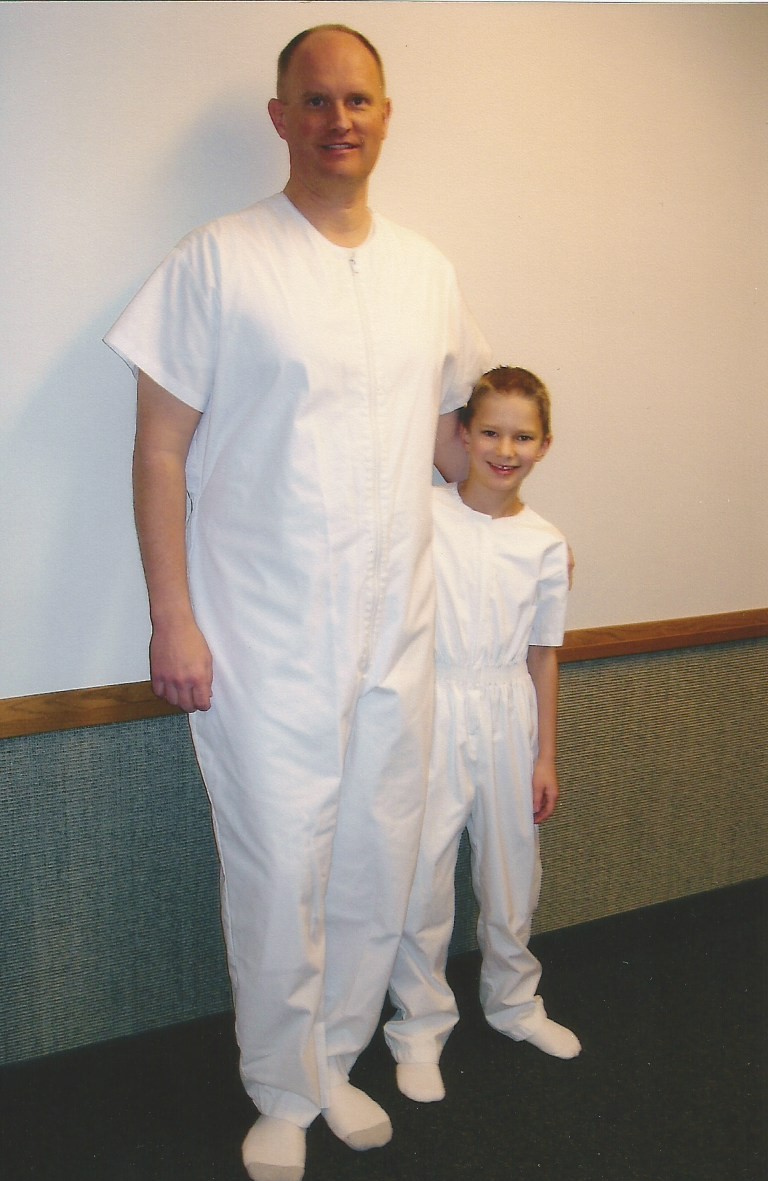
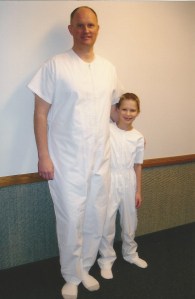
Two hours before the CNA came, Mom met me at the top of the staircase and motioned for me with her finger. She whispered that the urinal was full to the brim, and she worried that if Dad woke and needed the toilet before the CNA came, the bottle might spill.  She asked me to empty it.  “I was going to do it myself, but then I saw you and thought, ‘He’s the perfect victim—I’ll ask him to do it.’”  Her request touched off an internal mental struggle.  One voice chided, If she was going to do it, that means she was capable of doing it, and she should do for herself what she can do, and ask me to do what she cannot do.  An opposing voice stepped in with, Wait a minute!  I am here to help my father and my mother, to ease the burdens of both.  I pushed the selfish voice away and answered, “Sure, I’ll take care of that.  I’d be happy to.”  And in ten seconds I had emptied and rinsed the urinal and flushed the toilet, all while Dad slumbered.  The day was Saturday, and on Saturdays the CNA comes at 9, not the weekday 9:30, always surprising Mom by being “early.”  I opened the front door when the doorbell rang, and let the CNA in.  “Hi, I’m Jared,” he announced cheerfully.  I had never seen Jared before.  Mom rode down slowly in the stair lift chair, glaring unhappily at the new face that came at 8:50, ten minutes earlier than “early.”  But Jared won her over within those ten minutes, and Mom loved the short obese scraggly-bearded tattooed middle-aged man like a long-lost friend, asking him where he was from, if he had a family, where he went to school, how long he’s been a caregiver.  Jared cheerfully answered all her questions, then turned his attention to Dad.  Jared being new, Mom and Dad had to explain yet again all the little particularities of how things are best done, with using the walker, showering, dressing, transferring between various sitting surfaces, riding the stair lift (Mom insisted he ride it up the stairs to reach Dad, instead of walking up the stairs and bringing up the chair with the remote), eating his breakfast, taking his pills, and doing his upper-body rubber-band Pilates.  While Jared was learning the ropes, I was delving into my transient past, moving out of their hastily stacked places my beds, boxes, artwork, decorations, tools, and books, rearranging them more carefully, efficiently, and accessibly, reminding myself of what I own that I have not seen for 20 months, still finding it strange to have much of my life packed up in boxes.  In a shoebox I found old family photos Mom saved and gave to me, including one of me ready to baptize Hyrum, age eight, both of us happy and dressed in white.  I scanned and emailed the photograph to Hyrum, now 21, a missionary for his Church in Brazil, teaching the Good News of Christ, inviting others to enter the baptismal font, dressed in white, to be baptized, immersed, symbolically cleansed, to make a covenant with God to keep his commandments, to care for the poor, to mourn with those that mourn—the best kind of promises.

(Pictured above: Yours truly and my son Hyrum, age eight, on his baptism day.)


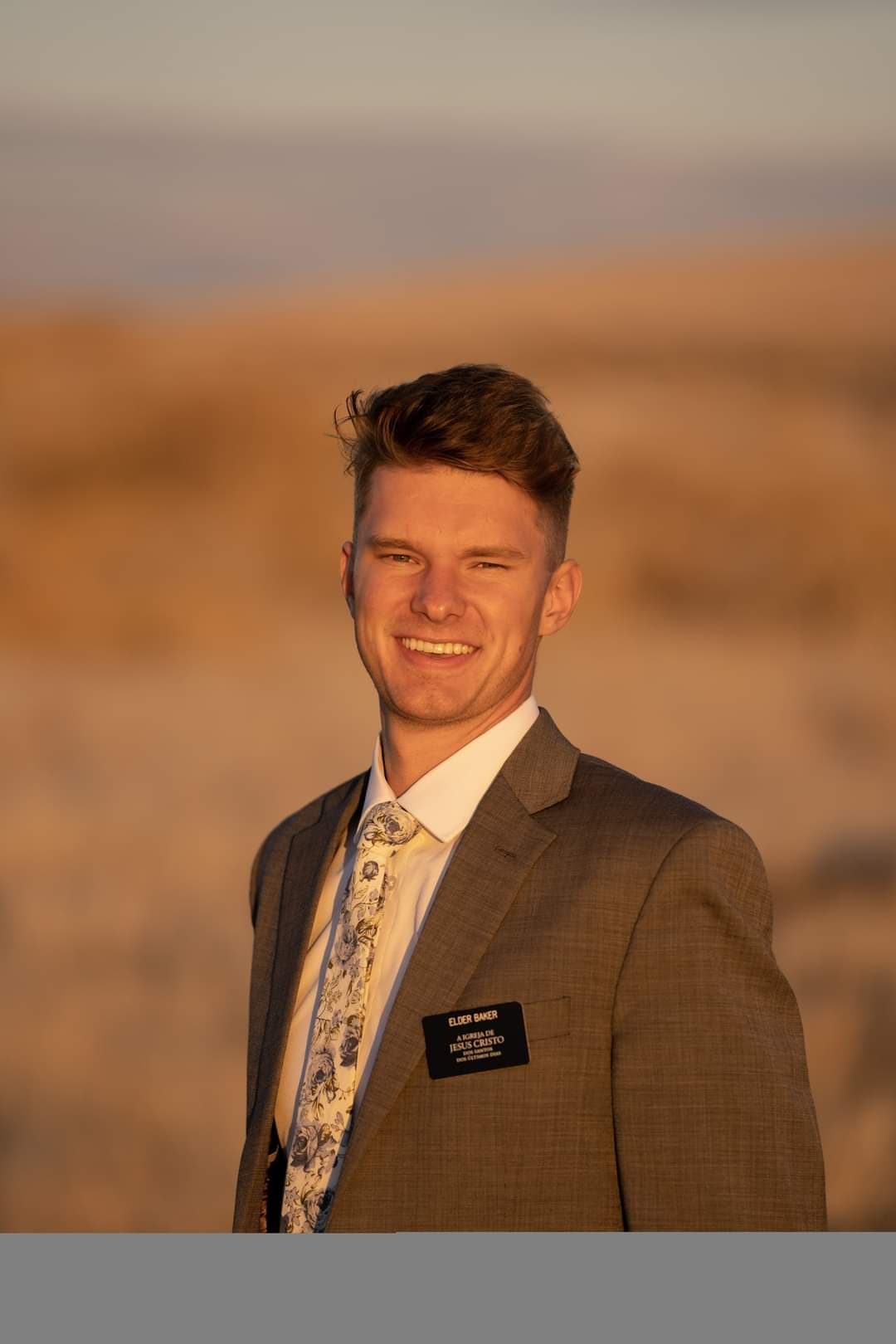
Hyrum today, a two-year volunteer missionary for the Church of Jesus Christ of Latter-day Saints, in Brazil.

Courage at Twilight: Dusting the Chandelier

The reunion is not for another month yet.  But Dad wants everything to be perfect for his former missionaries when they come.  He has made a mental list of all the little jobs he wants done, though he does not say he wants me to do them.  He and Mom have not been able to hold an April reunion for two years due to Covid-19.  But on March 31, up to one hundred of them, all dear friends, will descend upon the house and descend the basement stairs to tell stories and sing hymns and eat Brazilian food and bask in love and memory.  As their mission president, he was a young 36 (Mom 32), and they about 20.  Now he is 87 and they about 70.  As Dad rattled off his list, he tossed sections of the New York Times from his chair to the couch—better than dropping them on the floor to be tripped and slipped on, although sometimes he misses—and I grabbed pen and paper to write the tasks.  (I can remember a list of only two things; give me three and I am sunk.)  The first task was to clean the chandelier and replace all the bulbs, and I volunteered.  I could see no dust or grime, and all the teardrop lights worked fine, so I thought it a wasteful task.  But to honor him I dragged in the ten-foot step ladder, climbed to inspect, brought up a pack of baby wipes to wash off the dust, and swapped out all seventeen bulbs.  While I could see nothing wrong with the chandelier before, now it seemed to shine with twice its prior brilliance.  Most important, Dad was happy, which made Mom happy.  While I question the wisdom of a reunion, not wanting to see Dad push himself into an exhaustion difficult to recover from, the camaraderie will make him immensely happy.  And who knows if this will be the last reunion he hosts.  Dad’s days are growing shorter and shorter, by which I mean he rests longer and longer at night and during daytime naps.  He no longer reads until three in the morning.  Even midnight has been trimmed to 10:30, when Mom helps him upstairs after the ten o’clock news.  He keeps a volume of the encyclopedia upstairs and another downstairs, to sneak in minutes of study between CNAs and naps and Mom’s NCIS and meals and voyages to the restroom.  Upstairs is volume “A”.  I heard him telling Cecilia all about Air and Africa.  Downstairs is volume “R” and he reads until his bladder forces him to move.  I have wondered what should be my reaction to his grunts and groans as he moves around.  Are they signs of acute distress to which I should run in response?  Or are they a learned habit reflecting a pervasive state of chronic daily distress?  I know I cannot live my life poised tautly on the brink of anxiety, responding in a rush to all his distress, which would become my own acute and chronic mental distress.  I would break down teetering always on the edge of emergency.  My present reaction is to continue my activities while listening with one ear for signs of extreme distress, like Dad yelling, “Rog!  I need your help!”  That is when I run.  Far from acute, but still distressing, is when Dad or Mom ask me about things I have just finished telling them about.  I brought home from Zacateca’s Market three Big Burritos, filled with chopped steak, and announced the steak-filled burritos for dinner.  Taking a bite, he asked, “Is this steak?  My burrito has steak in it.”  Yes, I respond, I just told you it was a steak burrito.  “Oh,” he said, both of us feeling bad, for different reasons.  I am learning too slowly to be patient with fading memories and ears hard of hearing.

Courage at Twilight: All Creatures, Great and Small

I had bought the three hardbound books three decades ago, and they sit still unread on my bookshelf. But Dad, bored with his own library, picked up volume one and thoroughly enjoyed following Herriott on his rounds in rural Yorkshire.  As much as Herriott writes about animals, his true subjects are the animal owners, with their eccentricities and superstitions and their pure humanity.  Dad read All Creatures Great and Small, All Things Wise and Wonderful, and All Things Bright and Beautiful, then reread All Creatures, reading for hours at a time, chuckling quietly to himself, telling Mom and me stories of fearsome pigs and troublesome calf deliveries, and I remembered how much our family enjoyed watching the original BBC production.  In the spirit of the misty moors, I purchased the complete seven years of All Creatures on DVD for Mom and Dad to enjoy—an alternative to grisly crime shows—90 episodes over 12 years.  And then the old VHS/DVD player broke, swallowing a disk whole, so I brought home a new Phillips DVD/BR player from Wal-Mart.  The closed captions worked only on the first episode, and now Mom and Dad cannot follow the stories for Siegfried’s incomprehensible mumbling and shouting.  But Dad knows all the stories from his reading.  As she watches, Mom alternatively works her latest needlepoint or hunts for words in the puzzle book Jeanette gave her for Christmas.  I found the puzzle book in the recycle bin, all 108 puzzles completed, all the words found.  Who knew she would enjoy them so much?  Jeanette sent new a new book with even more word search puzzles.  On the afternoon Mom went to the dentist, she did neither needlepoint nor word searches, relaxing into her recliner, waiting for her face to come back to life after having a cavity filled and an old broken crown drilled out.  Her poor upper lip just would not work at all for three hours, and for a hundredth of a second flashed in my mind the specter of the dentist pulling all her upper teeth.  He had not of course.  Dad opened the back door and pulled his wheelchair close, watching me finish the last of the arctic willow pruning.  The bushes now look relatively round, and proportionate to their surroundings, with all the dead wood cut out, and another garbage can filled to the lid.  “I wish I could help you,” Dad called.  I stopped my work and approached with the consolation that as soon as the weather warmed a bit, and the grass dried out some, he could venture outside in his power wheelchair and do just about whatever yard job he wanted, including weeding with a hoe, trimming the bushes, edging the lawn, and general inspection.  He could even ride his chair into the garage to transfer to his riding mower and cut the grass.  He nodded and smiled and offered a simple “Yes” and that he looked forward to that.  Saturday’s work done, and our Coq au Vin dinner pleasurably consumed, and the kitchen cleaned and washed and put away, I sat down with the craft kits I had purchased and assembled, painted, and clothed four Valentine’s Day gnomes, little people that sit cutely on the hearth spelling the word “LOVE.”

Courage at Twilight: Standing Guard

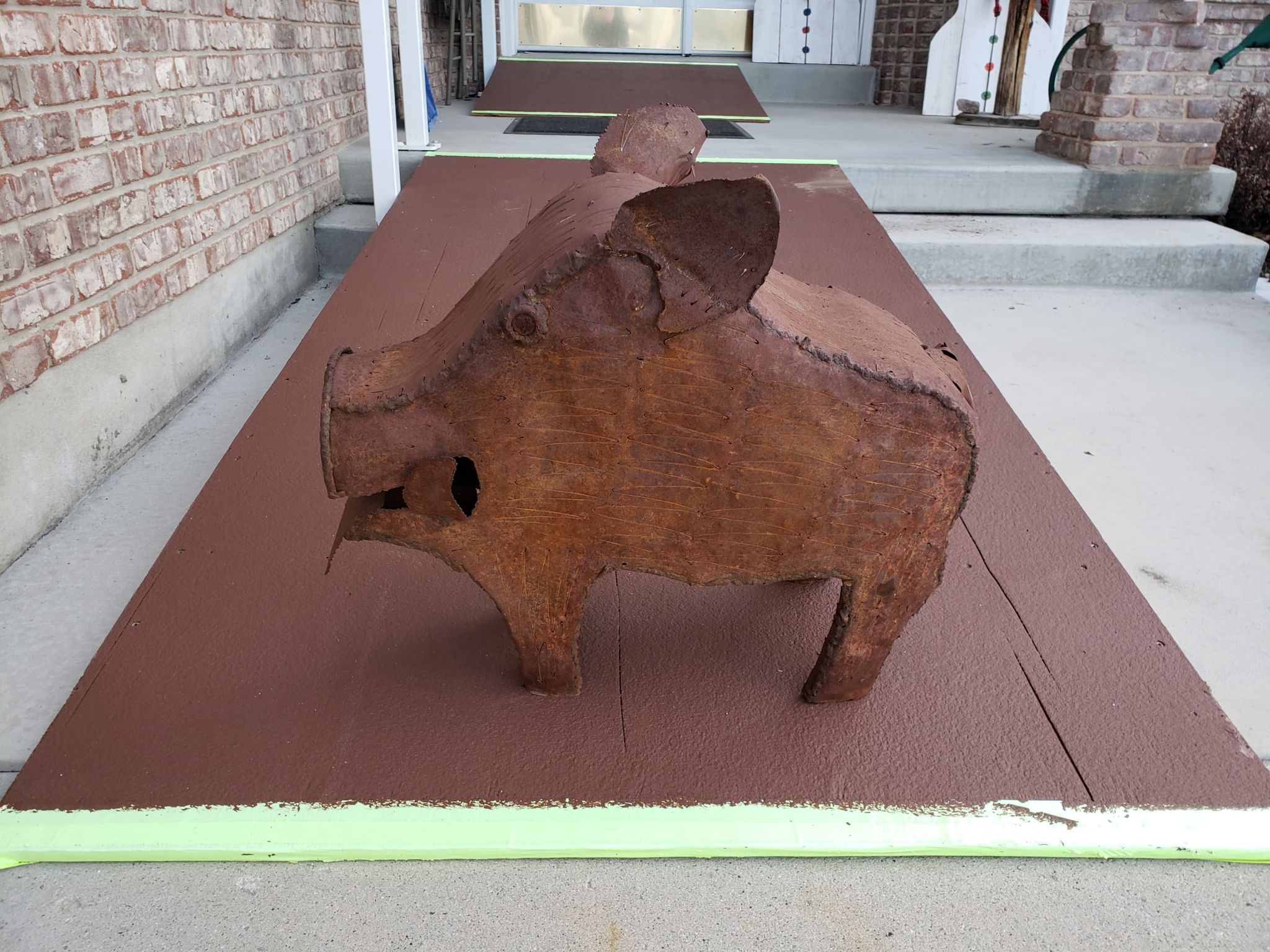
Dad explained that with the hard plastic mat under his new office chair, he could not stand up from it because the chair moved chaotically around beneath him on its coasters, and he invited me to remove the mat.  This was fortunate for me since my mat was cracked and broken.  A week later Dad remarked that without the hard plastic mat under his new office chair, he could not move the chair at all because its coasters sank into the shag and refused to roll, and he is stuck, too far (three feet) from his walker.  He asked me to return the mat.  I had since thrown my broken mat away, so now my chair is stuck in the shag.  As I carried the mat downstairs in the early morning, Mom walked past the door of her dark room dressed in her long white night dress.  She joked with me later that I must have thought I had seen a ghost.  I rejoined about having seen an angel with white hair in flowing white robes.  She laughed.  Bringing Dad home from the doctor at the end of the day, I prepared to build momentum to roll him up the long ramp.  (I am amazed at the gravitational difficulty one single foot of elevation makes behind a loaded wheelchair.)  “Where’s my javelina?” he interrupted.  “We just passed it,” I replied, not about to stop our progress mid-ramp to point out the pig.  I position the pig at the foot of the ramp, a warning to would-be ramp walkers (trippers), but moved it to make way for him and his wheelchair.  “Well, make sure not to leave him out in the rain and snow where he will rust too much,” Dad instructed.  You may recall that this particular javelina was plasma cut from a sheet of pre-corroded sheet steel, intended to mature with age and element, to continue rusting out of doors, the surface corrosion adding to the sculpture’s rustic charm but not damaging the structure.  I admit to returning the javelina to its guard post after depositing Dad inside.  But he was pleasant all evening, he praised my dinner of spicy chicken-and-sausage dirty rice, and this morning, when Cecilia asked cheerily, “How are you?” he responded with his trademark, “Marvelously well, thank you,” and moved on to his life’s great physical challenge: the journey to the shower.

Courage at Twilight: The Weight of Snow

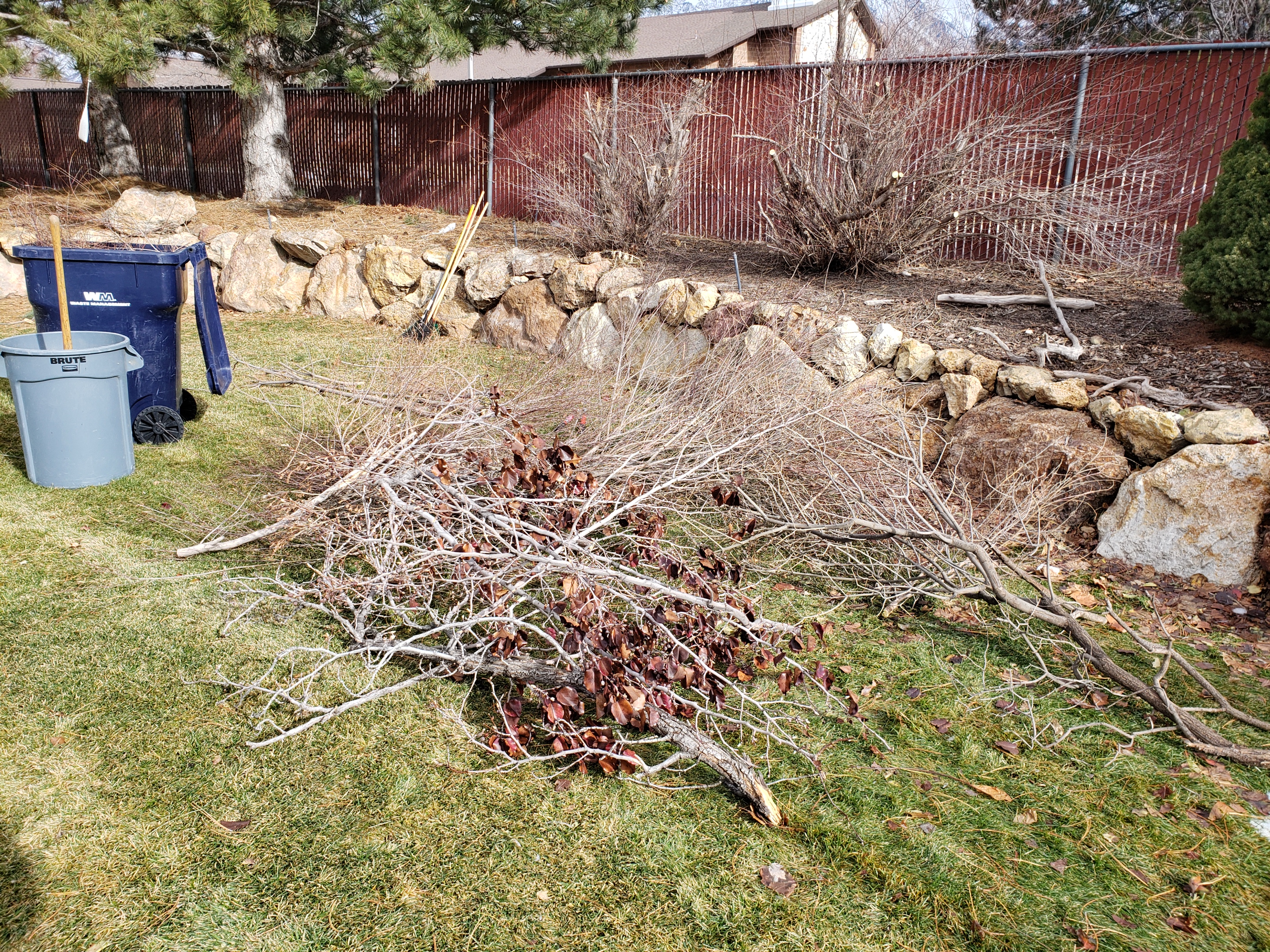
The backyard willow bushes were no match for the extraordinary snow, deep and heavy.  Branches broke and trunks twisted, nearly all of them.  My Saturday chore, after the snow melted in a sudden thaw, consisted of cutting out the broken wood and chopping it up and cramming it all into the big garbage cans for Monday’s pickup.  And I raked up piles of rotting leaves pressing on the grass against the rock wall, topping off the cans.  It is only January, and I asked myself why I was doing this chore now instead of putting it off until spring.  Because it needs doing was the simple answer, and I wanted to be outside.  Mom’s lower limbs still function but bend on stiff and painful knees, and she drove herself to the orthopedist who numbed her knees and inserted long needles that delivered impressive quantities of yellow steroidal liquid that will calm and lubricate the machinery for another six months.  She feels better now, but sees no reason to prove the point on the stairs, opting instead for the knee-saving chair lift.  Dad’s own legs have failed him, being of practically no utility and instead being a great nuisance of weight to be dragged around.  Though his doctor has seen him four times in six months, and knows first-hand Dad cannot walk, Medicare insisted on yet another face-to-face visit (we’re all for preventing insurance fraud) for the sole purpose of documenting Dad’s need for a power wheelchair.  So, Dad risked injury and jeopardized health to travel to his injury risk manager and health care provider to document his already well-documented decline.  A year ago, I had little notion of the complex (for me) and arduous (for Dad) procedure of transporting an overweight infirm 87-year-old to and from appointments.  Relieved to be back at home, Mom and Dad rested in their recliners, and I bustled about in my cooking apron.  The thermostat showed the temperature dropping, and Sandy’s public works department emailed to warn of freezing pipes (100 houses had burst pipes the night before), and advised the city’s population to leave a pencil-stream of water running in the kitchen sink—moving water is less likely to freeze—wasting the water we prayed so fervently for in our Utah desert clime.  At 6:00 the next morning, my phone announced the temperature of the air outside my window: 1⁰ F.  Our pipes did not freeze.

Courage at Twilight: Members of the Tribe

My ears are attuned to every little sound: the clicks of the break release handles on Dad’s downstairs walker; Mom’s syncopated shuffle; the single beep as the stair lift arrives at the end of the track, upstairs or down; cursing from the bathroom. This morning I awoke to the muscular sound of an industrial-strength vacuum in the master bedroom.  Through the doorway I saw Dad sitting on the walker seat and pushing the carpet cleaner forward and back next to the bed.  I did not ask, but I knew without asking.  His weekday CNA Cecilia—faithful, pleasant, and kind—came shortly after and helped him shower.  From my home office I could hear their one-way conversation: she said very little.  “Do you know how old the earth is?” he asked her.  “Four and a half billion years old!”  He knows and loves the Bible and its God, but informed Cecilia that “God did not make the earth in six days.”  Rather, He probably took billions of years to make our globe.  Dad explained to her about the sun burning hydrogen in nuclear fusion, with enough hydrogen still to burn brightly for billions of years more.  He told her that the only way we know how to use nuclear fusion reactions is with a hydrogen bomb, and referenced the atom bombs dropped on Japan.  He expounded about ocean currents, and about the hydrologic cycle of evaporation and precipitation and the rivers of water vapor coursing through the skies, and about Argentina’s defiant propensity to default on its international debts, and about the formation of galaxies and stars.  “I like to know things,” he summed up.  Cecilia, an excellent listener, interposed an occasional affirming “really?” and “oh.”  He told her about our family visiting an Indian tribe in Brazil in 1974, and how the tribal elders would not let us into their compound without being members of their tribe, and about how the tribal elders allowed us to become members of their tribe by following them on a course through the grounds and buildings, ending at a ceremonial tree, and about how we bought blow guns and bows and arrows from the indigenous women of the tribe.  This is a true story.  I know because I was ten and I was there.  Dad’s stories sometimes jump from one unconnected subject to another, shifting like an old car with a worn out clutch.  Dad lamented to Cecilia, “A few months ago I was a normal person.  I could walk.  I could do things.”  That is not true.  I know because I am 58 and I have been there with him, watching the insidiously steady downward degeneration culminating in painful undignified immobility and having to use the carpet cleaner in the mornings.  He is not untruthful—he just forgets.  And he cannot retrieve his books from his bookshelves or his checkbook from his desk or a glass of ice water, and has to ask Mom and me to fetch these and other things for him.  He asked me to bring him Mom’s youthful portrait from his desk, placing it on the end table by his recliner, where he can see it all day as he reads.  I remember seeing that portrait of Mom on his desk thirty years ago when I visited his New Brunswick office in the Johnson & Johnson tower.  He has gazed at Mom’s youthful portrait for more than six decades, and he tells Mom everyday what a wonderful person she is, and that he loves her.  And he steals hugs when she walks by, and she returns the hug and runs her fingers through his sparse wispy hair.

Courage at Twilight: Dream Walking

Behold: The Carina Nebula's 'Mystic Mountain' | NASA

I sat on the side of Dad’s bed to wake him on this Sunday morning, this Christmas morning, to talk about getting him showered and dressed and settled in his reading recliner. I could see that his whole body ached as he turned his head on his arthritic neck and stretched out his invalid legs and brought his arms under him to reposition.  His welcoming words were unexpected: “I have dreams…”  I wondered what kind of dreams, whether literal sleeping dreams or waking hopes and aspirations, and did not have to wait long to learn.  “And in my dreams, I am walking.”  I was touched that he had allowed me into this intimate and personal place, the place of his soul’s desires, and was touched by the aching irony of his wish to be healthy and for his body to function, but to be able to do so only in impotent dreams.  Dreams for the present broken.  “Sometimes,” he continued, “sometimes I think my paralysis has happened to me because God is trying to teach me a specific lesson.”  I personally am disinclined to believe God targets us with specific afflictions to teach us particular truths.  Rather, I am inclined to believe that the nature of this life is designed to bring us into inescapable contact with experience, and the equally inescapable choices associated with that experience.  A coworker is rude to me, for example.  That is the experience.  Will I react angrily, self-righteously, and judgmentally, or patiently, compassionately, and empathetically?  That is the choice.  And my choice—that all-powerful vehicle of self-creation—establishes the trajectory of my character.  But despite my inclinations, who am I to say that God cannot teach us in surgical fashion when he finds it appropriate?  “I want to be the kind of man who chooses to be humble of his own volition and is not compelled to be humble” by God or by circumstance.  Dad’s humility is the least of my concerns for his soul.  In fact, I am not concerned at all for his soul, only for his present comfort and happiness.  When Dad kneels before his Savior, he will look up into that glorious face and declare, “I did my best, Lord!”  That will be a sweet moment, for God accepts the offering of every effort we make for good.  With crumpled wrapping paper strewn about on the floor, and small piles of Christmas gifts on chairs, Dad sank into his gift of a Popular Science edition about outer space.  A photo of the Carina Nebula decorated the back cover, a gift from the Hubble and the James Webb.  “I love outer space,” he exclaimed.  “It won’t be long before I’m there.”


(Photo of the Carina Nebula courtesy of NASA, used here pursuant to the Fair Use Doctrine.)

Courage at Twilight: Transference

We have experienced another week of steady decline in Dad’s mobility.  He has suffered increased weakness.  I have suffered increased worry.  He cannot walk.  Life is very different when you have walked for 86 years and suddenly find yourself paralyzed and immobile.  The word of the day is “transfer,” by which I mean the experience and process and effort of shifting one’s bulk from one seat surface to another, like from and wheelchair to a toilet, or from a shower chair to a walker chair, in which one moves laterally rather than vertically, and does not ambulate.  I sat down across from Dad to suggest the time had come to focus on transferring rather than walking.  “I think we should refocus our approach,” I explained.  He nodded in sad reconciliation, feeling humiliated and small.  How could I reassure him?  In truth, with the power wheelchair, he can enjoy greater independence and freedom of movement than with trying to walk.  But transference is a skill to be practiced—it is not an easy exercise, and I invite you to pretend your legs do not work and try transferring from one chair to another with only the strength of your arms and the span of your bottom.  Now add arms to those chairs.  To help him transfer from off his sofa to his wheelchair, I installed risers under the sofa feet, raising the couch five inches, and screwed three inches of lumber to the legs of his recliners.  Struggling with this new necessary skill, his transfers can be, shall we say, inaccurate, like onto the arm of a chair instead of into the seat of that chair.  Some transfers are violent, like when he fell from his wheelchair onto his couch so roughly that he knocked the couch of its risers and was lucky not to capsize altogether.  Since the escapade did not end tragically, I can comment after-the-fact on how I wish I had seen it happen and how funny it must have seemed.  A hair’s breadth of fate or providence separates tragedy from comedy.  Dad pronounces all his mishaps as comical, veritable jokes, although he curses more than he laughs when in the midst of transference.  Mom pounced on me when I came home from work, before removing my coat and tie, asking me to re-elevate the couch.  Then she showed me the toilet plunger sitting in the kitchen sink, and explained how the food disposal had plugged up with old spaghetti, and she could not clear the clog, try as she might.  Putting my height and weight into the plunger, I compelled the dirty water and ground up food through the pipes and successfully drained the sink and emptied the disposal.  She is always so grateful when I fix things she can no longer manage.  The next problem to solve involved her pharmacy of 24 years.  She and Dad had received letters informing them that their pharmacy was no longer in their insurance network, and in only two weeks they would have to pay full retail price for their medicines.  I offered to help switch to a new pharmacy, and envisioned the hassle and weariness of assembling all the prescription bottles and insurance cards and driving to the new pharmacy to see the staff and taking an hour to input the data into the new system, and the weather was very cold, and the streets icy, and the sky darkening at 4:30 p.m., and I really did not want to leave the house on this cumbersome errand.  Instead, I called the store, they took our information, and promised to get their information transferred from the old pharmacy to the new.  Mom beamed, amazed at my miracle working with the sink and the pharmacy.  I will try to elicit the same response with tonight’s dinner.  It is time to shift from writing to cooking.

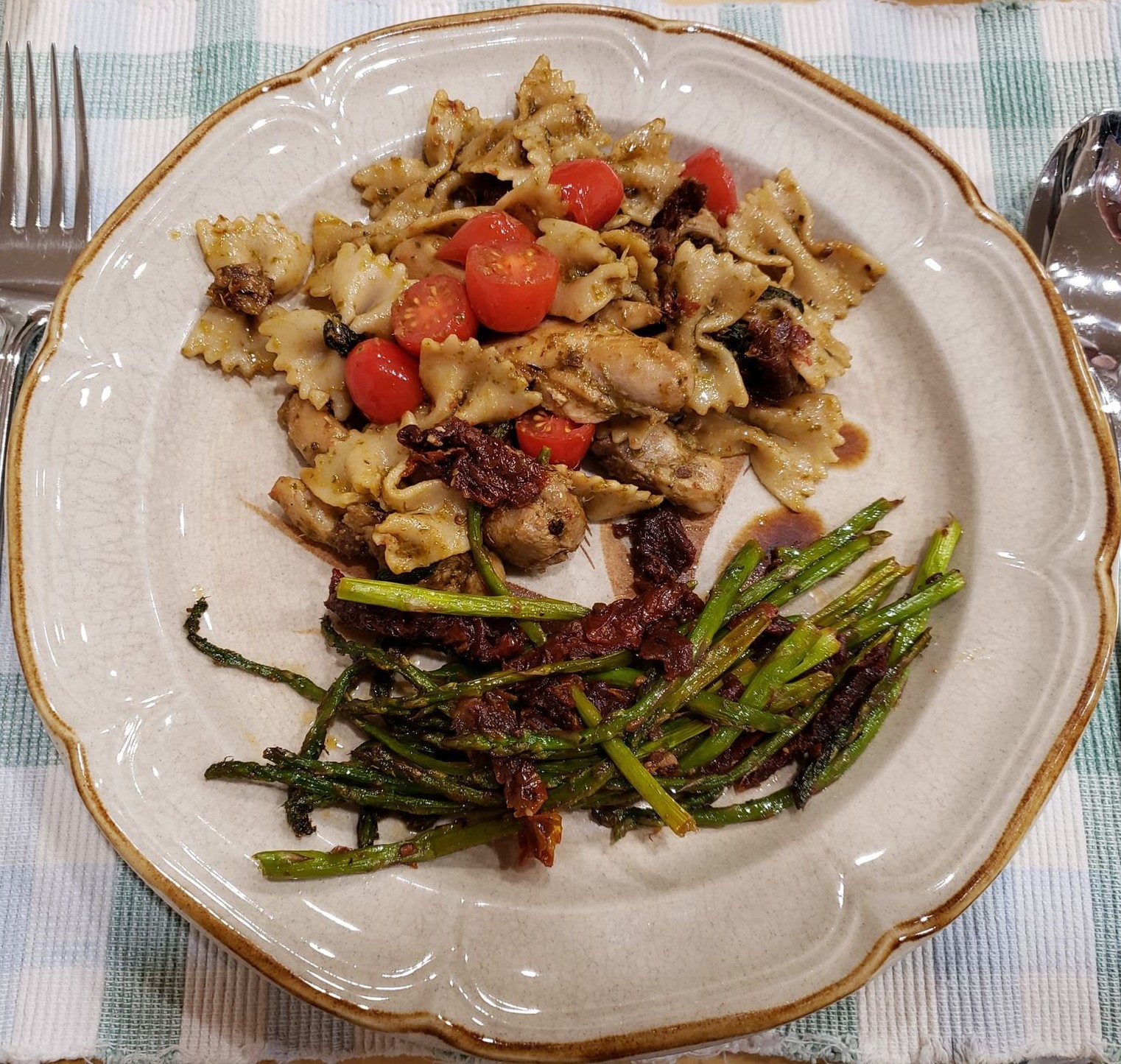
(Pictured above: Italian pesto pasta and chicken with brazed asparagus.)

Courage at Twilight: A Grimless Reaper

December 17.   Twelve degrees Fahrenheit.  I am hiking to Bell Canyon Falls.  But I am not alone this time.  My son John read about my December 4th loneliness and invited me to hike with him today.  Dad slept still when we left, but Mom asked his questions for him, about whether we had water, food, good boots, warm gloves, our hiking poles.  We pushed past where I had turned around two weeks before, pushed up to where the slow lay three feet deep beside the trampled trail.  We talked about life and love, relationships and challenges, joys and dreams, and I rejoiced quietly in his conversation and his character.  Cold in my bed two nights before, I had dreamt of death, a peaceful dream in which the presence of Death descended gently to touch those whose time had come to return—a soft, benign touch, not threatening, but caring and compassionate, possessing a perspective large as a universe about our journey through an eternity of time in an infinity of space.  Still, when I awoke in the dark, I felt compelled to check on Mom and Dad, to see if the dream had been prophetic or merely a macabre play on my anxieties.  As I stood in their bedroom doorway, the nightlight on the wall behind me cast an enormous human shadow on the wall before me, and I thought of the grim reaper, only I was grimless, and guileless, and I was not a messenger or a harbinger, but a steward and a servant and a son.  Dad snored calmly, and Mom’s sleep had sunk beneath his snores.  Throughout the week, groups of neighbors and church members had stopped by to wish Mom and Dad a merry Christmas.  A group of six young women and their adult advisors came to carol.  Dad had wanted to greet them in the formal living room, but he could not walk that far—he may never walk that far again.  So he smiled and joined in the singing from where he was, holding the large gift basket in which lay a loaf of cranberry walnut bread, wool-blend socks (even a pair for me), and mint truffle hot cocoa mix.  A bunch of boys with their adult advisors came to deliver a puzzle and oranges and blonde brownies and Andes mints.  Couples delivered a pineapple, whole wheat bread, peach freezer jam, a poinsettia, ornaments for the tree, and green bananas (because Mom told them Dad likes green bananas, not the brown blotchy sweet ones she enjoys), each gift an expression of love and regard and caring.  This is what I thought about as I slipped and rolled clumsily but harmlessly down the steep snowy mountainside, snow sticking to every inch of me, still with no spikes on my boots, still in the mountain’s cold shadow, my knees complaining loudly, the moisture from John’s breath frozen stiff on the whiskers of his mustache, my water bottle frozen in my coat pocket.  And then sunlight struck the tops of the snow-laden trees and worked its way warmly down to the snow-covered sagebrush and the deep snow drifts and the path and two hiking men with their poles swinging in easy rhythm.
Young ladies caroling to Mom and Dad.

John posing before the frozen Bell Canyon Falls.

Courage at Twilight: Will You Stand By Me?

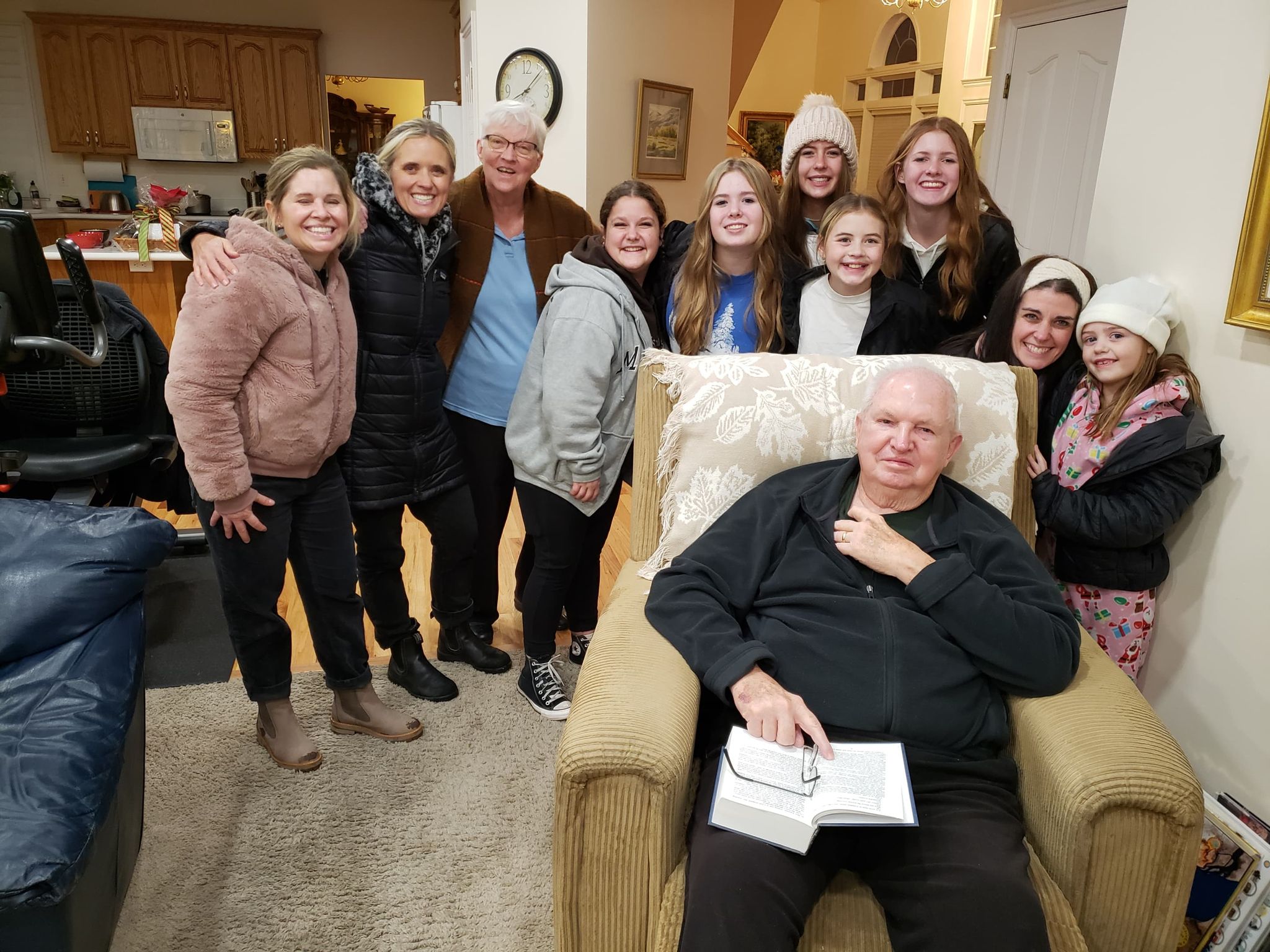
I am the shy quiet guy that lives with his parents, almost 60 years old, who they see pushing Dad’s wheelchair very slowly, so Mom can keep up, down the aisle to the front church pew, where a space is reserved for a wheelchair, where Dad has a better chance of hearing the worship meeting speakers, in the front where our family has sat in church for decades: in the front, where Dad, sitting on the stand those many years, presiding and exhorting and teaching, could keep an eye on his six children, not that we caused any trouble, and where he could be as close as possible to his family while carrying out his lay clergy duties. I am slowly learning their names, making a few acquaintanceships crawling toward friendship.  But today Dad was too weak to attend church meetings, and I had my granddaughter Lila with me, and we walked hand in hand down the aisle where Mom sat alone on the front church pew, and I could feel the eyes on me, friendly and interested and astonished eyes, and could hear their thoughts: Oh, he has a story!  And they wondered what my story could be as they saw my oldest son and his good wife and the little black-haired baby, my newest grandchild, and Lila my three-year-old friend, all sitting together in the front.  I share my desserts with church families now and then, always friendly cheerful encounters after which, as I am walking away, I hear them thinking to themselves: I wonder what his story is?  And they wonder if mine is a strange tragic story, as they munch tentatively, at first, and then with gusto, on my latest baking attempts, tonight’s being an enriched German holiday “Stollen” bread filled with dried fruits and sweet almond paste.  I baked the Stollen after cleaning up our Sunday dinner dishes, when I wanted to get off my aching feet but wanted more to make something pretty and interesting and sweet.  Dad asked if he could have a slice, which of course I gave him, in spite of the spiteful diabetes that is wrecking him, because he will be 87 in two weeks, and it was a thin slice after all, and let him live a little for heaven’s sake, and I said “no” to his importuning for seconds.  And he asked me, “Rog, will you stand by me while I try to stand up?” but I heard, Rog, will you stand by me as I am wasting away, in my pains, as I am dying?  Will you stand by me to the end?  Yes, Dad, I am here, and am not going anywhere.

(Pictured above and below: my first attempt at Stollen, an 18-inch loaf–delicious.)

Courage at Twilight: Diabetic Amyotrophy

Dad’s eyes followed me as I moved about the kitchen preparing my breakfast. “Let me know what you think of those gluten-free no-sugar keto cereals,” he commented as I rummaged through cereals bought for him that he will not eat.  You could try them yourself.  “Not blackberry jam!” he gibed when I took the bottle out of the refrigerator.  “Are you putting blackberry jam in your peanut butter granola?”  No, Dad, I’m having toast with jam.  “And is that cream cheese?”  Yes, Dad, I like it with toast and jam—reminds me of Portugal.  “You’re putting milk on your cereal, right?”  Oh, my, gosh, Dad—stop commenting on my food!  I can feel his eyes on my every movement, and I want to scream.  But they are benign, innocent, aged eyes.  Why does the inoffensive become so irksome in people we love so much?  After breakfast would come the drive to the hospital for the NCV and EMG tests.  “You brushed the snow from the Suburban, right.”  Of course, Dad.  And I shoveled the driveway.  And the Terry’s driveway—he has been looking feeble lately—and Melissa’s driveway.  I had enjoyed marching the snow blower through four inches of new powder; it sparkled in the sun at it flew.  Clearing our own driveway was anticlimactic, so I moved to the neighbors.  I hoped they would now know it was me—I enjoyed thinking of their surprise and gratitude.  And, being anonymous, I would not have to face my clumsiness at being thanked and smiling and saying you’re welcome and other social engagement awkwardness.  I have noticed my happiness is greatest when contributing to the happiness of others.  There is joy in service.  So why do I spend so much solitary energy unsuccessfully pursuing my own happiness?  There really is something to that business of finding your life by losing it.  At the hospital, the doctor performed two tests.  First, nerve conduction velocity: he hooked up small electrodes above key nerves and administered numerous not-unpainful electric shocks to measure nerve conduction in Dad’s legs and arms.  Second, electromyography: he inserted a needle in key places to “listen to the muscles” as Dad flexed them in various instructed ways.  Dr. Hunter focused on his work as I focused on Dad’s grimacing face and jumping limbs and spots of blood dripping.  The testing shows you have severe neuropathy in both legs; severe nerve damage.  We now, finally, have a diagnosis.  Diabetic amyotrophy: rare condition…severe burning leg pain …weakness and wasting of the muscles.  Experienced by older patients with moderate controlled diabetes.  No cure; no treatment.  The pain may subside, but the weakness will remain: your strength and mobility will not return.  I am sorry.  “Well…that’s life…I’m 87 in two weeks…my body is falling apart…that’s what happens.”  I retrieved the wheelchair from the back of the faithful Suburban, helped Dad slide from the front seat into the chair, pushed him through the melting ice and up the slick salt-covered ramps and through the front door to his recliner, the salt crunching under the wheels against the cold white tile.

(Pictured above; our after-hospital dinner of lemon chicken on a bed of pesto couscous with white bean and corn salsa.)

Courage at Twilight: Bittersweet Good-byes


“I’m not doing my arm exercises today,” Dad announced with some belligerence. I had heard the CNA coughing and sniffling continuously as she helped him bathe and dress.  How ironic, and alarming, for a health care provider to bring sickness into our home.  Dad was none too pleased, and invited her to leave an hour early.  He asked me for the physical therapy supervisor’s name (we’ll say “PT”) and phone number: “I’m going to call PT and tell him not to come back.”  Dad could not walk, could barely move, the day after PT poked and pushed and stretched him, yet a new depth of debilitation.  He made the call and left a message.  He did not confront either the CNA or PT, instead just removing himself from the threats.  For days now, there has been no question of walking to the bathroom at night: the bedside commode has to do, and it is all he can manage to transfer from the mattress to the commode three fee distant.  Today he could lift neither foot over the four-inch lip of the step-in shower stall.  On a happier note, I installed the old steel banister, removed with the stair lift installation, in the basement stairwell, making trips to the cold storage room and the freezer much easier for Mom: a “piece of cake.”  This morning I brought up frozen chicken breasts to thaw.  Hyrum came over for dinner—his last, for a while, with Mom and Dad—and I transformed the raw bird into tangy Hawaiian chicken on a coconut rice bed.  Hyrum, at age 20, is leaving for Brazil to begin his volunteer missionary service, as I did in Portugal in 1983, and as Dad did in Brazil in 1956, for The Church of Jesus Christ of Latter-day Saints.  Two years he will be gone, and I will miss him.  He is my son and my friend.  Dad told him the old stories about eating avocados the size of grapefruits for lunch and being arrested at the behest of local clergy and inviting hard men to lead their families in kneeling prayer and about feeling the love of God for the people.  Hyrum said his farewells, promising to send Mom and Dad his weekly email updates.  “I may not be alive when you get back, Hyrum,” Dad mused, “but I’ll be happy to read your emails while I’m still alive.”  Hyrum and I were both poignantly aware of the real possibility of Dad’s passing before Hyrum’s homecoming, making sweeter and sadder this good-bye from a grandfather to a grandson.

(Pictured above: Hyrum with Dad and Mom.)

The basement stairs, before and after installing the steel banister, left.

Courage at Twilight: Phases I Never Knew

Every day, it seems, Dad laments, “This is my worst day yet, Rog.” Every waking walking breath is an audible grunt or groan—no normal breathing in this house.  He fights for life with all his energy and might, both of which are diminishing—he knows it, and he is disheartened.  And so am I.  In my 14 months living here, I have seen Dad progress through late-life stages I did not know existed, from the two-foot-shuffle to the hand surf, from the hand surf to the clickety cane, from the clickety cane to the walker, from the walker to the so-slow stair lift, from the stair lift to the wheelchair, pushed, then self-propelled.  The recliner is an ever-greater presence in each successive phase.  So is the pain.  My worst day yet.  What am I supposed to do with that statement, that fact?  How am I to hold and examine and process that reality?  Why, of course, I am to be a fathomless fount of patience and love, of smiles and good humor.  And, of course, I am not.  I am a shallow pond of brine, with fresh water trickling in here and there.  His reality creates mine, and I find myself more irritable and impatient, symptoms, perhaps, of feeling powerless, and empty, and tired, and stuck.  I began this experience as a consecration, a mission of providential origin, I thought, and still think.  But a mission’s initial glamor always attenuates and turns into a long hard slog.  One’s initial intentions, however sincere, begin to quiver and equivocate.  Only then can I see, do I know, the kind of missionary I am.  No saint, to be sure.  No hero, certainly.  Just a laborer who shows up day after day, whose contentment is not to be found in his perquisites but in the solitary knowledge he is doing what must be done.  That alone is ennobling, I suppose.  And will this mission, this story, have a happy ending?  As with all true stories, the answer is both yes and no—both the joy and the sorrow.  How I feel when the story ends will be my choice.  Before it ends, however, I can choose to listen with a smile, to cook and clean with good cheer, to do the honey-dos with zest instead of a sigh and a roll of the eye.  Time to stop writing.  Time to get to work.

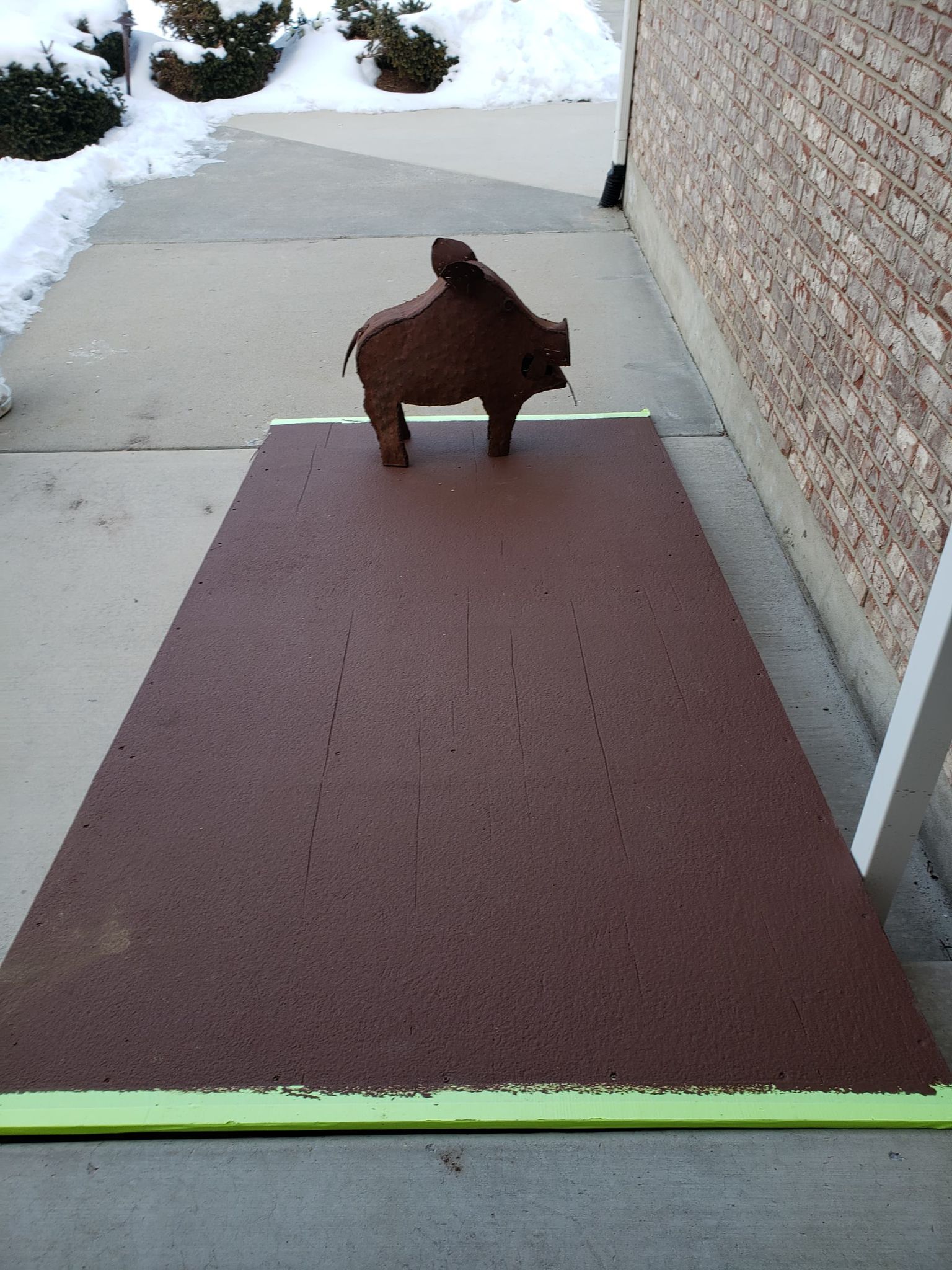
(Pictured above: the javelina guards the varnished ramp, slippery from last night’s snow.)

Courage at Twilight: Dirty Rice

I informed Mom and Dad I was cooking southwest wraps for dinner: ground turkey, black beans, corn, and rice rolled in tortillas and crisped in an iron skillet.  He looked at me funny and asked, “Rats for dinner?”  “Wraps,” I reassured him.  Earlier in the day he had cut himself.  He had reached through the bathroom doorway for his walker handles, and the door’s strike plate had sliced the paper skin of his forearm.  The CNA wiped the floor clean with baby wipes, and bandaged his arm.  He sat at the kitchen table telling me about it.  My daughter Laura has sent me her ten favorite recipes—all winners—and I have made two or three each week to spice up Mom’s and Dad’s dinner time.  Tonight, we gobbled up Cajun chicken with dirty rice, which I learned is rice cooked in the fats and juices and spices from cooking the sausage and chicken pieces.  Dad praised the meal no fewer than six times before we finished eating.  I relish the experience of making beautiful and delicious dishes which people enjoy.  As we ate, Dad told me the results of his Mayo Clinic spinal fluid test.  The nurse had called to inform him that his spinal fluid is “completely normal.”  Completely normal.  “My spinal fluid is completely normal,” he sounded discouraged.  “But I am getting worse by the day.”  Once again, the good news was hard to take.  No diagnosis equals no treatment.  Here was one more possibility explored.  Here was one more hope disappointed.  Here was yet another beginning of searching for elusive answers while suffering unanswerable pain and weakness and while fighting for his life and for his quality of life.  I am powerless.  All I can do is cook dirty rice.  James the physical therapist stopped by after dinner to evaluate the effectiveness of therapy.  He asked Dad all the same questions everyone else has asked.  He poked and prodded and asked “Does that hurt?” a dozen times.  Yes, it hurts.  A lot.  After ten minutes, James had figured out what dozens of doctors and nurses and tests and therapists had not figured out.  The spinal nerves are inflamed, causing him pain, due to his age and his recliner sedentariness and his stooping over and due to his spinal joints not being moved and not circulating blood to the nerves which therefore are inflamed and causing him pain.  Simple.  Just do these exercises.  And don’t sit: sitting kills your nerves.  I am skeptical of any one person who has all the answers, and that quickly.  But, could he be onto something?  I will try to help Dad to the exercises.  Meanwhile, he is too tired and weak to anything but sit in his recliner and kill his nerves.  He invited me to turn on the Christmas lights wrapped around the bushes, and asked if they had come on despite the snow.  Yep, I answered, for I had wrapped every joint and plug with black electrical tape to keep out the water, as I did last year, and the year before.

Courage at Twilight: Old Man’s Lament

Can I visit with you for a second, Rog? I know you’re up to your elbows in dishes right at the moment.  Thanks for coming over to me—I couldn’t have come to you.  I see everything you are doing for us.  You are doing all the cooking and cleaning up after.  I feel bad about that.  I would like to help you cook dinner and wash the dishes.  But I just can’t.  And I’m getting worse.  My legs hurt so bad when I try to stand, worse every day.  I’ll call the doctor tomorrow and see if they have sent my spinal fluid to the Mayo clinic—it’s been two weeks already—and I’ve gotten a lot worse.  I hope they find something so they can treat me.  I can’t stand just sitting here and deteriorating and not knowing why, or what I can do about it.  I just can’t walk at all—even with a walker my legs are too weak to walk.  Look, my walker is three feet away and I can’t even get to it without you pushing it to me.  I can’t help you, and I feel bad.  I’m so very grateful for everything you do for your mother and me.  Your meals are delicious and healthy.  Tonight’s pesto chicken pasta, and that braised asparagus, were both superb.  Do you think Olive Garden makes anything like that?  You always have to pick up after me: when I drop something, I can’t bend over to pick it up, so there it stays, unless you pick it up for me.  I love working in the yard, but you do the yardwork because I can’t.  And you fix what’s broken, like the toilet valves and the sink stoppers.  This year, you put up the Christmas lights for me.  They look so cheerful, and I’m so happy they are up and shining and bright.  Aren’t you?  I just couldn’t do it.  Two years ago, I did the lights myself.  Last year, I helped you a little.  This year, I just watched from the sidewalk, from my power wheelchair.  I tried driving it on the grass, to get closer, but the wheels just sank, and I couldn’t go anywhere but back the way I’d come.  I’m very grateful to you.  Well, that’s all I wanted to say.

Courage at Twilight: Rack and Pinion

I arise at 6:00 a.m. (ideally), slip on my gym clothes, and slink down the stairs without a sound to sit on the stationary bicycle.  I must read when I ride or I go mad with boredom and from focusing on the discomfort of hard exercise.  But Dad’s room is immediately adjacent, and the light would strike him fully in the sleeping face.  My headlamp is the answer.  I puff as I push and as I read N.T. Wright’s New Testaments translations and commentaries, and Dad is none the wiser (though I certainly hope I am).  But today the headlamp became moot, and I flipped the light switch on.  We are poorer in the pocket, but enriched with new possibilities for mobility and independence.  The stair lift finally has been installed.  And the taste is sour-sweet.  As Dad held the lever in the “up” position, the chair he sat slumped in rose slowly to the landing, pivoted 90 degrees, and carried him to the top of the staircase.  He ascended with a vacant emotionless expression.  Dad has new independence, even with increased weakness.  Dad has improved mobility, even with increased paralysis and pain.  Dad carries a dual humiliation: the marathon runner who cannot walk; sitting hunched in a chair, himself motionless, being rack-and-pinioned to the second floor.  Not a time of celebration.  Rather, a time of adjustment to a new tool and to a new routine, a time of relief with the decreased risk of ending his life horribly by falling down the stairs, a time to confront the fact that he will never climb the stairs again under his own power.  I asked for the opportunity to talk through how bedtime would now work, not just for him, but for Mom and me also, and I thought we settled on moving toward the stair lift and toward bed at 10:30 p.m. after the nightly news.  But discovered that he had settled on reading until midnight and moving himself achingly with his not-a-walker to transfer to the stair lift and push the “up” paddle, to push his heavy-duty blue walker to his bed, where he climbed in next to his sweetheart for the first time in ten long weeks, without an ounce of worry from me because of the lift.  A cause for celebration after all.  Four-year-old Gabe joined me in my own celebratory ride by sitting on my lap as I held the paddle in the “up” position and we rack-and-pinioned our way slowly up the stairs.

Courage at Twilight: Not a Walker

Dad sat reading volume “F” of the 1990 World Book Encyclopedia—“I haven’t read ‘F’ in some time”—and later at the dinner table expounded to Mom and me about Fahrenheit and Faulkner and Freedom. I think volume “L” might be his favorite.  Whereas last week he had to ask Mom to bring this and that book or plate or newspaper to him—because he could not hold both the walker handles and the object he wanted—his new caddy allows him the independence of transporting things himself.  While I searched the Deseret Industries thrift store for exercise dumbbells, which I did not find, the walker fairly stuck out its handles and introduced itself.  Fifteen dollars later, I walked into the living room and declared to Dad, “This is not a walker.”  He seemed fond of his floral-pattern walker, and I worried he might not welcome an interloper.  I explained, “This is a food caddy and a book caddy and an anything-else caddy.”  Dusty from sitting neglected in someone’s garage, I cleaned every inch of the caddy.  Next day, Dad transported his books and his lunch plates without relying on Mom or me.  He liked the like-new not-a-walker.  In a related story, Dad announced to Mom and me in church that his wheelchair cushion was freezing his bottom—we keep the wheelchair and the memory foam cushion in the faithful Suburban, and the night before had dipped to 19 degrees Fahrenheit.  I grinned and encouraged him to find consolation in not feeling too hot, for a change.

(Pictured above: Dad’s new thrift store not-a-walker caddy.)


Dad’s stylish pink floral old faithful walker.

Courage at Twilight: A Leg Up

Dad always slathers one piece of bread with mayonnaise and mustard which oozes out onto his hands and clothes when he bites into his onion-ham-and-Swiss sandwiches, until one day he saw my son John evenly spread a thin layer of mayo on one slice of bread and a thin layer of mustard on the other.  That does not sound revolutionary or even noteworthy to me, but to Dad it was a revelation.  He had discovered “a better sandwich.”  But he was unhappy about the hand soap Mom had bought, grousing that it did not foam, but merely dribbled down the side of the bottle instead of onto his hand.  Well, put your hand under the nozzle, Mom grumbled under her breath, unheard through his dead-battery hearing aids.  He insisted he go shopping with us so he could pick out the “right” hand soap.  I did not give him the chance: I bought some very regular foaming soap at Wal-Mart for about $1.59 each, and gave him a choice: “Which one do you want in your bathroom, the coconut-lime or the vanilla jasmine?”  Buried in the New York Times, he did not reply.  Later, he off-handed, “Thanks for the soap, Rog.”  Fleeces are another complaint.  The fireplace will not be fixed for another week, and Dad feels cold in his recliner.  He quite eagerly wished to explore the fleece jackets at Big 5.  They had very few, but we hung an XXL of four different styles.  Dad seems incapable of buying anything for himself without insisting that Mom or I or whoever is with him first buy something for themselves, which is both sweet and annoying, Mom and I loathing shopping.  When we know what we want, we do not take long reconnaissance sorties, but charge in, buy the thing, and bug out.  Mom walked quickly through store, announced that the store had nothing she wanted, and sat on a bench to await the results of his fleece deliberations.  Dad did choose two nice fleeces, though when we returned home he stayed in my old torn faded hoodie because of the convenience of already being in it.    Dad cannot raise his foot to the running board of the Might V8, let alone to the floor.  I found how to lift his leg easily from behind the knee into the car, to give him “a leg up,” after which he can hoist himself into his seat.  We went through this exercise four times on our Big 5 outing, then four more on an evening jaunt to Smith’s grocery store, and again today for church, where on the last lift he discovered how to use his right hand to lift his own left leg—another victory for self-sufficiency.  I began to worry about the wheelchair ramps I had built of wood, which had warped and twisted just enough to form half-inch lips perfect for tripping already compromised walkers.  Being a lawyer, I was disappointed in myself for not having thought sooner of the risk management implications, and drove to Wal-Mart for a roll of neon green duct tape which now decorates the toe and crown of each ramp, nicely set off against the red-brown stain.  And I baked banana cream pies for Mom’s birthday party, and finished editing my Portugal trip journal, and repaired the bathroom sink trap, and carried ham and ice cream and lima beans to the basement freezer, and mounted a grab bar in the garage to help Dad up three steps, which might as well be three mountains, and cleaned the seated walker I found at the Deseret Industries thrift store for Dad to use as a meal caddy and book caddy and other-things caddy, and ordered dress ties and a belt for Hyrum who leaves soon for Brazil, and baked the Madeiran Bolo do Caco with sweet potato and garlic.  I am a doer, always moving briskly from one job to the next, getting a lot done.  But I rarely feel satisfied, and often feel irritable, rarely savoring the things accomplished.  The doing of the thing has become more important than the thing being done, it seemed.  After checking off an arms-length of boxes, I collapse, tired and tense and wanting to do nothing more.  I could stand to slow down, to enjoy the doing of the thing rather than the mere checking of the box.  I would, perhaps, relish each accomplishment.  I confess that the banana cream pies did look wonderfully delicious.

(Pictured above: Bolo do Caco, traditional on the island of Madeira, a flat cake with sweet potato mixed in with the dough, brushed with garlic parsley butter.)


Banana cream pie.


Risk-alert ramps.

Courage at Twilight: Things Break

“I’m cold,” I heard Dad protest to Mom, who suggested he put on something warm.  I retrieved his sweatshirt from his office/bedroom and helped him find the arms.  Mom draped a crocheted blanket over him.  Normally, Dad, when cold, would ask the leading rhetorical question, “Should we turn on the fireplace?”  But the fireplace quit, despite the pilot light still burning—I was glad I smelled no gas—so we guessed a bad switch.  Out of fear of dying unpleasantly, I do not tinker with gas plumbing or electrical wiring, so we called Adam’s HVAC, who can come in two weeks.  Warmed up and growing hot, Dad cast off his blanket and shuffled to his office to write an email to a grandchild.  Sitting in his office chair, it suddenly sank on failed hydraulics to its lowest setting, and he could not get up from the chair without help, and I could not repair the chair.  While I baked cored apples filled with brown sugar, Splenda, and butter last week, I noticed the oven not heating well, and saw a molten metal bubble forming on the element.  When the box from Amazon came, I switched the breaker to “off” (that I will do) and installed the new element, though the old wiring needed coaxing to fit the new leads.  And I twisted and bent my glasses, because I put them on my bed and sat on them squarely.  Things break.  Sometimes they can be fixed.  Dad’s new physical therapist, Jerry, came one evening with his New Zealand speak to do therapy, and I learned why therapists order, “Up up up!” when having Dad stand, so that he engages his hip flexors and quadriceps so he can stand tall and take full steps and not a mere forward-leaning controlled-fall shuffle.  Jerry was gentle and patient and caring—I am always grateful for gentle, patient, caring people, in any profession.  But later Dad complained to me about how weak he was, that this was his worst day since he left the rehab center a month ago.  Such pronouncements sag my spirits, and I fret over any number of imagined impending crises.  Yeah, things break.  I pushed Dad in his wheelchair into the chapel Sunday morning—we were late, and I felt unhappy about being late—and Dad waved like teen royalty on a parade float as many congregants waved and smiled at him as we rolled down the aisle to the front handicapped pew.  If his legs will not work, the wheelchair works wonderfully well.  But I did not wave or smile—I was just the driver.  My mayor’s mother passed away unexpectedly from a random blood clot lodged in her heart, and I expressed my genuine condolences with a little ornamental pepper plant looking like a bonsai Christmas tree with tiny red lights.  I had known my boss’ mother, enjoyed meals and jokes, and I liked her and felt sad she was gone.  Old people go, frequently, and I came home that night with renewed gratitude for my parents, an increased measure of tenderness and patience, for they are sweet and loving and generous, and I have them still.  Things break, and we fix them, when we can, and continue onward.

Courage at Twilight: Haunted by Stairs

Eleven o’clock at night, and Dad’s reading light burned above his recliner, with Dad comfortably settled in, intently focused on a book. I felt very tired and wanted to be in bed an hour before, what with my 6:00 a.m. wake time routine.  Voiced echoes of “back to normal” and “climb the stairs” raced chaotically in my brain.  Daring to interrupt his reading, I asked carefully if we could have a conversation.  “Of course,” he said pleasantly, plainly happy to be home.  I explained to him how frightened I felt of him attempting to climb the stairs in the middle of the night, and how traumatized I felt from weeks of pre-hospital hauling him up the stairs with a gate belt and easing him down the stairs with the gate belt (he does not remember this), and I asked him, please, for his commitment to not climb the stairs tonight, and suggested now would be an excellent time to go to sleep, when Mom and I were going to sleep, being both so tired, so we did not need to worry about him moving safely around in the night.  He had come home just that day, after all.  “I am going to climb the stairs,” he asserted with confidence, “but I will not do it tonight.  I know my limits, and I am not going to be stupid.”  “Stupid” is a word that simply could never ever describe Dad.  “Super-intelligent,” yes.  “Super-determined,” absolutely.  But I have watched Dad dozens of times push himself beyond his capacity, with the predictable collapses that followed, and wondered if he really did know his limits, or rather knew what his limits used to be, or what he wanted them to be.  Still, physical therapists had been working him hard, and the idea of him being newly cognizant of his current limits was plausible.  With no further argument, Dad shuffled to his downstairs bedroom with a “good-night,” his book and a bag of mixed nuts in hand, while I stepped up the stairs.  The next morning, a Sunday, with the new CNA’s arrival, Dad expressed his understandable desire for a shower, which meant, of course, climbing the stairs.  I sat down with him again and practically yelled at him out of my fear of his falling down the stairs.  He deferred (after the CNA demurred), and accepted a sponge bath instead.  But on Monday, day three at home, after I left for work, the CNA helped him up the stairs to the shower—how wonderful and liberating that shower must have felt—and back down again, without incident, and I was glad I had not been there, and I was glad the CNA had felt sufficiently comfortable helping him, and that the story for that day had a happy ending.  True to his word, he indicated to the caregiver on Tuesday that he felt too weak to attempt the stairs.  And with all this my tension eased somewhat.  But I knew, as I have not known before, that now was the time to install the obscenely-expensive stair lift, and that only with the stair lift could we eliminate the issue of stair climbing and substitute constant dread and risk with comfort and ease and safety and freedom and independence, if not accomplishment.  As I myself plopped down the steps to discuss stair lifts with Mom and Dad, grasping the wood handrail, my hand suddenly slipped where the housecleaner had oiled the wood, and I caught myself without falling, and I pictured Mom grasping the railing and leaning out over the stairs to let her arthritic legs follow after, and I pictured Mom’s hand slipping on the greasy handrail and Mom going down, down, the stairs with nothing to stop her, and I knew the stair lift was her safe solution as well.  Straightaway, I ran for a spray bottle of kitchen degreaser and wiped the handrail squeaky grippy clean.

Courage at Twilight: Getting Ready

For a second time, United Health Care served a termination notice, ending Dad’s care the next day. Sarah scrambled to assemble her second appeal, bolstered by Dad’s nurse and physical therapist who averred he “would benefit from continued skilled therapy to maximize patient’s independence at home and reduce rehospitalization risk.”  And for the second time the appeal was granted only after Dad was to have been expelled.  But we only need two more days, and then he will be coming home.  Not to his own bed, sadly, but to a hospital bed on the main floor, in the office and library we transformed into a bedroom, still finding room for a computer—Mom’s wedding portrait sits framed on the desk these 60 years later—and a shelf full of his favorite books, with paintings of Jesus on the walls.  The bed will come in two days, and I will assemble the commode tomorrow.  In the meantime, Dad has worked hard pushing the walker down the hall and climbing up and down two railed stairs, after which he is exhausted for hours.  Still, he makes incremental progress every day.  With new hope, lost for a time, he has been hinting stubbornly that he anticipates settling back into his old-friend habits of reading late into the night and climbing the stairs alone at 3:00 a.m. to fall into bed, and arising at 10:00 a.m. to shower and dress and to brave the stairs and eat breakfast at noon.  And my mind shudders from the memories of pulling him up the stairs with a belt and lifting him off the toilet and hoisting him into bed, repeatedly, and his trembling and groaning and collapsing under me, and the thought of continuing fills me with dread and frustration and my own trembling, and I want to scream that I’m not doing this anymore!!! In my mind I have been rehearsing speeches to him about how his unhealthy night-owl habits not only weaken him but frighten and exhaust Mom and me, and how the thought of picking up where we left off the day of the ambulance ride, as if that ride had never happened, and thinking absurdly that I’m all better now when he almost died and he still barely can move and each step alone on the stairs is a tooth-clenching death dare.  The extent of Dad’s recovery is remarkable; I had felt the reaper breathing foully on me from too close.  Still, the thought of Dad’s homecoming has brought me no joy, only stress and anxiety and the phantom smell of raw onions, and visions of mayonnaise smeared on the kitchen counter, and the awful wait as Dad somehow pulls himself slowly up 16 stairs at 3:00 in the morning when I should be sleeping soundly but cannot for knowing how impossibly difficult each stair is to step up, and how easily he could misstep and tumble to the landing in a crumpled pile, mooting in three seconds the so-long month of pains and efforts, setbacks and struggles, fears and tearful longings, and the small but hard-won victories during four weeks of hospitalization and convalescence—all that for nothing, all that for the pride of doing it my way.

(Pictured above, Dad’s office-turned-bedroom awaiting his hospital bed, and him.)

Courage at Twilight: So Many Questions

Is this the end?  Will he get better?  What help do I ask for?  What help do I accept?  How do we get him to the bathroom, up the stairs, into bed?  Do we carry him down the stairs and to the car and drive him to the hospital, or do we call 911 because we cannot safely manage?  Did you bring his hearing aids?  What brought you to the emergency room today?  Is a lumbar puncture more dangerous than a spinal tap (or are they the same thing)?  What is the difference between meningitis and encephalitis?  Will he ever come home?  What do I tell the family?  And what do I not tell?  Is the occupational therapist single?  Why won’t he eat?  How do I manage multiple group texts, frequent updates wanted?  Why am I binging on onion rings and chocolate ice cream?  Why am I so tired?  Why am I so tense?  Why do I want to vomit?  Will I get through this?  How am I going to get through this?  What will I do when my brother goes home?  What are the visiting hours?  Who will take care of Mom when I’m at work?  Will you pray for him, please?  Do you want to watch TV?  A movie?  High Road to China or White Nights or Nacho Libre or The Scarlet Pimpernel?  Do you have a Galaxy S9 charging cord?  How are his blood glucose levels?  I wish I could retire.  What are their insurance co-pays, deductibles, and out-of-pocket maximums?  How can I get all my work done?  Will the mayor fire me?  Why do my colleagues keep sending me work when they know where I am?  Did the nurse sponge his back and give him his insulin shot?  Why is his knee pain so intense?  Why is the knee fluid brown?  Why won’t he take the narcotic?  Why won’t he swallow?  Can he swallow?  What do I do if he chokes on his food?  Who brought the pretty flowers, the red and white carnations wrapped in baby’s breath?  Do you have any questions, sir?  Will I know when it’s time to gather the family?  Did you bring his hearing aid batteries?  What did you have for lunch?  Where did we leave off with James Herriot?  Wasn’t that a lovely story?  How were your onion rings, Mom?  Does he have an advanced directive?  What is your name and what day is it and where are you right now and who is the president of the United States?  Do you consent to the procedure on Mr. Baker’s behalf?  How are you feeling tonight, Dad?  Can I raise your bed or rearrange your pillows or bring you another blanket?  Can I help you brush your teeth?  Can you see the mountains from your window?  How can I know the truth about anything?  What will fill the emptiness?  Are you with me, God?

(Photo from Intermountain Health Care used pursuant to the fair use doctrine.)

Courage at Twilight: The House Is Oddly Quiet

Imagine being strapped to another’s body and operating it from behind, climbing the stairs, lifting the body’s leg with yours to climb one step, then the other leg and another step, and more steps, the body sinking heavily into yours, a big body, a body too weak to move without help.  That is how my brother managed to convey Dad upstairs to bed.  We consulted, and we realized Dad needed hospital help, and we realized we could not safely convey him down the stairs and into his wheelchair and into the car, and we called for an ambulance.  Such sudden profound weakness: Dad could not move.  “I don’t understand it,” he bemoaned.  “I could do this two days ago.  Now I am so totally and absolutely weak and wasted.”  We had taken Mom and Dad to the Temple Quarry Trail in their wheelchairs.  Dad had not wanted to go—he felt too tired.  But we insisted he come, for his face to soak in some sun, for the fresh air to move around him and fill his lungs, to see the green of wild cherry and mountain maple and gambel oak—Mom brought home a pretty hatted acorn—and boxelder trees, to hear the river spilling noisily over quartz monzonite boulders.  To see Gabe gazelling down the trail with a four-year-old’s ebullient life dance.  But then the stairs, and the ambulance, and the utterly profound weakness.  “Common infections can present with profound weakness and disorientation in older patients,” the doctor explained.  Dad is now too weak to talk, too weak to chew his turkey cream cheese cranberry sandwich which sits drying on a plate, too weak to reach for his diet coke, staring through the 8th floor window at his beloved Wasatch mountains towering over the valley.  A last look before leaving his room for the evening: Dad is sleeping exhaustedly, his face glowing with diffuse light from the lamp above his bed, and he seems to lightly inhabit two worlds at once.  We are keeping up our spirits up at home, Mom and siblings and me.  We have experienced precarious near-collapses and kind ambulance EMTs and the ever-dragging emergency room and tests and scans and the making of plans one hour at a time.  We are weary.  And something feels different in the house.  Dad’s floor lamps do not burn until 3:00 a.m. with his reading.  His New Balance shoes sit empty by his chair.  Mom looks over the railing in the middle of night, like she does every night, to check on her beloved, to see him sleeping or reading and happy, but the chair is empty and dark.  The house seems oddly quiet, with someone missing.  And we pray for him to come home.

The Gambel Oak acorn Mom brought home from the Temple Quarry Trail.

Courage at Twilight: Banana Pancakes

“Could this really be the end?” Dad wondered aloud to me.  He could not even pivot on his feet to point-and-fall into his chair, and his legs trembled on the verge of collapse.  His sudden decline accompanied his cold—he tested negative twice for Covid antigens.  Yesterday was Wednesday, my long City-Council-meeting work day, and when I walked through the door at 10:30 p.m., Mom sighed with a drawn look, “I’m glad you’re home.  Your dad had quite an adventure today!”  Dad’s adventure was not watching hummingbirds on his back patio with Lone Mountain in the background, but a runaway walker crashing into the fireplace brickwork and Mom calling neighbor Brad to pick Dad up off the floor, which took several attempts.  He could not rise from his newly-elevated recliner, even as I strapped the new sling around his torso and pulled hard on the handles.  He could not walk to the stairs, but sat is his walker shuffling his feet as I nudged him forward.  He could not, of course, ascend the stairs, and his arms and legs trembled and shook as I pulled up on the sling with all my strength on each step.  (The quote for the stair lift was $14,000, which means we will not be purchasing the stair lift.)  He could not get into bed until I lugged his legs up and in.  He could not cross the bathroom after his shower this morning, when I wrapped him in a towel, turned him, and pointed him in a controlled fall onto the walker seat.  Mom murmured “I can’t do this” several times, foreseeing what she would face when I was at work, and she is right: she cannot do it.  I listened all night for panting groans and shuffling feet, and darted to his room at 5:00 a.m. when he was part way back to bed, about to collapse, and I grabbed him and dropped him on the mattress and hoisted his heavy lame legs into bed.  So, is this really the end?  I do not think so.  But the end grows forebodingly closer, and I feel like I am staring down the long dark rifle barrel of inevitable imminence.  While Mom helped him dress, I cooked up my daughter Laura’s “Foolproof Pancakes” with a twist of mashed baby red bananas and half whole wheat—and with bacon on the side, because why not?  And Dad enjoyed his banana pancakes and bacon.  And Mom enjoyed her banana pancakes and bacon.   Me, too.

The Sling.

Courage at Twilight: Red Ink

When Harvey turned 80, I gave him an antique workman’s lunch box, with oil rubbed into the rust—he adores antiques, and has a knack for turning junk into treasure. In the lunch box I included a homemade card with flower petals and leaves, and on the cardstock insert I wrote in my best longhand a celebratory message to my dear friend, Harvey, the hero of Rabbit Lane: Memoir of a Country Road and a one-time tanner and rendezvous mountain man who wears quietly the name Many Feathers bestowed by Goshute and Navajo chiefs.  A therapist once told me that emotional writing should be done longhand, accessing distinct brain quadrants than when typing, so I write in careful cursive my personal messages and in my journal.  In solidarity with my son, Brian, I purchased from Noodlers Inc. a whorled resin fountain pen named Ahab for its whale-shaped clip, and filled its cartridge with a blend of ink called Black Australian Rose.  But the mix was off in my ink batch, more of a cherry red than a red-and-black.  But I had bought it, so I was going to use it, and began signing official city documents in bright red ink.  “Signed in blood,” I joked rather lamely, a tad embarrassed for the bright resemblance.  The ink even bled through the cheap copy paper.  I thought to darken the red with a few drops of Moon Dust, and now the ink really does look like fresh blood instead of cherry juice, though I am enjoying signing in blood.  My message to Harvey in his 85th birthday card was written in this ink-blood.  When I came home from work on his birthday, I found a box from him on my desk.  Before opening it, Mom wanted to show me the five new grab bars in the bathrooms, the most important of which was just inside the master shower door, there anchored securely now to help Dad step over the deep tiled lip of the shower.  He acknowledged that shower ingress and egress had been precarious with him grasping the soap dish for lack of a bar.  Now the simple act of showering will be far safer and more enjoyable.  And with a doctor’s order we paid no sales tax.  Mom was happy with the installer, Austin, who was so careful and thorough and kind, and upon inspection I, too, was satisfied.  Retrieving Harvey’s box—how characteristic of the diminutive man to send me a gift on his birthday—I found inside his antique lunch box, for he had moved out after losing his third wife, and had no room for antiques in the bedroom of his daughter’s house, and did not how long he would be around anyway, and knew I would appreciate it more than anyone else in the world.

(Pictured above: Harvey on his 80th birthday with the antique lunch box.)

The antique lunch box.


My Ahab fountain pen resting on a pen bed made by Brian.  See Brian’s YouTube channel “Down the Breather Hole” for fun fountain pen photos and videos.


Black Australian Roses “blood” ink handwriting sample.


The new grab bars are in!

Courage at Twilight: Adapting

As we left church, Dad half wheeled and I half pushed his wheelchair down the sidewalk toward the handicapped parking stall where waited the Faithful Suburban, the Mighty V-8. He looked up at me and enthused, “This wheelchair business is working out pretty good!”  I fell speechless with pleasant surprise.  Dad was adapting, and while his condition continues to deteriorate, the wheelchair has actually improved his quality of life.  Suzie came a few days later to give the house another look over for ways we could adapt the house to Dad, rather than Dad to the house.  I had already elevated his reclining rockers by three inches, which Suzie was thrilled to see.  Kindly and encouraging, she talked with Dad about how to dress more easily and safely, how to bathe more easily and safely, how to avoid falls and fatigue, and how to pace himself.  She has us ordering various items of adaptive equipment, like a sock aid (complete with six illustrated sock aid steps) to pull on his socks without him needing to bend over or pull his feet up to his knees, and like a dressing stick to pull on his pant legs one at a time, and like a long-handled shoehorn to slip his feet into his shoes, and like sofa risers to lift the sofa height so he can escape the soft cushions.  When the power wheelchair comes (I committed the unfortunate faux pas of calling it an electric chair), we will order 5:1 (five feet long to one foot tall) portable foldable ramps for the living room, and longer ones for the garage and front porch.  Dad does not want to do any of this, but desire has become irrelevant: functionality is now what matters.  These simple, inexpensive devices will help adapt his surroundings to himself, and himself to his condition.  Like a sailboat tacking powerfully into the wind, I hope Dad will be able to pick up some speed and better enjoy the race.

Courage at Twilight: Home Health Debacle

I seethed and I fumed as I trimmed and I shaped the bushes and as I pruned the tree branches back from the house and as I ruminated on our home health debacle. My shoulders ached from raising the twenty-foot-long pole high into the canopy.  I had been so excited to observe Weston spend three hours patiently gathering Dad’s medical condition data, kindly listening to Dad describe his growing paralysis, and giving us tidbits of helpful advice (like elevating the recliners).  I had been so excited to have a physical therapist and an occupational therapist come to coach Dad how to live safely in his home, how to become stronger even.  Knowing Dad liked his yardwork, Weston said PT would show him how to work safely in the yard and how to keep his balance.  But PT came and pushed him too hard to ride the stationary bicycle and pushed him too hard to circle the house behind his walker and for days he was nearly too weak to move and never took him outside to train him in yardwork techniques and balance exercises.  PT’s second visit contained no therapy at all, only computer problems, and an abrupt announcement that she was no longer needed and would not be coming back.  Dad was too genteel to report her rudeness and abrasiveness to Weston, partly because he did not want her coming back to boss and belittle.  And OT came and reported that, indeed, a few grab bars would be helpful, which Dad had in the first place informed her.  Case manager Weston came a second time, today, spent no productive time with Dad, offered no suggestions or course of action, stated PT would not be returning, said he (the home health supervisor) had no idea who Dad might call to have grab bars installed, instructed Dad to do whatever exercise he felt was right for him and to devise his own treatment and strengthening plan, offered to get out of Dad’s hair, and announced that home health’s role was finished.  He would not be coming back.  That was it.  That was the beginning and the end of home health.  They had done nothing.  I elevated the recliners (giving them full credit for the idea).  Mom will find someone to install the grab bars.  Nothing at all.  Except I’m sure they billed Medicare for every visit.  Dad felt diminished, belittled, abandoned, and disheartened, as if the great Home Health had decided he were a lost cause, too decrepit and paralyzed, too close to knocking off for home health to do any good.  The great Home Health left Dad with the advice to figure out his own course of treatment and strengthening and balance and activity, as if the sum of their meager efforts was, We can’t help you.  Figure out how to help yourself, if you can.  Maybe Weston thinks Dad does not need home health care, that I, Roger Baker, am the de facto home health care provider.  In 295 installments, I have not used this forum to vent anger or sarcasm or skepticism, but to find strength and tenderness and hope in the details of a very challenging experience.  But today I am beside myself with frustration and discouragement at the utter lack of home health or home help or home care and feel abandoned to stumble along do our best by ourselves.  But we still watch in wonder the hummingbirds from our dinner table, see the sugar-water level dropping, refill the feeder, marvel at their tininess and beauty, and contemplate agog their brave twice-yearly over-ocean migrations to warmer lands during our winter, and to know that the world is a beautiful and good place to be, home health be damned.

Courage at Twilight: Hummingbirds and Rot

Dad made the rounds on his riding mower, the single yard-maintenance task left to him.  He donned his straw hat and sprays his arms with SPF 100 sunscreen and vroomed rapidly around the yard, missing corners and spots here and there and not knowing or caring.  On his mower, he is master.  No driver license required.  No traffic rules.  He sat on the back patio, resting, after finishing the job, when a tiny Black-chinned Hummingbird zoomed across the yard but stopped and hovered one foot from Dad’s face, eyeing him closely, pointing a long sharp beak at him in an ambiguous manner, neither clearly malevolent nor benevolent, but clearly curious.  Then she veered away to land on the feeder and lick sugar water with a pink tongue through that long beak.  Did you know the Portuguese name for Hummingbird is Beija Flor, meaning Flower Kiss?  Appropriate and romantically sweet.  Dad found the up-close-and-personal hummingbird encounter endearing and exhilarating, and stumbled into the house to tell Mom and me.  Dad does not get to see the hummingbirds Mom and I are always heralding with “There she is!” since he cannot turn his head and stiff neck.  His encounter was thus all the more personal, far from routine.  Hummingbirds are a fascinating combination of aggression and cuteness, peevishness and beauty.  But Mom and Dad and I are just glad they have found us and keep coming.  Their olive-green wings seem drab until the sunlight catches them just right, revealing a jeweled florescence.  Three days later, a rotting stench filled the garage, and I remembered that Dad had mowed the lawn, leaving the grass to compress and putresce in the canvas mower bags.  Vile black liquid dripped from the bag bottoms like bile.  I steeled myself against a recurring gag and plastic-bagged the grass for disposal in the outside cans, where the grass will continue to rot in the hot sun for another five days before the garbage truck rescues us.  Driving off to the grocery store later, Dad ventured, “Hey, Rog, you can ride the electric shopping cart, too, if you want to!”  I tried to smile at this prospect that held no attraction for me whatsoever but that offered some insight into his initial lack of enthusiasm for the motor-assisted cart.  After parking, I finally responded: “I’ll be right back, Dad,” and ran into the store to commandeer a cart and scoot it out the store doors and across the parking lot to Dad’s car door.  “What did you think?”  I pretended not to hear as I rushed a push cart over to Mom.  But I think we found a new grocery store routine.

(Hummingbird image by Daniel Roberts from Pixabay.)


The spotted fawn in our back yard.

Courage at Twilight: PT/OT

Weston sent Sarah and Suzie, a physical therapist and an occupational therapist, to see Dad a few days after the intake assessment.  Sarah put him on the stationary bike and instructed him to ride until he was too tired to ride anymore, and to repeat the burnout every day.  And she had him do what he will not do for me—amble around the house with his heavy-duty metallic blue walker, a stopwatch in her hand—and instructed him to practice every day because she would be timing him at every visit to see if he is improving.  The day after Sarah’s “therapy,” Dad could not walk at all, and the therapy seemed obviously counterproductive to him.  Suzie, who has a dozen hummingbird feeders at her house, looked over Dad’s house for ways we could make his life a bit easier.  Dad’s most painful moments of the day, both physically and mentally, are standing up from his recliner.  His pain is an 8 out 10 on the grimace scale, so severe that he avoids leaving his chair.  She suggested we attach risers to the feet of his recliners so Dad does not have to rise from such a plush depth, but can slide out more easily to a standing position.  What a simple idea, I thought.  (Another Duh.)  So, I brought home from Lowes some quality 2×3 lumber, cut it to size, drilled pilot holes, and attached two 26-inch lengths to the 26-inch two feet, then two more, adding a full three inches of height to the chair.  He was quite excited to try his elevated chair, now much easier to stand up from.  Of course, the increased height puts greater pressure on his hamstrings, so he must keep his feet elevated, which is better anyway for his edema.  Dad came outside and watched me while I measured the lumber, and cut it with a crosscut saw, and drilled the pilot holes, with divots for the screw heads.  Before he made it back into the house, the lumber risers were firmly anchored and his “new” chairs were ready.  Such a simple aid for such a serious problem.  And as we sat at the kitchen table eating our chicken rice almond casserole, two tiny spotted fawns wandered into the yard, stopping to nibble generously on Dad’s potentilla bushes.  Both the mule deer and the potentilla are endemic to the nearby mountains, so go well together also in our yard.  Each pull at the leaves tugged at me somewhat urgently me to shoo the fawns away, but Dad said, “Let them eat the whole bush.  I don’t care.  Don’t shoo them away.  I like to see them, such darling creatures.  I’m glad they are here.  And I’m glad the hummingbirds come to the feeder.”

Courage at Twilight: Practicing Balance

“I can’t walk!” Dad began as the home health case manager began his three-hour assessment. I felt proud of Dad for facing forcefully the reality of his condition.  “And I’m going downhill fast.”  Weston listened to everything Dad had to say as he inquired about every aspect of Dad’s health, from medications and mental health and mobility to bowels and balance.  He invited Dad to stand up from his kitchen chair, which required all Dad’s strength and induced level-8 pain in his legs.  “One gets to the point,” Dad explained, “where the pain induces one to not get up from the chair.  But I’m still getting up.”  Weston invited Dad to walk from the kitchen to his living room reading chair, using his cane and the kitchen counters and the piano top to surf to his destination and to point and fall in his chair.  Medical professionals measure balance on a 25-point scale, with 25 being the ideal, and, say, 9 being very concerning.  “The goal is not to get you to the ideal of 25,” Weston explained, “but to get you to from 9 to 10, or 12, or 15, to achieve improvement.  Improved balance always leads to increased safety.”  Dad was not confident he could improve, but promised to give it a try, to do whatever works.  I have talked often with my children about improving their life balance, between work, school, church, play, social life, health, exercise, nutrition, and family, and that our balance shifts constantly with our life changes.  I balanced my life as well as I knew how when I felt utterly crushed by work and responsibility and church and duty and sickness and keeping food on the table and clothes on their little backs and the bills paid.  And at times I teetered and did not balance well.  But not for lack of effort: I worked at balance, practiced it, and grew and strengthened and improved.  So, I teach them today about balance.  Weston taught Dad how to practice and improve his balance by standing in the corner against the walls of a room, with a walker in front, and letting go of both the walls and the walker for seconds at a time, seconds of being supported by nothing but his own balanced strength, knowing he could lean onto the walls or into the walker, wheels braked of course.

(Image by wal_172619 from Pixabay)

Courage at Twilight: The Time Is Six Months Past

I could hear a new voice from upstairs, a raised voice that began with “Hello!” and I knew that Sarah was giving Dad a long talking to. Through Marco Polo I had told her I needed professional advice on how to help Dad, and she had come with resources and with the right tone of voice, the tone of voice Dad learned years ago not to argue with or fight against, the tone of voice that said, This will happen!  When I thought the most important declarations had been declared, I thought I ought to join the conversation.  “Dad, you won’t ever get better.  Getting better is not the goal.  That’s the reality of where you are.  You should have begun using the walker a year ago, not never.  You should have begun using the wheelchair six months ago, not last week.  The goal is to keep you safe.  It’s time you ordered a motorized wheelchair.”  And he did not want to discuss an electric wheelchair.  “But Dad, when people see you zipping around in your motorized chair, they will think how young and active and motivated you still are, and how smart.  When they see you hanging on Roger and leaning on your cane and stumbling all stooped, they think how old you are and how you’re going downhill and how decrepit you’ve become.  The wheelchair is not a humiliation.  What you’re doing now is a humiliation.  The wheelchair is a tool of triumph, and will extend and improve your life and give you new energy and independence!”  And I agreed with every word she said, because they were all true.  She was not angry or rude, of course, just insistent that we face our reality and adjust our strategy.  She softened her voice: “We’re not ready for you to go, Dad.  Your mind is still laser sharp: you read several books a week.  We don’t want you to fall.  We don’t want you to break an arm or a leg or a hip.  We want you to stay safe so you can live in your home for years.”  And I agreed with every word she said, because they were all true.  Dad knew, too, that she spoke truth, insistent and intractable and loving truth.  And he assented.  “I’m not ready to go,” he declared.  “I will do whatever works.”  Home health is coming next week.  Physical therapy is coming next week.  Occupational therapy is coming next week.  Dad’s a fighter, and is not ready to yield the fight.  Dad has time yet, years of time, and we are determined to help him live those years.

(Pictured above: Mom and Dad in 2008.)

Courage at Twilight: Carpets, Canes, and Wheelchairs

You can imagine cream-colored carpets gathering dirt during regular big-family events where my siblings and their children and their children’s children gather to eat and talk and sing and eat more and tell stories and play games. Certain high-traffic areas are especially prone to pollution: passages between sofas; recliner curtilages; where the little ones play.  Dad has always enjoyed keeping the carpets clean, with his own carpet shampooer that begins with clear water and soap and ends with water dyed black.  He brings the carpets back to clean newness.  When I came home from work on an evening, I found him pushing the machine with one hand, barely balancing with his cane in the other, grimacing and red, and awkwardly bent at knee and hip, seeming ready to sink at any moment.  Seeing a crisis in the making, I stood with my back against the wall, waiting for him to collapse, my body tense and taut and my mind stressed and focused.  I do not take over and I do not chide or boss.  I wait and watch.  But this waiting is far from a passive, peaceful exercise: while the body is poised and still, the energized state of preparedness to pounce in advance of disaster takes a toll.  And at church he leans so heavily on my arm as I tip-toe stoically past the pews, waiting again for the trip and fall, or the spontaneous collapse.  Whether or not he was ready, for me the time for the wheelchair had come, so we had a talk.  I explained that our church mobility method was too stressful for his body, leaving him weak and fatigued for days, and was too stressful for my mind, with his every step an imminent disastrous fall.  I confessed to not being mentally sufficiently strong to stop my life’s orbit to stand with my back against the wall and watch him struggle and anguish over once-easy tasks, to stand tense and taut waiting for him to fall, at which moments I want to scream at my impotence and the agony and futility of his struggle.  I gave the kindest gentlest ultimatum I knew how: “When we go to church tomorrow, I would like you to use your wheelchair.”  It would be much easier for him and for me both, and I would appreciate it.  He looked at me, emotionless, then looked into some unseen distance, without a word, and I knew he was wrestling with overwhelming feelings of uselessness and obsolescence and whether the fight were worth the effort.  Dad has told me a hundred times, “I’m a fighter!” and his fighting spirit has seen him through many an adversity, has kept his family and his own life going in spite of terrible obstacles.  Assaulting Dad’s dignity and dousing the hot ember of his fighting spirit would hasten his demise and would be perhaps my life’s greatest sin.  So, I left my ultimatum-turned-plea floating heavily in the silent room, hoping he could find the mental niche that would allow him to use his wheelchair and to still fight on for life.  The next morning, he greeted me from his bowl of Cheerios and blueberries with a smile and called out, “Rog!  It’s time for church!  Grab that wheelchair and start up the Mighty V8!”  Hallelujah! sighed my spirit.  Glory Hallelujah!

Courage at Twilight: Temple Quarry Trail

We were here!  At the Temple Quarry Trail, for a new adventure, the adventure of the rolling immobile, Mom and Dad guided by myself and my sister Sarah pushing their wheelchairs.  I discovered the short asphalt trail when finding my hiking/biking trail which starts from the same trailhead.  Availing ourselves of the handicapped parking, and knowing the restroom was there just in case any of us needed it, we set off on the trail, Mom and Dad debuting their “new” used wheelchairs.  The trail was paved, but there was nothing flat about it, and I strained, my body slanted to 45 degrees, to muscle the chair and its occupant up the incline.  This was the place where a century and a half ago the newly-arrived Latter-day Saints chiseled by hand enormous granite blocks from the mountain as foundation stones for their new Temple in Salt Lake City, Utah.  The men worked in pairs, one holding a pointed steel bar, the other striking it with a sledgehammer, the bar man turning the bar a quarter turn, and the sledger striking the bar again, and the turn, and the strike, slowly drilling a hole six inches into the rock.  I cannot help but wonder how many arm bones and hand bones and finger bones were shattered by errant blows.  After a line of holes had been “drilled,” the mason inserted steel wedges and hammered until the granite broke with a “crack” in a neat line.  We could see the wedge holes in the giant slab of rock before us, and we shook our heads in awe at how the rudimentary techniques and tools of the time nevertheless resulted in a gloriously beautiful and sacred structure, a monument to the Living God and a tribute to his humble stonemasons and carpenters and plasterers and painters and tinsmiths and goldsmiths.  We pushed on, the river cascading in our ears, the granite mountain soaring overhead, the trees closing in gently over the trail where we pushed our parents.  There were their childhood canyons and rivers, their playgrounds and adventure grounds, and now here they were at the ends of their lives able to enjoy again, though differently, the sounds and sights and smells, because of wheeled chairs we all wish they did not need but which make these nature walks possible and pleasurable and safe (presuming one always engages the wheel breaks when letting go of the handles, which as a novice wheelchair facilitator I was careful to do).  Then the darkening clouds opened and baptized us with a gentle warm summer shower, and we turned our faces upwards and embraced each raindrop.  The Salt Lake Temple was completed and dedicated in 1893, a full forty years after its commencement.  The temple foundations stones weighed dozens of tons each, and broke the wagons and exhausted the oxen and foundered the canal boats and finally came more easily when the railroad spur reach the quarry.  But these remarkable people built that stunning thing which we call The House of the Lord.  The Temple stands strong and tall on its old granite foundation stones, not granite at all, actually, but quartz monzonite, a pretty white with black specks.  “White granite” they called it, and I am happy to call it granite, too.  We all thought we should roll the Temple Quarry Trail often, to get out of the house, to get into nature, to see the canyon as the seasons change and the gambel oaks and mountain maples and boxelders and wild cherries lose their leaves and the stream slows and freezes and the granite mountain stands as strong and as tall as ever.

In Little Cottonwood Canyon on the Temple Quarry Trail.


(Granite stonemason photo from Getty Images, used pursuant to the Fair Use Doctrine.)


Salt Lake Temple

(Salt Lake Temple photo from The Church of Jesus Christ of Latter-day Saints, used pursuant to the Fair Use Doctrine.)

Courage at Twilight: Pupusa Paralysis

“This reminds me of Brazil!” Mom exclaimed, not so much for the garish lemon-yellow and orange-burnt-umber and royal-blue paints and the grimy broken baseboards and the uncleanable black-and-white-checkered linoleum-square floor, but the for smells and humid heat of fried corn paste and stewed pinto beans and shredded port, and for the smiling brown-skinned servers and the radio trumpets and the humble homemade feel of the place. I had brought Mom and Dad to Carlos’ El Salvadoreño Café, for grilled bean-and-cheese pupusas and cinnamon-rice horchata and fried plantain empanadas with sweet cream for dessert.  “Las pupusas se tardan.  Por favor tengan paciencia.”  Pupusas take time.  Please be patient.  I knew this from experience, and so we reminisced beneath a blue El Salvadoran flag pinned to the wall.  We ordered two pupusas each, but could eat only one-half each—I had forgotten how filling pupusas are—and took the leftovers home for next day’s dinner.  I helped Dad walk to the restroom, but the return trip took a bad turn.  Even with my arm hoisting under his, his legs suddenly and simply would not move; they began to shake and buckle.  A kind and friendly teenage server rushed to buttress Dad’s other arm, and we inched across the restaurant floor.  “I don’t feel old,” Dad lamented, “I feel paralyzed.”  And I wondered if both were two faces of the same reality.  Mom was waiting in the cooling Mighty V8, which I had parked just outside the restaurant door.  Despite the struggle, we considered the outing a success.  It does Mom good to get out of the house, and it does Dad good to be out with Mom.  We may not venture out again, to Carlos’ Café or anywhere else, without a wheelchair, but I am thankful the wheelchair may make further fieldtrips possible, safe, and even enjoyable.  My Sunday-night snack of pupusa revuelta, with a slice of hot banana chocolate walnut bread, hit the spot, though I wish I had saved some horchata.

Courage at Twilight: Ah…Weddings

My nephew’s wedding day had finally come. I had worked many hours over several days to make Mom’s and Dad’s back yard—the wedding venue—look beautiful.  But as I sat at my circular blue-clothed table listening to the couple exchange their self-customized vows, I wondered at the irony and futility of my work.  In other words: not one living soul would have cared if the grass edges had not been string trimmed or if a weed or two had been missed—these would not have dampened anyone’s excited happiness.  My parents and my sister appreciated my effort more for the sacrifice and love it expressed than for the merits of the landscaping, and rightly so.  For the next event, will I target the same energy toward the venue appearance, or will I focus on weightier matters, like visiting with distant cousins and playing with the grandchildren and preparing heartfelt messages for the celebrants and lessening family burdens?  The temperature plunged from 92 degrees the evening before to 53 degrees on the morning of the wedding day, with rain falling all night and all morning.  But we tumbled the table cloths in the dryer and the clouds broke in time to warm and brighten the ceremony.  Poor Dad could not walk—he could merely lean heavily with both hands on his front-and-center cane and drag each foot forward a few inches, with screwed face and suppressed groans.  And that “walking” presupposed an ability to stand from his chair, which he could not.  I turned around to see a very-former son-in-law vaunting mock magnanimity by grabbing Dad by limbs and joints and hoisting with humble hubris.  But Dad preferred to wait for me, because the two of us together know just how to get the job done, with a heave of my elbow under his armpit to slowly stand, then his arm pretzeled heavily in mine to move across the grass toward the house.  The bride looked lovely and confident and serene, despite the morning’s rain and the morning’s drama by some guests who were invited to stay home.  And my nephew looked a naturally boyish nervous though he knew the marriage was right and good, and that his bride was the right bride and friend and life companion.  Little Gabe, almost four, came jaunting proudly down the center aisle carpet holding up as if for royalty a pillow to which were tied the bouncing rings, lifting them high toward the couple, his uncle and brother, his aunt and sister, who read to him and bathe him and feed him and play games with him before his tired mother returns late from work, for she pays the bills, and the bills must be paid.  Before the wedding, he fell and bonked his head and cried more from insult than from pain, wanting the comfort of love over a bag of ice, so I held him in my rocking chair and listened to his very big small-person sadness and fear—he was worried the new couple now would move to a house of their own and leave him alone and lonely.  But they will keep their comfortable niche in the family house and continue to be Gabe’s protectors and nurturers until his mom and dad come home from work.  Gabe’s head and heart felt better and soothed and he laughed at being tickled and dressed in a three-piece suit and praised.  Weddings are not my favorite occasions because I know how much is at stake and how much trouble and pain lie ahead and how awry things can go, and I hope they will make it against the odds, and I hope they can find happiness, together.  I always hope for a new couple, for who am I to jinx their joy with my suppressed sense of doom?  I am no one, and the doom is a false projection of bad prophecy.  We just need to put away our pride, and focus on the other’s happiness and fulfilment and meaning, and trust in life and in the Divine—then we can make it.

(Pictured above: Yours Truly with his two wonderful youngest children at my nephew’s back-yard wedding.)