Tag Archives: Music

Courage at Twilight: Missionary Choir

How different this funeral from the funeral of our father’s daughter 370 before, a funeral marked by tragedy and despair and anger, the wrongness of it all bound up in rightness of faith and family love.  Now, we basked in the power of our father’s life and legacy, trusting in our convictions about the goodness of this life and reality and betterness of the life to come.  We retold old stories, and told new stories, unknown to most, stories of love and service and faith.  And we wept.  In a powerful funerial moment, Mom called to the front of the chapel all of Dad’s former missionaries from Brazil.  These 30 men and women, all in their early 20s during their missionary service with Dad, now brought their 70-something gray hair and aching knees and backs to the front, and sang Israel, Israel God Is Calling, in parts, in Portuguese: Israel Jesus Te Chama.  My Portuguese-speaking sons and I joined the choir, and we felt the power of love and conviction and camaraderie echo within the chapel walls.

Courage at Twilight: I Hid My Face

Mom and I munched on Chicago-style deep-dish pepperoni pizza (which my miracle children had delivered from a Costoco freezer) while the two of us watched Field of Dreams, because I started a new book about baseball ballparks as fundamental features in the community fabric of American cities over nearly two centuries, and I wept at the transcendently beautiful James Horner soundtrack (not available on Spotify!) that carries me up and out fretfulness, and I bawled and bawled at Ray asking to play catch with his distant departed dad, but hiding my face from Mom for wanting to sob privately and unseen and for not wanting her to see me as her little baby boy anymore, wondering about the things we say or don’t say to our dads over the long decades and the things our dads say or don’t say to us, to me, and how some things wanting to be said cannot be said because the other’s ears have never learned to hear what I need to say and so I don’t speak or we speak in cryptic codes and we slap each other’s shoulders discuss safe subjects and we end up not saying anything at all, but wondering if we should have, and wishing we could have, in time, but understanding that no one, I think, ever says everything they wanted to say before the hearer is dead and cannot hear ever again until some goofball mystic plows under his corn and builds a ballpark in Iowa, and I’m asking him if he wants to play catch, so we play catch, tossing the ball back and forth with silly smiles, finding that, in this heaven, we don’t need to say anything at all.

Courage at Twilight: Hard Pressed


Hannah spent the morning with Mom and Dad and me, playing the piano, baking Guinness treacle bread, playing Carcassonne, and warming leftovers for lunch, topped off with last night’s Tarte Tatin (French up-side-down caramel apple pie). She played pretty hymn arrangements and the perennial sublimity of Claude Debussy’s Clair de Lune­—Moonlight.  Mom sat listening on the sofa with her eyes closed.  Dad reached the bottom stair just as Hannah finished playing.  “That was beautiful,” he complimented her.  “I think you played that exactly the way Beethoven would have liked.”  Hannah and I glanced at each other and smiled.  No one laughed, of course, because the music was so moving and his loving accolade so sincere.  The week Dad retired, more than 20 years ago, the law office joined him for a final jog through Johnson Park.  One heavy-breathing attorney, O’Shaunessy, panted amiably to Dad as they ran, “You know, Nelson, I appreciate that you are religious.  Before you came here, I had never heard the story of Moses and the Ark.”  A third attorney asked if O’Shaunessy meant Noah instead of Moses, and a friendly argument ensued, with Dad caught in the middle, not weighing in.  Maybe O’Shaunessy was not too far off, though, since Pharoah’s daughter had found the baby Moses floating in a tiny reed ark.  And Beethoven did compose the famous Moonlight Sonata.  As Hannah left for home, Dad called to her, “I love you,” and commented to me about what a delightful young woman she is.  He sat at his computer to type her a note.  I had judged him for pressing the mouse button so forcefully and deliberately, like an old person who had grown up flipping toggles and pressing mechanical switches.  But sitting later at Dad’s computer to retrieve a “lost” document, I realized his chorded mouse was not functioning properly, and that if I did not lean forcefully into the mouse, it did not respond.  I had judged incorrectly, as I often do, placing pride and arrogance before compassion and respect.  “Dad,” I called, “I’m sorry your mouse doesn’t work correctly,” and he thanked me for noticing, and I drove to the store and purchased a new mouse with a smooth wheel and a soft clicking touch.

Courage at Twilight: The Lord Is My Shepherd

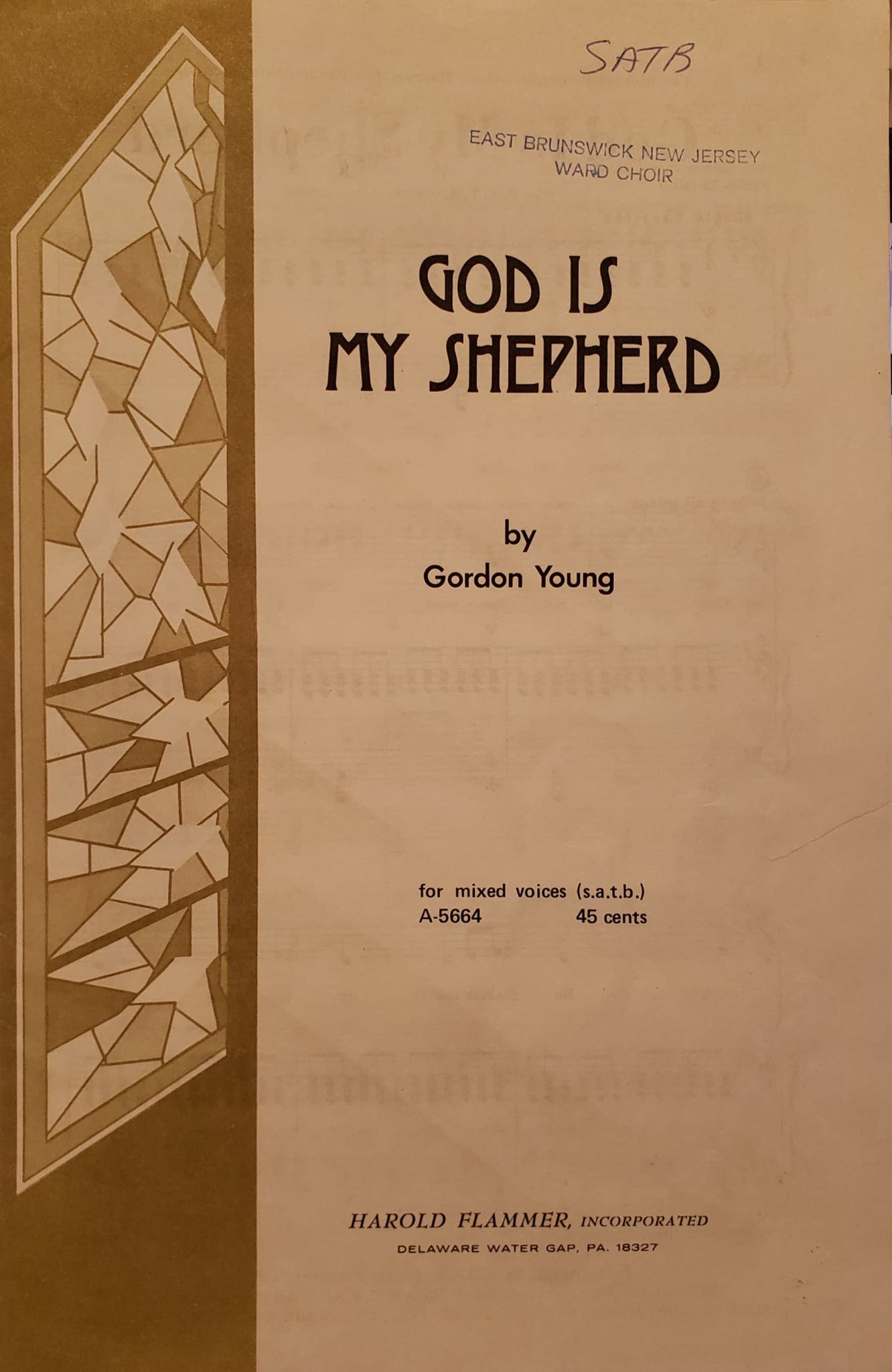
When I hear the 23rd Psalm and envision myself walking beside still waters and lying down in green pastures, I do not think of triple-forte fff. But exultation is the spirit of Gordon Young’s arrangement of The Lord Is My Shepherd.  Mom had been working her way through her filing cabinet stuffed with choir music—hundreds of pieces—keeping her favorites and tossing the rest.  As she began plunking the allegro maestoso introduction on the piano, the music and the memories drew me irresistibly down the stairs and across 45 years to the church choir where I learned to sing under Mom’s enthusiastic and competent direction.  I stood behind her now, put aside my usual inhibitions, and belted out “God is my Shepherd. I shall not want.” from memory.  Mom pounded out the triplet eighth-note chords, and this 57-year-old returned to 12 and sang the melody.  Abruptly and appropriately subdued to meno mosso, I walked through the valley of the shadow of death, very temporarily, for I need fear no evil with my Shepherd with me, providing comfort, preparing my table, and anointing my head with aromatic oil.  I confess that my cup ran over as the music washed over me and the song neared the fortississimo fff promise of dwelling forever with the Lord.  Suddenly very happy, I thanked Mom for the break from my work, climbed the stairs to my home office, absorbed in emotional echoes of musical memory, and sat at my old desk to write, grateful to my Shepherd.

Courage at Twilight: Pianos

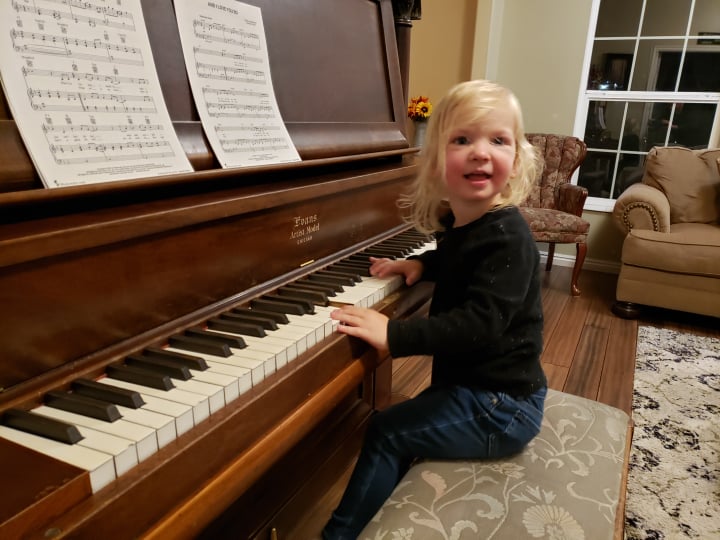
My daughter Hannah came to stay the night with Mom and Dad and me. We baked mince pies and banana chocolate chip muffins; we watched an episode of the delightful new All Creatures Great and Small; we birthday shopped around the valley; she played Mom’s baby grand piano.  When she began to play on Friday evening, Mom and Dad both quietly stood from their family room recliners and shuffled into the living room to hear her play, so beautifully, Clair de Lune, by Claude Debussy.  Her touch and phrasing added to the piece’s natural sublimity.  After baking on Saturday morning, Hannah played piano variations of our Church’s sacred hymns.  Dad, stepping down the stairs in time to give her a good-bye hug, praised her: “I heard and loved every single note you played: so pretty.”  I took piano lessons until I was 17, mastering Debussy’s Girl with the Flaxen Hair, another of history’s most beautiful compositions.  Practicing on the New Jersey baby grand was sometimes painful for the other family members as I struggled hundreds of times through difficult passages.  Hannah’s mother found a 1911 upright grand, which had survived a fire and been dropped on a corner, for $500, and I plunked its keys for over 20 years.  On that piano I dreamed up dozens of lullabies: gifts to my children.  I have told the story of their composition elsewhere on this blog.  Living now with Mom and Dad, for some reason I do not play the piano.  Perhaps the thought of creating music is a gray shadow of older years when my heart carried music.  Perhaps I have lost my touch and talent.  Perhaps I am emotionally empty.  But one evening Mom asked me to play.  I felt somewhat startled, both at the thought of playing, and at realizing I had not played for six months.  I sat down with my lullaby book and played and sang the old songs that opened my heart then and now.

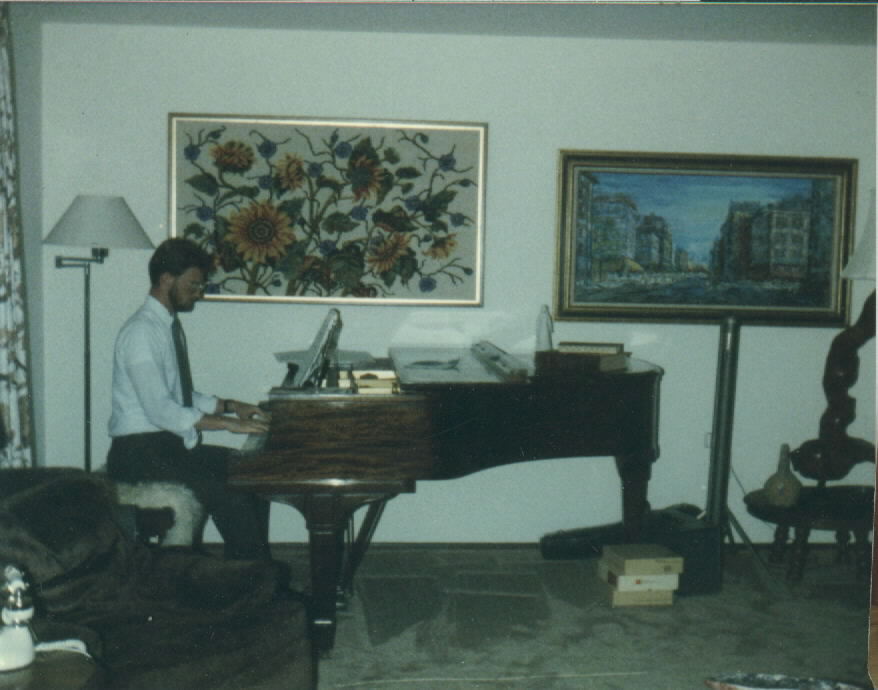
Pictured above: Yours Truly playing the piano in about 1986.

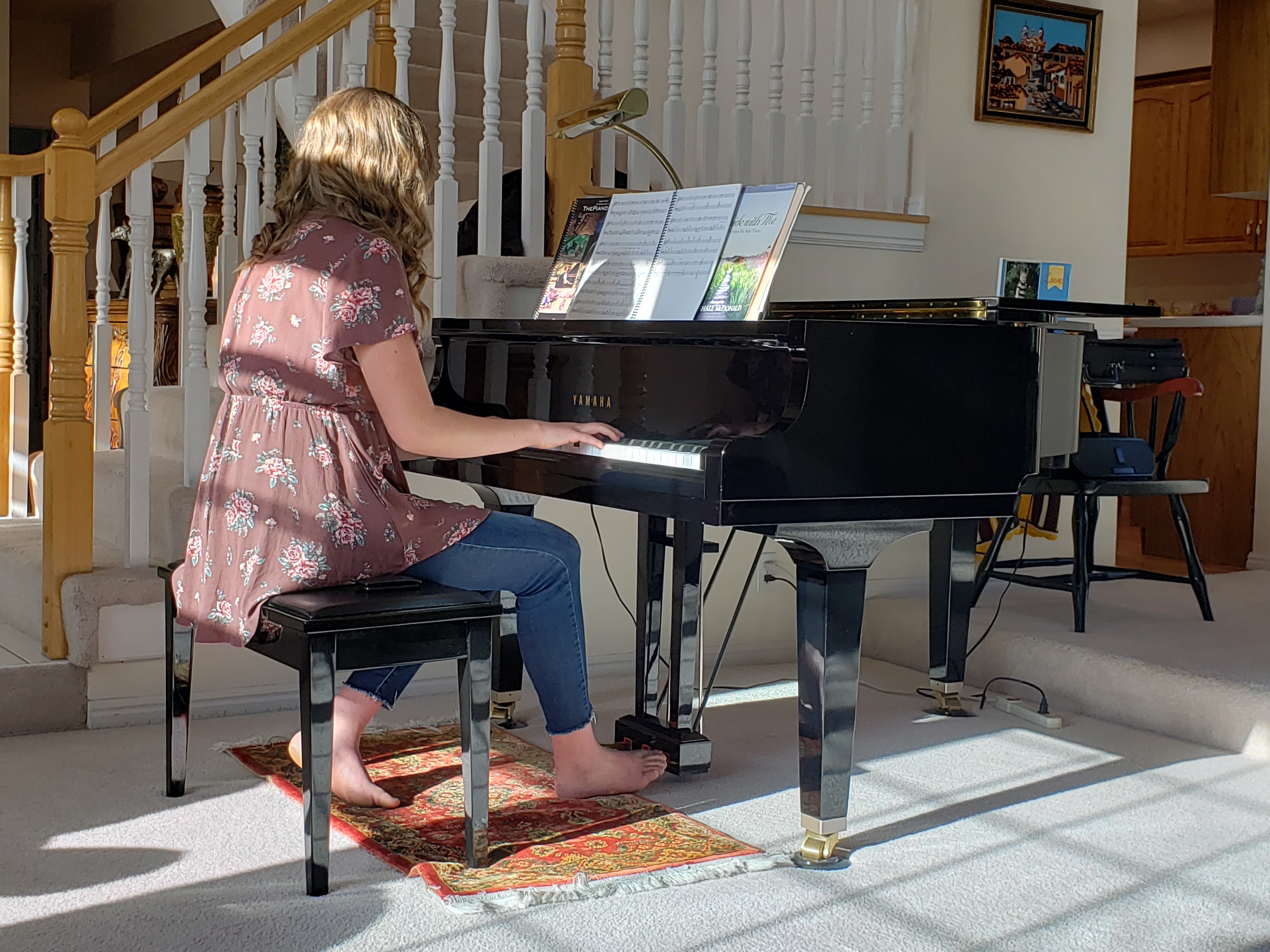
Pictured below: Hannah and Lila recently playing Mom’s baby grand.  My grandmother Dorothy played the piano, as does Mom.  If Lila learns, she will be the fifth generation of pianists in the family.

Courage at Twilight: The Joy of Violins

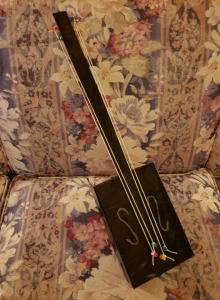
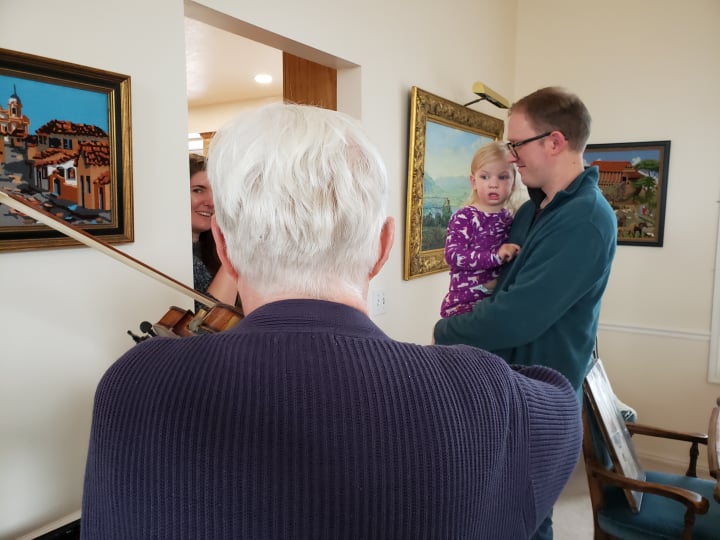
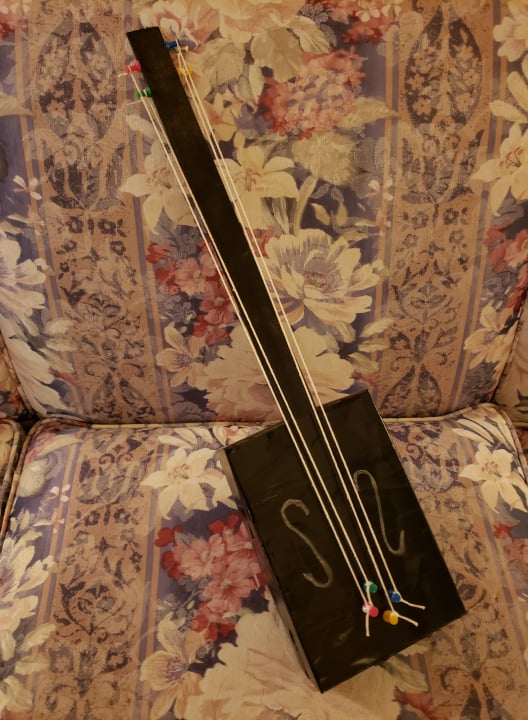
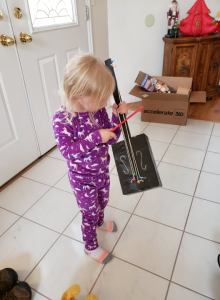
Mom’s elementary school music teacher Mr. Jeppesen hosted a music open house to which he invited all the children and their parents. One by one the teacher brought each child, including Mom, a 4th grader, to the piano where he sat.  “He was an older man, shorter, kind of hunched over.  He was a very good pianist, and he was very kind to me,” Mom remembered with fond appreciation.     Jeppesen plunked a few notes on the piano, and asked Mom to sing them.  The teacher then told Mom and her parents that she should play the violin.  Her father, Wallace, agreed, and took Mom to the music store to buy a very used violin, still at considerable expense for the struggling family.  Mom was a slight child, and the music store employee suggested a half-size or three-quarter-size violin.  Wallace said they would take a full-size violin, which is what Mom learned to play on, and grew into.  “We lived way out in the country, with no cultural advantages,” Mom explained about her joy to be playing the violin.  Sometime later, when Mom needed a better violin, Wallace found her one.  This is the violin she grew up with, played at the University of Utah, and took to Brazil in 1972 when she and Dad led a group of about 100 Church missionaries for three years.  At the end of their mission, they packed the violin in a shipping crate with other belongings, but upon opening the crate in New Jersey, the violin was gone.  The family pooled resources for Mom to purchase another violin.  With that instrument, she played in several community orchestras, including Highland Park (NJ), Bound Brook (NJ), Washington Square (NJ), and Murry (UT).  Covid-19 canceled rehearsals and concerts, and put an end to Mom’s public career.  She pulls out her violin once in a while, like during the Christmas holiday.  My granddaughter’s parents suggested Lila might like a violin, so I made one for her out of a cracker box, a yard stick, packing tape, spray paint, thumb tacks, and string.  And she loved it.  Pretending to stroke her strings with a red soda straw, Lila stood entranced as Mom played her real violin to her little great-granddaughter.  Mom just may have inspired another generation of Baker violinists.
Courage at Twilight: Putting Away the Lights

Mom announced it was time to bring in the pine wreaths and Christmas lights. Being the second week of January, I suppose she was right.  The temperature dropped quickly as the sun dipped behind the Oquirrh mountains, and I got to work.  I gently pulled the light strings off the bushes and rolled them into balls.  Dad and I had wrapped each plug in black electrical wire.  He was quite proud that the lights did not short out even once in six weeks of rain and melting snow.  Now, I unwrapped the brittle black tape and rolled the strings into balls, stowing them in the light tote, consigned to the basement until next November.  Coiling the extension cords came next.  As I worked in a race with the fading daylight and growing cold, my angers and jealousies and heartaches crowded in upon my mind, shouting their false and hostile narratives.  I did not feel strong enough to change my self-talk, and shifted tactics.  I begin to sing, standing there on the busy street corner coiling lights.  Not just any song, but a song that could chase away my dark thoughts and replace them with light and tenderness.  I sang the beloved children’s primary song, I’m Trying To Be Like Jesus.  I know only the first verse, so sang it again and again and again, shutting out the dark voices.  I was able to finish my chores and enter the house with a smile.  Here are the lyrics:

I’m trying to be like Jesus.  I’m following in his ways.

I’m trying to do as he did in all that I do and say.

At times I am tempted to make a wrong choice,

But I try to listen as the still small voice whispers:

Love one another as Jesus loves you;

Try to show kindness in all that you do;

Be gentle and loving in deed and in thought,

For these are the things Jesus taught.

Courage at Twilight: Here We Come A-Caroling

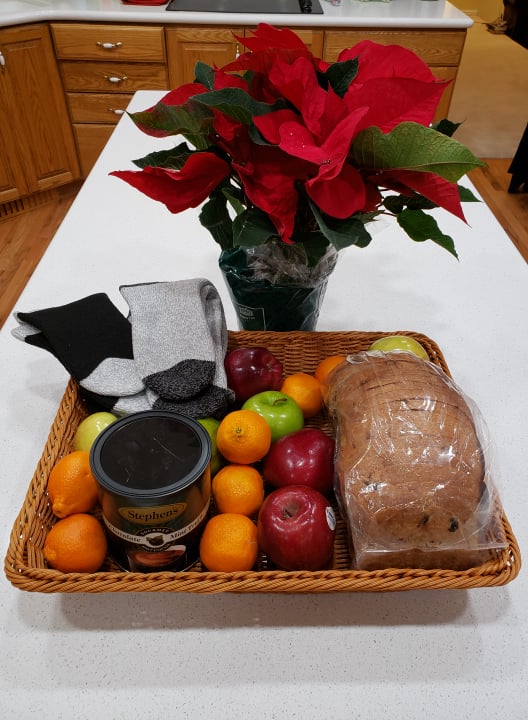
“Can we come around 7:00?” she asked.  “That would be lovely,” I answered.  And they came, on a very cold Tuesday night, a small group of church youth with their leaders—two young women and two young men.  “Merry Christmas!” they cheered.  Mom and Dad brought them into the living room, where the group sat visiting on the sofas.  The leaders sparked up a Christmas carol, and the youth sang in shy murmurs.  Until Mom joined, that is.  Though the youth came to serenade her, she jumped right in with her cheerful choral charisma and had the small group singing enthusiastically.  After half-an-hour of caroling, the group called again, “Merry Christmas!” and filed out the door, Mom and Dad waving, everyone happier for the visit.  “We had so much fun,” Mom beamed when I came home late from work.  The youth left a beautiful gift basket with a poinsettia, various fruits, a loaf of Great Harvest cinnamon-raisin bread, Stephen’s mint truffle hot cocoa mix, and two pair of warm winter socks.

Courage at Twilight: Christmas Orchestra

To prepare for the musical program at our church’s Christmas services, Mom’s friend Tamara organized a church orchestra from neighborhood musicians.  Mom has played the violin since elementary school, and plays still.  She played in the Murray Symphony, a community orchestra, until age 80, when Covid-19 ended all rehearsals and performances for a year and a half.  The family loved supporting her at concerts, cheering and taking photographs.  At age 82, Mom has decided the rehearsal schedule, the walking, the sitting, and the ornery conductor are just too hard, and she resigned from the symphony.  But she is thrilled to be part of the church Christmas orchestra.  Tamara and her husband Mike pick her up for rehearsal every Sunday afternoon at 3:30.  “They are just so nice,” Mom reported.  Tamara delivers Mom the music she needs, and looks carefully after her.  Mike helps her walk to and from the car, and carries her violin.  I am so happy for Mom to be playing her violin again in an orchestra, and to exchange greetings and rub shoulders with people she loves.  And I am so grateful for kind people in the world who make all the difference, as Mike and Tamara are doing for my cute, sweet, 82-year-old musician mother.

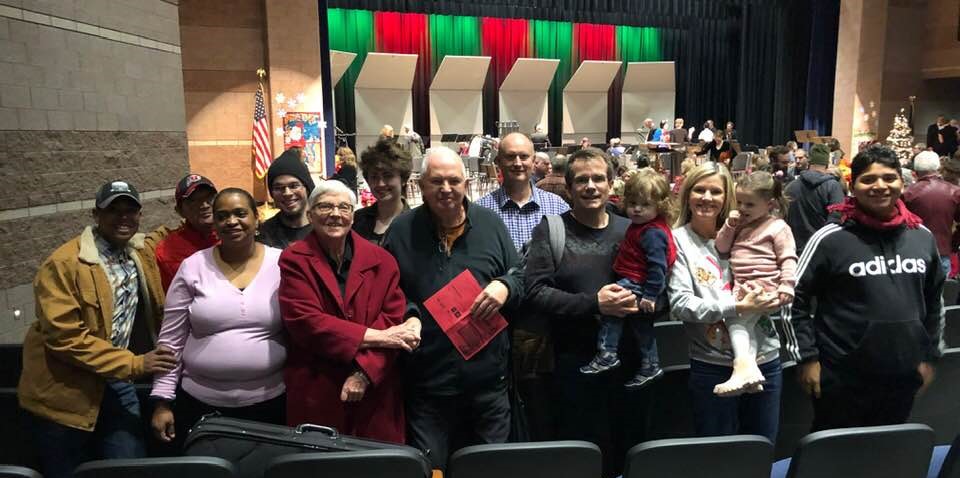
(Photo features Mom in her red coat, at the last concert performance of her career, in December 2019, with Dad and admiring family and friends.)

Courage at Twilight: Cooking to Music

Having recovered from my last exhausting cooking experience, I resolved to cook a nice Sunday dinner for Mom and Dad.  Mom sat in her recliner, reading the Sunday New York Times, listening to music in the family room: a home-made CD of Mom’s church choir performances.  Dad decided to rest in the living room, reading Michelle Obama’s excellent memoir Becoming, playing his daily Johnny Mathis.  The kitchen is situated in between.  I attempted to review Julia Child’s cooking instructions, with “Count Your Many Blessings” in one ear and “99 Miles from L.A.” in the other.  Unable to read, I put the book away and attacked the recipes from memory.  Cooking Julia’s French recipes has become easier with practice, I guess, because I had dinner ready in good time: sauced fish poached in white wine; creamy garlic onion mashed potatoes, steamed broccoli, and sliced cucumbers.  Practice is also helping me refine the textures and flavors for a more pleasurable outcome.  Mom and Dad agreed the meal was a triumph.  But now I am tired and do not want to cook for another week, knowing I will be hungry tomorrow.

Courage at Twilight: Begin the Beguine

After years of listening to Heitor Villa-Lobos music during his late-night reading, Dad abruptly shifted to Johnny Mathis. Seventeen tracks repeat every night.  Amazingly, I know all the songs—I heard them on the radio growing up.  And I learned to like his iconic voice.  The CD insert did not include the song lyrics, so I offered to print them for him, from the internet.  “You can do that?” he asked.  “Of course,” I answered, feeling smart.  I pasted the lyrics of the 17 songs into a Word document and handed him the stack of pages half an hour later.  He was impressed.  The next morning, however, he told me how disillusioned he felt with the song lyrics, which included a lot of “baby baby” and “I need you” and “our love will never die” stuff.  I expressed my experience that while popular lyrics are often shallow, the music and the feeling can still be quite moving.  Some lyrics are quite romantic and sweet, like in Cole Porter’s Begin the Beguine, the beguine being a slow rhumba-like French dance.  In the song, the commencement of the beguine dance music conjures powerful feelings of love and romance for the dancing couple.  From my home office one morning, I felt tender feelings as I heard Dad’s gravelly waking voice singing Begin the Beguine to Mom, his sweetheart of 60 years:

Let them begin the beguine, make them play

Till the stars that were there before return above you,

Till you whisper to me once more,

“Darling, I love you!”

And we suddenly know, what heaven we’re in,

When they begin the beguine.

Courage at Twilight: Reading with Villa-Lobos

Dad’s hobby is reading.  He is the smartest man I know, reading biography, theology, philosophy, history, fiction, science, etc.  He indulges his hobby from 10:30 p.m. until at least 2:00 a.m., every night.  One night’s literary fare may be the Book of Mormon, the Bible, or other scripture.  Another night may be The No. 1 Ladies Detective Agency novels or Rumpole of the Bailey stories.  Often he reads the World Book Encyclopedia, the next day telling me everything he learned during the night.  Did you know nectarines spontaneously appeared on a peach tree in China over two millennia ago?  Other days he reads books his children gave him for his birthday or Christmas, when book gifts are a sure thing.  During those late-night reading hours, Dad listens to the music of Brazilian composer Heitor Villa-Lobos, particularly his Bachianas Brasileiras (my translation: Brazilian musical pieces after the manner of Johann Sebastian Bach).  Having been a missionary, post-graduate student, minister, and international lawyer in Brazil, he loves Brazilian music.  And he loves the Brazilian people.  In 1971, while finishing the sweat equity on the new Baker house in New Jersey, a cassette tape of the Bachianas kept him company.  At a particular point in Bachiana No. 7, an electrifying sensation suddenly swept through him, a visit from a spiritual plane, and he knew somehow that he would be asked the following year to take his family to Brazil to oversee the Church’s missionary work.  The impression came to pass, and our little family went to Brazil for three years— I was eight years old.  I, too, love the Brazilian people, and the food, and the language, and the music.  Villa-Lobos—what a cool-sounding name—and it has a fun meaning as well: city of wolves.  Heitor City of Wolves.  Bachiana No. 7—at counter 16:55 in the Tocata/Desafio.  World Book Encyclopedia: N for Nectarine.  Two a.m. and all is well.

Courage at Twilight: Immersed in Music

Music is always playing at Mom’s house.  As a boy, I awoke on Sunday mornings to the sounds of Bach and Brahms and Beethoven filling the house.  I associated music with Mom, and with home.  On my 15th Christmas, she introduced me to Aaron Copland, whose music was the first to stir my soul in otherworldly ways.  I learned to change out dull needles and set the stylus on the vinyl track I wanted to hear.  Now, instead of one side of an LP, she places five CDs in the player, and pushes play for five concert hours.  I hear the bossa nova of António Carlos Jobim, Von Williams’ Fantasy on Greensleeves, the symphonies of Mahler and Janáček, Copland’s quintessentially American ballet scores, Bartok’s concerto for orchestra, Barber’s concerto for violin, the virtuosic guitar suites of Villa-Lobos, Arty Shaw’s swinging clarinet, Sergio Mendes and Brazil 66. . . .  I love them all.  Her collection has inspired my musical loves, and I have lately expanded her eclecticism with Ceumar, Tó Brandileone, and Cainã Cavalcante, brilliant contemporary Brazilian artists.  Music has some mysterious power to move us and to fill the corners of the spirit reason alone cannot seem to reach.

Courage at Twilight: Choir Practice

When church services ended, Mom led me to choir practice, held in the home of a neighbor.  The director was thrilled to have a new bass, and gave me a choir folder with my name on it, filled with favorites like Come Thou Fount of Every Blessing, Consider the Lilies, and John Rutter’s I Will Sing with the Spirit.  Mom was the ward choir director when I first started singing at the age of 12 in our New Jersey ward.  I learned from her so much about the beauty, complexity, and dynamics of choral singing and conducting.  She held this position for nine years.  In my forties, I was asked to direct the choir in my Utah ward.  I borrowed Mom’s choral music library, cleared the mental cobwebs, and put to work all the knowledge she taught me decades before.  At the same time, I sang in a wonderful Salt Lake City community choir, learning even more.  I have not sung with the church choir for a long time.  While choral singing can be uplifting and therapeutic, too much pain kept me away from people for too long.  I am happy to be singing again in the ward choir.  And as Mom expressed in choir practice today, “I am so grateful to be singing.”  Amen.

Courage at Twilight: Off to Church

We drive 200 yards to church—walking is just not an option.  I belong to the Church of Jesus Christ of Latter-day Saints.  First, a little context.  Our local church units are called wards.  The ward one attends depends on where one lives.  So, moving from Tooele to Sandy, my church record was transferred from the Westland Ward to the Crescent 18th Ward.  A bishop presides over each ward.  Every ward member is given the opportunity to contribute to the ward’s functioning (e.g., teaching youth classes) and to minister to the ward’s members.  All ward members serve voluntarily, without pay.  My first Sunday in the new ward, the bishop stood at the pulpit and invited to stand, telling the congregation of several hundred that I was new to the ward, and that I had moved in with my parents to help take care of them.  As I stood up, I resisted the almost irresistible urge to tuck in my shirt and pull up my slacks.  I am what I am; let them see me.  I felt the unusual nature of my situation: an older single man moving in with his octogenarian parents.  And I was sure Dad felt chagrined and being identified publicly as needing to be “taken care of.”  But these are all good people, many of whom approached me after the meeting to welcome me enthusiastically into the ward.  “I’m Brad.”  “I’m Ann.”  “I’m Bishop Callister.”  “So glad to meet you.  Your parents are such wonderful people.”