Tag Archives: Memoir

The Dementia Dossier: Silk Pie

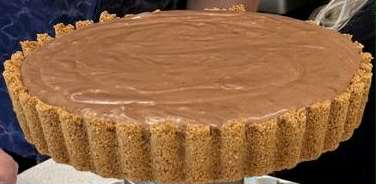
French silk chocolate Nutella cream pie in a toasted graham cracker crust.  Ahhhh.  “This is very possibly the most amazingly delicious thing I have ever tasted,” praised my son Brian at my birthday celebration.  Not wanting to ask anyone to bake or buy a birthday cake for me, I had made my own, this luscious French silk chocolate Nutella cream pie in a toasted graham cracker crust.  Everyone loved it.  I could eat only a small taste because of how the sweet aggravated my searing sore throat.  After the party, a plate with half the pie went into the fridge for Mom and me to enjoy later.  I’ll have a slice for my lunch tomorrow, Mom said.  I invited her to help herself to as much as she liked, only save me one piece, because I had labored two hours to make the pie and wanted to enjoy just one more slice when my throat felt better, despite dieting to reduce my sugars.  And later in the week I was ready, my throat feeling great, my sugar intake dramatically decreased, ready for my last piece of silky smooth sweet.  On opening the fridge, I found the plate gone.  Mom, where is my pie?  I told you to enjoy as much as you wanted but to save me just one piece.  Do you remember I told you that?  Just one piece?  Confusion clouded her face as she mumbled, I guess I forgot.  I’m sorry.

The Dementia Dossier: The Calendar

Mom’s weekly hand-drawn poster-sized calendar is taped to the pantry door. I have learned to take quick initiative each Sunday evening to write my commitments on her calendar in order to avoid her gentle badgering to write my commitments on her calendar.  She is smart to keep this calendar, because my explanations of events and dates and times quickly confuse and overwhelm her.  As I wrote on this week’s calendar, she called from her recliner, “What did you put on the calendar?”  I wanted to answer, What’s the point of me writing on the calendar if you’re just going to ask me what’s on the calendar? Why don’t you come and take a look for yourself at your calendar?  She persists: “What did you write in green?”  I opened the pantry door to show her, but she cannot read her poster from that far away.  I sighed.  “Tomorrow.    7:00 p.m.  Planning Commission meeting.”  That’s tomorrow?  Wednesday?  “Yes, Mom.”  And the next night is the police department awards banquet, so I’ll be home late two days in a row.  That one is written in fuchsia.  I am slow to understand that her mundane uneventful daily routine means everything to her sense of stability and calm.  Disruptions in daily the routine destabilize and frighten her.  Add to this her loneliness.  “I’m sad you’ll be gone,” she laments.  “I will miss you.”  And this time I actually do verbalize to her how inadequate a roommate I am for her, and how sometimes she becomes so clingy that I want to pull away.  “I’m sorry, dear,” she whispers, defeated.  Not only have I disrupted her routine with my green and pink events, but I have made her feel small and ashamed in her loneliness.  She needs a better roommate.

The Dementia Dossier: Toss It

Mom and I remain proud co-recyclers, filling our kitchen recycling bin with cans and bottles and newspapers, and emptying the bin into the two giant green street cans sitting in the garage.  Stepping down the two stairs into the garage is getting harder for Mom, even with the railing and grab bar.  Instead of carrying a 12-pack Coke Zero box to the green cans, or a shoe box, or a cereal box (which don’t fit well in the kitchen bin), she merely throws the box toward the green cans, where the boxes sit on the garage floor waiting for someone—I can’t imagine who—to pick up.  “Mom,” I remonstrated, “just put the box on the kitchen counter, and I’ll take it out.  Don’t just toss it into the garage.”  She apologized sheepishly, explaining that she just “got lazy.”  I do acknowledge the sheer carefree liberation of tossing a box toward the can, released from the effort and duty of depositing the box in the can, and the moral certainly that someone will place the box in its proper place for street curb pickup and saving the rainforest.


Image by Clker-Free-Vector-Images from Pixabay

Courage at Twilight: The After Words (Forgiveness)

My final (and 500th) entry in Courage at Twilight touches on forgiveness, which I hold to be the most powerful transformative life force in the universe.  As awesome as are the creative cosmological forces of nature, like black holes and supernovae and spiraling galaxies and evolution, the force of forgiveness is what exalts the human soul, both in the giving and in the receiving.  Living 1,262 days with caregiving and hospice provided ample opportunities for hurt and misunderstanding all around, and hence for forgiveness.  My siblings have been extraordinarily kind and forgiving as I have cared sincerely but imperfectly for their beloved father and mother.  They love and accept me even in the midst of my missteps.  They forgive.  My mother forgives me when I lose patience with her deafness and confusion, seeing me always as her darling boy.  In my father’s new life sphere, he understands me fully and pierces the mists of my depression and fear: he forgives me all my trespasses.  For you to whom I have been insensitive and for whom I have not been fully present in love, I desire your forgiveness.  This life is not designed for perfection, but for struggle and growth.  In any event, perfection I cannot do.  But I can do the work of life, and I will, forgiving myself along the way.

(Pictured: flower meadow beneath Mount Timponogos, Utah, a favorite hike of Dad’s and of his children and grandchildren.)

Courage at Twilight: The After Words (Privilege)

For every day of this caregiving experience, I have been conscious of the blessings, the resources, the benefits, the privileges that shaped and enabled the experience.  By “privileged” I simply mean to indicate our relative place on that vast spectrum of personal resources, our being somewhere in the in-between of those with tragically few resources and those with unnecessarily huge resources.  My caregiving experience, and my father’s and mother’s experience as the cared-for, undeniable was shaped and even determined by our relative resources.  My father’s pension allowed us to hire private-pay home health care and hospice, which sent aides for two hours a day, seven days a week, including holidays, for the last two years (about $30,000 per year).  To be sure, the costs ate away steadily at my parents’ savings, but the fact remains that they had savings, whereas many do not.  Not having this resource would have made my caregiving experience impossible, at least for me.  Add to our privileges the ability to purchase a $14,000 chair lift for the staircase.  While the lift was a major hit to our budget, we had the budget.  Add the blessings of medical insurance, prescription insurance, and social security.  Include the allowance I was given to work a flexible work schedule, which enabled me to cook healthy from-scratch meals from fresh ingredients.  While I am only a small-town government lawyer, my professional knowledge and social clout did clear obstacles others struggle to break through.  Our relative privileges do nothing to reduce the legitimacy or reality of my experience and my story.  But they do shape that story.  A lack of these resources would have dramatically altered the experience, and dramatically multiplied the stress and trauma, and I acknowledge the difficulties faced by persons with fewer resources.  I am not a community organizer, and offer no social solutions, but I am aware of some of the challenges and struggles faced by many.  It may be a cop out to say I would not have been up to the task without our resources, but I fear I would not have been up to the task.

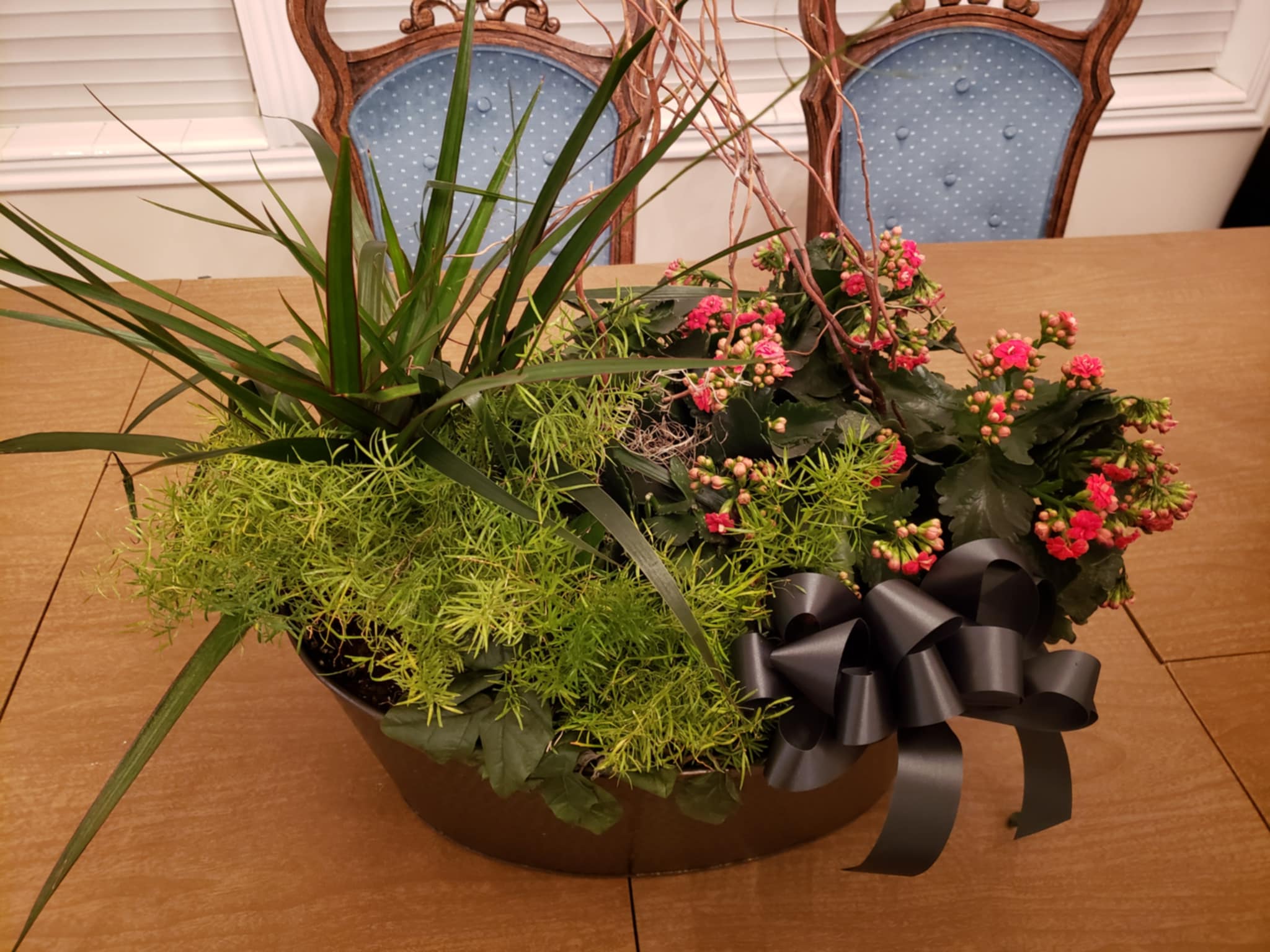
(Pictured: funeral planter from the Tooele City Mayor and City Council.)

Courage at Twilight: The After Words (Grief)

Three years ago, the thought of my father’s death terrified me.  Today, his death seems natural and necessary.  I feel no grief, only weariness, the fatigue of daily trauma settling deeply in, the after-crisis drain.  The desire to sleep and sleep and never wake up.  I have studied grief, and taught grief, and workshopped grief.  I have grieved my father’s dying for the three-and-a-half years before his death: an anticipatory grief; a preparatory grief; a preemptive grief.  Lorry reminded me, however, that the grief will come, in all its aspects, the anger, the regrets, the deadening sadness, the looking around wondering why he is not in his recliner reading the encyclopedia, the wishing we could talk again and the wondering about why our talking was so hard, reminded me that I need to give myself the permission and the space to feel every part of it.  I am not sure such wrenching grief will come.  For now, I am balancing the compassion fatigue and saturation trauma of caregiving against the fact of loss, wanting just to sleep, and finding a sort of macabre triumph in knowing that I stepped into the battle: I responded to every need, every day, for one thousand two hundred sixty-two days, imperfections and weaknesses and all.  And I am deeply grateful for all of you who helped.

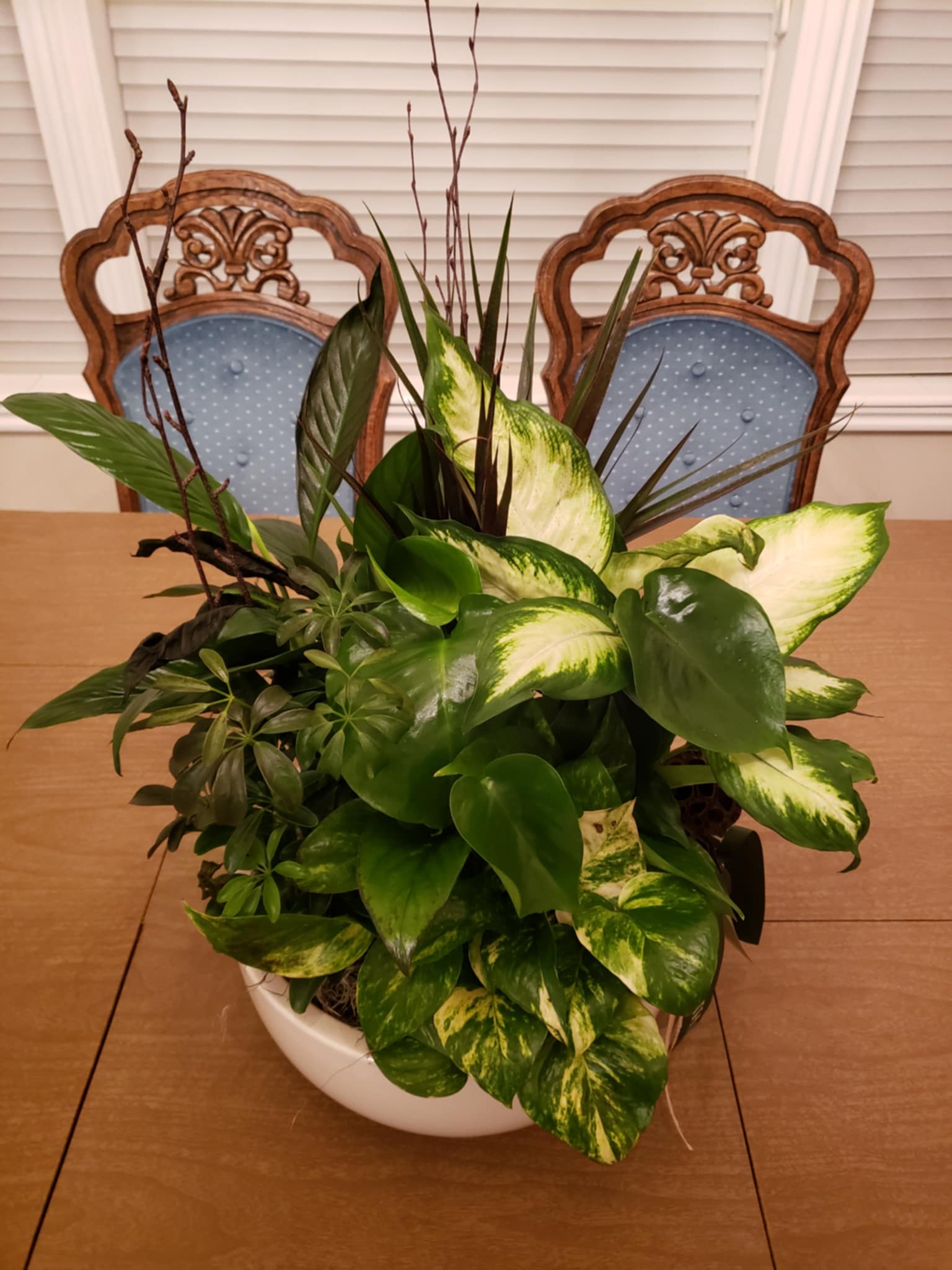
(Pictured: a funeral planter from the church choir.)

Courage at Twilight: The After Words (Guilt)

I feel no guilt in the enormous relief I find in being freed from witnessing and absorbing the accumulated daily traumas of Dad’s last three years of life with paralysis and pain.  My struggle with guilt will settle in, however, as I contemplate my struggles to be happy and cheerful—and failing—in my care responsibilities, in my silences and avoidances, in my angry and impatient outbursts and imperfect sensitivities.  My resentments, certainly, were not Dad’s fault, but rather haunt me as beacons of my own depression and selfishness and lack of resilience.  Still, I am determined to not be sucked into to the vortex of guilt, the shamefaced guilt which will come if I measure my imperfections instead of honor my humanness.  The facts remain that I offered to the endeavor all my energies, gave all my love and found a little more, persisted through the difficulties, and prevailed.  Our objective was for Dad to live and die in his own house, comfortably, happily, well-fed, in good company, with his books, with his wife and sweetheart.  And we did it.  We overcame.  We prevailed.  We protected.  We cared.  We endured.  We loved.  For Dad.  For Mom.  For family.

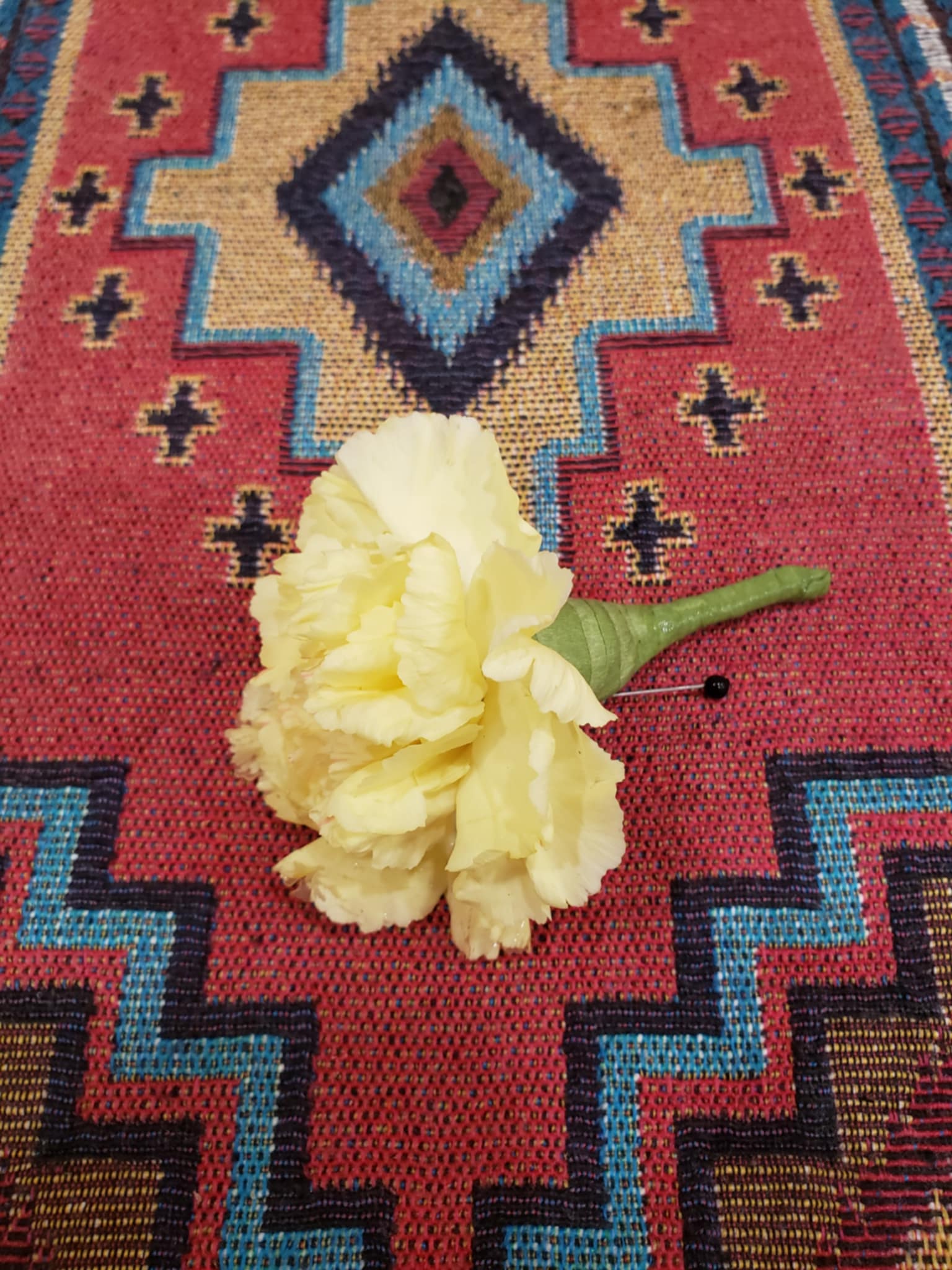
(Pictured: the funeral boutonniere.)

Courage at Twilight: The After Words (Loneliness)

We, my brother and sisters and I, navigated a week of days too filled with tasks to feel much grief—writing an obituary that attempted to summarize in two pages the long life of a great man—preparing a funeral program involving dozens of family members—writing a funeral talk I did not want to write—the mortuary checklists—settling affairs of estate—hundreds of texts and emails and messages to and from those who knew and loved him—the trickles and gushes of people through the house—all the standard tasks, which we were determined to perform in an exceptional manner.  Mom will be lonelier now, without her husband and friend of 65 years.  She will not hear him say as she sidles past his hospital bed, “You’re just the most wonderful wife, Lucille.  I love you.  We’ve been married 62 years.  When you walk by, I’ll give you a hug.”  I will not hear him exclaim “Roger!  Welcome home!” and “What a gorgeous dinner, Rog!  I just love steamed vechtables!”  Walking the grocery store aisles, I passed the zero sugar mint patties, the deluxe mixed nuts, the lidocaine foot lotion, the Brussels sprouts (Mom hates them), and no longer put them in the cart.  And, I felt the wrench of good-byes anew when I handed to the thrift store attendant the bags stuffed full of shoes and socks and shirts and sweats and suit coats and hoodies.  But our grinding struggle is over, and Mom will experience her widow’s aloneness with a new measure of calm.  A neighbor asked Mom how she was feeling, and she declared, “I’m so happy for my husband.  He’s not paralyzed or sick anymore.  He can run and jump and play.  He’s with Sarah, and with his mother, his father, his sister Louise, and all the rest.”

Courage at Twilight: What a Reunion

Fifty years.  These men and women, all in their 70s now, graying and wrinkling, limping and slowing, still loving and laughing, traveled in their 20s to Brazil, sent by their Church to be proselyting missionaries, to share a gospel message of love and spirit and Christ, of pure living and eternal families and love of God, with the people of 1970s Brazil.  Dad began his three-year unpaid tour of duty as their 36-year-old leader, mentor, and president, Mom by his side, their oldest child (me) only eight, with Sarah’s infant arrival imminent.  Now these mature men and women gathered at Mom’s and Dad’s house, sixty of them, seated in tight rows and listening, and Dad did not disappoint them.  I sat in the back with Megan, with my head in my hands, weary from the day’s setting-up, listening to all his old stories for the three-dozenth time, and looked up to see his audience enrapt, admiring, joyful, reliving the old stories, which are true, after all: the story of Maria who during World War II kept her tithing in a glass jar buried in her back yard, delivering the coins to Dad, himself a young missionary in 1957, and receiving from him a receipt for her widow’s mites; the story of Dad translating for a living prophet of God who greeted, became acquainted with, prayed for, laid his hands gently upon, and quietly healed each of the twenty sick and distressed Church members, one at a time, who awaited with faith his blessing; the story of Dad’s impression that all persons he contacted on this particular street would answer, “Yes—please come back and share your message with my family,” and they did; the story of priests who had Dad arrested in 1958, and through the iron bars his cell Dad told the prison guard he had arrested a minister of Christ, and the guard growled, “Prove it,” and Dad replied, “Pull up a chair,” and preached of Christ and his ancient Church restored in our day, with living prophets and apostles, preached for three hours until the prison guard had to confess Dad was, indeed, a minister, and released him from his cell, and committed to reading holy modern scripture; another story of Maria, who cooked in an outdoor oven made of loose bricks and sheet metal, feeding the fire with straw, her thermometer the back of her hand, Maria who baked a cake for the missionaries on the first day of every month, and invited them to visit on that first day if they wanted a fresh cake, or later in the month if freshness was not a priority; the story of a second arrest, Dad again behind bars, the prisoner in the adjoining cell screaming as the guard wacked him with a rubber hose, and the voice of God whispering to Dad, Do and say exactly as I instruct, and you will be safe and let go. This is not a joke, and Dad followed that voice and demanded to see the warden and instructed the warden on the doctrine of Christ and on his calling as a missionary ambassador of Jesus, instructed further on unlawful imprisonment and bad press and police duty until the warden relented and released him and promised him the police would not harass the young missionaries again; and the story of persons who dreamt of church buildings they had never seen until accompanying Dad and his missionaries to Sunday services in the very church buildings of their dreams, be they a rented room or a remodeled house or a regular Church meetinghouse; the story of Arthur, an Italian giant, whose hard heart softened from flint to flesh over Dad’s fifteen years of gentle shepherding until Arthur finally went grudgingly to a Church meeting and cried like a baby and demanded baptism, now, not in two weeks—tomorrow—and who remained a meek and faithful Jesus disciple to the last of his long days.  Though I had heard these stories many times, Dad’s retelling was expert and touching, compelling even, as if this mission reunion might be his last, his final tender testimony of God’s miracles and of Christ growing his latter-day Church and changing hearts and lives.  Sixty sets of eyes moist with memories and the love of God and the love of sisterhood and brotherhood and Christ community.  I led the group in Dorival Caymmi’s classic 1956 swinging hit “Maracangalha” ending with “…eu vou só, eu vou só, sem Anália, mas eu vou…”  The reunion ended with plates of coxinha chicken croquettes and kibe beef croquettes  and pão de queijo cheesy bread balls and bom-bom candies and cups of cold guaraná soda and catching up on grandchildren and jobs and health and passings away and sufferings and joys and handshakes and backclaps, visiting until near midnight, the happiest of gatherings.


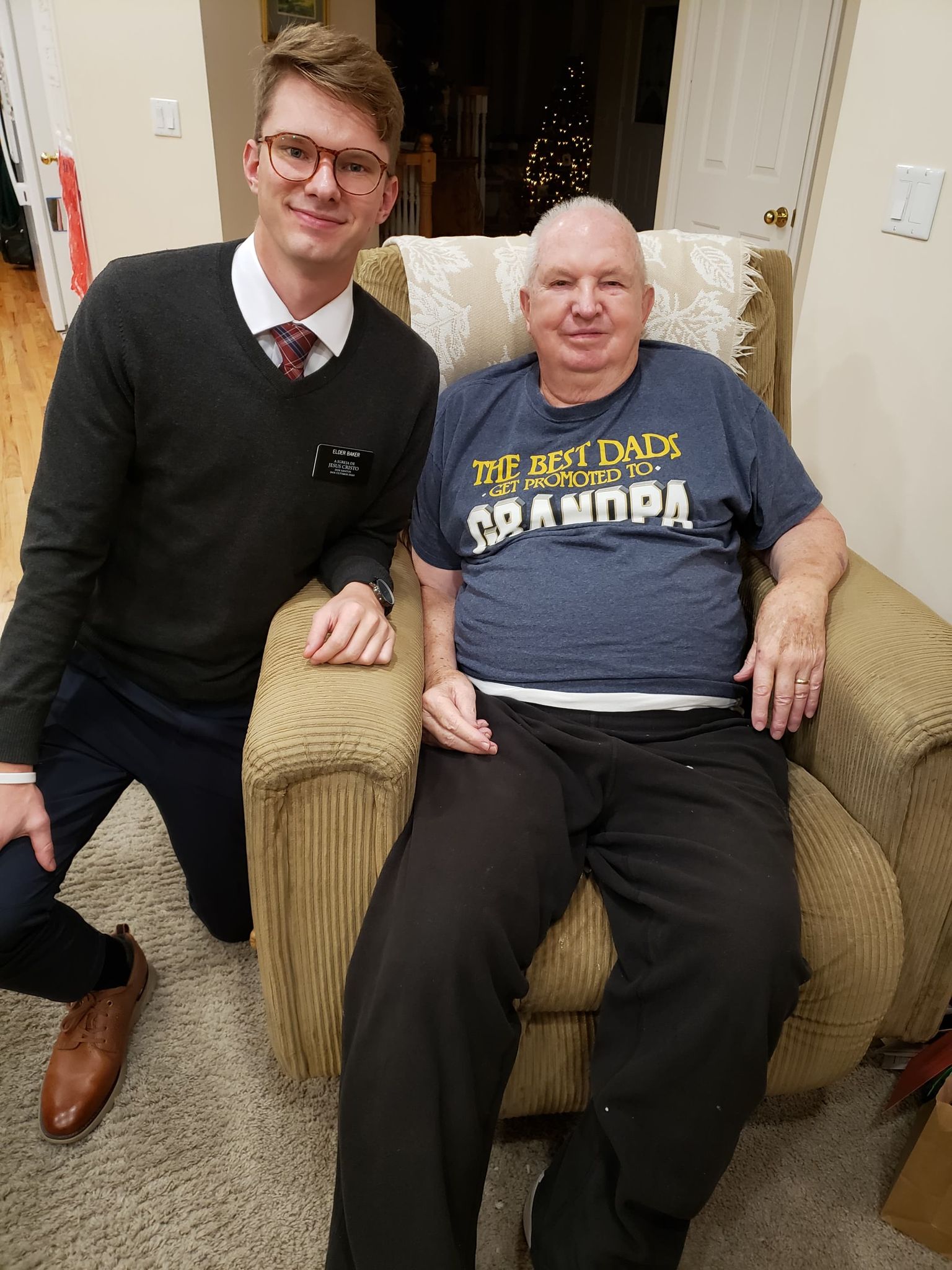
(Yours truly with my dear sister Megan)
Courage at Twilight: Welcome Home, Roger

Though Dad often cannot hear me shouting to him across the living room, he manages to hear the key turn the dead bolt, and before I have finished latching and locking the door, he is calling out to me, so cheerfully, “Rog! Welcome home, Roger!  It’s good to have you home!”  I’m not the brightest bulb in the box, but I’m pretty good at the light going on and showing me patterns and changes.  Dad has always welcomed me pleasantly home, but his greetings have cheered and lengthened noticeable almost three years into this caregiving experience.  And it is just like me to worry about the cause, and the meaning.  Might he be sensing the nearing of his end, and be making an extra effort to be kind and close and grateful?  Or is that just my mild paranoia?  On a Saturday morning, ratchet set in hand, I set about checking all the stair lift bolts for tightness; the bolts securing the brackets to the lift structure were tight, but the bolts anchoring the same brackets to the stairs were appallingly loose, and the sound of my ratchet doubling them down reached Dad’s ears.  What reached my ears was his worried complaint, “I hope he doesn’t break the lift.”  Poor Mom walked into the trap as she tottered over to me and reported, “Your dad wants you to know he’s worried you’re going to break the lift,” and I barked back at her, “I don’t care.  I know exactly what I’m doing.”  In tears she returned to Dad and ordered him to shut up, reminding him that I was a “big boy” and knew exactly what I was doing.  Of course, I soon apologized to her for barking at her, gnashing at the guileless messenger.  She smiled and teared and invited me to bark at her anytime I pleased (sweet thing), to which I retorted, “Never!  You deserve better.”  During dinner I explained to Dad what I had done to the lift, and he smiled weakly and seemed unconcerned, and he thanked me for dinner: “Roger, we are so lucky to have you make us such beautiful, delicious food for our dinners.”  All smoothed over, I guess.  My New Jersey friend Bruce was his mother’s caregiver for the better part of a decade, running up the stairs at her beckoning or at the slightest unusual sound.  He knows the life of sleeping with one eye and one ear open for anything out of the ordinary that might signal a need or a fall or a crisis or…  My eyes feel particularly tired this evening, and I think I’ll shut them early, though part of me will be on the alert until Mom and Dad are safely in their bed after midnight.  I am not a skilled caregiver, but I do live here with them and do cook and clean and fix and answer to their needful beckonings as best I can, and enjoy being welcomed home by my old mom and dad: “I’m sure glad you’re home, Roger.”

Courage at Twilight: Cousin Party

Jeanette has come to visit.  She came to lighten my load.  She came to visit and to love and to talk with her beloved ancient parents.  She came to lift and be lifted.  Before she came, she organized a cousins party.  “Come on Friday March 15 for pizza and brownies and lots and lots of games!”  And they came: the autistic, the trans, the straight, the atheist and the priest, the gluten-free and the vegan and the red-meaters, the married and the single and the living-together—they all came, and demolished five extra-large Costco pizzas and devoured an enormous platter of raw vegetables and cleaned off three heaping plates of frosted brownies, and they told stories and played a game matching clever memes with ridiculous photos and laughed and laughed and laughed, red-faced and crying and together, a group of cousins with several things in common, like the presence of their aunt Jeanette, and the absence of their aunt Sarah, and their love for one another.  One hermit-like cousin commented for only me to hear, “It’s so nice to be with people I actually like.”  Jeanette’s energy was electrically ebullient and conductively contagious, at the center of the circle, catalyzing their inertia into uproarious fun.  As the older uncle, I stood back and observed and rejoiced quietly in the transpiring of this knitting together of this grief-split generation.  I felt keenly the sting-throb of Sarah’s violent departure.  I saw no defect in the power of Jeanette’s presence, but merely the soft hole of Sarah’s absence.  The gathering, happy and healthy and hilarious, nonetheless occupied the crystalline comet-tail haze of Sarah’s gone-ness.  Dad motored into the room to bask in his posterity’s energy and mirth, but could not hear or understand the pop-culture drollery, and retreated to his recliner to rest and create his own quiet humor with Rumple of the Bailey and the Reign of Terror.  I followed, to help his rise and pivot and point and fall, hearing loud echoes of hilarity from across the house.  I felt sad for him, and I think he felt sad and lonely and resigned, but family is to him life’s great mandate, and I knew he felt mostly joy at the loving laughter of twenty cousins.  Mom accompanied Jeanette to pick up the pizzas, giving directions as she had done (without need) a hundred times, but this time Mom could not remember how to get there, and led Jeanette the wrong way, and the Costco was no longer in its tried and true location, and Jeanette showed her the map, and Mom looked up and cried because she could remember no longer that which she always has known, and she knew she was old and she knew she was losing her faculties, and there was nothing she could do about it.  We did find Sarah’s grave, though, and left in a crease of winter grass a brilliant bejeweled owlet with a poem inside, declaring “Do not look for me here.  I am not dead.”  Yes, actually she is.  But her essence, indeed, is not there buried under nine feet of dirt, but in my heart and my hope and my faith, and I will believe—tell me, why shouldn’t I?—that she sees and hears and cares and will welcome me that day when my turn comes.
Courage at Twilight: Reframing Life

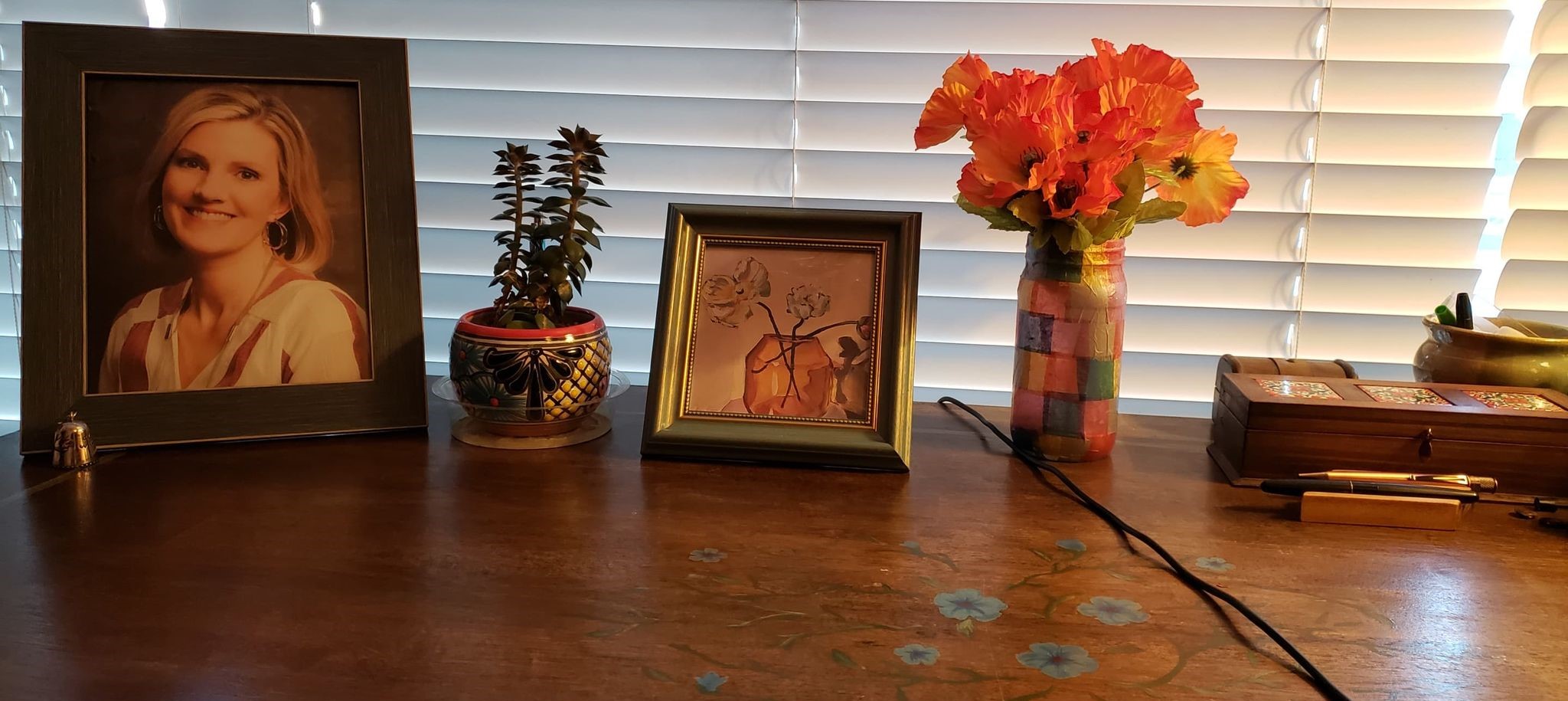
Across 30 months, and through 445 chapters in this memoir, I have been laboring to express the nature of my experience living with dying parents, how they have loved and irritated and blessed and taxed me, and how I have worked to keep them in their home and to care for them as they wane.  Sarah’s death was the most suddenly catastrophic and painful event of my 60-year life.  She looks at me kindly from her pastel blue-gray frame sitting on my desk, from behind the glass, always soft, always beautiful, always kind, to me.  Her traumatic passing has caused me to reevaluate my approach to love and family relationships, not in the shallow patronizing Western platitudes like “It must have been her time,” as if there were anything divinely ordained in her snow-blindness and bashing her helmeted head against a tree, or “You will grow from this, and become a better person,” implying I wasn’t a good enough person already, and somehow her death was for me.  Sorry—I don’t buy it.  What I do buy into is the pain and the sorrow and the memories and the dogged desire to be everything she believed I was and could be.  Something about sudden bone-crushing flat-smashing breath-sucking loss has a way of revealing stupidity and error, pointing me to a truer reflection of my life and myself.  And the notion occurred to me that I have travelled across 30 months and through 445 chapters in this memoir with perspectives that beg for reexamination.  And the thought distilled upon me that my purpose here is not to care for my parents until they die, a shuddering inevitability filled with extended anticipatory griefs, but instead to care for my parents so they can live, live everyday with comfort and companionship and compassion, even joy.  So, I am reframing the narrative.  Sarah’s family came over for Sunday dinner today, our first without her, and we sat around our pot roast and potatoes and told stories and related challenges and laughed and loved, and forgave, and it was a happy day for Mom and Dad to be with their children, grandchildren, and great-grandchildren, all beloved and beloving.  We will do it again, and again, and again, not dreading a death but celebrating a life, and it will be hard and wonderful.

(Pictured above: my snow-filled trail in Bell Canyon, Sandy, Utah, where I pondered the concept of reframing.)

Courage at Twilight: A Pat on the Butt

Dad is mildly delighted, in the way only a crippled 88-year-old former marathoner could be, with his new used walker, painted racing red. Leaving work early to hunt for a walker, I mentioned my mission to my legal secretaries, and one reported her family had a walker they weren’t using and didn’t need, and within the hour I was driving home with the walker in my Outback hatch.  With the walker cleaned and sanitized, and with the handles raised to their full height, I introduce it to Dad.  “What a great-looking walker!” he chortled.  “It’s a miracle!” Mom exclaimed.  Well, if not a miracle, certainly a convenience and a grace.  Past midnight, I stumbled to the toilet and heard Dad droning uninterrupted in his gravelly aged monotone.  He seems to talk like this past midnight every night (as I stumble to the toilet), and I wondered whether he kept Mom awake or whether she simply slept through it, acclimatized by decades of droning.  Back in bed for only a moment, I heard Mom utter a strange squeal, and I jumped out of bed to investigate.  I stood in the dark hallway in my undergarments, poked only my head through the doorway into their bedroom, and piped up, loud enough to be heard, “Is everything okay in there?”  “Oh yes,” they both called back, and Mom explained that Dad had just finished praying for them, and it was such a marvelous prayer, and show he reached over and “patted him on the butt.”  She giggled over having squealed.  Well, I chuckled to myself, good for you for praying and praising and being cute and cuddly and coquettish.  At 4:00 a.m. when I stumbled yet again to the toilet, I looked in on Mom and Dad, lying under their blankets, back to back and softly snoring.  And I remembered what kind, generous, loving, devoted people and parents they are, and how I am blessed to be theirs.

Courage at Twilight: The Bad Guy


On his way to help me peel potatoes for our dinner, Dad crashed his tank of a power wheelchair into his walker and snapped a walker leg. First came subdued cursing.  Then came open self-deprecating laughter.  “I crashed into my walker!” he grumble-chuckled, then began peeling.  With only three people, we needed only five small potatoes.  Back in his recliner for a dinner of Costco meatballs, mashed potatoes, and steamed broccoli, he pointed to the framed 8×10 of Sarah surrounded by her nieces and nephews, his grandchildren.  “I love this photo, Rog,” he explained.  “I find it quite comforting.”  I felt relieved, since I had given him the photo, and I felt a glimmer of enlightenment about his turning the portrait of Sarah and him face down on the table: perhaps he simply does not like looking at his 88-year-old self; or, just as likely, perhaps he does not like seeing Sarah with only himself, being reminded of the “giant hole” he still feels and likely will always feel.  Sarah stays with me, at least, in the sense of having her portrait on my desks at work and at home.  Still, the family feels smaller to me.  We were six sibling and now we are five.  I had four sisters and now I have three.  We were two Brazilian-born babies and now we are one.  Sarah is simply irreplaceable.  But I can say the same about my four living siblings: each is unique and remarkable in their own ways.  Munching on meatballs, we watched the tenth episode in an animated science-fiction series rated TV-Y7.  “Is he the bad guy?” Dad asked, and I said simply, “Yep,” but continued soto voce: and he’s the same bad guy we’ve seen in every episode.  As the 24-minute episode ended, Mom queried, “Explain to me what happened?” so I elucidated the plot and character basics.  After understanding the show, they asked to see another episode.  “Is he the bad guy?”  “What happened?”


(Photo used under the Fair Use Doctrine.)

Courage at Twilight: Bad Dreams

Mom phoned me from the first floor to where I worked on the second floor: she was too dizzy to get up and prepare lunch for herself and Dad, and would I please help. It was 4:30 p.m.  Dad complained at 7:00 p.m. that the bratwurst I served for dinner had upset his stomach.  I gave him an antacid.  Aide Jenifer texted me a photo of the bed sore on Dad’s bottom, and aide Diana texted that he almost fell getting out of the shower.  Nurse Chantelle brought calmoseptine cream for the sore and ordered a corrugated cushion.  Dad forgot aide Gloria’s name, and his head-crushing spells have returned.  Mom cries at his complaints.  And I can no longer seek Sarah’s counsel and support with a quick text or call.  Every day seems to bring compounding ailments, none of them small to my elderly parents, Dad 88 years old, and Mom 84.  It is what it is, and my job is simply to address the moments as they come.  “I still have a huge hole inside,” he laments.  To these griefs and ailments, add Dad’s worsening dreams.  Last night in his dream he was with Sarah as she snowmobiled along the obscured trail, her visor snow-streaked, was with her as she left the trail and crested the berm, was with her as she hit her head against the tree, saw her lying dead in the snow, watching and feeling and being present as the terrible event unfolded and finished, helpless and bereft.  He awoke and struggled to sit on the edge of his bed, where he sat until the full light of morning, afraid to lie down and go back to sleep for fear the very real dream would return.  Knowing what happened is bad enough.  Watching it happen is one-hundred-fold worse.  Experiencing it with her was infinitely more painful.  How awful, I thought, and served him with all the compassion and tenderness of which I am capable.


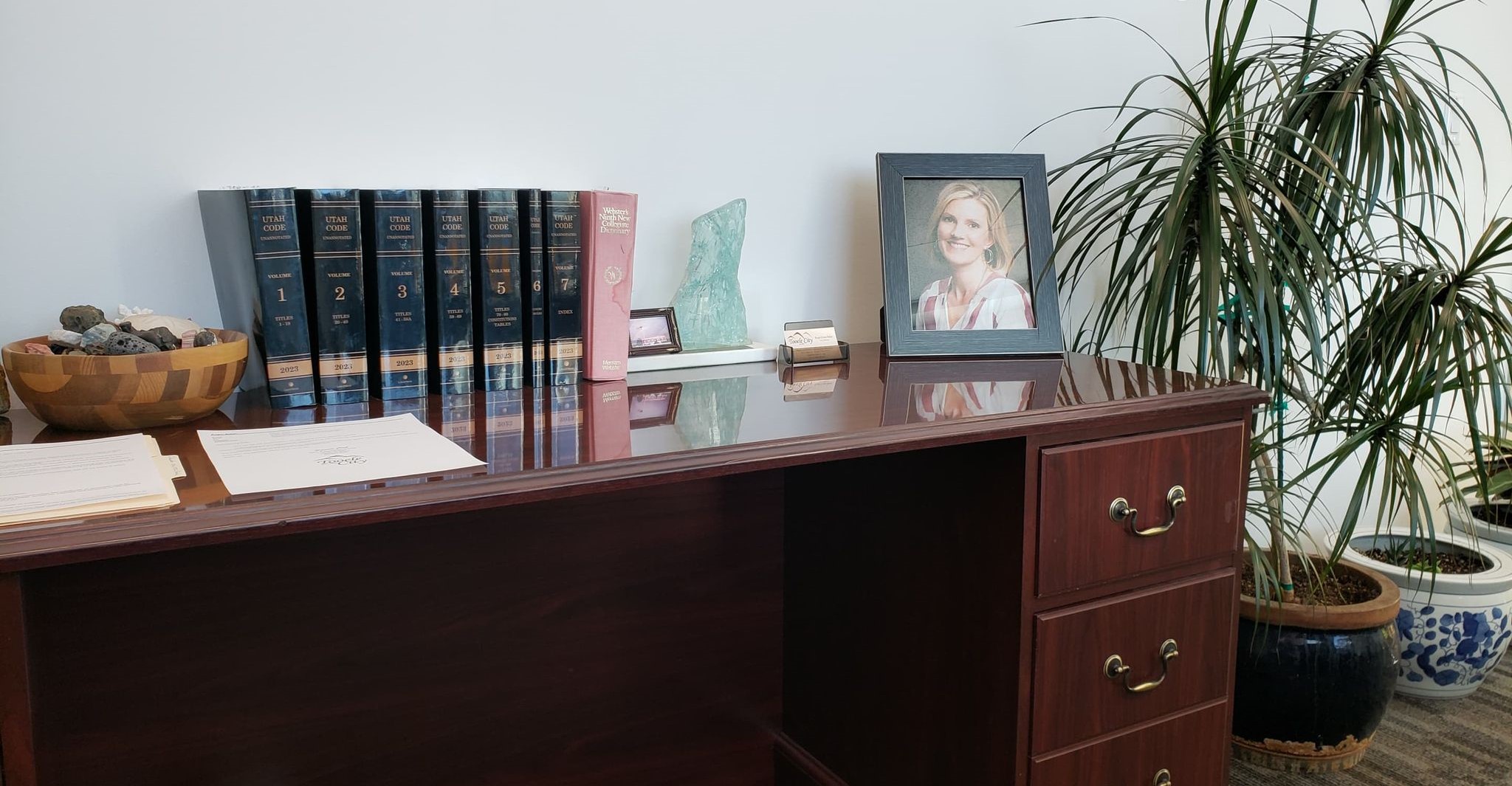
(Pictured above: my office credenza, with law books and portrait of Sarah.)

Courage at Twilight: An Enormity of Love

Dad insisted I speak at my sister’s funeral. Logical, of course, but impossible.  I had met her husband at the funeral home, at his invitation, where we spent three numbing hours making impossible decisions about vaults and caskets and flowers, payment plans and printed programs and Zoom links, fingernail polish and lipstick and hairstyle, rings or no rings, makeup to cover her wounds.  Feeling dead ourselves, we wandered through the casket showroom, and slowed before the Virginia Rose maple-wood casket, gently grained and softly carved in roses, lined with Easter pink fabric embroidered with a flower spray.  Tracy looked at me and choked, This is where she wants to rest, and I turned my face to the corner and sobbed and knew he was right.  The viewing became a bizarre reunion of a corpse and family and friends, with hundreds of hugs and thousands of tears.  “How’s Nelson holding up?” an uncle asked Mom.  Pierced.  That is the word she used.  Dad was crushed and broken and pale—and pierced through.  He has whispered revelations of his agony every day: I may not survive this.  I thought I might just go with her.  And he told us all of loved ones he looks forward to meeting on “the other side,” his grandmother Natalia Brighamina, a sweet-hearted Swedish beauty who infused the little boy with love and worth, his grandfather and namesake Nelson who rescued the mine’s company town when he detected the odor of almond in the water, his grandpa William T who lived in an unheated unplumbed shack and taught him to snag trout barehanded from the brook—and Sarah, who beat him there.  Every morning I wonder if Dad has survived the night.  The viewing room was hot and crowded and happy-sad, and I could not face my sister, meaning, I could not go to her and gaze at her and hold her hands or even glimpse her unliving body.  One little boy felt like I did, avoiding her “creepy” “plastic” visage.  I averted my eyes and said good-bye a million times in my heart, resolute on remembering her living laugh and her tight embrace, and her I love you dearest brother.  And the inevitable moment came when they closed the lid and clicked it shut, and I sank clear to the earth’s core.  The utter finality of that muffled click…  Her casket came rolling by, and I touched it, and I turned to the corner and sobbed.  Do I really have to speak?  Can I?  In my terror of the task to talk, a lovely friend eight states away softly suggested: Just speak to her.  And that is what I did: “Sarah, you are beautiful to me.  You share normal human imperfections, but to me you are a perfectly delightful, forgiving, super fun, uber smart, good, kind, hard-working, lovely, and loving woman.  You are one in a billion.  I adore you.  And I will miss you sorely for a long, long time.”  Standing at the congregational pulpit, there was no corner to weep in, but I wept anyway.  And I cannot deny that, in that fiery crucible of grief, I felt an enormity of love, and a universe of prayer, wrapping me warmly and holding me aloft and carrying me gently forward to tomorrow.  I love you dearest sister.


The maple-wood Virginia Rose.

Courage at Twilight: Comfort Kit

“How was traffic?” Heavy.  “How were the roads?”  Dry.  “Was it hard to drive in the snow?”  There was no snow, Mom—the roads were dry.  “Did you get to see Paul today?”  Yep—every day.  I work with my close friend the City Engineer every day.  For dinner, I served mini pizzas made from toasted English muffins topped with spaghetti sauce, chopped ham, and shredded Mexican blend cheese—a passable dinner—I have come a long way from my fine French entrees.  Dad has stopped taking the diuretic medicine because he grew tired of having to pee every hour (with the benefit of increased exercise), but his legs look like fleshy tree trunks and his feet like hot water bottles with stubby toes.  Nurse Chanetelle convinced him to wear his calf-length compression socks (he will not even talk about wearing the hip-length ones), and I dug them out of his sock drawer and laid then over the back of his bedroom sofa, where remain two days later.  The Christmas tree came down on New Years Day, leaving a green mess of fake needles, so the vacuum cleaner came out and sucked up the needles and the bits of dried food from Christmas Eve, leaving the food and foot stains behind, so the spot cleaner squirted and the carpet shampooer roared and roamed and sucked up dark water.  I take pride in my work, and left the dining and living rooms with beautiful rows of long triangular shapes, each width equal to the others.  Looks so much better, I thought with tired satisfaction, and while I was stowing the vacuum and shampooer and bottles of carpet soap Mom tottered across the wet carpet with her new dig-your-toes-in gait to put the crystal candlesticks away.  I suppose I am being silly, but I felt like someone had left prints in my new smoothed cement or dragged their fingers across my finished canvas.  No harm done, actually—none to justify my irritation.  Mom dug into the garbage to remove the mug I had thrown away, because the microwaved chocolate cake mix was gross and would take three gallons of water to wash out, and we don’t need another nondescript mug in the cupboards anyway—you see, I did have my justifying reasons for throwing the mug away, and then there are my used Ziploc bags which she pulls out of the garbage to wash with a gallon of water each and to dry over wooden spoon handles lined on the countertop, for recycling, even where they had contained raw chicken or fish—They don’t want our soiled baggies, I wanted to scream.  She has been such a dedicated recycler.  She has been such a dedicated mother.  Her dementia is worsening.  The pharmacy delivered a hospice Comfort Kit (also known as an emergency kit) and nurse Jonathan spread the contents out on the table and explained that the dozen blue oral-solution morphine micro-dose syringes are for pain or distress or discomfort or difficulty breathing (from congestive heart failure) and the dozen green oral-solution lorazepam syringes are for anxiety and distress, and they could be used together.  “I prefer not to take anything habit-forming,” Dad rebuffed, smiling righteously.  I want a Comfort Kit!! I felt like shouting.  I could use a little morphine now and again!  Another form of comfort came in Gaylen the hospice chaplain, who found Dad in great spirits and relatively great shape considering most of the people Gaylen counsels and comforts are days from death and cannot speak and do not know who anyone is and are wasted and broken and ready to go, so he assures them the afterlife is real and they have nothing to fear on the other side, where they will be free of their pains and troubles.  I wouldn’t mind a little of that comfort, too.

(Pictured above: Crossing over the suspension bridge on the Bonneville Shoreline Trail in Draper, Utah.)

Courage at Twilight: The Paint Has Faded

On the otherwise ivory-cream walls, rough white splotches of dried spackle have glared at me for a year as I have climbed the stairs several times a day, easily a thousand trips, with the chaotic white patches accusing me of not sanding them out and painting them over to blend with the smooth cream, not helping them fit it, bringing them into pleasing uniformity.   I don’t care.  Sitting on the toilet seat lid, Dad spread spackle on the screw-head holes and sheetrock seam, in the bathroom with the new (and unpainted) door.  He had asked me for the spackle and a puddy knife and sanding blocks: “this is something I can do.”  I knew he could do it, and I also knew I would have to redo it, not because I am better than he is at plastering walls, but because his unsteady hands and blurred eyes could not help but leave the job needing to be finished or repaired, or both.  But who am I to tell my father not to do something he wants to do and believes he can do and probably can do quite well?  He asked me to bring in the shop vac so he could vacuum the dried spackle dust after he sanded.  I brought in the vacuum and sanded and cleaned up.  He asked to me bring in the paint, and a roller pan, and new roller, so he could roll paint on the wall.  “I think we might need to plaster a bit more,” I suggested, in the third person, carefully, but he agreed and smeared on a second application, “and that maybe before we roll the walls, we brush on some paint over the plaster, as a primer.”  Okay, he said.  The first and second paint cans I opened found hardened, cracked paint.  “It’s probably been sitting there for 25 years,” Dad chuckled.  In the third can, the paint was as thick as buttery mashed potatoes, and much heavier, but uncongealed and stirrable.  The splotches on the walls above the stair lift have now been sanded smooth and painted over, and the wall above the stair lift is again its harmonious creamy self, without blemish.  And the bathroom is painted, or at least primed.  Another coat may hide the scars in the bathroom wall, without rolling, and I hope Dad will not, in fact, try to roll paint on the walls.  He believes the old paint has faded, and the new paint will not match.  I am not looking forward to cleaning up after that paint job.  But he wants to do that job, and this is his house, and who am I to tell him no?

Courage at Twilight: Gift Dispenser

“The doctor wants to see him in person,” the receptionist asserted, and this after Sarah, and then I, more than once each, had explained how delivering Dad to the doctor’s office was not only an impossible physical feat, but also an unsafe one, both for Dad and for me, for the sheer physical strain, and how leaving the doctor’s office after an in-person visit would find Dad worse off than when he arrived, and how is that in the patient’s best interest. She said, again, that she would talk with the doctor, who on the day of the video appointment commented on how well the five-minute visit had gone, and let’s do it again in two weeks to check on the diuretic.  A nurse had come to the house to take Dad’s vital signs (based upon which he is healthier than I am) the mornings of the video appointments.  My goodness—so much happening today.  Cecilia helped Dad for the last time, said she wished we could have worked things out with Arosa, said she might leave Arosa because the new rates are driving patients away and reducing her hours and her pay, said good-bye and said good luck and drove away.  Chantelle and Liz, the hospice nurse and social worker, came for Dad’s hospice intake interview and paperwork.  Dad got stuck on the “blue sheet” and what mechanical measures he did and did not want taken to unnaturally prolong his life if he had a stroke or a heart attack or a bad fall—he wants to live, damn it, not be given up on.  But doctors have explained to him how cardio-pulmonary resuscitation on his 88-year-old frame would leave him crushed and bruised and brain damaged and with a quality of life reduced to an oxymoronic noun (like “shit”) that “quality” would not describe.  Q: How are you feeling?  A: Like great shit.  We will come back to the blue sheet another day.  And we will come back another day to the long medications list, and the question of which prescription drugs he might dispense with in light of the hospice goal to maintain comfort rather than artificially extend life.  Mom and Dad each sat in their recliners during the long interview, and I sat in between them, moderating questions and answers, careful to let them answer what they could before jumping in, careful to quietly correct dementia’s inaccuracies, and a few downright lies, as to dates and weights and numbers and names.  I sat between them, just as I did on Christmas day when they opened the gifts their children had delivered, from where I dispensed one gift to Mom on my right and one gift to Dad on my left, from their respective gift piles, identifying whom the gifts were from, keeping a written list, and moving the unwrapped gifts to new respective piles, gathering and crumpling the wrapping paper after each unveiling.  (Wrapping paper is recyclable, I researched, so long as it stays compressed and crumpled when compressed and crumpled, meaning it is really paper instead of mixed with plastic or metal or cloth fibers.)  Fuzzy slippers, fuzzy socks, biographies of the Fonz and Captain Picard, pounds of chocolates, word puzzle books, Horatio Hornblower DVDs, needlepoint kits, and signed cards.  Mom held up her hands for her gifts, as she does with her dinner plates, like an eager chick.  As the hospice women left, instant new friends, Mom announced they would each receive an Afton hug, a full-bodied arm-wrapping embrace with dancing left and dancing right, named after a beloved granddaughter.  I felt mortified and turned away from the tender bizarre scene, all my inhibitions overwhelmed, but Chantelle and Liz laughed and joined heartily in.

Courage at Twilight: For the Love of Clementine

Dad turned eighty-eight years old today, and for his birthday gift I fixed his toilet. It was not a job I had done before, but how hard could it be to turn off water, drain the tank, remove the old bolts and washers and tank-to-bowl gasket?  How hard?  Three hours later I finished the job.  I had told him he could use the bathroom at any time—this toilet could not be taken fully off-line—but that he had only one flush.  But I forgot I had removed the tank, with the flushing mechanism, silly me.  A gallon pitcher from the kitchen sink flushed everything down, and then I replaced the tank, after driving to three national chain hardware stores that did not stock the right Toto part.  I made due, and toilet no longer leaks.  And I gave him my new book of poems, including six poems about Clementine, with whom I made friends during the ordeal of my separation exactly ten years ago, when I lived in a friend’s construction zone remodel project after his drug-dealing non-rent-paying tenants destroyed the house.  Clementine was a spindly-legged spider in one shower-ceiling corner, and she greeted me every morning and every evening, and I talked to her and told her my troubles.  She could not respond, but she quietly listened: she was my only constant, always there for me, not judging me, not scowling her contempt, not sending me away, not caring about my flaws or my brokenness or my heart-trauma.  Dad thanked me for both gifts—said he would get to reading my book right away—and  the family all came over for dinner and carol-singing and sweet token gifts and homemade chocolate peanut-butter coconut-caramel cashew-coconut-raisin gooey bars which every loved, and they listened to me read the story of the birth of Jesus, and the feeding trough, and the announcing angel and skies of singing warriors, the wise men from the east, and the light of that singular star.

Courage at Twilight: Tasting Sweetness

Grinch Candy Cane Hunt - KC Parent Magazine

Dare I dip my toe again into the dark eddies, and launch into the currents of this memoir of living with the dying?  My resolve to navigate these waters began before I embarked, and the eight hundred and seventy-fourth day is no time to beach.  Arosa raised Dad’s in-home care rates by 75%, charging a “premium” for clients who receive less than four hours of care per day—Dad receives two—but I perceive the premium as a penalty, and the company as preying on the most vulnerable. Continue reading

Courage at Twilight: Powers of Attorney

The air has cleared, and the energy has calmed, at home, and we have moved on to other matters weighty and light. Light like what’s for dinner.  Weighty like powers of attorney.  Dinner is hot deli roast beef slices left over from a family party, with mashed potatoes and gravy and steamed asparagus on the side.  On the weightier end, new powers of attorney are signed and notarized.  Mom’s and Dad’s “springing” powers of attorney from 1999 each named the other an attorney-in-fact, an agent, effective only upon the disability or incapacity or incompetence of either one.  I was named as substitute attorney upon the incapacity of them both.  These documents have fulfilled their 24-year function well, and I rested peacefully on them, that is, until my very smart brother explained their potential effect-in-fact at this point in time.  To trigger either POA, I would have to transport my incapacitated father or mother to one or more “disinterested” physicians (not their own), explain to those physicians, in my father’s and mother’s presence, the ways in which they are no longer competent, and obtain physician affidavits to that effect.  Only then could I act on my parents’ behalf in making decisions and managing affairs.  This, say the experts, is a process “destined to destroy” even the most loving and supportive of families.  With sibling support, I discussed this concern carefully and fully with Mom and Dad, and received their blessing to prepare “durable” powers of attorney, which will allow me to help them with their decisions and affairs irrespective of their competence.  Of course, I will consult first with them, and with my wonderful siblings, in so doing.  A notary came to our house to notarize Mom’s and Dad’s signatures on the new POAs.  Mom and Dad feel relieved, and I feel so relieved.  In additional to protecting them and their assets, I hope to have avoided unnecessary and uncharacteristic stress in the family.  We can focus more on caring for Mom and Dad, and each other.

Courage at Twilight: Closing and Opening Doors

On Dad’s first day home from a month of hospitalization and rehabilitation, he poked me with two questions.  First, whether I had bought any whole wheat English muffins for his diabetic breakfast diet.  Second (after I motioned to the muffins in their habitual spot on the kitchen counter), whether they had or had not been sitting there for two months.  I ignored the slight, the suggestion that even if I had remembered his whole wheat muffins, I had not managed them properly.  The rebuff after dinner, however, flamed my already roiling magma.  Sarah and I were explaining to him how, while he was away, we had studied the house in light of his challenges, and saw that we needed to replace the 28-inch bathroom door with a 36-inch door, opening into the hallway instead of into the tiny bathroom, and how our cousin David was bringing his tools the next day to do the job.  I thought he would be happy with our ideas and efforts on his behalf.  He was not.  He walked us through every minute detail of his maneuvering around the bathroom, like a hundred-point K-turn, including using the doorknob as a handhold before hand-surfing heavily across the sink counter toward the grab bars and toilet.  I promise you I was patient and calm as I explained: “I know that has worked for you in the past, Dad, but relying on a round rotating nob is not safe anymore.  Don’t worry, we’ll install new grab bars.  You will be able to follow a similar but safer transferring routine.  I promise, it will be better.”  And he looked at me with that omniscient omnipotent head-tilted smolder of his and demanded, “When you are making plans for my future, you will speak to me first,” tapping his chest.  And this long dormant volcano, which has seethed and smoked for decades, suddenly spewed out its lava heat.  “You weren’t here!  You’ve been hospitalized.  And we had to move fast when we found out you were coming home so you could move around as safely as possible.  Dad, I have given my whole life to taking care of you and keeping you safe and healthy for more than two years, and you have criticized and fought me since the day I moved in!”  As I hollered at him, I pounded the granite countertop with my fist, “since the day [pound] I moved [pound] IN (pound)!”  (Have I broken my hand? I wondered vaguely as it began to tingle.)  I abandoned the beginnings of my Christmas party chocolate mousse and fled to the dark living room, sitting in the glow of the Christmas tree lights, trying to calm myself.  I had never ever erupted, boiled over, blown up, confronted like that, not in all my life, not with my dad, not with my mom, not with my wife, not with my siblings, not with my children, not with anyone, ever.  I was not proud of myself for what had just happened, but neither did I feel ashamed or guilt-ridden.  I could hear Dad complaining to Mom in the next room, “Why is Roger so furious with me?”  “Because you don’t listen,” she responded.  “Why can’t you just be quiet and listen.  And be grateful.”  I cherished her firm meek support.  “And I don’t want to talk about it anymore!”  He complained again: “The older I get, the more everyone just tells me what to do.  Why is everyone ordering me around?”  “Just listen to people and be grateful for what everyone is trying to do for you!” she countered.  “And I said I don’t want to talk about it anymore!”  Dad pouted, “Well, I guess I’ll just add you to the list of people who won’t speak to me.  It’s a long list.”  My heat rose again, but more controlled and focused, and I approached him and challenged, “Do you really think this is about me wanting to tell you what to do?  To control you?  Really?”  He covered his eyes with his hand: “I can’t listen to you when you’re angry.  I can’t take it.”  “Oh, that’s rich: everyone has to listen to you, but you don’t listen to the people who are trying to care for you and keep you alive.  You just complain that they’re bossy and telling you what to do.”  (Eyes still covered): “I just can’t listen to people who are angry.”  Me: “I’m not angry, but I am very frustrated, because I can’t listen to people who are ungrateful and disrespectful.”  Dad: “Is that what you think I am?”  Me: “Absolutely.  Everything I do here I do to help you and Mom be safe and comfortable.  I’m not interested in telling you what to do.  But instead of appreciating it, you judge it.”  A full Ambien, twice my typical one-half, got me through the night.  David and I worked all the next day to install the new door, a 36-inch-wide left-hinged door turned inside out to be a right-hinged door opening into the hallway.  The bathroom looks twice the size and is so much easier to get into and move around in.  A grab bar has replaced the rickety doorknob.  Dad enjoyed keeping tabs on the construction, chatting amiably with David.  In the end, he enjoyed the bathroom’s inaugural visit, emerging to remark on how nice the new bathroom was.

Courage at Twilight: Long Ago Letters

For months Mom has approached me in the kitchen or in my home office to read to me snippets of her old letters recounting my birth in Brazil in 1964.  “…they laid him on my stomach…he sure has a big cry…he has very long fingers and feet…he does not have poky-out ears…he is very funny looking (as all newborns are)…he is beautiful to me.”  Then follows the historical material for their favorite family stories about me, which Dad delights to tell the assembled family on my birthdays: “We seem to be living in a jungle of diapers.  We have no laundry facilities [and] do all our laundry by hand.  We hang [diapers] in the kitchen, bathroom, over chairs and tables…we iron them dry and put them away.”  How can I divert her attention to something else, I wondered.  And I recalled having a stack of a hundred letters she wrote to me from 1983-85 when I served my Church as a volunteer missionary in Portugal, letters which I saved but which no one has read in 40 years.  With Dad in a hospital and care facility for a month, I have taken to reading aloud one of her 1980s letters each evening after dinner.  She chuckles at the busyness of life as a mother of young children, the piano lessons, allergy shots, band concerts, basketball games, school snow days, choir rehearsals, prom disappointments, bouts with the flu, reading Newberry books, Sunday church meetings, and watching the bats at dusk.  On October 25, 1983, Mom recounted how she bought a tie for my then three-year-old brother Steven.  “He wears it to church every Sunday.  He looks very grown up.  He said…last night, ‘When I was a little boy, I was big!’  After church he went around the house singing ‘Jesus wants me for a Sun Bean!’”  On March 6, 1984, she sympathized with my homesickness and discouragement, wishing she could “make things easier” for me, and reassuring me that “everything here at home is fine.  We get tired and discouraged just like everyone else, but we keep going, we bounce back.  I’m always at it.  I have to make sure that I create the right feeling here at home with EACH child as much of the time as possible.  That is really not easy.  I never give up, though.  I have to keep trying.”  She was 44 years old.  On November 15, 1983, she reminisced, “There are so many things a mother feels for her children.  They are just very dear to her.  She remembers nursing them as tiny infants, carrying them around as little children, making cakes and going on walks with them as they get bigger, taking care of their things, helping them in school, etc.  Then, when the children leave, it is hard for her.  The empty bedroom, the missing place at the table, all the little things that were fixed or made better [by the child].  At the same time, it is right that children leave.  They grow and become independent and contributing adults.  That’s the way of it.  It’s right.”  And she ended that now 40-year-old letter with the sweetest of sentiments: “You will always be a part of me and I will always love you without limit.”  At age 59, as I again live with her and help care for her, her feelings for me (and my five siblings) are just as tender, and she looks at me still as her little boy.  I cannot be that little boy, that infant.  I am a grown man with my own life and children, and grandchildren.  But I am still her son, and she deserves in return the same sweetness she has given to me all of my life.

Courage at Twilight: Pushing Buttons

Mom greeted me as I walked through the door, anxious because the stair lift would not work. She checked the chair and receiver power chords, replaced the remote batteries, and still the chair would not move for her.  As I suspected, my curious grandchildren had pushed the red power button to the off position during our Thanksgiving festivities.  Turning the power button to the on position brought the lift back to life, and embarrassed Mom a bit.  “I’m so dense,” she whispered.  I reassured her she was not at all dense.  We grabbed our coats and keys and left for the rehabilitation center.  She had promised to give Dad a break from rehab food with a “treat,” code for a combo meal of hamburger, large fries, and Diet Coke.  Indeed, he was pleased, though still full from his rehab dinner.  For our big family Thanksgiving turkey and smoked ham dinner, Sarah was allowed to bring Dad home for three hours—the most United Health Care would allow without jeopardizing his coverage (i.e., if UHC thought he were well enough to be home all day, UHC might think he didn’t need in-patient rehab).  He sat hunched in his wheelchair, smiling weakly, introducing his old standard stories with, “That reminds me…,” and sad for the too-short stay.  At three hours’ end, he again had to leave his wife and family and home and comfort and return to his hated rehab room.  Seeing that he was still unable to care for himself, I shuddered with terror at the thought of him returning home in just one week.  I hoped he would be strong enough, but knew that if he were not strong enough, the burden would fall to Mom and me to make up the difference, to fetch this and that, to launder and mop and shampoo, to winch him up with a gate belt, to sit stiffly on my mental seat’s anxious edge.  Where is this big bitterness of anger coming from? I quizzed myself, and quickly perceived that the anger did not mean I did not love him and admire him and want to care for him.  Instead, my anger derived from my fear of the coming all-but-certain burdens, and of wishing they were not mine to carry.  With this realization, I turned to face my realities, and the anger left.  But the anxiety and the fear did not.  They remained, obstinately entrenched.  Time for more diaphragmatic breathing.

Courage at Twilight: Each Other’s Heroes

After days of dissolved fiber and a suppository, the hospital cleared Dad for discharge to the rehabilitation facility.  Sarah was pulled into the strange world of his hospital room for five days and nights, never leaving.  She supplemented excellent hospital care with all the little things an immobile old person in a hospital bed needs in order to not suffer too terribly: brushing his teeth, slathering his back with anti-itch cream and his bum with anti-bed-sore cream, alerting the nurses when his oxygen dipped, adjusting him so he could pee into the urinal, applying lip balm, shaving his sparse whiskers, adjusting the bed angles, changing the TV channels, ordering his meals, replacing the cannulas he kept pulling out, pulling up his compression leggings (he shed ten pounds of water, from each leg, in five days), listening to him prattle past midnight.  She hugged pillows over her face to block out the light and beeping instruments and snoring, not completely successfully, rising to his calls for help every 45 minutes of the night.  This list of little services yanked me back to the other hospital room, 14 months ago, and the other rehab, 13 months ago, and the other homecoming, 12 months ago, when I rushed to build the ramps.  “I’ll be out of here in three days!” he enthused to Sarah today with typical optimism and sudden delusion.  And just today he complained he could not do it, he could not stand up from the toilet or the bed or the shower chair or to dress, could not shuffle with a walker ten feet.  “It’s too hard.”  Well, that’s not an option, Daddio.  That’s a terminal philosophy you can’t afford.  You simply have to.  If you can’t do this, you can’t go home.  You can’t go home and burden Mom and Roger with all this because they can’t do it for you, and shouldn’t have to—you have to be able to do it for yourself.  So do it, so you can go home.  Receiving these necessary reports from Sarah, memories of 2022 began to seep in, along with their tension and terror and trauma, memories morphing into anticipations, along with new stresses and trepidations and traumas, of what awaits, of the care he will need, knowing his needs may often outpace my abilities and availabilities and resilience.  So, now, I am slowing my in-breathing and my out-breathing and reminding myself that memories are just that, impressions of things past, and that the future will take care of itself, day by day, and that Dad will work hard at rehab.  He will be ready for home, and I will be ready for him.  And we all will resume our routines to our utmost.  My lovely friend Liddy from the east shores of England, counseled me sweetly: When were babies, so small and helpless, we worried our parents.  As our parents enter their winter years, they worry us.  It turns full circle.  The feeling of exhaustion and defeat is at times unbearable.  But we find the strength because we have to.  We have to put our exhaustion to one side, if you will.  Something inside us will still fight, and we become protectors.  We do for our parents what they did for us in our time of helplessness.  We become our parents’ parents.  The experience your family is going through, and the feelings that go with it, allow you to be human.  You become each other’s heroes.  You develop a greater understanding of each other, and become wiser.  You are not, and never will be, alone.

Courage at Twilight: Round Two

Last week I worried about sucking up leaves and maple seeds with the riding mower, and the orange cup overflowing with red ketchup packets from Burger King, and why we keep it, with a half-gallon ketchup bottle in the fridge, and the shrimp I skimped on because they were cheaper but Dad could not pull the shells off with his stalling fingers and gave up on his dinner. Last week I listened to Diana sing, “There is sunshine in my soul today!” as she bathed and dried and dressed Dad and brought him downstairs for his breakfast and got him settled in.  She is always singing, bless her.  But now I lie, for the second time, shivering under my blankets with the body pains of Covid while my father suffers worse Covid pains and debilitations in the hospital where my sister Sarah stays with him round the clock 24/7 to help him shave and pee and bathe and eat his unusually delicious hospital meals and change the TV channels and brush his teeth, and to not let him grow lonely, bless her, snatching sleep in one-hour increments on the hospital room couch.  On the Sunday the ambulance drove Dad away, I sent and received hundreds of texts and emails, whole hours of messaging, keeping loved ones and friends up to date and reassured, fending off premature requests to visit for fear they would overtax the exhausted patient and infect the visitor, and I would have sent more messages but for an aunt and a daughter keeping their respective siblings informed.  Now I wait, weary and aching, for the virus to leave me, so I can resume my duties.  And in the meantime, I am isolating from Mom and at the same time watching over her, wearing a KN-95, hovering with hourly inquiries about how she is feeling, fearing she, too, will succumb.  And in the meantime, my children have delivered a week’s worth of delicious prepared meals, to ease my mind about cooking, and tonight Mom and I enjoyed chicken burrito bowls with rice and beans, a salad on the side, and are looking forward to tomorrow’s chicken alfredo, or maybe deep dish pepperoni pizza, bless them.

Courage at Twilight: One More Ride

New sounds of distress sent me running in my bathrobe to Dad’s room at 2:00 a.m., where he struggled in vain to sit up on the edge of his bed (hoping to pee). I pulled on his shoulders to sit him up, and held him there for twenty minutes (unable to pee).  Mom’s 5:00 a.m. knock on my bedroom, and her cry that Dad needed my help, sent me dashing again.  Dad lay face down on the floor, wedged between the bed frame and the night stand, his face in a gallon-size garbage can.  (I am learning, too slowly, to elder-proof a home.)  He could not move, only grunt.  With difficulty, I lifted his torso enough to free his face from the can.  “Just leave me here,” he begged.  I could do nothing but leave him there, except provide a pillow to protect his face from rough carpet pile.  And I covered him with a quilt.  I stood there watching him breathe, inside me a growing fury that he was so helpless and incontinent and that I was so helpless and impotent, that I could not move his bulk, could not help him relieve himself, could do nothing but watch him struggle and fade.  (At 84, his mother Dora fell out of bed and became wedged between the bed frame and the night stand.  And that is where she died.)  In a rage disoriented by little sleep and much fear and grief and stress and acridity and a traumatized waiting for disaster, I wondered angrily why he didn’t just get it over with and die.  Take him, I demanded—put us both out of our misery.  We can’t do this anymore.  I just could not manage one more night, or one more hour, of death struggle and incontinence.  In that moment, I saw the threshold, with two helpless men on one side, and professional paramedics on the other.  My mind cleared and I saw “911” as the only answer.  But I needed some time to think through the details, and Dad was sleeping comfortably, finally, albeit on the floor, and my leaving him there snoring for thirty minutes while I prepared my mind and my plan would do him no hard.  I buzzed my stubble hair and showered and shaved and ate some Quaker granola with icy milk and packed a bag with the advance directive and the power of attorney, my books, water bottles, cash, an apple, and Dad’s glasses and wallet and insurance card.  Only then was I ready to awaken Mom and explain that I needed to call the paramedics—she did not want to have to—and to awaken Dad and explain that I needed to call the paramedics—he did not want to have to—ready to dial “911.”  Strong young men, they carted him out on a flexible stretcher and drove him away to Alta View, and I followed, convinced this was his life’s end, his final ambulance ride.  I felt grateful he would not die in my arms, that someone else was in charge now.  Eight vials of blood and three hours later, Kirk, a superb nurse, entered ER Room #5 wearing a surgeon’s mask, and announced, “Guess what, Nelson?  You have Covid.”  Covid?  Covid!  How surreal to feel a surge of giddy relief that Dad had Covid.  What Dad and I dreaded was the intractable mystery of his utter undiagnosed debilitation and his slow trajectory toward an unexplained death.  That we could not handle.  But Covid we could get our brains around.  The doctors and nurses knew exactly what to do with Covid.  And the Covid diagnosis explained his symptoms of total exhaustion and chest pain and profound weakness and a slight fever and the beginnings of a cough and cognitive disorientation.  I wanted to cheer, “Eat! Drink! Be merry! For tomorrow he will live!”  The doctor stated with nonchalance: “Yeah, this Covid variant really hammers old people, but Nelson should make a full recovery.”  After a night of anguish and impotence, a new day of hope and of better tomorrows broke open.

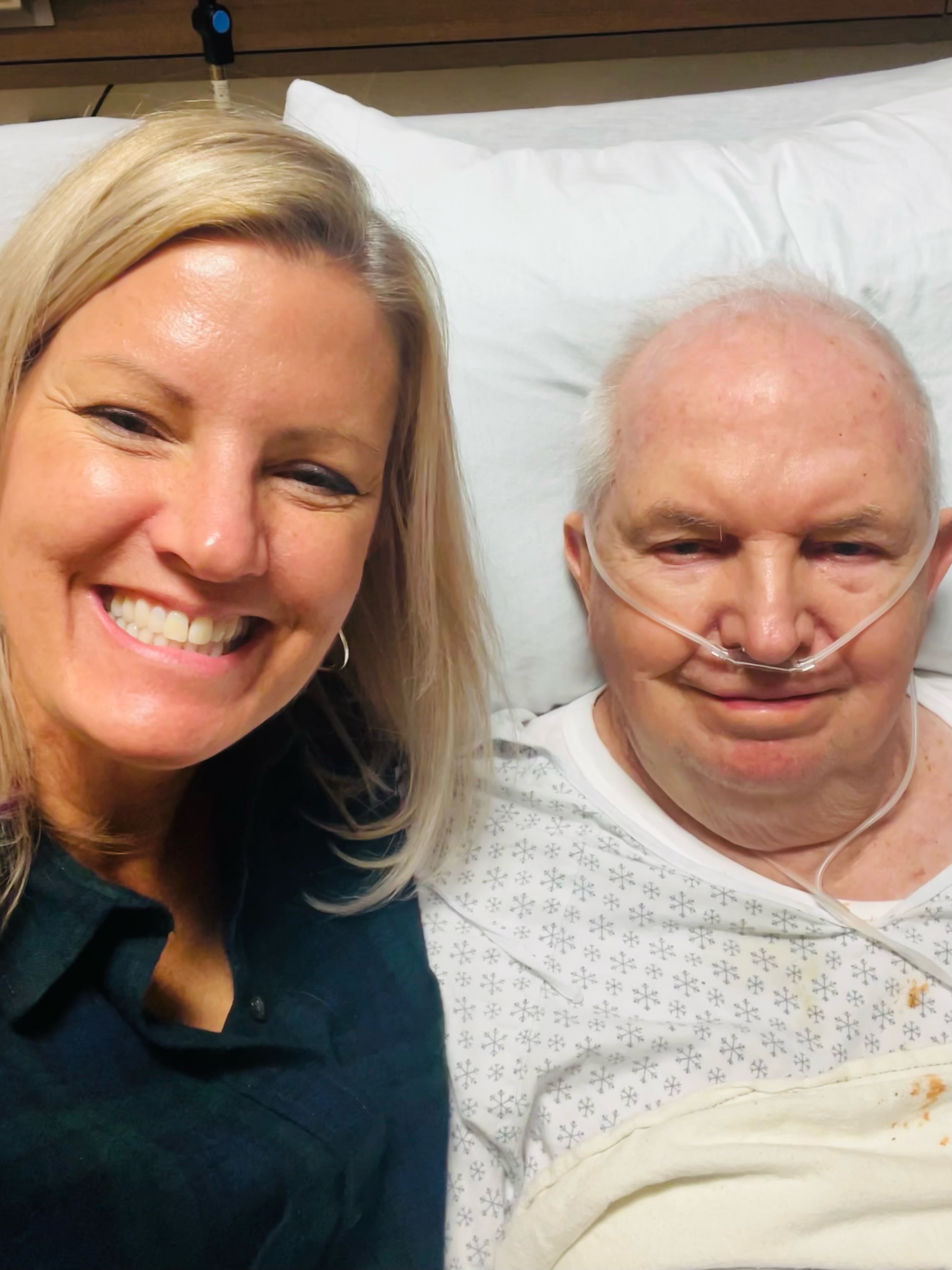
(Pictured above: Dad in the hospital with my sister Sarah.)

Courage at Twilight: Just Let Me Rest

Raspy, distressed breathing, not a loud thump, alerted me to something wrong, and I found Dad lying on the floor quivering with total futility to move.  I verified he was not injured, then rubbed his back and encouraged him to just rest for a few minutes until he regained some strength, code for, relax while I figure out what to do, and draped a blanket over his bare legs and bottom.  Rising from his bed, he had taken two steps with his walker and collapsed, utterly spent.  “I have no strength at all,” he croaked, frightened and suddenly hoarse.  “I wonder if this could be the end?”  After his first fall two years ago, I bought a padded sling to wrap around his big chest and help me lift him, which I did now, hoisting him to his hands and knees, and I held his weight as he crawled to the couch.  More heaving brought his arms onto the couch, and my knee leveraged a hip onto the cushion.  From there I fine-tuned his position with awkward pushings and pullings.  The operation took all my strength.  Nick, the strong young nursing assistant, arrived and bathed Dad with a sponge.  He managed to bring Dad downstairs—Dad insisted on it—but I almost wished he hadn’t, wondering how I would manage to get Dad back upstairs and in bed.  He grew weaker during the day, croaking and coughing.  I served a dinner of baked squash, steamed spinach, and organic apple-wood chicken sausage, sliced for him into single-bite portions, and I watched dismayed as he stabbed his fork eight times into the plate, missing the sausage.  He began sentences only to slip into confused nonsense, and I wondered, Could this be the end?  At bedtime, I did not succeed in transferring him from his recliner to the walker seat, and he sank again to the floor, helpless.  “Just let me rest here,” he whispered, wheezing.  My morning strength failed me, my muscles ached, and I knew absolutely I could not get him up.  Our neighbor Josh is a big man who knows how to hoist big disabled men, and he ran over at my phone call.  Together (mostly Josh), we got him into the walker seat, onto the stair lift, back into the walker seat, and into bed, a pad tucked under him.  Mom is beside herself with worry and fear, and wondered to me whether this were the beginning of the end.  We will see how he fares in the night, and what the morning brings.  In the meantime, I am on call: Mom has instructions to wake me with even the smallest need.  Calm during the day’s crises, my own silent distress compounded during the day’s uneventful hours, and has grown in the quiet and dark of my room.

Courage at Twilight: You’d Be So Nice To Come Home To

A blogger commented about our souvlaki and fries: “Interesting perspective on family dynamics and meal choices.” I wonder what he would quip about our incongruous hodge-podge of jam on French toast, Korean dumplings, and buttered peas.  “What a wonderful looking meal!” Dad kindly commented, and blew his wet nose into his dish towel/napkin/food catcher/bib.  “There were no buggers,” he rationalized when I brought him a new box of tissues.  Previous to this week, all the little personal items he needed for his daily comfort had accumulated on a small end table and on the floor—everything must be within his reach.  Eight dollars bought me a handy sturdy thrift-store shelf that vastly increased the items he can have with reach—books, Bible, gum, flosser-picks, tissues, hearing aid batteries, nail clippers, yellow legal pad, pens, reading glasses, check book, wallet—and reduce clutter.  Conversation turned to the lawn and yard.  Victor came with his air compressor, turned off the irrigation system, and blew out the lines.  This week will be the last mowing, mostly to vacuum up maple and sweetgum leaves.  “I almost went out to suck up all the leaves, but Lucille wouldn’t let me,” he pouted.  “I would have just ridden in my wheel chair and transferred to the mower.”  I was incredulous, and I asked, carefully, if he remembered the nearly impossible effort of getting him on and off the mower last spring, how I had to hoist and heave and shove and pull, how I hurt my back.  He did not remember.  But he remembers the distant past.  Struggling behind his walker, he announced to our company, “I have a vision Roger as an infant standing in his crib and gumming on the top rail.  You must have been teething.”  Not again, I reddened.  At least it wasn’t the washing-the-cloth-diapers and ironing-the-diapers-dry story again.  Mom diverted attention by inviting me to inspect the drawer full of new towels—church sister Marla had taken her to Kohls—the old towels were stained and worn thin.  Last week, church sister Barbara took Mom to a music store, and brought home a 1940s song book.  She bought the book of 104 songs for fondness of song #104, Cole Porter’s “You’d Be So Nice to Come Home to,” and wanted to show me the moment I walked in the door from work.

It’s not that you’re fairer than a lot of girls just as pleasin’,
That I doff my hat as a worshipper at your shrine.
It’s not that you’re rarer than asparagus out of season.
No, my darling, this is the reason why you’ve got to be mine.
You’d be so nice to come home to.
You’d be so nice by the fire, while the breeze on high sang a lullaby.
You’d be all that I could desire.
Under stars, chilled by the winter, under an August moon, burning above,
You’d be so nice, you’d be paradise, to come home to and love.


Dad’s new organizational setup.

Courage at Twilight: French Fries for Dinner

Mom worried the “meat” would upset Dad’s stomach, and I wondered, since when does meat upset Dad’s stomach? Not with last Sunday’s post roast or the hamburgers from Jeanette’s visit or….  The “meat” was four small chicken chunks on a kebob—Greek souvlaki—with a mountain of fries on the side, and a spot of salad and a dry pita.  I had arrived home late from the NOMÁS free immigration clinic, which, after two years of nightly cooking, I now use as an excuse to order out on Thursdays.  Look at these French fries, Rog!  Dad had been hoping for French fries, had been craving French Fries, all day, but Mom had not felt up to driving alone to McDonald’s or Arby’s or Arctic Circle.  These are such wonderful French fries, Rog!  Mom took a swallow from her glass of Juicy Juicy mango juice, and the swallow sounded wrong, and she sputtered and choked and her face turned red then purple and she coughed and coughed with her lap towel to her face.  As with so many of their hardships, I could only watch and worry.  But she recovered, and chuckled with an embarrassed squeaky rasp that things sometimes go down the wrong pipe.  As I well know, from my own frequent experience.  One of my siblings drinks only from a straw to avoid certain aspiration otherwise.  Is it genetic?  Dad choked through his own mis-swallow: I just love [cough] these French fries [cough], Rog! [cough cough].  I’m glad, Dad, because apparently you are having a mess of French fries for dinner, since you are worried about the chicken and pick at your salad and nibble at your pita.  I spent the whoooole day wanting French fries, Rog, and here you just walked through the door with the best French fries ever!  Thank you, Crown Burger, I think.  Cough cough cough.

Courage at Twilight: Partial Eclipse of the Sun

That morning I worked like the careful assassin who leaves no trace at the bloody crime scene, with the walls and floors scrubbed and sanitized, the clothing rinsed and washed (and sometimes thrown away), the washing machine sterilized with hot bleachy soapy water, the trash deposited in a distant dumpster, a squirt of Febreze.  No one would ever know the bathroom was anything more than a bathroom and not a crime scene.  Back in his recliner, Dad lamented his nighttime desperation for his children and grandchildren—he had prayed all night for their protection and triumph over tragedy.  What can he do, he asked, but trust in the God he loves?  Desperation for the same children, my children, worries me at night, too, and during the day, too, and what can I do but toil and trust?  But last night I worried about the deer plucking my mum blossoms and nibling at the arborvitae, and I braced myself, shivering, for the stink of putrescent eggs sprayed liberally.  In the kitchen, the warm slimy aroma of raw onions rises in moist billows, roiling the contents of my stomach, which never sees raw onions.  Another trip to the trash.  I shiver again in the quick darkness and chill of the moon crossing before the sun, the fusion globe a mere crescent in my eclipse glasses—but even ten percent of the sun’s surface blinds without the dark plastic.  How fascinating that the rocky moon can be precisely the size and the arc to neatly eclipse the giant gaseous sun to reveal the coronal “ring of fire.”  Home from work, I found Dad in his chair with only his red velvet throw over his legs.  “Your dad had an unfortunate accident,” Mom announced, matter-of-fact, and I braced for a crime scene cleaning.  But the “accident” was merely that he had fallen asleep with his icy glass of Coke Zero in his hand, which had slowly tipped in his slumber until it spilled fully into his lap and soaked his pants and his undergarments and his sitting pillow and his chair and his No. 1 Ladies Detective Agency books, now drying wrinkled in a row.  “He was so upset!” Mom grinned.  Yes, an unfortunate accident, but one we can handle, anytime.


Photo by Brian Baker, October 14, 2023

Courage at Twilight: How Does Your Garden Grow?

The man died fully four years ago, at just 28, and yet she keeps coming every day to his grave, where the flat headstone bears only a first name, but does contain a carved silhouette of him holding two named children by the hand.  Remember: there is no wrong way to grieve.  Mourn loud and long if you wish, or quick and quiet, mourn until the love and the loss and the anguish seep into your soul as you stagger on.  On Sundays, Dad and I sing the hymns with the televised congregation, holding our hymnals, and he is either ahead or behind the tempo, finishing the words too early or quite late, and often on the wrong verse.  But he is singing, and I with him, and he still reads the bass part well.  On Wednesdays, Mom has gone with the Church sisters on little outings, to Trader Joe’s grocery store, to Deseret Industries thrift store, to Pirate O’s import store, to Hobby Lobby craft store, for nothing in particular, but some little thing always catches her fancy and comes home with her, like secondhand colorful plastic cups, like O’Henry bars from Canada, like the round artist sponges she likes in the shower, like two small terra cotta pots to replace the ones I gifted to Solange with volunteer blue junipers to transplant to her yard, if she wants.  What could I do for the young woman grieving daily at her dead lover’s grave—what could I do that would not be frightening or unwelcome or weird?  And on Sundays while Mom sits with her friends at church, I pronounce the prayers upon the morsel of bread and the swallow of water, sacred emblems of sacrifice and hope, and stretch them out to my father, and he accepts them with quaking hands.  As customary in my Church, he received the priesthood and was ordained a priest at the age of 16, in 1951, a priest who is not a pastor or a reverend but a youth who pronounces the prayers upon the bread and the water and reaches them out to the covenanting congregants, promising to mourn with those who mourn, to comfort those who need comfort, and to always remember Him.  Dad always found his priesthood participation meaningful, as have I, being part of something holy and transforming.  His mentor, the Bishop (who in my Church is the unpaid pastor or reverend), passed him a scrap of a note that read, “that is exactly how the sacrament should be blessed,” which praise never did leave his heart, from years 16 to 88.  The simple note I wrote to the woman at the grave, tucked under her windshield unnoticed while she slept wrapped in a blanket on the dewy grass, read “a gift for you in your grief,” and in a bag Megan’s book about grieving for as long and however is right for you as you pull the anguish into you and hold it and sit with it and rock it until it becomes forever part of who you are.  Then I knew I had done enough and should leave her be.  Dad asks me often about my pumpkins, needing me to be his eyes, and I answer I don’t know because I have not checked them in weeks and do not seem to want to check them, preferring they grow or wither without me knowing, but I tell him one plant seems to be very happy and climbs each day a bit higher up the chain link fence, and today reached the top, and perhaps in some weeks some little pumpkins will have turned from green to orange and be plucked from dead vines to sit squatly on the porch for the neighbors and us to enjoy.

Courage at Twilight: Pulling Puncturevine

I lamented to mom that now she had eight sets of sheets and eight towels and eight pillowcases to launder, and I offered to help.  But she enthused, “That’s okay.  I love doing laundry!  I have always loved doing laundry!”  The bathroom in the Bawden house sported above the tub a small hinged door, behind which descended into the darkness of the basement a laundry shoot.  As a little boy I felt tempted to slide down the shoot, but I never did—a good thing, I am sure.  And I remember the old washing machine and wringer and tanks, long disused, and the drying lines still spotted with clothespins like wooden birds below the open joists of the seven-foot-tall basement, perpetually dark.  As a small girl and then a grown-up girl, Mom used these machines to wash the family laundry.  The washing machine churned noisily back and forth.  But there was no spin cycle.  Mom slopped the soapy wet clothes into a tank of clean water for a rinse, then passed them through the electric-motor wringer, pressing the clothes between two tight rolling pins made of wood.  The launderer needed to be very careful not to let the wringer grab her fingers or hair shirt sleeves: serious injury could result.  A second rinse in a second clean water tank, a second wringing, and the clothes were ready to be hung on the lines, either outside during spring through fall, or in the basement in winter.  “I’ll do it a little at a time,” Mom reassured me, not at all put out.  In fact, the thought that our company had been comfortable and dry with these bed clothes and towels gave her a sort of familial connecting comfort.  She finished on this National Day of Service, the 22nd anniversary of the shocking and traumatic destruction of the Twin Towers and the Pentagon and so much incinerated life by a new kind of terrorism.  The service I chose lacked glamor, and I wondered guiltily if it were worthy of the trauma and sacrifice that produced this special day.  Millions of people in thousands of places doing all manner of service.  Me?  I chose to pick weeds.  Not just any weeds, mind you, but puncturevine weeds growing along the Jordan River Parkway trail, with their two-pronged “goat head” seeds that puncture all passing tires and ruin many a bike ride.  I joined Jordan River Commission staffers, and other volunteers, and after four hours, my heavy-duty black plastic bag was full and heavy, weighing perhaps sixty pounds.  It must have contained ten thousand goat head seeds, which I was happy to equate to ten thousand saved bicycle tires.  One monster had creeped to a diameter of six feet and bragged hundreds of noxious seeds.  At a convention for city officials this week, I spent my networking breaks tying quilts for Stitching Hearts, quilts which will be given to foster and homeless children, a warm, soft, comforting homemade possession all their own that they can take with them from home to home or camp to camp—for some kids, the quilt will be their only possession in this world.  Stitching and cutting and tying with these silver-haired ladies in their seventies and eighties, my loneliness ebbed a bit.  While not the love I have searched for—a kind, intimate, whispering partner love—I felt happy in this new relationship, joining good people in service, small service, like pulling puncturevine, filling out immigration forms, tying quilts, washing sheets—I felt happy in this other kind of companionship and love, that comes with the giving of oneself, no matter how small the service.  For me, smaller is better, because big always overwhelms.  I can do the little things.  Stitching and chatting and chuckling, I wondered if this is the type of love and companionship which will temper my sadness and loneliness, which will bring me a measure of happiness and joy, which will carry me through my future days.  It just might be.

(Pictured above: a three-foot radius puncturevine spotted with hundreds of goat head seeds and flowers, hanging from a Russian Olive tree.)

Courage at Twilight: Christmas in August

“Freeze them all!” Dad commanded. “They don’t belong on my body.”  Indeed, all the moles and tags and bumps offended his dignity and threatened his pride.  Kirk the PA said he would be happy to freeze Dad’s little lesions to the extend he could tolerate the pain.  “Freeze them all!” Dad repeated, grimacing at each squirt of the liquid nitrogen.  Thirty minutes later I wheeled Dad out of the dermatologist’s office with his chest, neck, face, and head boasting more thirty red polka dots.  Back at the car, he realized all the freezing and pain had triggered a bladder response, so back into the building we went to look for a bathroom, a building with no automatic doors for the disabled.  The men’s room at least was ostensibly wheelchair friendly, but we soon entered into pathetic gymnastics with doors and wheelchair and multi-point k-turns and misplaced grab bars—this bathroom might be legal, but it definitely was not wheelchair friendly, in fact it was wheelchair nearly-impossible.  We barely managed, as a team.  Having visited the restroom, the drive home was much more comfortable, despite his painful polka dots.  Two incognito spots had hidden in the wrinkles above his mouth, one on each side of his face, symmetrical.  “A little poke,” lied the friendly Kirk, injecting lidocaine in each spot ahead of the biopsy.  Dad fretted immediately about the possibility of two surgeries on his face, above his lips, a horrifying prospect.  I could not help thinking briefly of the Joker, but banished the thought unuttered.  With dinner Dad had Coke Zero in one glass and apple juice in another, and drank neither.  I cannot get him to drink during the day, and I am tempted to remonstrate.  But then I remember that each trip to the bathroom is a life-or-death struggle, and, as he tells me frequently, his paralysis worsens every day.  No wonder he avoids hydrating.  On the front porch lay a package decorated in floral wrapping.  I had ordered the needlepoints in November last year for Mom’s Christmas gift, but they never came.  I entered into the longest email string of my life: can you check on my order? one item is out of stock, we can’t order the other item in, no that replacement choice is also out of stock, can you check my order? yes we have that one, they will be mailed soon, can you check my order? so sorry, we’ll get right on it, can you check my order? and they never came.  Exasperated, I mailed a letter to the owner about my terrible customer service experience, adding that they had my money, inviting them to make things right, and then I let the issue go, certain I would never see my order.  But today, August 28, against the odds, the package finally came: “Merry Christmas, Mom!” I finally got to say.

Courage at Twilight: Such Nice Neighbors

Mom fussed over Dad as she and I left for Smith’s. “I will miss you,” she cooed, patting his hand.  “Will you be alright until we get back?”  At the grocery store, she pulled a sandwich from a bank of coolers, and whispered her excitement: “I’m getting this for your father.  He is going to love it!”  The sandwich looked unremarkable, but her whisper conveyed the pride and power of a simple choice and purchase, when so much has fled her influence.  She delivered the sandwich to Dad immediately upon our return, and looked chagrined at his request to add slices of sweet onion and slathers of mayonnaise and mustard, requests she perhaps thought challenged her whimsical magnanimity, rained on her pride, and poo-pooed her power.  But, in the end, they both happy munched on their lunch, with Special Agent Gibbs on the screen.  For the first time in a year, Dad successfully watched our neighborhood church services online.  Zoom has failed him consistently, with bad microphones making the speakers unintelligible with their underwater garble.  Frustrated week after week, he merely fell asleep, later receiving Mom’s report.  With polite urging from several congregants, including me, the three local congregations pooled their budgets and purchased the equipment to connect directly to the Church’s broadcasting system, with a dedicated camera and hard-wired mic.  “I loved seeing church today, Rog!  Weren’t the talks great!”    I stayed home with him so I could refresh the link when the screen froze from low bandwidth.  There are always things to improve.  But he sang from his hymn book, and appreciated the emblems of sacramental bread and water.  Walking down our street that evening, Mom relished the fresh air, and Dad admired the gold-tinged clouds, and a distant airplane flew by the moon, bright silver from the western sun, and Steve and Marla emerged from their house “to wave to the parade” of two wheelchairs, one pushed and the other motorized, and to say hello.  Nice neighbors.  But I cannot take my parents for walks often enough, and Mom aches to get out of the house.  I asked the Church’s women of the Relief Society if they could assign “sisters” to take turns picking up Mom every Wednesday for half-hour outings.  The “sisters” were delighted—“we just love your mom”—and texted the next day with September’s schedule.  Such nice neighbors.  I will report her adventures.


(Pictured above: a mere four hours’ effort to extirpate weeds and shape shrubs in the back yard.)

Courage at Twilight: Dry

The ink has drained from my Lincoln rollerball, and I lack the means to refill. But the sun never stops its monotonous movement morning till night.  I asked Mom if that day were a good day for me to do laundry, and she exclaimed, “Yes! You can do laundry forever and ever!”  So I began.  The next day I came home from work to find them in Dad’s office, organizing his papers, a team effort, their combined age pushing 175 years, Dad instructing Mom from his coastered office chair: File this. Shred this. Throw this away. Shred this, and this.  File these. No, throw those away—away!  They both beamed their pride at their tidiness.  This week brought hard conversations about fading finances and funerals and planning for the end of life, and after.  They have always managed to afford their generosity, until now, when their spirit of giving exceeds their means to give.  To my great calming relief, they were open, accepting, and grateful for my “thinking logically about things.”  After all, they are one illness or fall away from assisted living and selling the house to pay.  They proposed, and I agreed, that the only practical solution is for them to die in their own home.  Dad has three abscessed teeth, poor guy, to be extracted soon, poor guy.  But he felt inspired as I cast to their sagging television the national steeplechase championships where the BYU runner fell on a hurdle and rolled and rolled and jumped up to rejoin the group and win the race, and he felt happy to see all the dozens of photos I took on my mountain camping trip with Hannah (17) and Brian (33) and Avery and Lila (3 years 11 months) and Owen (10 months) and their smiles and explorations and crawlings in the dirt and splashings in the river pool and paddlings in the kayak on the high mountain lake and their roastings and burnings of marshmallows over the hot cedar fire, and the ripe thimbleberries.  He still says, “I love life.”

Above: about to kayak on Moosehorn Lake, Mirror Lake Highway, Uinta mountains.

Below: peek-a-boo with baby; thimbleberry bushes with ripe sweet berries; the Provo River next campsite #18 at Cobblerest; view of the Uinta mountains from Bald Mountain pass, with two of the hundreds of lakes.

Courage at Twilight: I Really Want To Go

1953-plymouth-cranbrook

Old patterns seem to reassert themselves without my even noticing.  I had pulled and raked weeds for three hours in 95 degrees.  The gardens looked beautiful, and I definitely did not.  At 3 pm I took Mom to the grocery store to cross off our lists.  At 4 pm we put the groceries away in various pantries, cupboards, refrigerators, and freezers.  At 5 pm began the peeling and slicing of vegetables for roasting: yams, carrots, onions, potatoes, mushrooms (plus sliced Kielbasa).  At 7 pm dinner was served to grateful parents who cannot cook their own.  At 8 pm came the washing of dishes and cleaning of kitchen.  And I was so glad to be done with my work for the day.  But at 8 pm Mom asked if we could go for a walk now, and, in fairness to her, I had hinted earlier in the day a willingness to take them on an evening walk.  Now, I complained about having been on my feet the last five hours and about wanting my day’s labors to be done.  “I really want to go,” she persisted sweetly, and I felt my weak attempt to draw boundaries and wind down my Saturday giving way to a kindly old lady’s pining to get out of the house, to feel the evening air on her face, to see trees in their multitudinous shades of green, to wave to the waving neighbors, to revel in freedom and calm and beauty with her arms raised exultantly to the sky.  So, out the door we trundled.  Nick drove by in his vintage Mustang, waiving, and smiled at our “We love your car!” and said he’d be back with something she would really enjoy seeing.  Every night I sigh wearily, wanting my day’s labors to end, and there is always more work to be done.  I am remembering back to Saturday mornings pulling weeds for three hours in 95 degrees, to the days of two decades of raising my seven children, when I often fell asleep comforting a crying child who himself soon slept sprawled and drooling on my chest, when I would seethe over dirty greasy soapy dishes at midnight, when the next day’s unbearable stresses already came crushing.  “I love it!” Mom exclaimed after passing an enormous blue spruce twenty feet across and forty tall.  I confessed to enjoying our walk, too, and heard her relieving sigh.  Boundaries feel selfish to me.  Every boundary I draw limits another’s needs and my service to those needs.  Trying to draw lines leaves me feeling guilt for others’ disappointments.  But a life without boundaries, as I well know, will leave me empty and dry and weary and resentful and depressed—all used up.    I am getting a little better at saying, “That will have to wait until tomorrow,” Mom or Dad.  Our walk finished at 9 pm.  The doorbell rang at 9:10, just as I sat down to rest.  Nick had come back, this time with his 1949 Plymouth (blue).  “What do you think of her!” he asked.  His gray mustache grew from his lip down his cheeks to well below his jawline.  “It’s a Plymouth!” she impressed him, hanging on my arm as we walked slowly to the rumbling car at the curb in the dark.  She told him the story of how she and Dad as newlyweds had driven their 1953 Plymouth (green) for five days from Salt Lake City to New York City, in 1963, at a top speed of 40 miles per hour, on local and state roads before interstates.  The city had alternate side of the street parking rules, and Dad sleepily descended the apartment stairs at 5 every morning to move the car to the other side of the street to avoid tickets and towing.  After three days of that, they decided they didn’t need a car in Greenwich Village, put a “For Sale $50” sign in the window, and sold the big rounded old Plymouth to a clerk at the corner grocery, who waxed it up and proudly cruised the Big Apple in his new Plymouth.  I shook Nick’s hand.  I became so weary raising my family, my love for them notwithstanding, and I am weary again now, my love for Mom and Dad notwithstanding.  My work feels never done.  That is the human experience: the work to be done always outpaces the time and energy to do it, and we tire despite ennobling lives.  The thermometer reached 102 that day, the same day an email came from the company that hangs our Christmas lights on the house, asking for a deposit.  How strange to think about Christmas in 102 degrees in July, waiting for parts to repair the air conditioning, grateful for refrigerators and freezers and ice and little water cooler fans bedside.  We will forego the house lights this year.  Is there irony in my hanging three August calendars on my bedroom wall, one for Push-ups, one for Planks, and one for Prayer?  They can wait for August, I decided, and dropped into bed before 10.

(Picture of 1953 Plymouth from Dragers.com, used under the fair use doctrine.)

Courage at Twilight: Waiting for Miracles

Dad talked with me for 63 minutes about bedding and food and shampoo and vehicles for the wedding guests coming in a month, and about Cecilia’s food poisoning and the country’s ammunition shortage and increasing road rage and the weeks of 100-degree days.  Climbing the stairs to change after work, I felt the temperature rise with every step.  My west-facing home office had turned sauna: 90 degrees and rising.  (In Phoenix, Jeanette’s house rose to 109 when their AC quit.)  Our air conditioner hummed but pushed only warm air through the vents.  Dad complained about not sleeping at night and instead lying awake sweating and sticky and stuck.  I escaped to the basement, perpetually cool, but he and Mom have no escape.  A “bang” in their room startled them in the dark of night three.  “Lucille, get up and see what that was!” Dad instructed; he would have done it himself in earlier years, when he could move.  Mom found that the ceiling fan I had turned on the move the air had flung the metal trim off a glass blade into a wall, thankfully not hitting a mirror or a window, or them, so the fan had to be turned off.  Another thing for me to fix.  The floor fan I borrowed from Terry only transformed the sultry night into a hot hurricane.  Across the region, Home Depot and Lowes and other stores had sold out their indoor air conditioners, except for the models $400 and up, exceeding my budget, but I found at Target two tiny seven-inch-cube coolers that blow air over cold water, and I set them up for us bedside.  The repair technician will save us in two days.  The lack of air conditioning is a first-world problem, I know, but high temperatures can be deadly to 88-year-olds in any country, and I felt oppressed by both the heat and the responsibility of Dad’s well-being as I scurried to provide some relief, a bit of which the little water boxes brought by gently blowing cooler air on him all night, helping him sleep.  He has asked me to bring him a scraper, a pallet knife, a sanding block, and the spackle—he had resolved to fill the old banister holes in the wall above the chair lift, and I resolved to let him do what he could do before jumping in to do it myself.  The chair, unhappy at being stopped mid-rise, chirped continually at him as he worked.  But he succeeded, and thanked me for giving him a job he could do.  Dripping with sweat in my own chair, nervous about tonight’s pain and tomorrow’s root canal, I whined to Liddy about our woes, and she listened and affirmed and told me she was, at that moment, lying on her bed an ocean and a continent away listening to the waves lap the surf, and I asked her how she has been, and she said about the same, waiting for miracles but counting blessings.

(Pictured above: dried spackle ready to be sanded and painted, which Dad wants to do himself.)

(Pictured below: the ceiling fan glass blade metal trim.)

Courage at Twilight: Apron Strings

When I moved out in 1982 and drove 2,200 miles from New Jersey to Utah and to Brigham Young University, her first child to leave home, Mom walked the house for weeks feeling an aching emptiness, looked in my room to find me gone, missed my voice and my laugh and my presence at the dinner table and in the church pew and at Sunday afternoon games of raucous Pit. “Where Roger?” two-year-old Steven queried, lacking the experience with space and time and life to understand Mom’s answers about me being “at school.”  I was simply and suddenly gone, and she experienced a mourning like for the dead.  We had no internet, no mobile phones, no unlimited data plans, no email, no texting, no Facetime or Zoom or Messenger or WhatsApp for video calling, no Snapchat or Instagram or Marco Polo.  We had hand-written letters that took a week or two each to cross the country.  And we had exorbitantly expensive long-distance calls on chorded telephones.  That old apron string had been cut clean through.  And I did not give it any thought, had no awareness of her grief, did nothing to fill the hole.  And now at age 60 I am home again, and Mom sees me in the hall and finds me in my room, and hears me practice piano, and waves good-bye from the porch when I drive away, and like a relieved chick she raises her hands and her chin and her expectations for her dinner.  I am learning that apron strings come in myriad colors, patterns, hefts, lengths, and strengths.  And they are never fully cut, but merely injured and stretched and tearing.  Some mend.  Others strangle.  All scar.  On Friday night at 8, after another late dinner, Mom asked if I would please take them for a walk in their wheelchairs, and we loaded up and rode down the ramps and rolled up the street, jogging out into the road around the neighbor’s big blue spruce.  A sprinkler caught us, and Mom reveled in cool wetness with a squeal and her arms stretched to the sky.  I announced at 9, with bedtime at 10, that my day was done and that I needed to wrap things up and move toward bed.  Disappointment showed on her face, exhaustion dragged at mine, and she squeezed out, “Just know that I will miss you!”


(Pictured above: Yours Truly about to drive away from home.)

Courage at Twilight: Is Today Tuesday?

“Is today Tuesday?” Dad suddenly asked. “No,” I responded carefully, “today is Sunday.”  “Oh, right,” and he observed how the days melt together, for during all of these days he sits in his recliner reading bestseller books, except for the compulsory state and national news and political commentaries.  But I suspected this was more than the melting together of days.  He is forgetting, losing his bearings.  For my part, having made a study of grief and empathy in recent months, my word for the week is integration, by which I mean the perpetual process of welcoming into myself all of myselves: my fearful child and anxious adolescent, my flaws and brilliance, my wounded divorcé and bursting-with-proud father, all of my joyful wounded grieving giggling selves, the Me’s of every day and year and hour, with every cruelty and kindness meted out and swallowed—all of me, every bit, every moment—they are all here in a single whole Me, and I am working to love and to welcome even the unlovable and unbelonging pieces of my fractured whole.  Integration eddied and swam in my thoughts as I sat in the 100-degree sun ridding the grassy strip between street and sidewalk of tentacled clover choking the grass, for hours, my hands aching and my head pulsing with heat.  But I could not stop weeding.  Was I trying to impress Mom and Dad, or the neighbors?  Was my fealty working out a good son’s guilt?  Was I aching for praise, or craving perfection?  Dad cannot do it, so I will, and we will enjoy the results together.  On that hot afternoon, their bedroom registered 85 degrees Fahrenheit; my room climbed to 90.  So, I slept in the basement where the air always flows cool.  For reasons he cannot fathom, Dad stuck his gym on the armrest of his recliner, then stuck himself to his gum, which promptly stretched and gooed in his fingers.  Mom pulled out the trusty old (banned) bottle of Thoro and cotton-balled it onto his fingertips and forearm and the armrest and quickly dissolved the gum.  The room reeked of naphtha, and Dad complained of the chemical taste on his tongue even though Mom and I both washed and scrubbed the armrest with various detergents and covered it with towels.  “Thoro: The All-Purpose Spot Remover Since 1902!” the bottle title boasted, with the small-print subtitle, “Fatal If Swallowed.”  We really did try to be careful.  At least the gum is gone.

Courage at Twilight: To Show Myself I Could

Dad whispered to Steven that he didn’t think I could fix it.  But I did not know that.  The last three heads on the long line of high-pressure heads gave no water but sat dry and unproductive.  What in the world is happening between the last spraying sprinkler and the first dead one? a mere eight feet apart.  I wondered day after day as the old junipers crackled with drought.  I had conceded to myself that I might not be able to diagnosis the cause, much less to repair it.  The fallen blue spruce is gone but left behind a complicated carpet of crisscrossing roots impossible to shovel-dig.  Dad’s ax, freshly sharpened with a finely-grooved file, cut a spade-wide trench I could shovel.  Dad had been ruminating over his long and productive life, and lamented to Mom and me that “I worked too hard for too long.  I wasn’t home enough with Lucille or you children.  She raised our family almost alone.”  And Mom and I reassured him we were all fine, better for it in fact, and reminded him of the great legal work he had done and the greater soul-saving labor that enriched thousands of lives over thirty years.  And here I was on my knees slashing and digging and swearing to discover, hopefully, and repair, improbably, the unseen sprinkler pipe problem while family visited indoors.  Four hours was too high a price to pay for the project: “We could call Victor to come fix it,” Dad had offered.  Not worth the return given lost time for other projects.  But I wanted to prove to myself (and to him?) that I was smart enough and persistent enough and strong enough to solve the mystery and repair the break.  Even with the pipe exposed, no visible problem revealed itself, but cutting into the black funny pipe and unscrewing the elbow from the white PVC, I found a dense round ball of fine roots entwined with pebbles, and could instantly discern how each pressurization of the line pressed the ball into the too-small funny-pipe, creating a very effective plug.  Terry contributed spare funny part connectors—a “T” and two elbows—and Dad some dust funny pipe scraps.  Repairing the pipe ended up being the simplest part of the entire project.  I cast the pipe repair photo onto Dad’s TV and explained the process, the problem, and the repair.  “You did it!” he praised, genuinely grateful and unsurprised, not knowing that I now knew of his earlier doubts.  I had proven to myself (and to him?) that I could do it, and for that outcome four hours was an excellent investment.  Resting with Dad in the living room that evening, he conveyed the increasing feeling of urgency he has been feeling to prove to himself and to God that he could change, that he could abandon old idiocies, could phase out his foolishness, could align himself more completely with truth and orient his mind and heart more exactly to his God.  The Son of that God had explained to his faithful that the Father that sent him is true.  And that is the truth Dad trusts, now and forever.

Courage at Twilight: Valeu a Pena

Three hundred ninety-two. An arbitrary number, I suppose, but a number representing at least three hundred ninety-two hours, hours I spent thinking about and writing and revising and revising these short creative non-fiction essays—is that what they are?—pieces of the story of a nearly-sixty-year-old divorced nearly-retired still-commuting lawyer living with his aged parents to help them keep living in their own home, living with their books and needlepoints and (mostly) healthy delicious food and television programs and recliners and all the familiarities of a long life together: 61 years and counting.  I was neither prepared nor worthy to be their caregiver.  What family member is, I wonder?  But I was available, and my lack simply does not matter: here we are, together.  Valeu a pena.  (Continental Portuguese: It was worth it.)  The New York Times delivery lady in the squeaky broken Durango has just tossed the newspaper onto the sidewalk.  Dad is sitting on his bedroom sofa reading volume “T” of the World Book Encyclopedia (1998) waiting for his CNA, his naked legs covered with a crocheted afghan throw.  Merilee no-showed last Sunday, so I had the privilege of a son learning the routine of getting a father safety to the shower, then drying and dressing him, while Mom went off to choir practice.  I will conduct the church choir today—“Precious Savior”—and am terribly anxious about being so visibly expressive and expressively visible, two-hundred congregants watching my waiving arms.  My pumpkin seeds have sprouted, and the deer seem to be leaving the landscaping alone, whether from the cannisters of dried blood, or the putrescent egg spray, or the dangling bars of Irish Spring.  I have placed little rings of stones around the volunteer juniper saplings to connote their belonging and because they look cute that way, cared for, embraced.  Dad has been wondering about the bottle of honey that claims to come from Uruguay, India, and Argentina, and suggests I next purchase a Utah brand.  Within minutes of the desert downpour last week the lawn care company mowed the lawn and left a rotting mess for me to clean up the next day: it was either rake for two hours or watch a thousand patches of turf suffocate under wet steaming clumps.  Three days later, Dad came motoring down the ramps, wanting himself to mow the lawn mid-week, and I helped him transfer from the wheelchair to the riding mower, surely a never-intended transfer, impossible of grace, but with shovings and heavings and unspoken curses and doubts I muscled him awkwardly onto the mower and watched him tool around the yard, utterly happy.  Transferring back to the wheelchair was even more ungainly and frightening: I doubt he will want to try again soon.  And last night the thick smell of skunk jolted me from sleep, a smell far beyond a smell, a noxious choking vapor that penetrates and lingers and reminds me of my former family-raising life in the country.

Courage at Twilight: Will You Stand By Me?

I am the shy quiet guy that lives with his parents, almost 60 years old, who they see pushing Dad’s wheelchair very slowly, so Mom can keep up, down the aisle to the front church pew, where a space is reserved for a wheelchair, where Dad has a better chance of hearing the worship meeting speakers, in the front where our family has sat in church for decades: in the front, where Dad, sitting on the stand those many years, presiding and exhorting and teaching, could keep an eye on his six children, not that we caused any trouble, and where he could be as close as possible to his family while carrying out his lay clergy duties. I am slowly learning their names, making a few acquaintanceships crawling toward friendship.  But today Dad was too weak to attend church meetings, and I had my granddaughter Lila with me, and we walked hand in hand down the aisle where Mom sat alone on the front church pew, and I could feel the eyes on me, friendly and interested and astonished eyes, and could hear their thoughts: Oh, he has a story!  And they wondered what my story could be as they saw my oldest son and his good wife and the little black-haired baby, my newest grandchild, and Lila my three-year-old friend, all sitting together in the front.  I share my desserts with church families now and then, always friendly cheerful encounters after which, as I am walking away, I hear them thinking to themselves: I wonder what his story is?  And they wonder if mine is a strange tragic story, as they munch tentatively, at first, and then with gusto, on my latest baking attempts, tonight’s being an enriched German holiday “Stollen” bread filled with dried fruits and sweet almond paste.  I baked the Stollen after cleaning up our Sunday dinner dishes, when I wanted to get off my aching feet but wanted more to make something pretty and interesting and sweet.  Dad asked if he could have a slice, which of course I gave him, in spite of the spiteful diabetes that is wrecking him, because he will be 87 in two weeks, and it was a thin slice after all, and let him live a little for heaven’s sake, and I said “no” to his importuning for seconds.  And he asked me, “Rog, will you stand by me while I try to stand up?” but I heard, Rog, will you stand by me as I am wasting away, in my pains, as I am dying?  Will you stand by me to the end?  Yes, Dad, I am here, and am not going anywhere.

(Pictured above and below: my first attempt at Stollen, an 18-inch loaf–delicious.)

Courage at Twilight: Diabetic Amyotrophy

Dad’s eyes followed me as I moved about the kitchen preparing my breakfast. “Let me know what you think of those gluten-free no-sugar keto cereals,” he commented as I rummaged through cereals bought for him that he will not eat.  You could try them yourself.  “Not blackberry jam!” he gibed when I took the bottle out of the refrigerator.  “Are you putting blackberry jam in your peanut butter granola?”  No, Dad, I’m having toast with jam.  “And is that cream cheese?”  Yes, Dad, I like it with toast and jam—reminds me of Portugal.  “You’re putting milk on your cereal, right?”  Oh, my, gosh, Dad—stop commenting on my food!  I can feel his eyes on my every movement, and I want to scream.  But they are benign, innocent, aged eyes.  Why does the inoffensive become so irksome in people we love so much?  After breakfast would come the drive to the hospital for the NCV and EMG tests.  “You brushed the snow from the Suburban, right.”  Of course, Dad.  And I shoveled the driveway.  And the Terry’s driveway—he has been looking feeble lately—and Melissa’s driveway.  I had enjoyed marching the snow blower through four inches of new powder; it sparkled in the sun at it flew.  Clearing our own driveway was anticlimactic, so I moved to the neighbors.  I hoped they would now know it was me—I enjoyed thinking of their surprise and gratitude.  And, being anonymous, I would not have to face my clumsiness at being thanked and smiling and saying you’re welcome and other social engagement awkwardness.  I have noticed my happiness is greatest when contributing to the happiness of others.  There is joy in service.  So why do I spend so much solitary energy unsuccessfully pursuing my own happiness?  There really is something to that business of finding your life by losing it.  At the hospital, the doctor performed two tests.  First, nerve conduction velocity: he hooked up small electrodes above key nerves and administered numerous not-unpainful electric shocks to measure nerve conduction in Dad’s legs and arms.  Second, electromyography: he inserted a needle in key places to “listen to the muscles” as Dad flexed them in various instructed ways.  Dr. Hunter focused on his work as I focused on Dad’s grimacing face and jumping limbs and spots of blood dripping.  The testing shows you have severe neuropathy in both legs; severe nerve damage.  We now, finally, have a diagnosis.  Diabetic amyotrophy: rare condition…severe burning leg pain …weakness and wasting of the muscles.  Experienced by older patients with moderate controlled diabetes.  No cure; no treatment.  The pain may subside, but the weakness will remain: your strength and mobility will not return.  I am sorry.  “Well…that’s life…I’m 87 in two weeks…my body is falling apart…that’s what happens.”  I retrieved the wheelchair from the back of the faithful Suburban, helped Dad slide from the front seat into the chair, pushed him through the melting ice and up the slick salt-covered ramps and through the front door to his recliner, the salt crunching under the wheels against the cold white tile.

(Pictured above; our after-hospital dinner of lemon chicken on a bed of pesto couscous with white bean and corn salsa.)

Courage at Twilight: Bittersweet Good-byes


“I’m not doing my arm exercises today,” Dad announced with some belligerence. I had heard the CNA coughing and sniffling continuously as she helped him bathe and dress.  How ironic, and alarming, for a health care provider to bring sickness into our home.  Dad was none too pleased, and invited her to leave an hour early.  He asked me for the physical therapy supervisor’s name (we’ll say “PT”) and phone number: “I’m going to call PT and tell him not to come back.”  Dad could not walk, could barely move, the day after PT poked and pushed and stretched him, yet a new depth of debilitation.  He made the call and left a message.  He did not confront either the CNA or PT, instead just removing himself from the threats.  For days now, there has been no question of walking to the bathroom at night: the bedside commode has to do, and it is all he can manage to transfer from the mattress to the commode three fee distant.  Today he could lift neither foot over the four-inch lip of the step-in shower stall.  On a happier note, I installed the old steel banister, removed with the stair lift installation, in the basement stairwell, making trips to the cold storage room and the freezer much easier for Mom: a “piece of cake.”  This morning I brought up frozen chicken breasts to thaw.  Hyrum came over for dinner—his last, for a while, with Mom and Dad—and I transformed the raw bird into tangy Hawaiian chicken on a coconut rice bed.  Hyrum, at age 20, is leaving for Brazil to begin his volunteer missionary service, as I did in Portugal in 1983, and as Dad did in Brazil in 1956, for The Church of Jesus Christ of Latter-day Saints.  Two years he will be gone, and I will miss him.  He is my son and my friend.  Dad told him the old stories about eating avocados the size of grapefruits for lunch and being arrested at the behest of local clergy and inviting hard men to lead their families in kneeling prayer and about feeling the love of God for the people.  Hyrum said his farewells, promising to send Mom and Dad his weekly email updates.  “I may not be alive when you get back, Hyrum,” Dad mused, “but I’ll be happy to read your emails while I’m still alive.”  Hyrum and I were both poignantly aware of the real possibility of Dad’s passing before Hyrum’s homecoming, making sweeter and sadder this good-bye from a grandfather to a grandson.

(Pictured above: Hyrum with Dad and Mom.)

The basement stairs, before and after installing the steel banister, left.

Courage at Twilight: Wheelchair Halloween

Our ballots came this week, in yellow envelopes.  Mom spread the campaign mailings over the kitchen table.  “Should we do our ballots?” she suggested.  “Do you know anything about this candidate?” Dad asked 14 times.  I certainly knew one incumbent senator and one judge I would not be voting for, and told them why.  “I like this one,” Mom offered as we filled in our circles with blue ink.  “I’ve never voted by committee,” I observed.  It felt unorthodox, but not unnatural.  Why not talk about the candidates and their positions and records and agree amongst ourselves who we think are the better candidates?  Mom took the sealed ballots to Help-U-Mail for delivery—though she likes our mail carrier, she does not trust the mailbox because of how easily mail can be stolen.  The calzone dough is rising, waiting to be rolled and filled and crimped for baking on the very hot pizza stone.    Pepperoni.  Mushrooms.   Sauce.  This year on Halloween, Dad is sitting by the front door in his power wheelchair, a book in his hands, a bowl of candy on the card table—Mom bought four enormous bags of candy bar minis—waiting hopefully for the doorbell to ring.  His first customer was a cheerful young woman with a toddler in one arm and a baby in a car seat in the other.  She smiled and said “thank you” and I thought how quickly tired she is going to be, but more importantly how she was out with her children making a fun memory of the national candy-grab.  Dad is surprisingly nimble and dexterous with his wheelchair—joy stick precision.  Cecelia came this morning, as she does every morning, at 9:30 a.m.  Dad awakes in his hospital bed earlier, but his day starts when Cecelia comes at 9:30, to help him up the stairs lifting a gate belt, to help him shower and shave and dry off and dress, to help him come back down the stairs, pulling back on the gate belt, for his breakfast, and to coach him through his daily therapy with colored elastic bands.  He talks and talks, about the sports section and his childhood and his aches and pains and the subtle changes in how his body feels and about Mexico and her family and his family, and he tells the old stories, and she listens with “mmm-hmmn”s and knowing nods.  Perhaps the best two hours of his day.  “Ding dong!”  “Trick or treat?!”  Dad will have to eat his calzone from his post of vigilance at the front door.

Courage at Twilight: Witch Season

My relative mood seems tied directly to Dad’s relative strength, and today has been his weakest in the eight days since his homecoming, too reminiscent of pre-hospital days, days of barely standing and of barely walking and of legs quivering. “Up up up!” I commanded, using physical therapy’s compulsory three-times repetition (is that diacope, palilalia, or anaphora?).  Straighten your legs.  Pull your butt in.  Chest out.  Chin up.  All this harassment to make standing and walking as safe and easy as possible.  Leaning over a walker is never safe, for the walker can run away, leaving its master behind on the floor.  My spirits had sunk with his sinking strength.  But Jeanette and I pushed Mom in her wheelchair as Dad motored himself very slowly down the street—until I showed him how to switch from “slow” to “moderate” (there is no “fast” in a power wheelchair), allowing us to walk along at a normal pace.  The Wasatch mountains looked powerfully but benignly down upon us, boasting a vast patched skirt of oranges and reds from the gambel oaks and mountain maples transitioning toward winter.  And Mom and I assembled and painted our witch craft kits—all cute and no scary—I added no warts but mere freckles to her nose—and added them to the decorated front porch, along with a witch’s broom I fortuitously forgot to put away yesterday, and purple mums, and pumpkins newly painted by Jeanette and Amy, next to the wheelchair ramps now stained and sealed as well as sturdy.  And we sat on the back patio in the cool evening air, so pleasant on the skin, discussing already our traditional family Christmas Eve gathering, the shadow of the sinking sun climbing up the mountain’s skirt, the vibrancy of red and orange leaves delighting in matching sunset hues, both fading now to the subdued, the sleepy.

Courage at Twilight: Glad You Survived

Despite Dad’s continuing profound weakness, I see how much he has improved since his hospital admittance a short thirty days ago, when he was too weak to talk or to eat or to raise a finger or toe, when his light was almost extinguished, when he wept to see his siblings, to whisper “we have never been angry with one another,” to sigh his life’s great spiritual thoughts and convictions perhaps one last time, witnessing of Jesus and the process of atonement He works in our hearts and minds every moment of every day for every human being—to be more kind and humble and teachable, generous and self-sacrificing and good, forgiving and loving and meek—working not only to forgive sin and wipe away tears but to uplift and ennoble and exalt: that is Dad’s Savior. And he told us again about the old dream, when he stood observing a great green grassy field filled with babies who crawled and played and sat looking around as babies do, when a great snake emerged from a hidden hole and coiled itself around a defenseless child and slithered back toward the dark hole.  Whereupon the Dad in the dream ran to attack the serpent, to rescue the child, to beat the snake back into its hole, to feel the relief of avoided tragedy and the joyful energy of victory.  But another snake slithered from another hole and grabbed another baby, and Dad reenacted the rescue.  And another snake and another battle.  And a growing fatigue.  And a growing awareness that the field was infested and the babies so vulnerable.  Then waking into the questions of the meaning of such dreams where the feelings are real and the stakes are real and high, and of whether the field could ever be rid of serpents, and of whether he were strong enough to persevere in battle knowing that to rest is to condemn the defenseless.  Then glimpsing an image of a small oil lamp lighted and placed atop a peach bushel on a hill overlooking a green grassy field.  In the hospital, I watched Dad’s life-light flicker, knowing he has done his work tirelessly and well, that many many serpents have taken his beating, and many many children have been rescued, that the disciple had helped the Master do His Kingdom-work.  So now he fights on, and Victor has repaired the sprinkler pipe for station 7, and Baxter measured and photographed the staircase and took the lift deposit, and PT Virgilio declared the yellow band too flimsy and gave Dad both a blue and a black, and Cecilia helped him up the stairs for a shower, and Harold the wheelchair sits in a corner while the flower-print walker still works, and Dr. Hoffman said limply “glad you survived.”  Dad wondered all afternoon about that word, “survived.”  Yes, he is surviving, not cured, not healed, not strong, but surviving, his lamp still full and aflame, for another great-grandchild, also named Owen, who arrived today from the heavens to crawl and giggle in the grass under Dad’s acute and ready eye.

Pictured above: the view of the mountain from Dad’s and Mom’s kitchen, with the oak and maple turning red.

The broken pipe that caused the big leak.

Courage at Twilight: Haunted by Stairs

Eleven o’clock at night, and Dad’s reading light burned above his recliner, with Dad comfortably settled in, intently focused on a book. I felt very tired and wanted to be in bed an hour before, what with my 6:00 a.m. wake time routine.  Voiced echoes of “back to normal” and “climb the stairs” raced chaotically in my brain.  Daring to interrupt his reading, I asked carefully if we could have a conversation.  “Of course,” he said pleasantly, plainly happy to be home.  I explained to him how frightened I felt of him attempting to climb the stairs in the middle of the night, and how traumatized I felt from weeks of pre-hospital hauling him up the stairs with a gate belt and easing him down the stairs with the gate belt (he does not remember this), and I asked him, please, for his commitment to not climb the stairs tonight, and suggested now would be an excellent time to go to sleep, when Mom and I were going to sleep, being both so tired, so we did not need to worry about him moving safely around in the night.  He had come home just that day, after all.  “I am going to climb the stairs,” he asserted with confidence, “but I will not do it tonight.  I know my limits, and I am not going to be stupid.”  “Stupid” is a word that simply could never ever describe Dad.  “Super-intelligent,” yes.  “Super-determined,” absolutely.  But I have watched Dad dozens of times push himself beyond his capacity, with the predictable collapses that followed, and wondered if he really did know his limits, or rather knew what his limits used to be, or what he wanted them to be.  Still, physical therapists had been working him hard, and the idea of him being newly cognizant of his current limits was plausible.  With no further argument, Dad shuffled to his downstairs bedroom with a “good-night,” his book and a bag of mixed nuts in hand, while I stepped up the stairs.  The next morning, a Sunday, with the new CNA’s arrival, Dad expressed his understandable desire for a shower, which meant, of course, climbing the stairs.  I sat down with him again and practically yelled at him out of my fear of his falling down the stairs.  He deferred (after the CNA demurred), and accepted a sponge bath instead.  But on Monday, day three at home, after I left for work, the CNA helped him up the stairs to the shower—how wonderful and liberating that shower must have felt—and back down again, without incident, and I was glad I had not been there, and I was glad the CNA had felt sufficiently comfortable helping him, and that the story for that day had a happy ending.  True to his word, he indicated to the caregiver on Tuesday that he felt too weak to attempt the stairs.  And with all this my tension eased somewhat.  But I knew, as I have not known before, that now was the time to install the obscenely-expensive stair lift, and that only with the stair lift could we eliminate the issue of stair climbing and substitute constant dread and risk with comfort and ease and safety and freedom and independence, if not accomplishment.  As I myself plopped down the steps to discuss stair lifts with Mom and Dad, grasping the wood handrail, my hand suddenly slipped where the housecleaner had oiled the wood, and I caught myself without falling, and I pictured Mom grasping the railing and leaning out over the stairs to let her arthritic legs follow after, and I pictured Mom’s hand slipping on the greasy handrail and Mom going down, down, the stairs with nothing to stop her, and I knew the stair lift was her safe solution as well.  Straightaway, I ran for a spray bottle of kitchen degreaser and wiped the handrail squeaky grippy clean.