
Amy and her friend dressed in their adorable costumes and took their adorable bearded dragons tricking or treating on Halloween. I think they scared away large quantities of candy. But the foursome had great fun together anyway.
Amy and her friend dressed in their adorable costumes and took their adorable bearded dragons tricking or treating on Halloween. I think they scared away large quantities of candy. But the foursome had great fun together anyway.

After days of dissolved fiber and a suppository, the hospital cleared Dad for discharge to the rehabilitation facility. Sarah was pulled into the strange world of his hospital room for five days and nights, never leaving. She supplemented excellent hospital care with all the little things an immobile old person in a hospital bed needs in order to not suffer too terribly: brushing his teeth, slathering his back with anti-itch cream and his bum with anti-bed-sore cream, alerting the nurses when his oxygen dipped, adjusting him so he could pee into the urinal, applying lip balm, shaving his sparse whiskers, adjusting the bed angles, changing the TV channels, ordering his meals, replacing the cannulas he kept pulling out, pulling up his compression leggings (he shed ten pounds of water, from each leg, in five days), listening to him prattle past midnight. She hugged pillows over her face to block out the light and beeping instruments and snoring, not completely successfully, rising to his calls for help every 45 minutes of the night. This list of little services yanked me back to the other hospital room, 14 months ago, and the other rehab, 13 months ago, and the other homecoming, 12 months ago, when I rushed to build the ramps. “I’ll be out of here in three days!” he enthused to Sarah today with typical optimism and sudden delusion. And just today he complained he could not do it, he could not stand up from the toilet or the bed or the shower chair or to dress, could not shuffle with a walker ten feet. “It’s too hard.” Well, that’s not an option, Daddio. That’s a terminal philosophy you can’t afford. You simply have to. If you can’t do this, you can’t go home. You can’t go home and burden Mom and Roger with all this because they can’t do it for you, and shouldn’t have to—you have to be able to do it for yourself. So do it, so you can go home. Receiving these necessary reports from Sarah, memories of 2022 began to seep in, along with their tension and terror and trauma, memories morphing into anticipations, along with new stresses and trepidations and traumas, of what awaits, of the care he will need, knowing his needs may often outpace my abilities and availabilities and resilience. So, now, I am slowing my in-breathing and my out-breathing and reminding myself that memories are just that, impressions of things past, and that the future will take care of itself, day by day, and that Dad will work hard at rehab. He will be ready for home, and I will be ready for him. And we all will resume our routines to our utmost. My lovely friend Liddy from the east shores of England, counseled me sweetly: When were babies, so small and helpless, we worried our parents. As our parents enter their winter years, they worry us. It turns full circle. The feeling of exhaustion and defeat is at times unbearable. But we find the strength because we have to. We have to put our exhaustion to one side, if you will. Something inside us will still fight, and we become protectors. We do for our parents what they did for us in our time of helplessness. We become our parents’ parents. The experience your family is going through, and the feelings that go with it, allow you to be human. You become each other’s heroes. You develop a greater understanding of each other, and become wiser. You are not, and never will be, alone.

Calendar appointment: November 8: Wednesday: 2:45 p.m.: Alta View Hospital Radiology: Mammogram. “I’m looking forward to my breast squish,” Mom texted her daughters, to whom she once likened a mammogram to lying on a concrete floor and having a semi park on her breast. Pat was to pick her up at 2:00. Though she was symptomless, I had given her my last KN95 for the trip. She put it on right away. “You don’t need to wear it in the house,” I explained—I was isolating. “I like it,” she answered, never having worn a KN95, “I think it’s sexy!” But on the morning of: a little cough and a small sniffle and a rasp in her voice and a bit more tired than usual. With Dad and me positive for Covid, what else could it be? “Mom, I think you probably have Covid. You can’t go to the hospital for your mammogram if you have Covid—you’ll infect the whole place! You need to test before you go, and if you test negative, you can go with your sexy mask.” “I do not have Covid! I feel just fine. Just a little tired.” “Well, you can’t go unless you test negative first.” “I’m going! I can’t cancel on the day of! I’ll test when I get home!” (You’ll test after you expose everyone?) “Believe me, Mom, they don’t want you there if you’re sick—they’ll be glad you called to let them know.” “I’m not sick, just tired.” (“Sarah, I need your help. Mom won’t test and won’t let me reschedule. Can you give me some support?”) “Mom, you are not going unless you test negative! ” Sarah did not enjoy the call, but she’s good at being the bad guy, so she says. As they talked, I prepared the testing kit. Our two-flanked approach got her tested: Covid positive. I rescheduled the mammogram and called off Pat and informed a disappointed Mom, who deflated into her chair, wrapped in her orange fleece sweater and blue fleece throw. Her doctor sent in a Paxlovid prescription to our regular Walgreen’s, and we waited for the “ready to pick up” text. During each call I made, the automated system reported the prescription had been received, and I would receive a text when it was ready to pick up. I did not receive the text, so we drove to the store a half-hour before closing. The drive-through was card-boarded up—“We are short staffed”—so I had no choice but to mask up and go in. “We’ve been out of Paxlovid for a week,” said the tech, and he sent us racing to a store 20 minutes away that had some. This drive-through was open, and at 8:58 Mom got her medicine. The fact that my prescription never made it into the system did not matter: Mom’s was the store’s last box. I spent the next day in bed, except to warm chicken broth, when Mom announced, “I want you to help me do some things: I need to go to the post office to mail my election ballot, and I need to fill the gas tank, and I want you to drive me past the rehab center where your dad will be.” Saying NO to my sweet 83-year-old mother is not easy, but I needed a boundary. “I’m sorry, Mom, I’m not up for an outing today.” “Well then I guess I’ll go by myself,” her disappointment dripped, but, in the end, she did not feel well enough either, with now a deeper cough and a stronger sniffle and deeper fatigue. But she’s taking her Paxlovid, and resting, and eating, and word puzzling, and needlepointing, and news and Jeopardy and N.C.I.S. and Incredible Dr. Pol watching. On the father front, Sarah reports that Cora, a 22-year veteran CNA from Mexico City, resembles Zsa Zsa Gabor as she coos her daily “My daaaling” greetings to Dad. With his blood glucose elevated, she gently chides, “Oh, you are just too sweet, my daaaling.”

Last week I worried about sucking up leaves and maple seeds with the riding mower, and the orange cup overflowing with red ketchup packets from Burger King, and why we keep it, with a half-gallon ketchup bottle in the fridge, and the shrimp I skimped on because they were cheaper but Dad could not pull the shells off with his stalling fingers and gave up on his dinner. Last week I listened to Diana sing, “There is sunshine in my soul today!” as she bathed and dried and dressed Dad and brought him downstairs for his breakfast and got him settled in. She is always singing, bless her. But now I lie, for the second time, shivering under my blankets with the body pains of Covid while my father suffers worse Covid pains and debilitations in the hospital where my sister Sarah stays with him round the clock 24/7 to help him shave and pee and bathe and eat his unusually delicious hospital meals and change the TV channels and brush his teeth, and to not let him grow lonely, bless her, snatching sleep in one-hour increments on the hospital room couch. On the Sunday the ambulance drove Dad away, I sent and received hundreds of texts and emails, whole hours of messaging, keeping loved ones and friends up to date and reassured, fending off premature requests to visit for fear they would overtax the exhausted patient and infect the visitor, and I would have sent more messages but for an aunt and a daughter keeping their respective siblings informed. Now I wait, weary and aching, for the virus to leave me, so I can resume my duties. And in the meantime, I am isolating from Mom and at the same time watching over her, wearing a KN-95, hovering with hourly inquiries about how she is feeling, fearing she, too, will succumb. And in the meantime, my children have delivered a week’s worth of delicious prepared meals, to ease my mind about cooking, and tonight Mom and I enjoyed chicken burrito bowls with rice and beans, a salad on the side, and are looking forward to tomorrow’s chicken alfredo, or maybe deep dish pepperoni pizza, bless them.
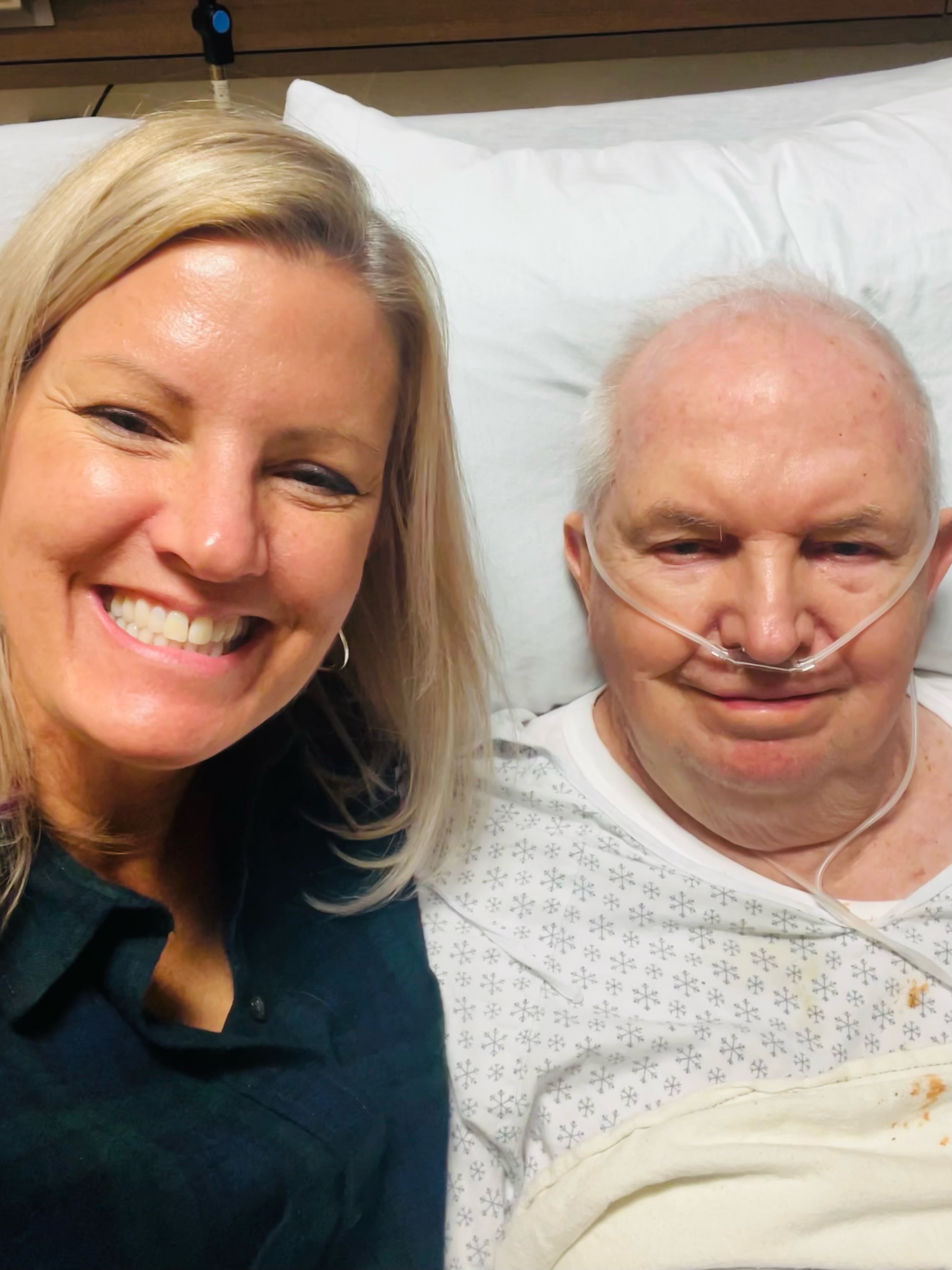
New sounds of distress sent me running in my bathrobe to Dad’s room at 2:00 a.m., where he struggled in vain to sit up on the edge of his bed (hoping to pee). I pulled on his shoulders to sit him up, and held him there for twenty minutes (unable to pee). Mom’s 5:00 a.m. knock on my bedroom, and her cry that Dad needed my help, sent me dashing again. Dad lay face down on the floor, wedged between the bed frame and the night stand, his face in a gallon-size garbage can. (I am learning, too slowly, to elder-proof a home.) He could not move, only grunt. With difficulty, I lifted his torso enough to free his face from the can. “Just leave me here,” he begged. I could do nothing but leave him there, except provide a pillow to protect his face from rough carpet pile. And I covered him with a quilt. I stood there watching him breathe, inside me a growing fury that he was so helpless and incontinent and that I was so helpless and impotent, that I could not move his bulk, could not help him relieve himself, could do nothing but watch him struggle and fade. (At 84, his mother Dora fell out of bed and became wedged between the bed frame and the night stand. And that is where she died.) In a rage disoriented by little sleep and much fear and grief and stress and acridity and a traumatized waiting for disaster, I wondered angrily why he didn’t just get it over with and die. Take him, I demanded—put us both out of our misery. We can’t do this anymore. I just could not manage one more night, or one more hour, of death struggle and incontinence. In that moment, I saw the threshold, with two helpless men on one side, and professional paramedics on the other. My mind cleared and I saw “911” as the only answer. But I needed some time to think through the details, and Dad was sleeping comfortably, finally, albeit on the floor, and my leaving him there snoring for thirty minutes while I prepared my mind and my plan would do him no hard. I buzzed my stubble hair and showered and shaved and ate some Quaker granola with icy milk and packed a bag with the advance directive and the power of attorney, my books, water bottles, cash, an apple, and Dad’s glasses and wallet and insurance card. Only then was I ready to awaken Mom and explain that I needed to call the paramedics—she did not want to have to—and to awaken Dad and explain that I needed to call the paramedics—he did not want to have to—ready to dial “911.” Strong young men, they carted him out on a flexible stretcher and drove him away to Alta View, and I followed, convinced this was his life’s end, his final ambulance ride. I felt grateful he would not die in my arms, that someone else was in charge now. Eight vials of blood and three hours later, Kirk, a superb nurse, entered ER Room #5 wearing a surgeon’s mask, and announced, “Guess what, Nelson? You have Covid.” Covid? Covid! How surreal to feel a surge of giddy relief that Dad had Covid. What Dad and I dreaded was the intractable mystery of his utter undiagnosed debilitation and his slow trajectory toward an unexplained death. That we could not handle. But Covid we could get our brains around. The doctors and nurses knew exactly what to do with Covid. And the Covid diagnosis explained his symptoms of total exhaustion and chest pain and profound weakness and a slight fever and the beginnings of a cough and cognitive disorientation. I wanted to cheer, “Eat! Drink! Be merry! For tomorrow he will live!” The doctor stated with nonchalance: “Yeah, this Covid variant really hammers old people, but Nelson should make a full recovery.” After a night of anguish and impotence, a new day of hope and of better tomorrows broke open.
(Pictured above: Dad in the hospital with my sister Sarah.)

Raspy, distressed breathing, not a loud thump, alerted me to something wrong, and I found Dad lying on the floor quivering with total futility to move. I verified he was not injured, then rubbed his back and encouraged him to just rest for a few minutes until he regained some strength, code for, relax while I figure out what to do, and draped a blanket over his bare legs and bottom. Rising from his bed, he had taken two steps with his walker and collapsed, utterly spent. “I have no strength at all,” he croaked, frightened and suddenly hoarse. “I wonder if this could be the end?” After his first fall two years ago, I bought a padded sling to wrap around his big chest and help me lift him, which I did now, hoisting him to his hands and knees, and I held his weight as he crawled to the couch. More heaving brought his arms onto the couch, and my knee leveraged a hip onto the cushion. From there I fine-tuned his position with awkward pushings and pullings. The operation took all my strength. Nick, the strong young nursing assistant, arrived and bathed Dad with a sponge. He managed to bring Dad downstairs—Dad insisted on it—but I almost wished he hadn’t, wondering how I would manage to get Dad back upstairs and in bed. He grew weaker during the day, croaking and coughing. I served a dinner of baked squash, steamed spinach, and organic apple-wood chicken sausage, sliced for him into single-bite portions, and I watched dismayed as he stabbed his fork eight times into the plate, missing the sausage. He began sentences only to slip into confused nonsense, and I wondered, Could this be the end? At bedtime, I did not succeed in transferring him from his recliner to the walker seat, and he sank again to the floor, helpless. “Just let me rest here,” he whispered, wheezing. My morning strength failed me, my muscles ached, and I knew absolutely I could not get him up. Our neighbor Josh is a big man who knows how to hoist big disabled men, and he ran over at my phone call. Together (mostly Josh), we got him into the walker seat, onto the stair lift, back into the walker seat, and into bed, a pad tucked under him. Mom is beside herself with worry and fear, and wondered to me whether this were the beginning of the end. We will see how he fares in the night, and what the morning brings. In the meantime, I am on call: Mom has instructions to wake me with even the smallest need. Calm during the day’s crises, my own silent distress compounded during the day’s uneventful hours, and has grown in the quiet and dark of my room.

“Tell me what’s happening,” Dr. Hawkins asked me over the phone. I was not sure how to express the subtle changes my siblings and I had observed, but I breathed deeply and tried. Well, first, there’s her memory. She forgets what I told her just minutes or hours before. And she’s forgetting the names of familiar people and places. (Heck, I do that, too.) Second, she becomes easily confused. I explain simple things several times before she comprehends, and I interpret for her much of her mail. Third, anxiety. When something needs doing, it needs doing right now. Small things distress her, until I reassure her everything will be fine. And when go for a drive, she points to cows and clouds and airplanes and exclaims, “Look, a cow!…a cloud!…an airplane!” “Well, I think you’ve expressed it pretty well,” the doctor confirmed. “Bring her to my office, and we’ll talk.” Raising with Mom the subject of a doctor visit to discuss memory and confusion hurt her feelings, though I had tried to gentle and assuring. “I don’t remember forgetting anything,” she worried. Hawkins was so kind, entering the examination room with “Hello Lucille!” and pulling her into an embrace. He thanked her for having the courage and wisdom to have this hard conversation, but assured her she had done the right thing. “If we catch dementia early, we have ways of slowing it down. (And don’t worry about the name: dementia is just the medical term for memory loss.) If you had waited until there was a real problem, there is little we could have done. Dementia is caused by brain atrophy and is not reversable. You were right to come in early.” An MRI two years prior (which Mom remembered but the doctor and I had forgotten) had revealed mild brain atrophy, normal for her age, so the doctor moved right into Mom’s treatment plan, which included taking a new once-a-day pill and doing lots of word puzzles and needlepoints. “Thank you so much for coming in to talk with me about this difficult subject,” he said. “You’re doing great.” Mom left the doctor’s office feeling good about herself and her future, and I left feeling grateful for a kind doctor.

A blogger commented about our souvlaki and fries: “Interesting perspective on family dynamics and meal choices.” I wonder what he would quip about our incongruous hodge-podge of jam on French toast, Korean dumplings, and buttered peas. “What a wonderful looking meal!” Dad kindly commented, and blew his wet nose into his dish towel/napkin/food catcher/bib. “There were no buggers,” he rationalized when I brought him a new box of tissues. Previous to this week, all the little personal items he needed for his daily comfort had accumulated on a small end table and on the floor—everything must be within his reach. Eight dollars bought me a handy sturdy thrift-store shelf that vastly increased the items he can have with reach—books, Bible, gum, flosser-picks, tissues, hearing aid batteries, nail clippers, yellow legal pad, pens, reading glasses, check book, wallet—and reduce clutter. Conversation turned to the lawn and yard. Victor came with his air compressor, turned off the irrigation system, and blew out the lines. This week will be the last mowing, mostly to vacuum up maple and sweetgum leaves. “I almost went out to suck up all the leaves, but Lucille wouldn’t let me,” he pouted. “I would have just ridden in my wheel chair and transferred to the mower.” I was incredulous, and I asked, carefully, if he remembered the nearly impossible effort of getting him on and off the mower last spring, how I had to hoist and heave and shove and pull, how I hurt my back. He did not remember. But he remembers the distant past. Struggling behind his walker, he announced to our company, “I have a vision Roger as an infant standing in his crib and gumming on the top rail. You must have been teething.” Not again, I reddened. At least it wasn’t the washing-the-cloth-diapers and ironing-the-diapers-dry story again. Mom diverted attention by inviting me to inspect the drawer full of new towels—church sister Marla had taken her to Kohls—the old towels were stained and worn thin. Last week, church sister Barbara took Mom to a music store, and brought home a 1940s song book. She bought the book of 104 songs for fondness of song #104, Cole Porter’s “You’d Be So Nice to Come Home to,” and wanted to show me the moment I walked in the door from work.
It’s not that you’re fairer than a lot of girls just as pleasin’,
That I doff my hat as a worshipper at your shrine.
It’s not that you’re rarer than asparagus out of season.
No, my darling, this is the reason why you’ve got to be mine.
You’d be so nice to come home to.
You’d be so nice by the fire, while the breeze on high sang a lullaby.
You’d be all that I could desire.
Under stars, chilled by the winter, under an August moon, burning above,
You’d be so nice, you’d be paradise, to come home to and love.
 Dad’s new organizational setup.

Mom worried the “meat” would upset Dad’s stomach, and I wondered, since when does meat upset Dad’s stomach? Not with last Sunday’s post roast or the hamburgers from Jeanette’s visit or…. The “meat” was four small chicken chunks on a kebob—Greek souvlaki—with a mountain of fries on the side, and a spot of salad and a dry pita. I had arrived home late from the NOMÁS free immigration clinic, which, after two years of nightly cooking, I now use as an excuse to order out on Thursdays. Look at these French fries, Rog! Dad had been hoping for French fries, had been craving French Fries, all day, but Mom had not felt up to driving alone to McDonald’s or Arby’s or Arctic Circle. These are such wonderful French fries, Rog! Mom took a swallow from her glass of Juicy Juicy mango juice, and the swallow sounded wrong, and she sputtered and choked and her face turned red then purple and she coughed and coughed with her lap towel to her face. As with so many of their hardships, I could only watch and worry. But she recovered, and chuckled with an embarrassed squeaky rasp that things sometimes go down the wrong pipe. As I well know, from my own frequent experience. One of my siblings drinks only from a straw to avoid certain aspiration otherwise. Is it genetic? Dad choked through his own mis-swallow: I just love [cough] these French fries [cough], Rog! [cough cough]. I’m glad, Dad, because apparently you are having a mess of French fries for dinner, since you are worried about the chicken and pick at your salad and nibble at your pita. I spent the whoooole day wanting French fries, Rog, and here you just walked through the door with the best French fries ever! Thank you, Crown Burger, I think. Cough cough cough.

That morning I worked like the careful assassin who leaves no trace at the bloody crime scene, with the walls and floors scrubbed and sanitized, the clothing rinsed and washed (and sometimes thrown away), the washing machine sterilized with hot bleachy soapy water, the trash deposited in a distant dumpster, a squirt of Febreze. No one would ever know the bathroom was anything more than a bathroom and not a crime scene. Back in his recliner, Dad lamented his nighttime desperation for his children and grandchildren—he had prayed all night for their protection and triumph over tragedy. What can he do, he asked, but trust in the God he loves? Desperation for the same children, my children, worries me at night, too, and during the day, too, and what can I do but toil and trust? But last night I worried about the deer plucking my mum blossoms and nibling at the arborvitae, and I braced myself, shivering, for the stink of putrescent eggs sprayed liberally. In the kitchen, the warm slimy aroma of raw onions rises in moist billows, roiling the contents of my stomach, which never sees raw onions. Another trip to the trash. I shiver again in the quick darkness and chill of the moon crossing before the sun, the fusion globe a mere crescent in my eclipse glasses—but even ten percent of the sun’s surface blinds without the dark plastic. How fascinating that the rocky moon can be precisely the size and the arc to neatly eclipse the giant gaseous sun to reveal the coronal “ring of fire.” Home from work, I found Dad in his chair with only his red velvet throw over his legs. “Your dad had an unfortunate accident,” Mom announced, matter-of-fact, and I braced for a crime scene cleaning. But the “accident” was merely that he had fallen asleep with his icy glass of Coke Zero in his hand, which had slowly tipped in his slumber until it spilled fully into his lap and soaked his pants and his undergarments and his sitting pillow and his chair and his No. 1 Ladies Detective Agency books, now drying wrinkled in a row. “He was so upset!” Mom grinned. Yes, an unfortunate accident, but one we can handle, anytime.
Photo by Brian Baker, October 14, 2023

English Ivy clad the three-story brick wall hemming in the Edgewater playground, and Chicago’s breezy updrafts lifted every leaf in unison, looking like thousands of tiny green baffles rising and falling with each caprice of the wind. My fearless garrulous year-and-a-half-old grandson William worried his mamma by walking on the low walls and climbing the rain-slicked stairs, and he soaked his pants sliding into the pool gathered at the foot of the slide. (Why do playground designers always make slides that gather pools of water at the bottom?) Admiring the ivy, sticky with after-rain humidity, I called Mom and Dad to let them know I had traveled well and arrived safely and was enjoying William and his mamma and papa and their third-floor brownstone apartment and Lex the coy Maine Coon cat. (I know he likes me, or at least tolerates me, because he deigns to touch my offered nose to his, sometimes.) How nice to get away from the duties of home and caregiving for a week, and to visit a beloved daughter. The week passed in a happy instant, with long urban walks and bagels at the kosher deli and the farmers market and the annual Andersonville yard sale day, but especially reading to William and playing with William and chasing William screaming and running down the creaky hardwood hall. Sarah had looked after Mom and Dad in my absence, and when Dad had lamented over how hard it was to transport himself to the bathroom to brush his teeth after meals, she had told him about flosser-picks, and he asked Mom to ask me to get some from the store, but I had some already and could quickly deliver a bag when I returned to Utah. Flosser-picks and Mentos gum keep his teeth clean until he can take the stair lift at night to his master bath water pick. The flossers delivered, I drove away to meet some people I did not know at a local park, under a pavilion. At a friend’s suggestion, I signed up for MeetUp notices from groups that interested me, like kayaking and hiking, painting and mountain biking, and another group caught my eye, and I swallowed hard and headed into the unknown to meet people I do not know, with whom I may or may not have anything in common, to play Apples to Apples and to laugh and be pleasant and to try to remember all their names—Sally and Julie and Johnny and Greg—the names of people who, like me, had joined a MeetUp group named Introverts Who Are Not Total Hermits. Yeah, that fits. And I actually enjoyed being there with them, these people I did not know.
 A Chicago wall in winter with defoliated English Ivy.

The man died fully four years ago, at just 28, and yet she keeps coming every day to his grave, where the flat headstone bears only a first name, but does contain a carved silhouette of him holding two named children by the hand. Remember: there is no wrong way to grieve. Mourn loud and long if you wish, or quick and quiet, mourn until the love and the loss and the anguish seep into your soul as you stagger on. On Sundays, Dad and I sing the hymns with the televised congregation, holding our hymnals, and he is either ahead or behind the tempo, finishing the words too early or quite late, and often on the wrong verse. But he is singing, and I with him, and he still reads the bass part well. On Wednesdays, Mom has gone with the Church sisters on little outings, to Trader Joe’s grocery store, to Deseret Industries thrift store, to Pirate O’s import store, to Hobby Lobby craft store, for nothing in particular, but some little thing always catches her fancy and comes home with her, like secondhand colorful plastic cups, like O’Henry bars from Canada, like the round artist sponges she likes in the shower, like two small terra cotta pots to replace the ones I gifted to Solange with volunteer blue junipers to transplant to her yard, if she wants. What could I do for the young woman grieving daily at her dead lover’s grave—what could I do that would not be frightening or unwelcome or weird? And on Sundays while Mom sits with her friends at church, I pronounce the prayers upon the morsel of bread and the swallow of water, sacred emblems of sacrifice and hope, and stretch them out to my father, and he accepts them with quaking hands. As customary in my Church, he received the priesthood and was ordained a priest at the age of 16, in 1951, a priest who is not a pastor or a reverend but a youth who pronounces the prayers upon the bread and the water and reaches them out to the covenanting congregants, promising to mourn with those who mourn, to comfort those who need comfort, and to always remember Him. Dad always found his priesthood participation meaningful, as have I, being part of something holy and transforming. His mentor, the Bishop (who in my Church is the unpaid pastor or reverend), passed him a scrap of a note that read, “that is exactly how the sacrament should be blessed,” which praise never did leave his heart, from years 16 to 88. The simple note I wrote to the woman at the grave, tucked under her windshield unnoticed while she slept wrapped in a blanket on the dewy grass, read “a gift for you in your grief,” and in a bag Megan’s book about grieving for as long and however is right for you as you pull the anguish into you and hold it and sit with it and rock it until it becomes forever part of who you are. Then I knew I had done enough and should leave her be. Dad asks me often about my pumpkins, needing me to be his eyes, and I answer I don’t know because I have not checked them in weeks and do not seem to want to check them, preferring they grow or wither without me knowing, but I tell him one plant seems to be very happy and climbs each day a bit higher up the chain link fence, and today reached the top, and perhaps in some weeks some little pumpkins will have turned from green to orange and be plucked from dead vines to sit squatly on the porch for the neighbors and us to enjoy.


A young woman has been sitting by a grave every morning at 8:00 as I commute past, and I cannot help wondering about her story, and her grief, and her devotion. Fresh flowers appear weekly in the vase, this week white and passion purple. The bright warm colors of the mums I planted have brought me happiness each morning and evening I leave from and return to my parents’ home, which they keep telling me is my home, too. Color is happiness, I think. Fushcia. Yellow cream. Tangerine. Scarlet blending to barn red. Dad effused as I maneuvered his wheelchair for him to see them. Color is happiness. And color is grief, and color is comfort. The hardest aspect of having the basal cell cancer scraped from Dad’s left nasal fold was the effort of the trip with its great strainings into and out of the Faithful Suburban. Every aspect of the next day’s visit to the dentist, or should I say the oral maxillofacial surgeon, who pulled and yanked and twisted at the infected tooth which finally came forth with it enormous roots half again the size of the tooth, proved arduous. Mom asked for the tooth. “I don’t want to see it,” I announced, but at home she wanted to show me anyway. “Why would I possibly want to see that bloody tooth!” I retorted. I quease at blood and everything else that belongs on the body’s inside. Sarah, though, will find it fascinating: she has a strong stomach and an eager medical mind. Poor Dad had to deal with a bleeding mouth and an anesthetized face and bloody gauze and salt water rinses and feeling beat up. Waiting for the surgeon, Dad told me had been in lots of fights in high school, but his fights involved stepping in to stop other fights and to rescue the bullied, and his toughness intimidated the tough guys, even though one punch did break his nose, and the doctor rammed two rods up his nostrils and lifted the broken bones and set them back where they belonged. Despite the tooth extraction trauma, the pain never came, which astonished me for the depth of the abscess and the size of the gape left behind. Grandpa Wallace had lost all but his front teeth before Mom outgrew girlhood. She remembers his slightly sunken cheeks, and she remembers standing by his side as the dentist pulled what teeth he had left—she had insisted on being there, a little girl defending her dad. Dentures followed healing, and Wally was so happy with his full cheeks and full mouth of teeth, for now he could eat everything he loved but had been denied him for years, including apples, carrots, and corn on the cob. And Mom was happy for his happiness. The family, as it grew, had no money for dentists. “Thank God for Harvey!” Mom sighed. Uncle Harvey had married into the family and become a dentist, and forever after gave the children free dental care, including many fillings. His jolly laughter resounds in my memory these decades after his death. This morning the young woman lay in the wet grass wrapped in a blanket against the cold and slept on the grave, and I felt a blend of admiration for her great love and of sadness for her great loss.

I lamented to mom that now she had eight sets of sheets and eight towels and eight pillowcases to launder, and I offered to help. But she enthused, “That’s okay. I love doing laundry! I have always loved doing laundry!” The bathroom in the Bawden house sported above the tub a small hinged door, behind which descended into the darkness of the basement a laundry shoot. As a little boy I felt tempted to slide down the shoot, but I never did—a good thing, I am sure. And I remember the old washing machine and wringer and tanks, long disused, and the drying lines still spotted with clothespins like wooden birds below the open joists of the seven-foot-tall basement, perpetually dark. As a small girl and then a grown-up girl, Mom used these machines to wash the family laundry. The washing machine churned noisily back and forth. But there was no spin cycle. Mom slopped the soapy wet clothes into a tank of clean water for a rinse, then passed them through the electric-motor wringer, pressing the clothes between two tight rolling pins made of wood. The launderer needed to be very careful not to let the wringer grab her fingers or hair shirt sleeves: serious injury could result. A second rinse in a second clean water tank, a second wringing, and the clothes were ready to be hung on the lines, either outside during spring through fall, or in the basement in winter. “I’ll do it a little at a time,” Mom reassured me, not at all put out. In fact, the thought that our company had been comfortable and dry with these bed clothes and towels gave her a sort of familial connecting comfort. She finished on this National Day of Service, the 22nd anniversary of the shocking and traumatic destruction of the Twin Towers and the Pentagon and so much incinerated life by a new kind of terrorism. The service I chose lacked glamor, and I wondered guiltily if it were worthy of the trauma and sacrifice that produced this special day. Millions of people in thousands of places doing all manner of service. Me? I chose to pick weeds. Not just any weeds, mind you, but puncturevine weeds growing along the Jordan River Parkway trail, with their two-pronged “goat head” seeds that puncture all passing tires and ruin many a bike ride. I joined Jordan River Commission staffers, and other volunteers, and after four hours, my heavy-duty black plastic bag was full and heavy, weighing perhaps sixty pounds. It must have contained ten thousand goat head seeds, which I was happy to equate to ten thousand saved bicycle tires. One monster had creeped to a diameter of six feet and bragged hundreds of noxious seeds. At a convention for city officials this week, I spent my networking breaks tying quilts for Stitching Hearts, quilts which will be given to foster and homeless children, a warm, soft, comforting homemade possession all their own that they can take with them from home to home or camp to camp—for some kids, the quilt will be their only possession in this world. Stitching and cutting and tying with these silver-haired ladies in their seventies and eighties, my loneliness ebbed a bit. While not the love I have searched for—a kind, intimate, whispering partner love—I felt happy in this new relationship, joining good people in service, small service, like pulling puncturevine, filling out immigration forms, tying quilts, washing sheets—I felt happy in this other kind of companionship and love, that comes with the giving of oneself, no matter how small the service. For me, smaller is better, because big always overwhelms. I can do the little things. Stitching and chatting and chuckling, I wondered if this is the type of love and companionship which will temper my sadness and loneliness, which will bring me a measure of happiness and joy, which will carry me through my future days. It just might be.
(Pictured above: a three-foot radius puncturevine spotted with hundreds of goat head seeds and flowers, hanging from a Russian Olive tree.)
Eight family guests flew in Friday night for the next morning’s wedding, the beds set up and clothed with sheets and blankets and the towels stacked and the groceries bought. And the water heater broke, so the wedding day brought cold showers all around, and no one grumbled and everyone smiled and looked beautiful at the temple, radiant and soft as the light through the stained glass and the zinnias and roses on the grounds. The officiator instructed the groom and bride after vows to cleave to each other and to labor together in love, and that the groom may now communicate his love with a kiss, and the bride quipped grinning that he was a good communicator. Soft laughter rolling through the temple. My predominant emotion at weddings is doom, for marriage has brought so much sadness and pain and grief to me and to so many I love, the termination of built hopes and the loss of future memories the absence of whispers and touch, and I struggle to want to celebrate. I wished them luck and congratulations, wanting to believe theirs could work. My children have chosen well, and I encourage them often to just keep talking and giving, come what may. This white-veiled wedding has brought the family together in hope and love, at least, and that is a good thing. I have noticed a young woman sitting graveside in the green expanse of Larkin cemetery, morning after morning. Sometimes she is lying on the patch of new sod, a white bouquet in the vase, and I sense her black veil of mourning. You know you have a gift for her, came the thought, and I slid Megan Devine’s book into a zip loc bag with a note: A gift for you in your grief… to leave by the bouquet for her to find, but she lay there again, sleeping wrapped in her blanket against Fall’s chill, so I secreted my gift under the windshield wiper of her blue Jetta and tiptoed away, glad for the anonymity that might ease the gift-giving and avoid the awkwardness of a stranger’s strange approach. The man had died at 28, leaving behind two children and, presumably, this grieving young woman. I wonder if I will see her again sitting graveside. Not today, as I returned from the happy wedding, stuffed with Brick Oven pizza, returning to do what I do best, eradicating weeds and pruning dead wood, the blooming geraniums belying my aching arthritic hands. Their infirmities did not allow Mom and Dad to attend the wedding festivities, but Mom called and pleaded and Scott came on this Labor Day Saturday and brought a new water heater when he could have not cared and made us wait until Tuesday, but he came, and the water heater was under warranty, saving us $2,200, so he said. And $900 later everyone is happily but tiredly home, enjoying sprays of warm water, languid on the couch, munching Oreos, the couple married off, off on their adventure, having stepped into the mystery of marriage.

“Freeze them all!” Dad commanded. “They don’t belong on my body.” Indeed, all the moles and tags and bumps offended his dignity and threatened his pride. Kirk the PA said he would be happy to freeze Dad’s little lesions to the extend he could tolerate the pain. “Freeze them all!” Dad repeated, grimacing at each squirt of the liquid nitrogen. Thirty minutes later I wheeled Dad out of the dermatologist’s office with his chest, neck, face, and head boasting more thirty red polka dots. Back at the car, he realized all the freezing and pain had triggered a bladder response, so back into the building we went to look for a bathroom, a building with no automatic doors for the disabled. The men’s room at least was ostensibly wheelchair friendly, but we soon entered into pathetic gymnastics with doors and wheelchair and multi-point k-turns and misplaced grab bars—this bathroom might be legal, but it definitely was not wheelchair friendly, in fact it was wheelchair nearly-impossible. We barely managed, as a team. Having visited the restroom, the drive home was much more comfortable, despite his painful polka dots. Two incognito spots had hidden in the wrinkles above his mouth, one on each side of his face, symmetrical. “A little poke,” lied the friendly Kirk, injecting lidocaine in each spot ahead of the biopsy. Dad fretted immediately about the possibility of two surgeries on his face, above his lips, a horrifying prospect. I could not help thinking briefly of the Joker, but banished the thought unuttered. With dinner Dad had Coke Zero in one glass and apple juice in another, and drank neither. I cannot get him to drink during the day, and I am tempted to remonstrate. But then I remember that each trip to the bathroom is a life-or-death struggle, and, as he tells me frequently, his paralysis worsens every day. No wonder he avoids hydrating. On the front porch lay a package decorated in floral wrapping. I had ordered the needlepoints in November last year for Mom’s Christmas gift, but they never came. I entered into the longest email string of my life: can you check on my order? one item is out of stock, we can’t order the other item in, no that replacement choice is also out of stock, can you check my order? yes we have that one, they will be mailed soon, can you check my order? so sorry, we’ll get right on it, can you check my order? and they never came. Exasperated, I mailed a letter to the owner about my terrible customer service experience, adding that they had my money, inviting them to make things right, and then I let the issue go, certain I would never see my order. But today, August 28, against the odds, the package finally came: “Merry Christmas, Mom!” I finally got to say.


Mom fussed over Dad as she and I left for Smith’s. “I will miss you,” she cooed, patting his hand. “Will you be alright until we get back?” At the grocery store, she pulled a sandwich from a bank of coolers, and whispered her excitement: “I’m getting this for your father. He is going to love it!” The sandwich looked unremarkable, but her whisper conveyed the pride and power of a simple choice and purchase, when so much has fled her influence. She delivered the sandwich to Dad immediately upon our return, and looked chagrined at his request to add slices of sweet onion and slathers of mayonnaise and mustard, requests she perhaps thought challenged her whimsical magnanimity, rained on her pride, and poo-pooed her power. But, in the end, they both happy munched on their lunch, with Special Agent Gibbs on the screen. For the first time in a year, Dad successfully watched our neighborhood church services online. Zoom has failed him consistently, with bad microphones making the speakers unintelligible with their underwater garble. Frustrated week after week, he merely fell asleep, later receiving Mom’s report. With polite urging from several congregants, including me, the three local congregations pooled their budgets and purchased the equipment to connect directly to the Church’s broadcasting system, with a dedicated camera and hard-wired mic. “I loved seeing church today, Rog! Weren’t the talks great!” I stayed home with him so I could refresh the link when the screen froze from low bandwidth. There are always things to improve. But he sang from his hymn book, and appreciated the emblems of sacramental bread and water. Walking down our street that evening, Mom relished the fresh air, and Dad admired the gold-tinged clouds, and a distant airplane flew by the moon, bright silver from the western sun, and Steve and Marla emerged from their house “to wave to the parade” of two wheelchairs, one pushed and the other motorized, and to say hello. Nice neighbors. But I cannot take my parents for walks often enough, and Mom aches to get out of the house. I asked the Church’s women of the Relief Society if they could assign “sisters” to take turns picking up Mom every Wednesday for half-hour outings. The “sisters” were delighted—“we just love your mom”—and texted the next day with September’s schedule. Such nice neighbors. I will report her adventures.
(Pictured above: a mere four hours’ effort to extirpate weeds and shape shrubs in the back yard.)

The ink has drained from my Lincoln rollerball, and I lack the means to refill. But the sun never stops its monotonous movement morning till night. I asked Mom if that day were a good day for me to do laundry, and she exclaimed, “Yes! You can do laundry forever and ever!” So I began. The next day I came home from work to find them in Dad’s office, organizing his papers, a team effort, their combined age pushing 175 years, Dad instructing Mom from his coastered office chair: File this. Shred this. Throw this away. Shred this, and this. File these. No, throw those away—away! They both beamed their pride at their tidiness. This week brought hard conversations about fading finances and funerals and planning for the end of life, and after. They have always managed to afford their generosity, until now, when their spirit of giving exceeds their means to give. To my great calming relief, they were open, accepting, and grateful for my “thinking logically about things.” After all, they are one illness or fall away from assisted living and selling the house to pay. They proposed, and I agreed, that the only practical solution is for them to die in their own home. Dad has three abscessed teeth, poor guy, to be extracted soon, poor guy. But he felt inspired as I cast to their sagging television the national steeplechase championships where the BYU runner fell on a hurdle and rolled and rolled and jumped up to rejoin the group and win the race, and he felt happy to see all the dozens of photos I took on my mountain camping trip with Hannah (17) and Brian (33) and Avery and Lila (3 years 11 months) and Owen (10 months) and their smiles and explorations and crawlings in the dirt and splashings in the river pool and paddlings in the kayak on the high mountain lake and their roastings and burnings of marshmallows over the hot cedar fire, and the ripe thimbleberries. He still says, “I love life.”
Above: about to kayak on Moosehorn Lake, Mirror Lake Highway, Uinta mountains.
Below: peek-a-boo with baby; thimbleberry bushes with ripe sweet berries; the Provo River next campsite #18 at Cobblerest; view of the Uinta mountains from Bald Mountain pass, with two of the hundreds of lakes.


Old patterns seem to reassert themselves without my even noticing. I had pulled and raked weeds for three hours in 95 degrees. The gardens looked beautiful, and I definitely did not. At 3 pm I took Mom to the grocery store to cross off our lists. At 4 pm we put the groceries away in various pantries, cupboards, refrigerators, and freezers. At 5 pm began the peeling and slicing of vegetables for roasting: yams, carrots, onions, potatoes, mushrooms (plus sliced Kielbasa). At 7 pm dinner was served to grateful parents who cannot cook their own. At 8 pm came the washing of dishes and cleaning of kitchen. And I was so glad to be done with my work for the day. But at 8 pm Mom asked if we could go for a walk now, and, in fairness to her, I had hinted earlier in the day a willingness to take them on an evening walk. Now, I complained about having been on my feet the last five hours and about wanting my day’s labors to be done. “I really want to go,” she persisted sweetly, and I felt my weak attempt to draw boundaries and wind down my Saturday giving way to a kindly old lady’s pining to get out of the house, to feel the evening air on her face, to see trees in their multitudinous shades of green, to wave to the waving neighbors, to revel in freedom and calm and beauty with her arms raised exultantly to the sky. So, out the door we trundled. Nick drove by in his vintage Mustang, waiving, and smiled at our “We love your car!” and said he’d be back with something she would really enjoy seeing. Every night I sigh wearily, wanting my day’s labors to end, and there is always more work to be done. I am remembering back to Saturday mornings pulling weeds for three hours in 95 degrees, to the days of two decades of raising my seven children, when I often fell asleep comforting a crying child who himself soon slept sprawled and drooling on my chest, when I would seethe over dirty greasy soapy dishes at midnight, when the next day’s unbearable stresses already came crushing. “I love it!” Mom exclaimed after passing an enormous blue spruce twenty feet across and forty tall. I confessed to enjoying our walk, too, and heard her relieving sigh. Boundaries feel selfish to me. Every boundary I draw limits another’s needs and my service to those needs. Trying to draw lines leaves me feeling guilt for others’ disappointments. But a life without boundaries, as I well know, will leave me empty and dry and weary and resentful and depressed—all used up. I am getting a little better at saying, “That will have to wait until tomorrow,” Mom or Dad. Our walk finished at 9 pm. The doorbell rang at 9:10, just as I sat down to rest. Nick had come back, this time with his 1949 Plymouth (blue). “What do you think of her!” he asked. His gray mustache grew from his lip down his cheeks to well below his jawline. “It’s a Plymouth!” she impressed him, hanging on my arm as we walked slowly to the rumbling car at the curb in the dark. She told him the story of how she and Dad as newlyweds had driven their 1953 Plymouth (green) for five days from Salt Lake City to New York City, in 1963, at a top speed of 40 miles per hour, on local and state roads before interstates. The city had alternate side of the street parking rules, and Dad sleepily descended the apartment stairs at 5 every morning to move the car to the other side of the street to avoid tickets and towing. After three days of that, they decided they didn’t need a car in Greenwich Village, put a “For Sale $50” sign in the window, and sold the big rounded old Plymouth to a clerk at the corner grocery, who waxed it up and proudly cruised the Big Apple in his new Plymouth. I shook Nick’s hand. I became so weary raising my family, my love for them notwithstanding, and I am weary again now, my love for Mom and Dad notwithstanding. My work feels never done. That is the human experience: the work to be done always outpaces the time and energy to do it, and we tire despite ennobling lives. The thermometer reached 102 that day, the same day an email came from the company that hangs our Christmas lights on the house, asking for a deposit. How strange to think about Christmas in 102 degrees in July, waiting for parts to repair the air conditioning, grateful for refrigerators and freezers and ice and little water cooler fans bedside. We will forego the house lights this year. Is there irony in my hanging three August calendars on my bedroom wall, one for Push-ups, one for Planks, and one for Prayer? They can wait for August, I decided, and dropped into bed before 10.
(Picture of 1953 Plymouth from Dragers.com, used under the fair use doctrine.)

Dad talked with me for 63 minutes about bedding and food and shampoo and vehicles for the wedding guests coming in a month, and about Cecilia’s food poisoning and the country’s ammunition shortage and increasing road rage and the weeks of 100-degree days. Climbing the stairs to change after work, I felt the temperature rise with every step. My west-facing home office had turned sauna: 90 degrees and rising. (In Phoenix, Jeanette’s house rose to 109 when their AC quit.) Our air conditioner hummed but pushed only warm air through the vents. Dad complained about not sleeping at night and instead lying awake sweating and sticky and stuck. I escaped to the basement, perpetually cool, but he and Mom have no escape. A “bang” in their room startled them in the dark of night three. “Lucille, get up and see what that was!” Dad instructed; he would have done it himself in earlier years, when he could move. Mom found that the ceiling fan I had turned on the move the air had flung the metal trim off a glass blade into a wall, thankfully not hitting a mirror or a window, or them, so the fan had to be turned off. Another thing for me to fix. The floor fan I borrowed from Terry only transformed the sultry night into a hot hurricane. Across the region, Home Depot and Lowes and other stores had sold out their indoor air conditioners, except for the models $400 and up, exceeding my budget, but I found at Target two tiny seven-inch-cube coolers that blow air over cold water, and I set them up for us bedside. The repair technician will save us in two days. The lack of air conditioning is a first-world problem, I know, but high temperatures can be deadly to 88-year-olds in any country, and I felt oppressed by both the heat and the responsibility of Dad’s well-being as I scurried to provide some relief, a bit of which the little water boxes brought by gently blowing cooler air on him all night, helping him sleep. He has asked me to bring him a scraper, a pallet knife, a sanding block, and the spackle—he had resolved to fill the old banister holes in the wall above the chair lift, and I resolved to let him do what he could do before jumping in to do it myself. The chair, unhappy at being stopped mid-rise, chirped continually at him as he worked. But he succeeded, and thanked me for giving him a job he could do. Dripping with sweat in my own chair, nervous about tonight’s pain and tomorrow’s root canal, I whined to Liddy about our woes, and she listened and affirmed and told me she was, at that moment, lying on her bed an ocean and a continent away listening to the waves lap the surf, and I asked her how she has been, and she said about the same, waiting for miracles but counting blessings.
(Pictured above: dried spackle ready to be sanded and painted, which Dad wants to do himself.)
(Pictured below: the ceiling fan glass blade metal trim.)

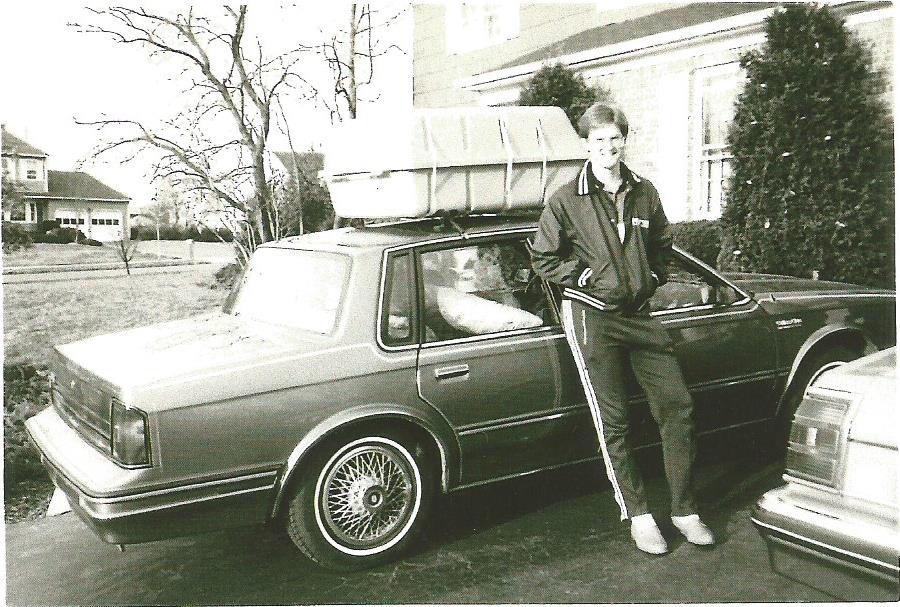
When I moved out in 1982 and drove 2,200 miles from New Jersey to Utah and to Brigham Young University, her first child to leave home, Mom walked the house for weeks feeling an aching emptiness, looked in my room to find me gone, missed my voice and my laugh and my presence at the dinner table and in the church pew and at Sunday afternoon games of raucous Pit. “Where Roger?” two-year-old Steven queried, lacking the experience with space and time and life to understand Mom’s answers about me being “at school.” I was simply and suddenly gone, and she experienced a mourning like for the dead. We had no internet, no mobile phones, no unlimited data plans, no email, no texting, no Facetime or Zoom or Messenger or WhatsApp for video calling, no Snapchat or Instagram or Marco Polo. We had hand-written letters that took a week or two each to cross the country. And we had exorbitantly expensive long-distance calls on chorded telephones. That old apron string had been cut clean through. And I did not give it any thought, had no awareness of her grief, did nothing to fill the hole. And now at age 60 I am home again, and Mom sees me in the hall and finds me in my room, and hears me practice piano, and waves good-bye from the porch when I drive away, and like a relieved chick she raises her hands and her chin and her expectations for her dinner. I am learning that apron strings come in myriad colors, patterns, hefts, lengths, and strengths. And they are never fully cut, but merely injured and stretched and tearing. Some mend. Others strangle. All scar. On Friday night at 8, after another late dinner, Mom asked if I would please take them for a walk in their wheelchairs, and we loaded up and rode down the ramps and rolled up the street, jogging out into the road around the neighbor’s big blue spruce. A sprinkler caught us, and Mom reveled in cool wetness with a squeal and her arms stretched to the sky. I announced at 9, with bedtime at 10, that my day was done and that I needed to wrap things up and move toward bed. Disappointment showed on her face, exhaustion dragged at mine, and she squeezed out, “Just know that I will miss you!”
(Pictured above: Yours Truly about to drive away from home.)
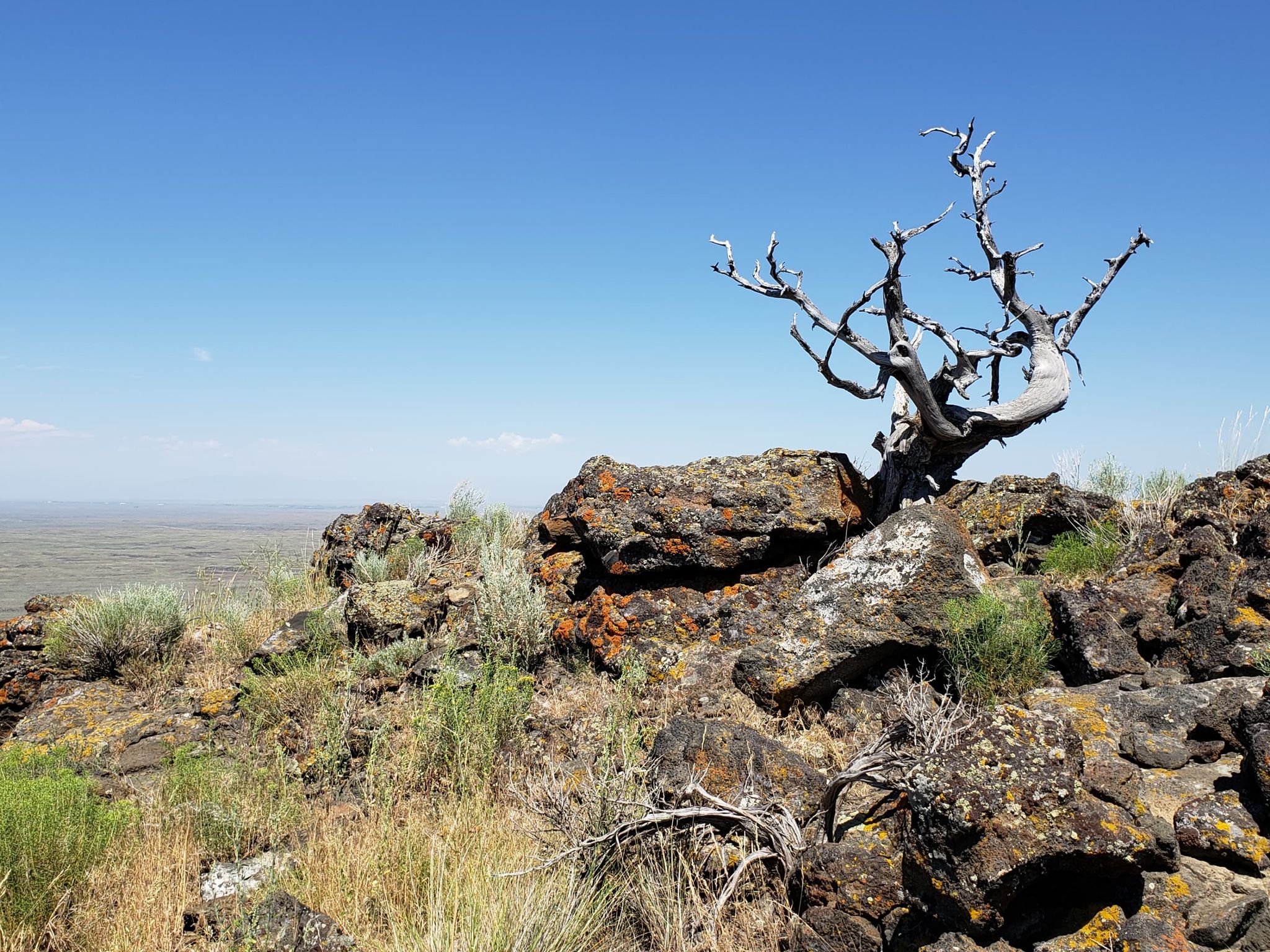
Sweat trickled down my arms and dripped from my fingertips, and my growing girth stretched my shirt against its buttons. I shall be thin(ner) again: I have signed onto the galactic S.U.G.A.R. treaty (I cannot remember what the acronym represents) and have foresworn all things donut-cake-cookie-candy. Ice cream once a week is an important negotiated exception. Breaking for breath, the trumpeted cackles of sandhill cranes float up from the Snake to where I stand on the rim of the world’s largest tuff cones, the Menan Buttes, ancient volcanos formed by magma boiling upward through groundwater. A pair of red-tailed hawks screech overhead, circling each other on warm currents, the same screech TV commercials ascribe to the mighty magisterial bald eagle because it sounds cooler and more mighty and magisterial than the eagle’s pinched laughter. On this high Idaho desert my four sons have struggled at university, jogged in fifteen below zero Fahrenheit wrapped and bundled, set climbing routes at the gym, served smokey sauced meat at Blisters BBQ, rafted class 4s on the Salmon, discovered the spirituality of a stone labyrinth laid out in the sagebrush, found dear wives and seen babies birthed, and graduated. They make me proud, because I love them, come what will. And when I walk through the front door to shouts of “Welcome Home!!” Mom and Dad have me sit right down to tell them about it all. They will not remember what I tell them. Dad commented to Mom last week, “I’m having trouble remembering peoples’ names,” and she answered, “Whose name?” “Nobody’s name!” he retorted: “I can’t re-mem-ber….” They won’t remember what I told them, but they will remember my pride in my sons’ personalities and my happiness in my sons’ successes and how beautiful were the photos of the high Idaho desert and the Snake River and the alfalfa pivots and the views from “R” Mountain.
 The core of the volcanic tuff cone.
 Views of the Snake River to the North and South

“Is today Tuesday?” Dad suddenly asked. “No,” I responded carefully, “today is Sunday.” “Oh, right,” and he observed how the days melt together, for during all of these days he sits in his recliner reading bestseller books, except for the compulsory state and national news and political commentaries. But I suspected this was more than the melting together of days. He is forgetting, losing his bearings. For my part, having made a study of grief and empathy in recent months, my word for the week is integration, by which I mean the perpetual process of welcoming into myself all of myselves: my fearful child and anxious adolescent, my flaws and brilliance, my wounded divorcé and bursting-with-proud father, all of my joyful wounded grieving giggling selves, the Me’s of every day and year and hour, with every cruelty and kindness meted out and swallowed—all of me, every bit, every moment—they are all here in a single whole Me, and I am working to love and to welcome even the unlovable and unbelonging pieces of my fractured whole. Integration eddied and swam in my thoughts as I sat in the 100-degree sun ridding the grassy strip between street and sidewalk of tentacled clover choking the grass, for hours, my hands aching and my head pulsing with heat. But I could not stop weeding. Was I trying to impress Mom and Dad, or the neighbors? Was my fealty working out a good son’s guilt? Was I aching for praise, or craving perfection? Dad cannot do it, so I will, and we will enjoy the results together. On that hot afternoon, their bedroom registered 85 degrees Fahrenheit; my room climbed to 90. So, I slept in the basement where the air always flows cool. For reasons he cannot fathom, Dad stuck his gym on the armrest of his recliner, then stuck himself to his gum, which promptly stretched and gooed in his fingers. Mom pulled out the trusty old (banned) bottle of Thoro and cotton-balled it onto his fingertips and forearm and the armrest and quickly dissolved the gum. The room reeked of naphtha, and Dad complained of the chemical taste on his tongue even though Mom and I both washed and scrubbed the armrest with various detergents and covered it with towels. “Thoro: The All-Purpose Spot Remover Since 1902!” the bottle title boasted, with the small-print subtitle, “Fatal If Swallowed.” We really did try to be careful. At least the gum is gone.

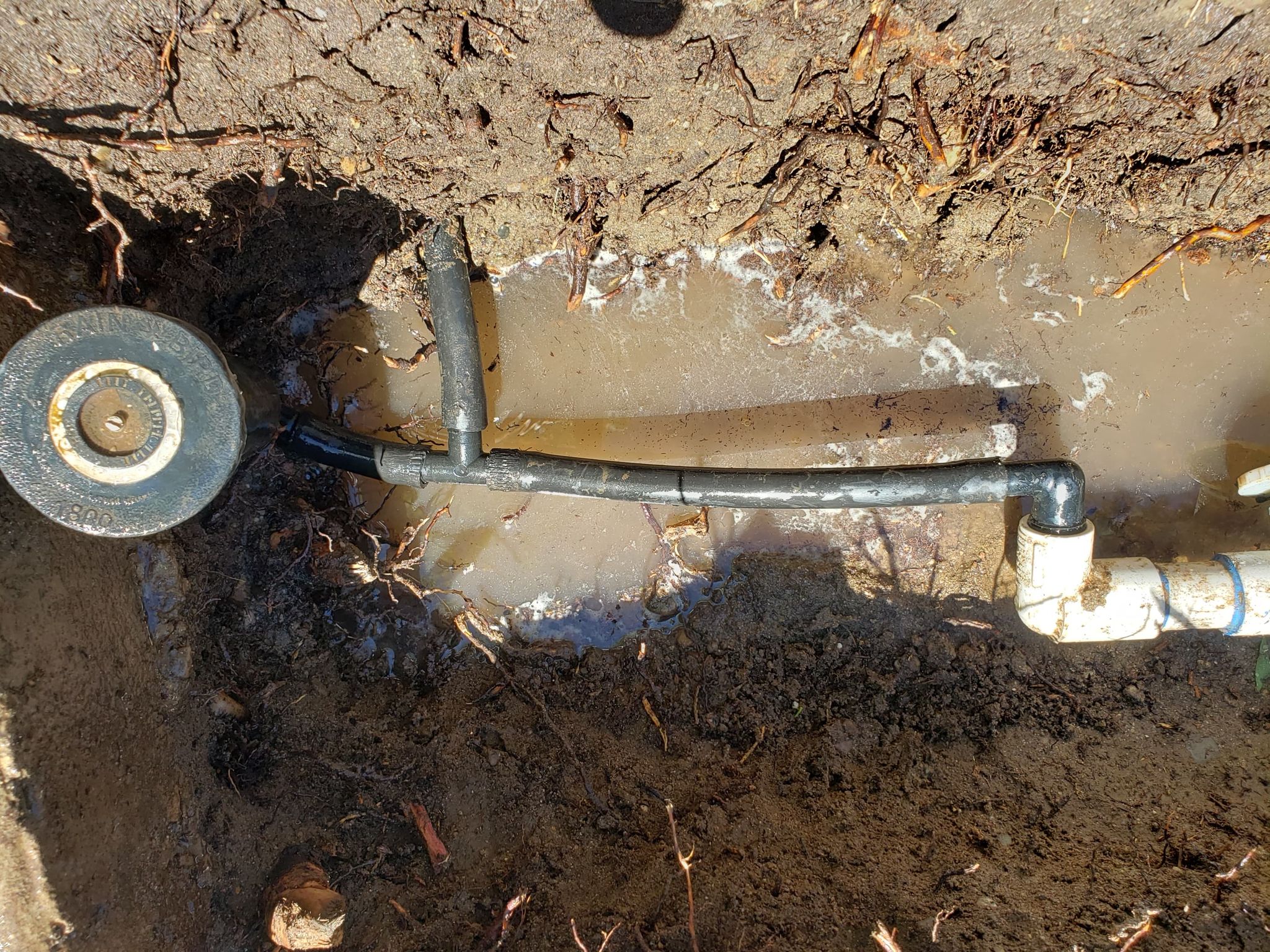
Dad whispered to Steven that he didn’t think I could fix it. But I did not know that. The last three heads on the long line of high-pressure heads gave no water but sat dry and unproductive. What in the world is happening between the last spraying sprinkler and the first dead one? a mere eight feet apart. I wondered day after day as the old junipers crackled with drought. I had conceded to myself that I might not be able to diagnosis the cause, much less to repair it. The fallen blue spruce is gone but left behind a complicated carpet of crisscrossing roots impossible to shovel-dig. Dad’s ax, freshly sharpened with a finely-grooved file, cut a spade-wide trench I could shovel. Dad had been ruminating over his long and productive life, and lamented to Mom and me that “I worked too hard for too long. I wasn’t home enough with Lucille or you children. She raised our family almost alone.” And Mom and I reassured him we were all fine, better for it in fact, and reminded him of the great legal work he had done and the greater soul-saving labor that enriched thousands of lives over thirty years. And here I was on my knees slashing and digging and swearing to discover, hopefully, and repair, improbably, the unseen sprinkler pipe problem while family visited indoors. Four hours was too high a price to pay for the project: “We could call Victor to come fix it,” Dad had offered. Not worth the return given lost time for other projects. But I wanted to prove to myself (and to him?) that I was smart enough and persistent enough and strong enough to solve the mystery and repair the break. Even with the pipe exposed, no visible problem revealed itself, but cutting into the black funny pipe and unscrewing the elbow from the white PVC, I found a dense round ball of fine roots entwined with pebbles, and could instantly discern how each pressurization of the line pressed the ball into the too-small funny-pipe, creating a very effective plug. Terry contributed spare funny part connectors—a “T” and two elbows—and Dad some dust funny pipe scraps. Repairing the pipe ended up being the simplest part of the entire project. I cast the pipe repair photo onto Dad’s TV and explained the process, the problem, and the repair. “You did it!” he praised, genuinely grateful and unsurprised, not knowing that I now knew of his earlier doubts. I had proven to myself (and to him?) that I could do it, and for that outcome four hours was an excellent investment. Resting with Dad in the living room that evening, he conveyed the increasing feeling of urgency he has been feeling to prove to himself and to God that he could change, that he could abandon old idiocies, could phase out his foolishness, could align himself more completely with truth and orient his mind and heart more exactly to his God. The Son of that God had explained to his faithful that the Father that sent him is true. And that is the truth Dad trusts, now and forever.
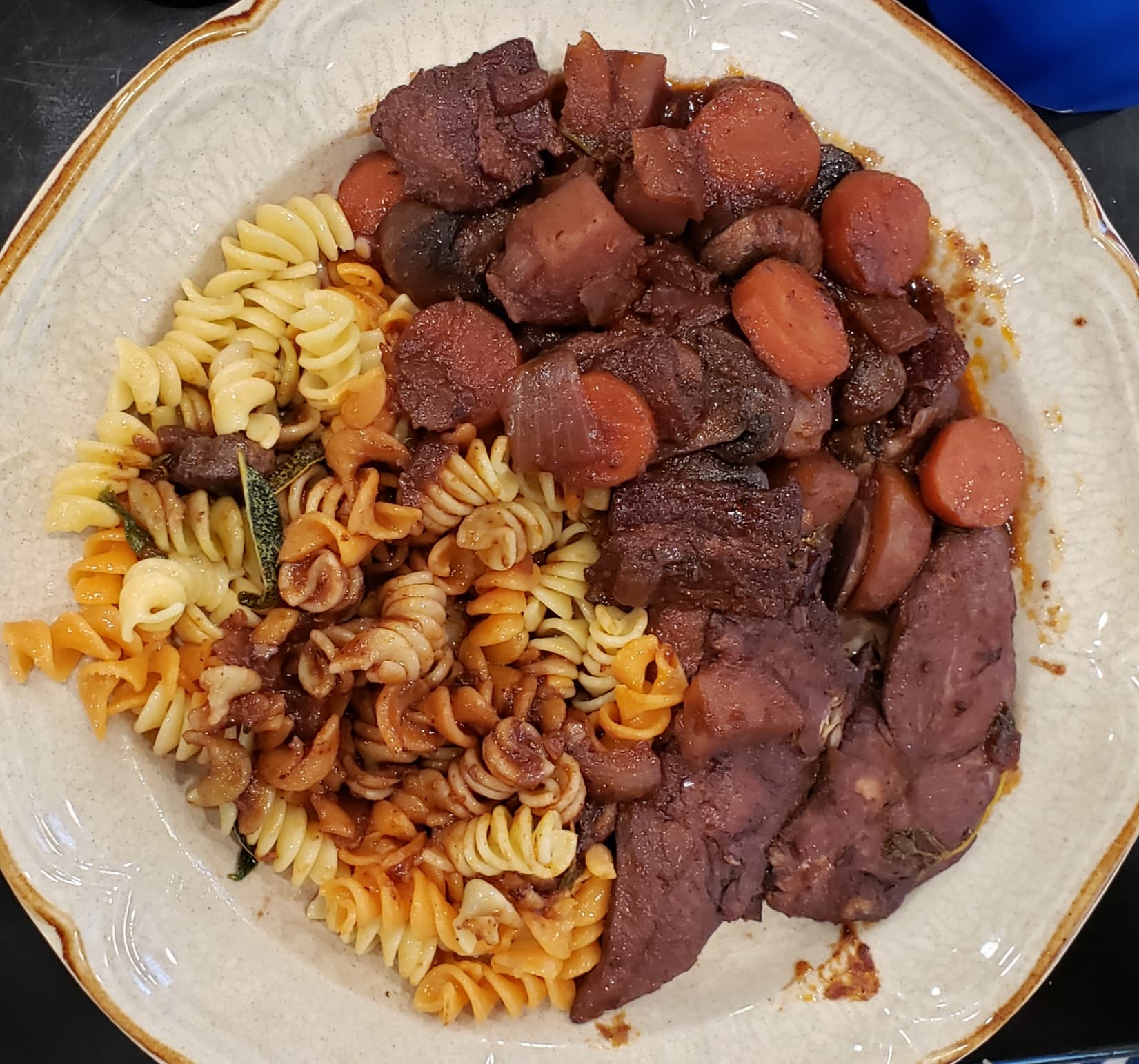
“Mom, I need to explain something to you,” I ventured. When I tell you something—Dinner will be in ten minutes—and you respond Excuse me, dear? and I raise my voice—DIN-NER WILL BE IN TEN MIN-UTES!—and you answer, I’m sorry, dear, like you think I’m shouting at you, and I am shouting because I am trying to be heard this second time around, but I am not angry (maybe a little frustrated because you can’t hear me and don’t wear your hearing aids), I’m just trying to be heard. “I know,” Mom sighs, “but I HATE them!” and around we go. She came to me meekly and asked if I could possibly find time to take them for a wheelchair walk to the end of their street and back sometime that evening, and we commented on each neighbor and their house and trees and shrubs and the perfect blue sky and the day’s 100 degrees cooling a bit in the dusk and how happy we are Mark and Julie are back in their home after remodeling it for their disabled grandchild and how pleasant the fresh evening breeze feels. Dad had called Steven earlier, and I listened vaguely from my kitchen coq au vin alchemy as they reminisced about scout camps old and new, old when he was 12 (and when I was 12) and Dad manned the waterfront and checked out the sailboats and swam the mile swim with us in Lake Seneca at Camp Liahona summer after summer—he always came and stayed the week—and now Steve is taking his sons to camp and manning the waterfront and wrestling and scrapping with boys on the dock and in the water and breaking his toe. Dad laughed at the old memories and grimaced at the paining toe, and did not want the talk to end, and waiting a bit too long, and sent me upstairs for fresh clothing. And he said to me that he didn’t think about dying, but rather about passing over into his next life, and when he gets there and sees his Savior he is not going to fall blubbering at His feet but will stand straight and look Him in the eye and say, “I love You, and I did my very best.”

The law firm had changed names four times in the decade-and-a-half since Mom and Dad retained a friend of a friend to prepare their estate planning documents. But I tracked down the firm and the lawyer, and scheduled to meet. I have felt unprepared to be the personal representative of Mom’s and Dad’s small estate, and had many questions, such as, Do they need to update their documents? How do I handle the cars? Is the deed correct? What is an estate tax credit? Do I need to understand QTIP? (No.) What is the first call I make when the time comes? What is your hourly rate? He told me not to worry, that I was well-prepared, even “light years” ahead of 95% of his clients. I breathed deeply and reassured myself, Maybe I can do this after all. Then I was off to NOMAS’ Thursday evening clinic to help with a U crime-victim visa for a humble hard-working woman whose paramour turned perpetrator, who refused to work or contribute to business and household expenses and who screamed and threatened and hammered, whose trump card in oppressing her with power and control was the threat of deportation if she called the police. But the U visa helps people be in America legally and shelters victims of crime from the further victimization and trauma of deportation for their mere victimhood. I knew how to find the court dockets and case numbers and protective orders that would corroborate her truthfulness and his abuse, and printed them for the file. Driving away from the clinic, I saw some clients walking down the street, laden with foodstuffs from the community pantry, laboring to the bus stop with their sacs and their children, because they cannot afford cars or cannot afford to fix their cars, and thought of my neighbors with their several Porsches and BMWs, and still cannot make sense of the world. I stopped at NY Pizza Patrol for a Brazilian Bahaiana pizza with calabresa sausage and kalamata olives and sliced eggs: I just could not face the kitchen for a 9:00 dinner. The pizza was a rare treat, which Mom and Dad (and I) loved. On Friday evenings in June, I have been trying to make sense of the world, searching for calm and beauty on the calm brown waters of the Jordan River. Dozens of homeless encampments lined the banks of one urban section. A beaver and birds greeted me downstream: black cormorants, Bullock’s orioles, Clark’s grebes, coots, Canada geese, Mallard ducks, avocets, black-necked stilts, Wilson’s phalaropes. I missed seeing my territorial friend the belted kingfisher, and hoped he had not fallen prey to a Swainson’s hawk. With my new and first-ever drybag clipped to the kayak, and my phone hanging safely in its clear pouch around my neck, I lounged in the shade under a willow bush, smelling sweet Russian olive blossoms and arousing yellow iris blooms, when the Messenger alert rang and rang and rang while I fumbled to answer, knowing who it likely was, and, yes, it was William calling me from his high chair where he sat munching on pineapple chunks, with his smiling adoring amazing mother beside, telling me about her day as I floated and rocked on the river, making some sense of the world.
 Yours Truly on the Jordan River.
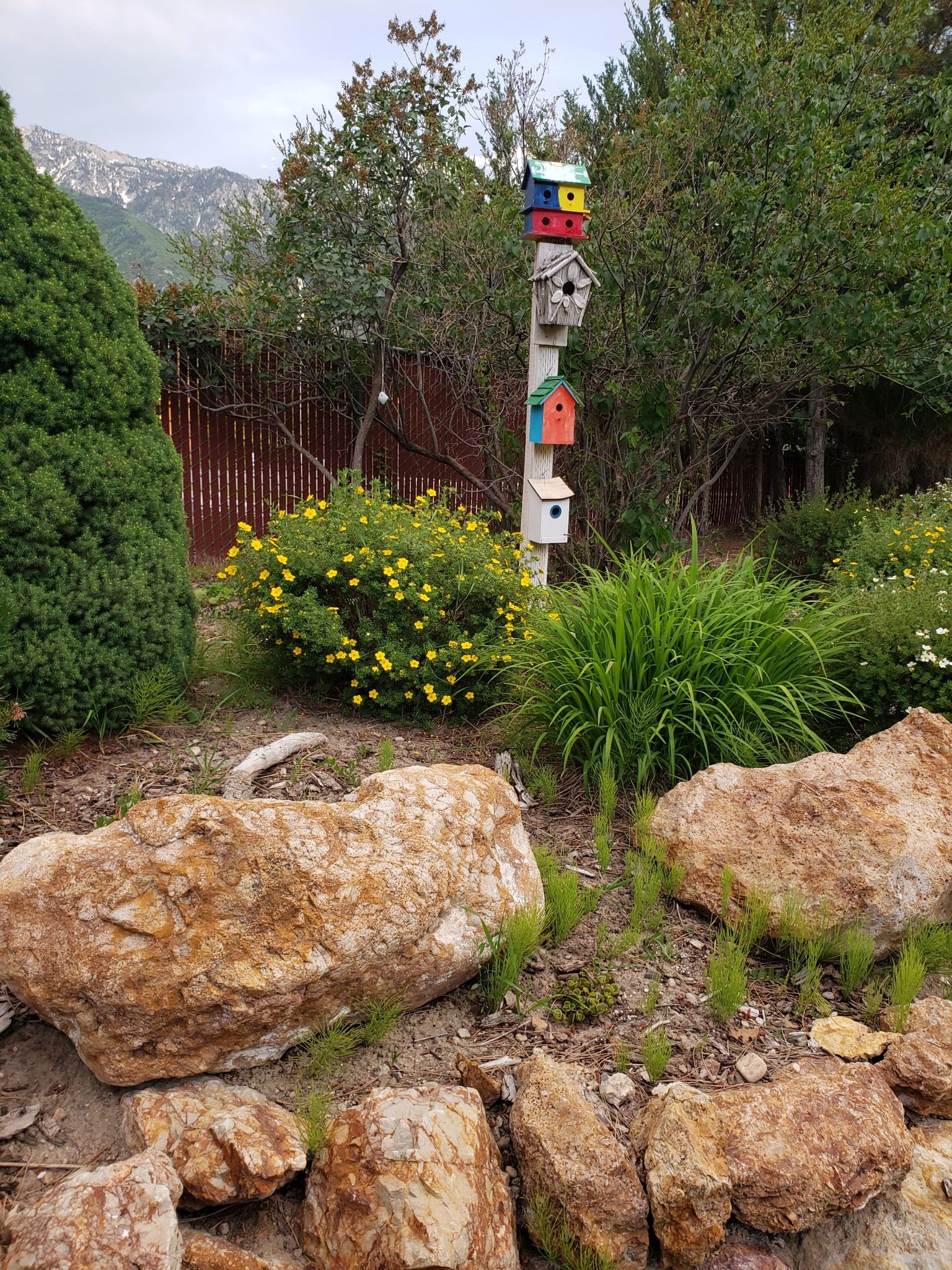
Among the green blades of Japanese Iris I found a scattering of soft-gray Mountain Chickadee feathers, the chitting chiding black-striped bird who came and went from her birdhouse in spite of my irksome gardening presence. Her house is empty now. But the Wilson’s Warbler hops and pecks through the shrubs and flits up to the birdhouse Gabe painted last year. I hated to trim the shrubs, but several had grown to engulf sprinkler heads, hogging water. Mom looked askance when I came to dinner in shorts and flip-flops, and I answered her unasked question over cheesy tuna-noodle-green-pea casserole that I had resolved to audit the automatic sprinkler system, ten stations, perhaps a hundred heads, after dinner. I adjusted the angles and flows and station times and arcs and entered the house completely soaked and dripping and wanting fresh-brewed cacao on the nearly-July night. Dad rolled down the ramps the next night, still anxious he might tip off the side and crash for his unsteady hands on the controls, and followed me as I cut back the shrubs. I stopped frequently to ask if I was shaping the bushes how he wanted. “Just cut off the spikes” of new growth, he instructed, then “use your own best judgment.” Several times I looked over at him, to receive his smiling thumbs up. The trimmings filled a 50-gallon can. Neighbors comment that I must like yard work as much as Dad, which may be true, but my main motivation is not the yard’s beauty so much as his happiness with the beauty of the yards and beds he can no longer garden. I offered him the hedge trimmer, but he observed what we both already knew: “I can’t do it.” In his momentary grief, I let myself be his hands and feet and strength, and together we did the job, and together we were proud. My recent commuter reading has included books on parenting styles, marriage relationships, emotion coaching, community race culture, shame resilience, vulnerability, wholeheartedness, forgiveness, grief and grieving, outward mindset and outward inclusion, active bystandership, American history, mass incarceration and justice equity, the Bible, and I think I detect a common thread: empathy, the act of sitting with someone in their pain, without judgment—empathy, the boiled-down essence of human happiness and success. “Empathy isn’t about fixing” anything, Brené declares. Empathy is “the brave choice to be with someone in their darkness [and] not to race to turn on the light so we feel better.” Empathy is “using our own experiences to understand others’ thoughts, feelings, and behaviors from their perspectives without judgment” (quotes from Brené Brown). I believe what Megan and Brené and others say, but to be honest, I need lots of practice. I’m an old student on his first day at their school, and I am striving at my homework, wanting to pass the tests, hoping to earn my degree.
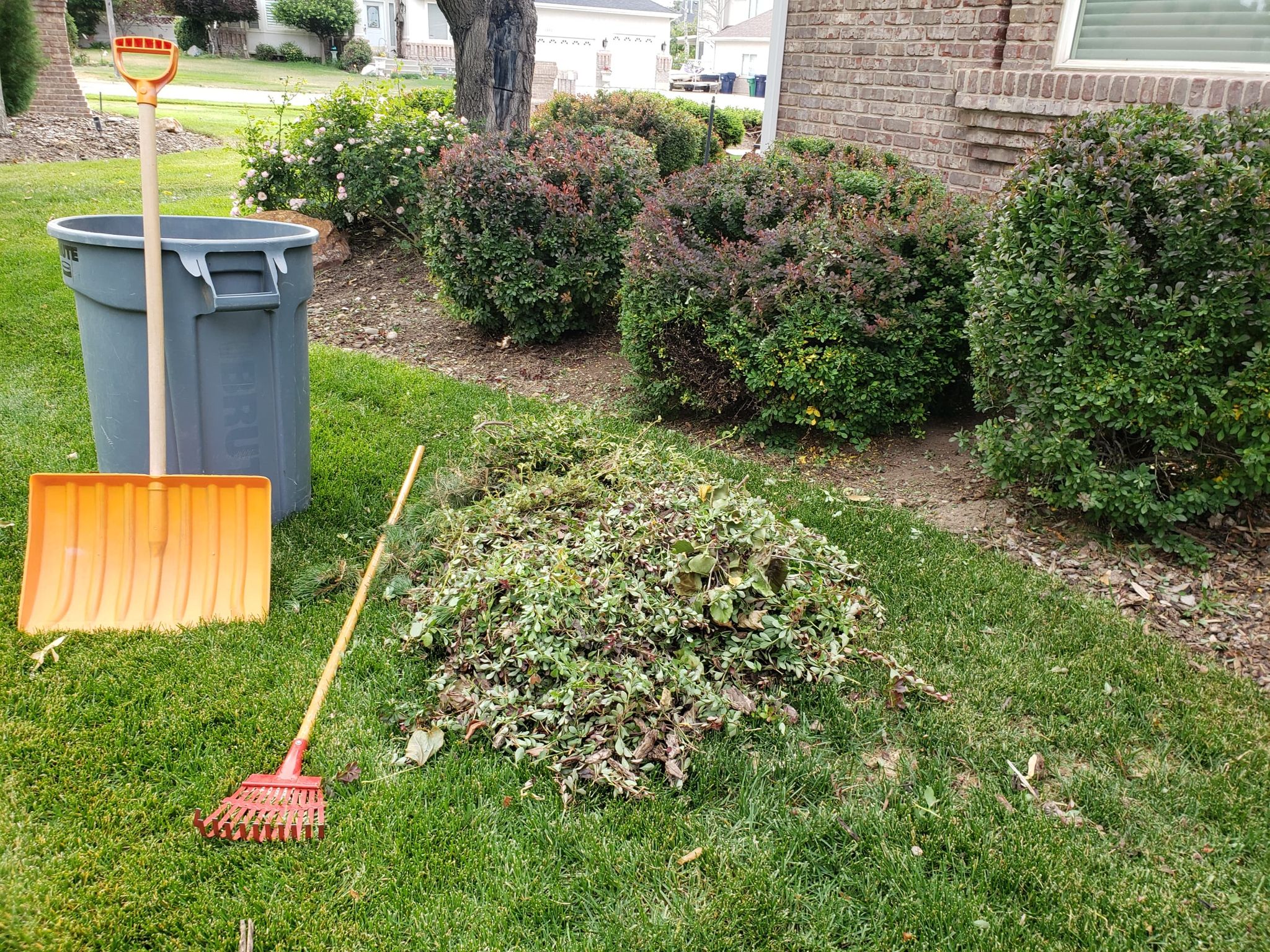


Left unchecked, dandelions can proliferate and kill the grass with their broad, flat leaves anchored to thick stems. But Dad has the best tool for purging the lawn of dandelions, and I pluck the weeds mostly for the pleasure of utilizing the tool: a forked steel poker on the end of a long wooden stick. A thrust into the turf cuts the weed at the root, and a flick tosses the severed plants away to die and dry. I don’t even have to bend over. I almost feel sad when I cannot find anymore dandelions, and have to stow the forked tool in the garage. As I wander the yards, I sometimes slide into the sadness of mistakes made and opportunities lost: taking a week to patch a child’s bike tire; grumbling at the boys wanting new wooden swords because last week’s have already broken; not knowing my child was hurting inside, or knowing but not knowing what to do or say; being stretched and stressed and overwhelmed and unpresent when she wrecked my car and wanted reassurance but I was empty and numb and could not come out of my darkness, and she silently walked away. And I anxiously foresee losses yet to come, portended by deteriorating strength and health and means and memory. And I slip into seeing life as a series of sadnesses strung together. Of course, I could choose to see my life as a collection of connected joys—but while I live for these joyful moments, I tend to gravitate toward grief, to swirl in the emotional eddies of mourning. Megan, however, is teaching me that grief is not an illness to be cured, not a problem to be solved, not a process to be rushed through, not an incident to put behind me, but a natural human pain, a pain that is an inseparable part of love and loss, a human pain to be tended with tenderness and carried with compassion. Thank you for teaching me. So, now, I want to sit with my grieving neighbor dying of cancer, and to sit with her grieving spouse; I want to sit with my children in their sicknesses and joblessnesses and injustices and lonelinesses; and I will sit with my mother and my father as they approach the end of this phase of their life-existence. I will sit with myself in my own pain, tending to it gently and patiently. And as I wandered the yard, Sarah hugged me and praised me for the beauty of the dandelion-free turf and bragged to Dad about how hard I had worked in the yard and how beautiful the landscaping looked, and insisted he come and see, right now. And he motored around the yard in his wheelchair, looking at everything, studying the yellow and orange marigolds, the red geraniums, the reviving arborvitae with new poking green, the weedless beds, and thanked me with, “Everything looks really nice, Rog: just perfect.”
(Pictured above: Mom’s and Dad’s back yard with the backdrop of the Wasatch mountains. Notice the wheelchair tracks in the lawn.)

“Lucille!” I thought perhaps I might have heard from under my cool-morning covers the calling of Mom’s name, but I could not deny even in my profound grogginess the second “Lucille!!” with clearly Nelson-like tones, and I jumped from my bed fully alert and threw on my bathrobe and bolted to Dad’s room. Mom, alerted from downstairs, whence she heard his bellowing even without her hearing aids and even with her ever-present morning music plucking away—this time a harp concerto—raced upstairs, a slow sprint across the house and up on the stair lift in time to hear me call: “Is everything okay, Dad?” Of course, everything is okay, he said, oblivious of our cause for alarm. “When you go to Harmons,” he said cheerily, “if they have fresh cherries, open the bag and squeeze one to make sure they are ripe and not rotten or green, and get two bags, no, three, because John likes them, too, and tap on the watermelon like I showed you to make sure it’s ripe and not overripe or green—of course, you can’t tell the taste by tapping.” Mom sat on her cedar chest crying quietly from fright and relief and frustration, and I could not help remonstrating that I have been sitting on the edge of my metaphorical bed for two years waiting to hear him shout “Lucille!!!” so I could run to his rescue, save him from some crisis, lift him off the floor, and he’s shouting “Lucille!!!!” to make sure we check the ripeness of the cherries at Harmon’s? “Why, yes,” because company was coming, and everything had to be just right, including the tomato bisque, including two loaves of gluten-free bread, and sliced mild cheese, but no meat for the vegetarian melts, and guacamole and salsa and humus and two bags of corn chips, and gluten-free cakes, and just-right cherries and watermelon. “I told you we were shopping at 10!” Mom burst out, “and it’s only 8!” and “why would you shout for me throughout the whole house to tell me to squeeze the cherries!” and she stumbled back to the slow lift down the stairs to her harp music and her soggy breakfast, and I could not be angry because of how comical the whole scene struck and because everything was okay, because he was not dead or on the floor but was okay. “I’m sorry I shouted for Lucille to come,” Dad lamented as I yawned, for my body so ached in the night that I could not sleep and had taken naproxen sodium and half a fluoxetine hydrochloride at one in the morning and had a lovely sleep until I heard “Lucille!!!!!” because 13 miles on the Jordan River down rapids through eddies and mysterious invisible cross currents and from long portages around the dams and with the awkward ins and outs from my kayak on the muddy banks had pulled and twisted and tired me out, but that bird we saw, oh, that bird, that black-crowned night heron that watched me float within ten feet before it flew a hundred feet downstream and watched me again approach until I could see his crimson eye and the long white head feathers streaking loosely down his black back and the hint of yellow on his neck, stretch after hundred-foot stretch, mile after mile, until he flew back up stream back to his territorial stretch to stalk for ducklings and fish. “You can go back to sleep if you want—it’s only 8 o’clock.”


The sun spews huge masses of atomic particles in loops and flares and flashes a million miles above its seething four-million-degree (F) surface into a stellar corona. And the sun shoots immense volumes of cosmic rays and subatomic particles at nearly the speed of light, a solar wind that picks apart human DNA when given the change. But the earth’s molten iron-and-nickel core sloshes spherically around inside, generating a massive magnetic field that deflects most of the solar wind. What this all means, Dad explained to Cecilia, is that we can live, here, safely on earth. “Without the magnetic field….” His cosmology lesson came from volume “C” of the encyclopedia: corona; core; cosmology: this morning’s reading. Cecilia reminded Dad about his shower, and his breakfast of a whole wheat English muffin and two slices of pre-cooked bacon and a tall glass of cold milk (and 19 pills). The chair lift shook and boomed at the bottom of the stairs, and I worried he or Mom would tumble onto the tile. Accessible Systems came the next morning to repair it, under warranty, so now I need not worry, as much. “Do you think we might cut the grass today?” Dad asked me after work, and I felt sad that he felt he needed my permission, though certainly he needed my help. 6:00 p.m. I reminded him about how frightening and difficult it was for him to mount the mower last time, but could not say “no.” Don’t rob him of what little he has left, I thought. But this time we managed impressive transfers to and from the mower, and he motored around the yard, sun hat askew, all the jogging neighbors waiving and smiling their astonishment. Pull weeds and trim bushes. 7:00 p.m. Cook dinner and serve. 8:00 p.m. Clean up kitchen. 9:00. Listen to thoughts and stories. 10:00 p.m. I am just too tired to read or to pray or to clean my teeth (though I do the latter anyway). No time for TV, for 6:00 a.m. comes early, and I am too old to go without sleep. And I self-assess: Why am I so irritable? Mom thinks of me wistfully as her little boy, her first baby pulling pots out of cupboards and crawling, cloth-diapered, across the floor, smiling and untroubled. When, troubled, I say good-night: “I will miss you.” When, troubled, I arrive at home: “I’m so glad you’re back.” But I am almost 60, too prickly, less cuddly and cute. It would be better for them if I visited here rather than lived here: the visits would be more joyful and less chore-full. But they need me, and a visiting life cannot be the agenda. As I said good-night, I wondered aloud to Dad: How is it that the moon is just the right shape and size and distance and orbit to just block out the sun and reveal its beautiful chaotic million-mile hot hot corona? And he shrugged with like wonder.

Three hundred ninety-two. An arbitrary number, I suppose, but a number representing at least three hundred ninety-two hours, hours I spent thinking about and writing and revising and revising these short creative non-fiction essays—is that what they are?—pieces of the story of a nearly-sixty-year-old divorced nearly-retired still-commuting lawyer living with his aged parents to help them keep living in their own home, living with their books and needlepoints and (mostly) healthy delicious food and television programs and recliners and all the familiarities of a long life together: 61 years and counting. I was neither prepared nor worthy to be their caregiver. What family member is, I wonder? But I was available, and my lack simply does not matter: here we are, together. Valeu a pena. (Continental Portuguese: It was worth it.) The New York Times delivery lady in the squeaky broken Durango has just tossed the newspaper onto the sidewalk. Dad is sitting on his bedroom sofa reading volume “T” of the World Book Encyclopedia (1998) waiting for his CNA, his naked legs covered with a crocheted afghan throw. Merilee no-showed last Sunday, so I had the privilege of a son learning the routine of getting a father safety to the shower, then drying and dressing him, while Mom went off to choir practice. I will conduct the church choir today—“Precious Savior”—and am terribly anxious about being so visibly expressive and expressively visible, two-hundred congregants watching my waiving arms. My pumpkin seeds have sprouted, and the deer seem to be leaving the landscaping alone, whether from the cannisters of dried blood, or the putrescent egg spray, or the dangling bars of Irish Spring. I have placed little rings of stones around the volunteer juniper saplings to connote their belonging and because they look cute that way, cared for, embraced. Dad has been wondering about the bottle of honey that claims to come from Uruguay, India, and Argentina, and suggests I next purchase a Utah brand. Within minutes of the desert downpour last week the lawn care company mowed the lawn and left a rotting mess for me to clean up the next day: it was either rake for two hours or watch a thousand patches of turf suffocate under wet steaming clumps. Three days later, Dad came motoring down the ramps, wanting himself to mow the lawn mid-week, and I helped him transfer from the wheelchair to the riding mower, surely a never-intended transfer, impossible of grace, but with shovings and heavings and unspoken curses and doubts I muscled him awkwardly onto the mower and watched him tool around the yard, utterly happy. Transferring back to the wheelchair was even more ungainly and frightening: I doubt he will want to try again soon. And last night the thick smell of skunk jolted me from sleep, a smell far beyond a smell, a noxious choking vapor that penetrates and lingers and reminds me of my former family-raising life in the country.

Zoe on Zoom taught me that an “access point” is a moment in space-time when I feel sufficiently safe to risk human connection, and I found myself musing after sundown that every moment of my lifetime of space-time is either an access point or the absence of an access point: I am either seeking or avoiding connection. Dad felt safe enough to tell Cecilia his leg felt “off.” Cecilia felt safe enough to tell Mom that Dad’s leg was alarmingly swollen and red, and Mom told Jeanette, and Jeanette told her siblings, and announced to Mom and Dad: “We are going to the doctor, now.” And fear entered my heart, and I wondered, what does this mean? and I thought he might lose his leg to diabetes and infection and gangrene and amputation, altering his life and our lives horribly, this story’s end sprinting too-fast forward. But the doctor diagnosed cellulitis, a skin infection, and sent Mom and me to Walgreen’s for antibiotics while Jeanette trundled Dad home. A mere skin infection—nothing serious—a relief. Sarah sobered us with facts: cellulitis can lead to sepsis and to septic shock and to death, and she was soooooo glad Jeanette acted quickly. My sisters are heroines, aren’t they? They regularly save the day. Dad became downright chipper, perhaps from the relief of realizing he would keep his leg, and he tooled around the yard in his power chair with his electric hedge trimmers giving each of the many bushes a mullet cut: he could not reach the bush backs. When Dad was six, he used that leg to climb the neighbor’s old cherry tree, high into its branches, and the neighbor groused, “Get down from that tree!” but the boy only climbed higher. The neighbor threatened to squirt him with water from the garden hose, but the weak stream reached only part way up. And the neighbor sighed and pulled a nickel from his pocket and offered it to the boy if would climb down from the branches of the old cherry tree. That day in 1941, a six-year-old boy skipped home five cents richer. On another day in another tree, Dora grumbled for the boy to come down at once, and he did, with a “Yes, Mother,” because he loved her. Zoe told me over Zoom that our first and deepest question as human infants is this: Are my needs in life going to be met? and I found myself reflecting that I have asked this question long past my infancy, across my childhood and over my adolescence and into my marriage and my mid-life and will ask this question still in my old age. And with the asking I also answer: Yes, I will give myself to you, to you, and to you, and to you….

Jeanette has come, and I have left her with the work and fled to my upstairs office to read Brian Doyle’s humorous penetrating moving essays, and have escaped to the yards to trim low shrub runners and pluck crab grass and spray the arborvitae with putrescent eggs spiced with clove oil that mule deer despise, and I beg off from the evening walk to the end of the street and back, my feet aching from a bloody self-pedicure and the day’s hike, content that someone else has come to push the wheelchair. I want to heave at the odor of commercialized rot—I am desperate to deter the deer—and decide to follow a neighbor’s suggestion to cut in half bars of Irish Spring soap, drill a hole in each half, and drape a green perfumed necklace to each faltering arborvitae tree. Nearly half of the trees’ greenery was eaten by deer, and nearly the other half froze and dried and sluffed away, but new green, darker than the soap, richer, is peaking out from what I thought were dead twig ends. A new day, and Sarah has come, and she has rousted Dad from his reading lethargy to come watch the cousins play cards and to coax the cousins out the front door and down the homemade ramps, and Jeanette and Sarah have struck off to the end of the street, Amy aahing at divinely gorgeous flowers. I had followed, too, and waived at Greg, the thirty-three-year veteran retired police officer whose garage walls are speckled with five thousand police agency shoulder patches from all over the U.S. and the world, though he used to have six thousand patches and has sold one-thousand on e-Bay to self-fund a missing dental plan. I shoved off and caught up, and we ended the walk in the back yard on Memorial Day and encouraged Mom and Dad to tell stories of their long lives. Dad’s first memory of his mother came when he shut his finger in the screen door and sprouted tears and a purple blood blister, and Dora cooed and chortled over him and kissed his finger and comforted and promised he would be okay, and Dad decided at that moment in his life that he would be okay. Dad’s first memory of his father came from working outside in the yard, where Owen had a bucket of dirty transmission oil, and where Owen and Owen Jr., the latter only three, each dipped a paint brush in the black oil and slathered it darkly onto the thirsty sun-bleached wood-fence slats, an inexpensive waterproofing stain. Dad’s first memory of Mom was of the church dance when he was 25 and she was 21 and they met and he asked her for her phone number and she willingly gave him her number, and over the coming months he gazed at her often and thought how kind and smart and beautiful she was, and how nice it would be to live a long life together. They have moved inside for ice cream, and I have watered my pumpkin-seed mounds, waiting for sprouts to emerge, upon which I will shave flakes of green soap against the deer.

Yours Truly with sweet sisters Jeanette and Sarah.

Snow covered the trail, in huge slush-packed mounds—unexpectedly. Yet I should have expected all this snow, this high in the mountains, this early in the year, three days before June. My pack carried water and food, and deet, though I could see mosquitoes were yet weeks away. And I had my hiking poles, but not the Kahtoola-spikes and boots I really needed. Pines and aspens lay across the obscured trail, and I lost myself for a while, sandal-numbed feet falling through warmer patches past my knees. I learned quickly to stay in the still-frozen shade. Simply put, I was not prepared, and fear chemicals began to ooze through my blood. But I need to be prepared. “Something’s changing,” Dad observed through the flaccidity of his smile. “I can feel it.” Still a fighter, yet resignation is percolating. I can feel it, the squishy ooze of my fear, and I must prepare. The lawyer is retained, and the CPA. The policies and accounts and trusts and burial plans are in order and understood. The stories are written and archived. I still do not know whom to call first. Yet in the warmth of late spring, Cecilia helps him transfer into his power wheelchair for a ten-minute sortie into the yard with the dandelion picker before returning to his recliner. The sun and fresh air and bird song (and dead dandelions) do him unaccountable good. My mending pile has sat staring at me for a year, the Tongan turtle tapa shirt still missing a button, my cycling shorts still torn. But I finally pick it up and thread the needles and sew on the button and stitch up the rip and close the hole in the pocket my glasses kept slipping through. Somehow today I am ready to repair them. And with my turtle shirt on, perhaps I am more ready.
(Pictured above: Donut Falls, where the cascade disappears momentarily through a hole in the rock before again emerging.)
(Pictured below: the snow-covored Donut Falls trail; the view downstream toward Big Cottonwood Canyon; Yours Truly.)



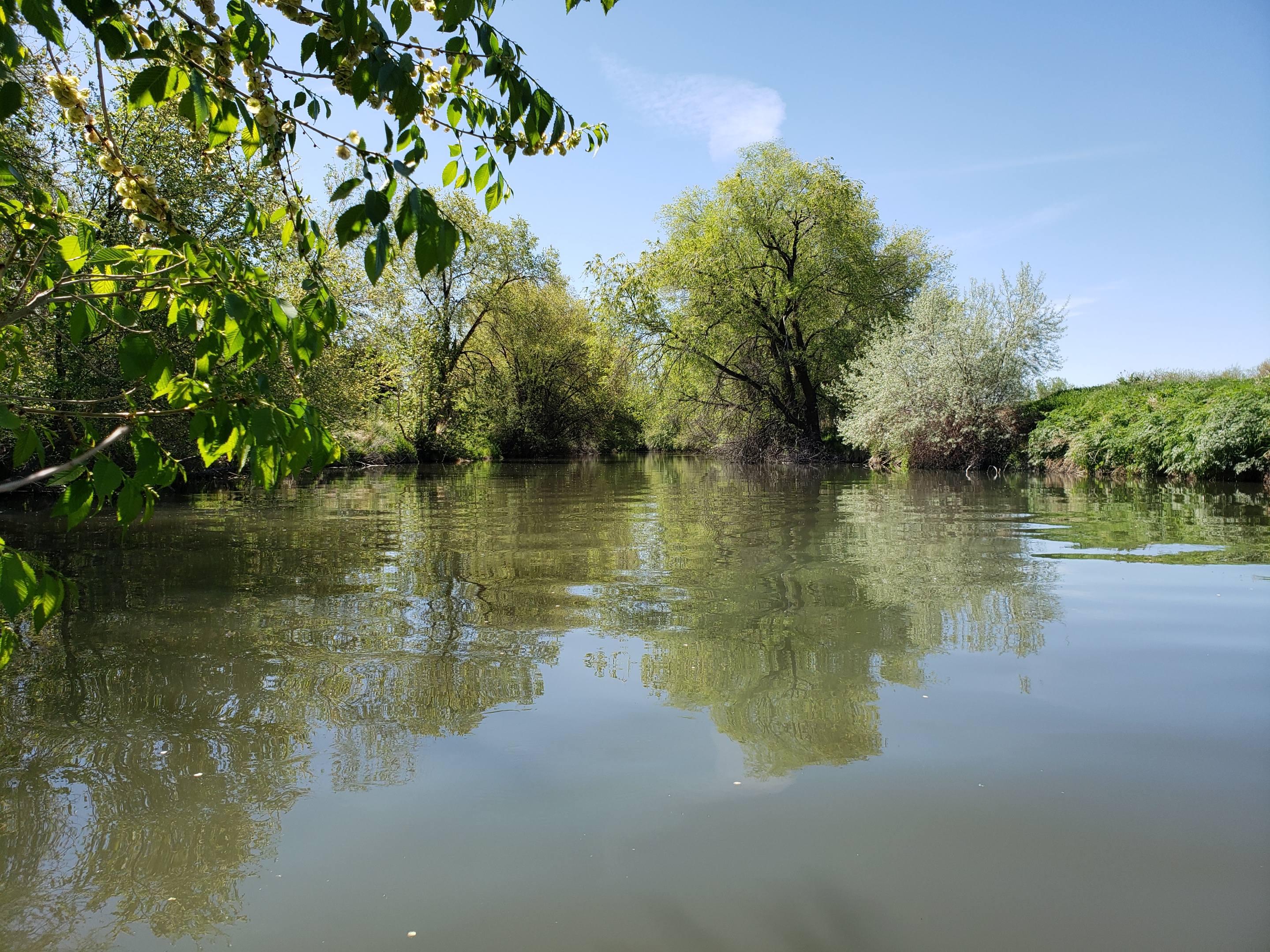
The sub-sonic motor of the stair lift rumbled almost beneath hearing—Mom was slowly being carried down the stairs—and a loud double-beep signaled her arrival. She clump-clumped around the corner into the kitchen. “Hi Mom,” I greeted her. “Good morning, my boy!” she smiled. “I’m running off for a bike ride on the Jordan River Trail. See you soon,” and I was out the door. I always feel happy on the broad paved trail by the river, and today hundreds of other people also felt happy to be on the trail. I always find humorous the greeting rituals of trail users. A nodding up of the head, or down—never both. A raise of an index finger, or four fingers, or eight, just over the handlebars. A smile or a non-smiling pursing-of-lips smile. Most cohorts, from older women to middle-aged men in full cycling gear to young couples with young children—they all offer some sort of fleeting greeting. Many wait for me to initiate the ritual, responding eagerly when I do. A small minority works hard to pretend I do not exist in order to avoid having to offer any greeting at all. Some who do this may be afraid, others absorbed, others seeking solitary quiet and not wanting to engage. One young woman stood straddling her bicycle at the crest of a high hill, looking out over the winding river and broad marshlands, glancing at me several times as I labored up the hill in low gear. When I arrived, puffing, she smiled and cheered, “You made it!” I did not flatter myself that she flirted with a man three times her age—she was simply a kind, cheerful, observant soul, encourage a fellow cyclist. Careering down the hill, I screeched to a stop before a baby garter snake sunning itself on the trail. He coiled like a cobra when I approached. My snake holding days are over, even with harmless serpents, so with a twig I tenderly tossed the critter into high grass ten feet away. Within seconds, had I not stopped, he would have been smashed several times over. Above the marsh grass, a rust-backed kestrel hovered then dove for a flying insect. Older men and women passed by me on their fat-tired e-bikes, making nary an effort, as did the youngsters on motorized scooters. I tend to judge others by own standard: I was out there to push myself at speed down the trail, and to enjoy the wind in my face and the springtime nature flashing by, and I judged others for their lazily allowing the motors to do all the work. I knew my judgment was misguided, of course: these good people all had their own motives for being on the trail: enjoyment; relaxation; nature; sociality; enjoying the wind in their faces. And then there were those perfectly-physiqued specimens jogging completely under their own power, next to whom, with my wheels and gears and sprockets, I was the loafer. I decided to admire them all for knowing what they wanted and doing it with a nod or a smile or a wave. Seventy-eight city blocks and one hour later, my thigh muscles burning, I returned to my car, still unconnected despite hundreds of subtle salutations. I felt disappointingly unaltered. But the river-front ride had indeed changed me, especially through gratitude—for the pretty young woman who lauded me on—and through saving the life of a brave little snake. Dad wanted to hear all about the birds and snakes and turtles, and even the people. He loves that trail, and remembers nostalgically the days and years when he rode in his retirement, his long-career labors ended, instead enjoying the birds and snakes and turtles, the winding narrow river, the wood-planked foot bridges, the feel of speed as he pushed at his pedals, and even the people, to whom he nodded and smiled and waved. “I’m off with Mom to the grocery store,” I called to him, and he asked me not to forget the pre-cooked bacon, and said to please bring home some red geraniums for the front corner garden.

On the Jordan River Trail, monuments to Utah’s eight native tribes.
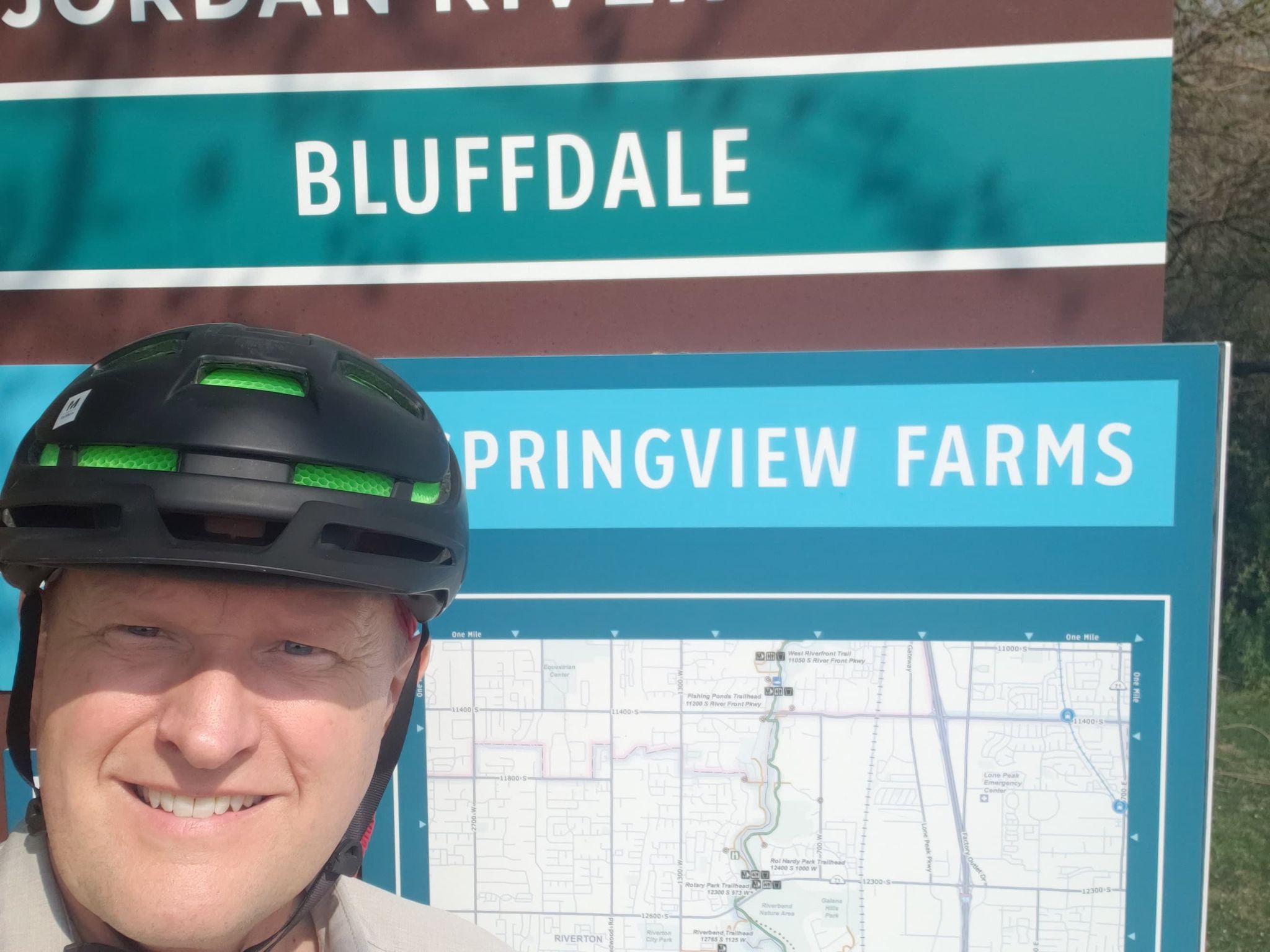 Yours Truly at the block 39 turning point.

Dad has read all the various books his various children have given him in the last year, and he wished for more books to read. I scoured my shelves and brought him an eclectic stack: political leadership; environmental activism; third-world memoir; history; biography. I was not sure he would be interested in the selection, but he exclaimed, “I’m going to read them all!” as he started in on the first. Reading: that is what he can do, and he does it well. His enthusiasm faded as he labored in quaking pain to rise from his chair and stagger to the restroom, unable to straighten, hunched dangerously over his walker. Mom and I helped him redress that day, for ne needed all his arm and leg strength merely not to collapse. “Today was a hard day,” Dad lamented. Mom looked uncharacteristically drawn and worried, and she suggested I call Brad and ask him to come help me with a religious enactment we call a Priesthood Blessing. But I did not want to call Brad: the time was after 9:00; and, I did not want to have to summon the emotional energy to approach the Almighty God to seek a blessing from Him; and, I lacked confidence in my worthiness and strength to draw upon Divine power. But after breathing deep for a few minutes, I called Brad, and he said “Yes!” and walked over. Brad and I did as the Apostle James instructed two thousand years ago in answer to his own question, “Is any sick among you?” then “let him call for the elders of the church” to “pray over him,” “anointing him with oil in the name of the Lord.” And it was our privilege, Brad and I, ordained Elders in our Church, to anoint Dad’s head with a drop of consecrated olive oil, to place our hands lightly on his head, to invoke the name and priesthood authority of Jesus, and to prayer over this father and neighbor of ours. Brad proclaimed the infinite love the Father and the Son each have for Dad, that they know him and are mindful of him and his sufferings. Brad reminded Dad of the love and admiration all his family have for him, and praised his goodness and sacrifice. Brad pronounced a blessing upon him, both of deep peace and of a body sufficiently strong to control and perform its functions. And we all said “Amen.” I marveled at how in my Church we presume to access the priesthood power of God to pronounce blessings of healing, or comfort, or counsel, or release, how we often feel God’s unfathomable love for the afflicted person, and how these blessing experiences bring comfort and peace, hope and love, to all involved. Lying in bed, I yielded to the ritual of checking my social media accounts for updates, and realized I was not seeking information but rather affirmation. Upon waking every morning, I check Facebook, Instagram, Messenger, WhatsApp, Marco Polo, Gmail, and texts, hoping for a shot of external affirmation, and again at bedside at night, and again several times during the day, and I never find it, or I find some but want more, always more. Lying in bed, I resolved to set aside the compulsion, knowing suddenly the truth that the only real affirmation comes from within oneself. Lying in bed, resolving to be better and stronger, I thanked God for once in a while allowing me to be the weakest of His servants in blessing the lives of others, the lives of His children, in blessing Mom and Dad. And I slipped into sleep.

“I slept so much better last night,” Dad crowed, reporting how much softer his mattress felt now that it was flipped over. I quietly asked Mom if she had noticed a difference, too, and she slightly shook her head no. Whether placebo or fact, I felt glad his sleep had been more comfortable, devoid of aching hips and nightmares. What would an 87-year-old have nightmares about? Answer: dreams of walking effortlessly to any destination he desires, and then waking up paralyzed. The waking is the nightmare. He grunts and he groans, but he rarely complains, and he keeps fighting for his best life. With Dad awake, showered, and breakfasted, the time had come for Mom’s requested Mother’s Day gift: an outing in the faithful Suburban to the forgotten little town of Copperton, located 20 miles straight west of us. Dad and I did not even know it existed. “This is very educational,” he opined. Copperton lies hidden behind a sandy bluff at the foot of the world’s biggest strip mine, the Bigham Canyon Mine, boasts about six gridded blocks, houses 829 inhabitants, and was founded by Utah Copper in 1926 as a model subsidized town for Mine employees. Mom and Dad grew up in the shadow of the Mine, and Dad postponed his education to work for Kennecott prior to university study and missionary service. He labored at two grueling tasks, the first shoveling up ore that had sloshed out of house-sized steel tumblers, tossing the escaped ore back in, and the second keeping free of obstruction sluices conveying rushing liquified ore. The tumblers destroyed his hearing. The sluices swept away lives as well as ore, lives of men trying to clear mine beams and fence posts and boulders from the flumes and instead getting swept away and drowned and crushed by the rushing rock. He risked limb and life for his education, for his mission, for his future. But in Copperton, all those agonies were 70 years past. Today, in the Mighty V8, we crawled past well-maintained century-old brick and stucco houses with steep Scandinavian gables and porticoed porches, neat little lawns and rose bushes, and friendly old-timers returning our waves. Mom loves roses, especially yellow roses. She instructed Dad to buy no more than a single yellow rose, but I bought her a dozen-cluster of miniature yellow rosebuds, ready to burst. She set the vase on the fireplace hearth where she could see the roses all the long lazy days. Washing dishes that evening, I watched through the kitchen window a scarlet-headed house finch perched on a lilac twig, tearing at the tiny purple petals one at a time, as in a game of She loves me—She loves me not—She loves me.

“Welcome home!” Mom cheered with a bright smile and her arms raised high. “Welcome Home, Raj!” Dad echoed. (“Rog” looks sensical but rhymes with “Frog.”) The day was just another of 400 days I have come home to Sandy from work 55 miles away in Tooele. Yet Mom and Dad made me feel like the son newly home victorious from the front lines of life. Slurping our Lazy Rigatoni with sausage and sauce, I told them about volunteering that day at the free NoMas immigration clinic (No More a Stranger), and how I wished the facts for my asylum application were stronger, but that stronger facts would include kidnappings or beatings or murders, and how returning the man and his family to Maduro’s Venezuela likely would mean kidnappings and beatings and murders, and about how well I performed my work might mean escape, and if not escape, returning the man and his family to…. That morning, the shower pipe had again slipped into vibrating screams, which I loathe with rending vehemence, screaming in my soap-slimed face: “You’re doing it wrong! You’ll never be good enough!” and I had again adjusted the water quickly to quiet the unbearable banshee. And that evening, after dinner, Mom handed me a note Dad had written to Tamara, and asked if could deliver it, but after a twelve-hour work day I did not want to find the emotional energy needed to deliver a note to a woman dying of pancreatic cancer, feeling awkward with what to say, but I said simply, “My Dad wrote you a note: he loves you and hopes for you, we all do.” Tears and smiles: they arrive with our suffering and hope. We do hope for her. This is our faith, that in healing or in dying she finds hope and finds love. Pine needles had fallen thick over the years, an unruly mat in the back yard, and I quickly filled both cans, pensive about Tamara, waiting for next week to fill the cans again. With his bowl of chocolate ice cream and a slice of warm chocolate-chip pecan banana bread, Dad complained that he could not sleep the night before, how his hips and legs had hurt, how he sat on the edge of the bed in darkness wondering whether years of sleeping in the same spot on the same side of the same mattress might suggest turning the mattress over. In the day’s eleventh hour, I hurriedly stripped the bed, flipped the queen mattress over, and strapped on fresh sheets. Rising slowly in the stair lift, still they caught me in the last tuckings. “Which way did you flip it?” Dad asked. “I flipped it,” I answered. I hope he sleeps better. We shall see.
 The Spotted Towhee pecked at seeds on the ground and flitted from tree to rock to limb. I watched him for a full 20 minutes, and decided he was such an adorable little creature. I think he has taken up residence in the tangle of arctic willow trunks. Watching the pretty bird in the cool evening breeze, I reflected on many things. On how Dr. Seegmiller has decided to care for his invalid patients by making home visits, kneeling at recliners to clip nails and shave callouses. On how the new Church missionary from our neighborhood, off to Argentina for 18 months, had discounted her “simple faith” because it was not more sophisticated or profound, not realizing, yet, that simple faith is pure and powerful faith: genuine. On how Dad observed one evening, “Rog, if you got married now, we would be in a rest home” and I thought he might be right, and I determined to continue my mission to minister to my parents in their days of feebleness and need. On how I gave an ethics presentation to the city’s Public Works Department (water, sewer, and roads divisions), a tough crowd in boots and ball caps and dirty jeans, and how I coaxed them to laugh and to think, and how Mom and Dad insisted I show them my PowerPoint slides in an abbreviated show, and how we learn ethics through living, and promise to do better next time. On how I took Mom and Dad for a roll, pushing Mom’s wheelchair, past the guard shack and gate, into wealth and privilege, all the Porsches and Audis and Lincolns and BMWs racing by, and how they are not representative of most of America, or of me, and how I joked with Dad that he would be pulled over if he didn’t stop riding off the edge of the asphalt trail. And on how Steven had remarked that for all Dad’s disappointment and misery, and despite two minutes of agony every two hours (when nature calls), he is happy in his life, reading his books (several a week), scanning the New York Times (daily), watching television (totally at Mom’s mercy since he cannot operate the remote), enjoying tasty nutritious food (yesterday French sauteed chicken in onion cream sauce), visiting with visitors (from church, mostly), balancing his checkbook (check register in one hand, pencil in the other, calculator on his lap), doting on grandchildren and great-grandchildren (I have lost count), and chatting with his white-haired sweetheart (of 62 years). And Mr. Towhee hopped and flew all the while.
Above: French sauteed chick in onion cream sauce, roasted tarragon asparagus, and scalloped potatoes from a box.
Below: The melted jumper cables from my failed attempt to jump start Mom’s dead car battery.


Dad has tired of ham-onion-Swiss sandwiches, and Mom has had to get creative with his lunches. A plate of mixed nuts, applesauce, a slice of cheddar, carrot sticks, celery and cream cheese, and a peach cup—do not forget the diet Coke, on the rocks—have been this week’s fare. And the bag of kettle-fried potato chips on the floor by his recliner. Mom assembles Dad’s lunches simply because Dad cannot. He seems to enjoy ordering her around a bit, e.g., “Lucille, get me some crackers.” While they munched, I dug out the Subaru owner’s manual and read the jumper cable instructions carefully, three times, connected the jumper cables, carefully, to Mom’s Legacy and the Mighty V8, rechecked the instructions twice, started the Mighty V8’s engine, then turned the key to Mom’s Legacy. Dad’s faithful Suburban soon began to falter, then died, and smoke curled up from both batteries. Mom’s car never started. Continue reading
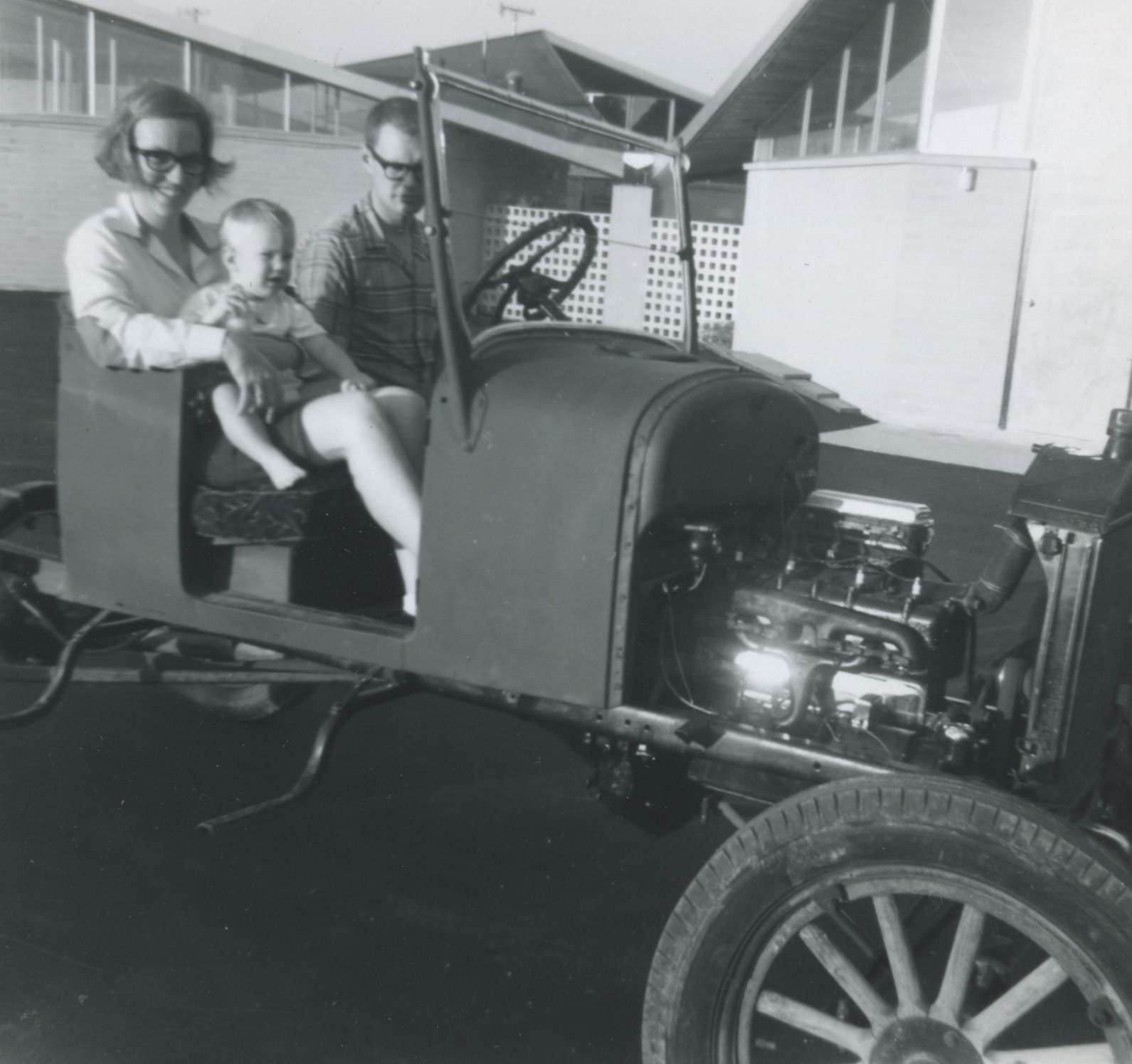
“There’s a hole in my head!” Dad groused, fingering his newly-stitchless scalp. “Why did Hinckley leave a hole in my head?” I examined Dad’s new scar, which curved over eight inches of wispy-haired scalp. The scar centered on a remaining scab, where the initial cancer had been scooped deeply out. I reassured him that his head looked fine, that there was no open wound, that what he felt as a hole was just a scab. “Why didn’t he stitch the skin together so there isn’t a hole in my head?” When the scab falls out, I suggested, I was sure he would see how neatly sutured the whole incision was. “But there’s a hole in my head.” Mom scowled and rolled her eyes, and I let the matter go. I would not be able convince him there was not a hole in his head, and did not want to argue. Maybe the surgeon did leave a hole in Dad’s head—what could I do about it other than watch for both healing and infection? Continue reading

Three weeks is a long time to wear a shower cap and to slather your scalp with Vaseline. And those three weeks are over. The nurse Blanca praised Dad’s head as she bent over him to cut and gently pull each black stitch—“Your head is healing beautifully!”—which Dad said did not hurt except when the stitch was glued to a wisp of white hair, and then he grimaced, as anyone would to have hairs plucked out from healing scar tissue. The relief of a stitch-less head counterbalanced the strain of the trek. Dad and I conversed on the drive home about Joe Rantz and his gold-medal eight-man rowing crew in the 1936 Olympic Games, who mastered themselves and their sport and found their gold-medal “swing,” and George Pocock, mentor and craftsman, builder of their sixty-foot-long cedarwood shell with its signature two-inch camber and gleaming shellac sheen, George who taught Joe about balance and harmony and teamwork and especially about trust, trust in his crew. And they out-rowed the Third Reich across the finish line and into history. And after pushing Dad in his wheelchair into the house, I pruned the rose bushes, just as Dad taught me five decades ago, snipping just above each bud, knowing last fall’s scraggle would now be this spring’s flourishing.
(Image by ❤ Monika 💚 💚 Schröder ❤ from Pixabay.)

Four interminable months have passed since our visit to Dr. Neurologist, when he pricked and prodded, when he found severe neurological damage and no knee reflex, months of worsening ambulatory paralysis and increasing pain, months without answer or insight. Dad’s questions have burned in his brain: What is the diagnosis? Why the severe? What can I do to improve? And finally, after those four months, he had the chance to ask the doctor these questions, again. N had been 80% certain of the diagnosis of diabetic amyotrophy, and after the negative spinal MRI, presumably 100% certain, there being no other working hypothesis. Before him again on his examination table, the condition worsening, his answer to Dad’s renewed questions was a simple, “I have no idea.” When that is the state of things, of course you order more x-rays and blood work and tell the patient you will can him with the results. Punt. At least the lumbar puncture/spinal tap and the MRIs and CTs are done and need not be repeated. At least no one quipped, “What do you expect? He’s almost 88 years old!” Eighty-eight and still with a resting heart rate of 65 from decades of physical fitness. Eighty-eight with a world heavy-weight champion fighting spirit. Meanwhile, we waste away at home in our recliners, grateful for stair lifts and showers and power wheelchairs and books, and family. Surely, there must be a team of experts out there that can decipher this mystery and say, “Do this.”
(Pictured above: the healing squiggly scar on Dad’s scalp after skin cancer surgery last month.)
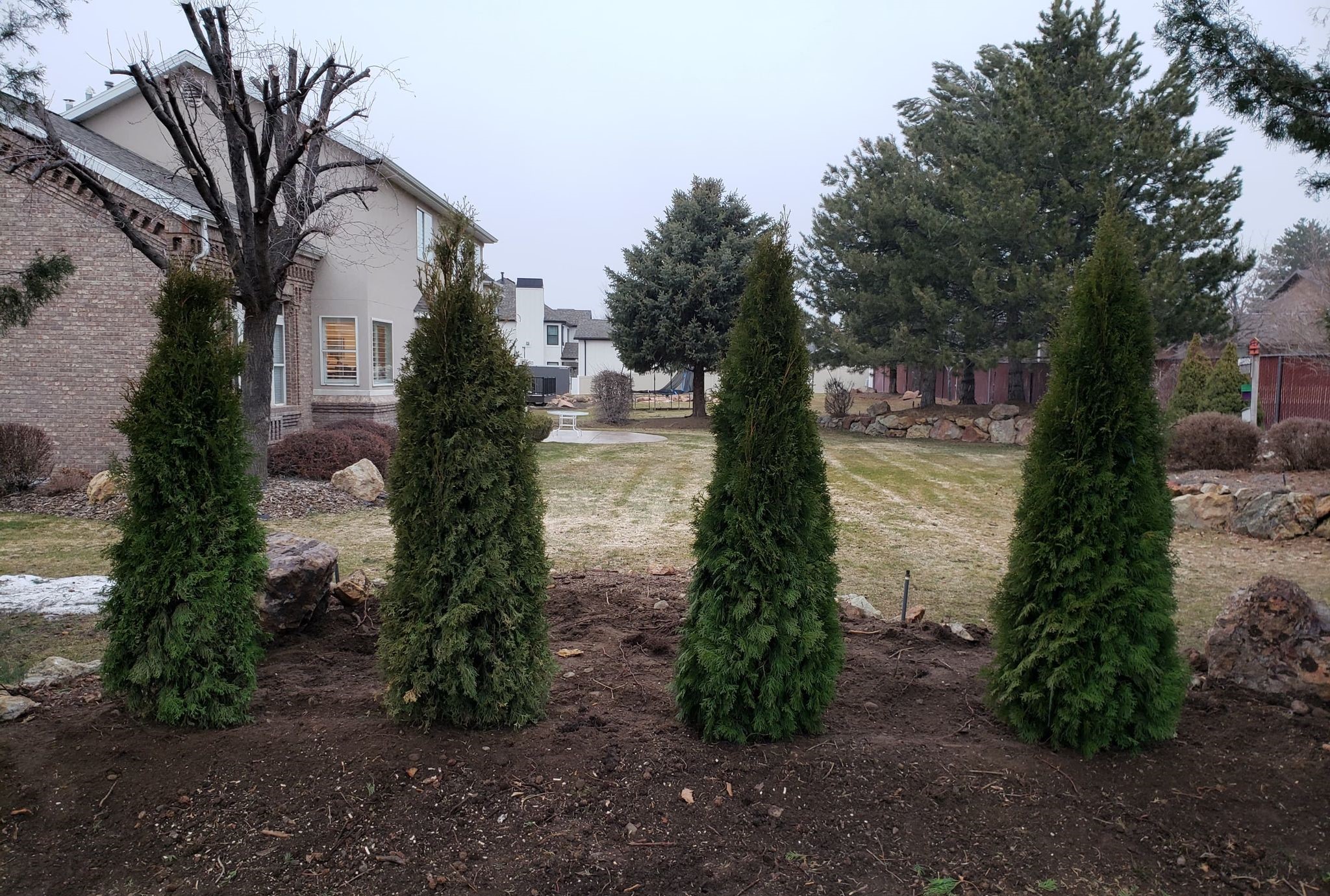

In the three weeks since Steven and I planted the four emerald green arborvitae, I have watched them disintegrate before my eyes, each day more pieces of green leaf littering the ground. I emailed the nursery pleading for help to keep them alive—we had worked too hard and brotherly to let them die—and the nursery’s diagnostician replied that the trees looked alive but badly eaten, and he wondered if we had deer in the neighborhood. Boy do we, I fumed to myself for the thousandth time. Mule deer roam the neighborhood by the dozen, nipping at tulip sprouts and lily petals and other flowers and shrubs and garden produce, transforming from wild novelty to neighborhood bane—but I had not thought they would eat evergreens full of resins. I drove to Lowes immediately and purchased two deer repellent products, the first a powder of dried blood (the package did not say whose) that would trigger the instinctual flight response in deer (so the package promised), and the second a liquid concoction of putrescent egg solids graced with garlic. Eager for the trees to begin their recovery, I sprayed them liberally with putrescence, and discovered instantly why deer and rabbits—indeed any sane creature—would stay away. Then I spent an hour manicuring the tree moats and surrounding grounds, skunked and gagging the while. I would have done well to reverse the order of things. But by the time I had finished, the revolting stench had become strangely comforting: if it worked, our trees would recover and fill out, emerald green and evergreen fragrant (except for the days of repeated treatments). After my report to Dad, he explained how he has had increasing trouble rising from his shower chair after bathing. He thought he must be getting fatter because the arms of the chair hugged his hips tighter and tighter. Today he could not free himself of the chair, but stood with the chair clinging to his backside like in The Bishop’s Wife. Surely, he thought, he could not have gained that much weight in just a few days. He asked Elie to take a look at the chair. After turning the chair over, Elie announced that the chair’s metal supports had cracked, allowing the chair to bend and the arms to squeeze, and that if Mom and Dad kept using the chair it would soon snap in half and collapse beneath them. Sarah lost no time sending over a newer, stronger chair, a pleasant blue color. I have contemplated many times, in fact constantly, the value of the help and service my siblings have gifted to our parents, and how the gifts are in turn mine, lessening the weight of burdens, making room for a break, unstringing the bow. And I am grateful. After dinner Dad declared, “Roger, it is so nice of you to get home late from work and make us a dinner of roasted vegetables.” The sweet potato and butternut squash wedges, roasted in olive oil and salt, had indeed been delicious. But the odor of putrescent garlicky eggs remains arrogantly in my nostrils.

By some fluke of chaotic coincidence, light from the morning sun barely peaking over the Wasatch ridgelines glinted off the reflecting white octagonal Stop sign tape and flashed at an acute angle through the open blinds of my bedroom window and projected onto my closet doors shifting prismatic flickers, quite beautiful and striking, creating one of those moments when ask myself, not without gratitude and awe, What are the odds? and I answer, There are no odds, because that phenomenon simply should not have happened, but it did. And only I saw. Just imagine: trillions of such impossibilities happen spontaneously in nature every day somewhere on our miracle globe. I left for work and hefted throughout the day Dad’s anxiety about thatching and fertilizing the lawn before Thursday’s snow and rain, and I arrived at home with bags of crabgrass-killing fertilizer, costing an obscene $100 for a single application and stinking up my car and causing me to choke with real or imagined chemical fumes. But before I could fertilize, we needed to race the mower over the lawn, the blade set low, to suck up all the thatch and pine needles. “Dad, are you up to it?” Of course, he wasn’t. But I bundled him into his power chair anyway, after Mom rebandaged the six-inch S-curve stitched incision on the top of his head and covered the bandage with a spacious straw hat. But the hat’s brim and the chair’s headrest conflicted—will the indignities never end?—so I quickly allen-wrenched the headrest out of the way, and out the front door he went. Dad transferred from the chair to the lawn mower with great difficulty and with noisy lifting and heaving and shoving from me. This mower was not designed for 87-year-old paraplegics. With fresh gasoline, thankfully, the mower started up, and off Dad drove. Dinner would have to be made, so I rushed into the kitchen to put the meat in the oven and start the squash to steaming, listening for the moving mower and watching Dad through the open shutters of the kitchen windows as he zoomed contentedly back and forth, filling both bags with dead grass and pine needles and dust. Finished, he pulled up to the garage and killed the motor while I emptied the dusty bags. But the mower would not start again. Examining the engine, I found that one of the battery leads was corroded and encrusted, and the red wire had snapped off its lead. This mower was not going to start, though I had scraped the encrustation off and touched the wire to the lead. Nope—this mower was dead, and Dad would have to call the service center, again, to have them come pick it up. I lead the way up the ramps and into the house, frustrated at the entropy that breaks everything down, frustrated that I could not fix the mower but had bruised my knuckles trying. Dad suspiciously did not come through the front door, and, checking on him, I found him stuck where he had cut a corner too sharply and had sunk the central wheel into the mud. “I fell in a hole,” he said sheepishly with a dubious grin. I yanked the chair out, and he left a muddy trail up the ramp and through the door and across the floor to his recliner. A chop stick cleaned the treads. A broom swept up the drying dirt. And I backed the chair, which had done a fine job and was not responsible for the wreck, cautiously into its dark corner in Dad’s office.


The sconce light on the garage had worked itself loose in winter’s gales, and when the finials fell off, the fixture hung by its wiring, daring me to fix it. I did not take the dare for a month, but finally found the courage to attempt. Home from work, ready to face the challenge, I heard Dad call me over. He detailed for me his “mental list” of chores he needed to do, including 1) power thatch the lawn, 2) purchase crabgrass and weed killer fertilizers, and 3) apply the fertilizers. He was clear that this was just his mental list, and that the chores needn’t be done right away, although rain was forecast in two days. He thought he would hire Victor to do the work, but I told him I could and I would do them, and he should save his dwindling funds. I promised to pick up the fertilizers tomorrow on my way home from work, to run the mower over the lawn, and to spread the fertilizer, this last one a quick and easy chore, for me. He wishes keenly that he could do the work, but he just cannot. Maybe, just maybe, I can push him in his wheelchair down the ramps and into the garage and help him transfer to the riding mower (a most difficult machine to mount), just last year a doable and delightful chore for him. I am willing to try. But today I had planned to attempt the sconce light repair, I told him, and walked outside to study the situation for a long spell while attempting to envision a solution. I could salvage the two brackets, though they had twisted a bit in the world. And the wiring remained intact. But I could I find the right bolts, nuts, and washers in Dad’s bolt box? Bolts and nuts can be hard to match for their varying thicknesses and treads. I had scoured the blue metal box as a teenager when learning to fix broken things and to assemble my own creations, and the blue box never left me wanting: I always found the hardware I needed. The box seemed to have a bottomless supply of bolts, screws, washers, and nuts, with an occasional hinge, and I enjoyed the clinking sounds and the rough poking on my fingers as I rummaged. The box seemed a tinkerer’s tiny treasure trove. The box was Dad’s meager inheritance from his father, Owen, who in turn received the box from his father, Nelson—both Owen and Nelson died before I was born. And today, a century after, here I was searching for, and finding, exactly the hardware I needed. “It must be a magic box,” Dad mused as I boasted of my success. Indeed, it must be, in more ways than the supply of random parts, but also the sounds and scratches and smells that carry me back generations to my forefathers, master mechanics in the mines of Utah and Nevada. Truthfully, I was more relieved than proud to have succeeded in remounting the fixture to the brick, and whispered a “thank you” to heaven to have been spared the frustration of very possible defeat. Mom just had to come and see the makeshift repair, and we stood staring at the light with delight. As the sun began to set, I suddenly knew I needed to get Dad out of his recliner, out of the house, and into the cool twilight sun for a “walk”—winter has been so long, and the snow finished melting just yesterday. Dad struggled into his power wheelchair and zoomed away toward the front door and the ramps that followed—I called after him a warning that his new chair is much faster than the loaner—in fact, I had just tested top speed and had frightened myself careening through the house, with G-force sensations similar to flooring a Tesla (well, almost). I gathered Mom into the other chair and pushed her down the driveway and up the sidewalk, Dad tooling independently behind, feeling a new awareness, similar to the pleasure of walking one’s beloved pets—but not quite—and somewhat like the simply joy of walking one’s children around the block—closer, but still a bit off—and I thought how nice it was to be able to take both of my parents for a walk in their wheelchairs at dusk.
The magic box and the sconce light:

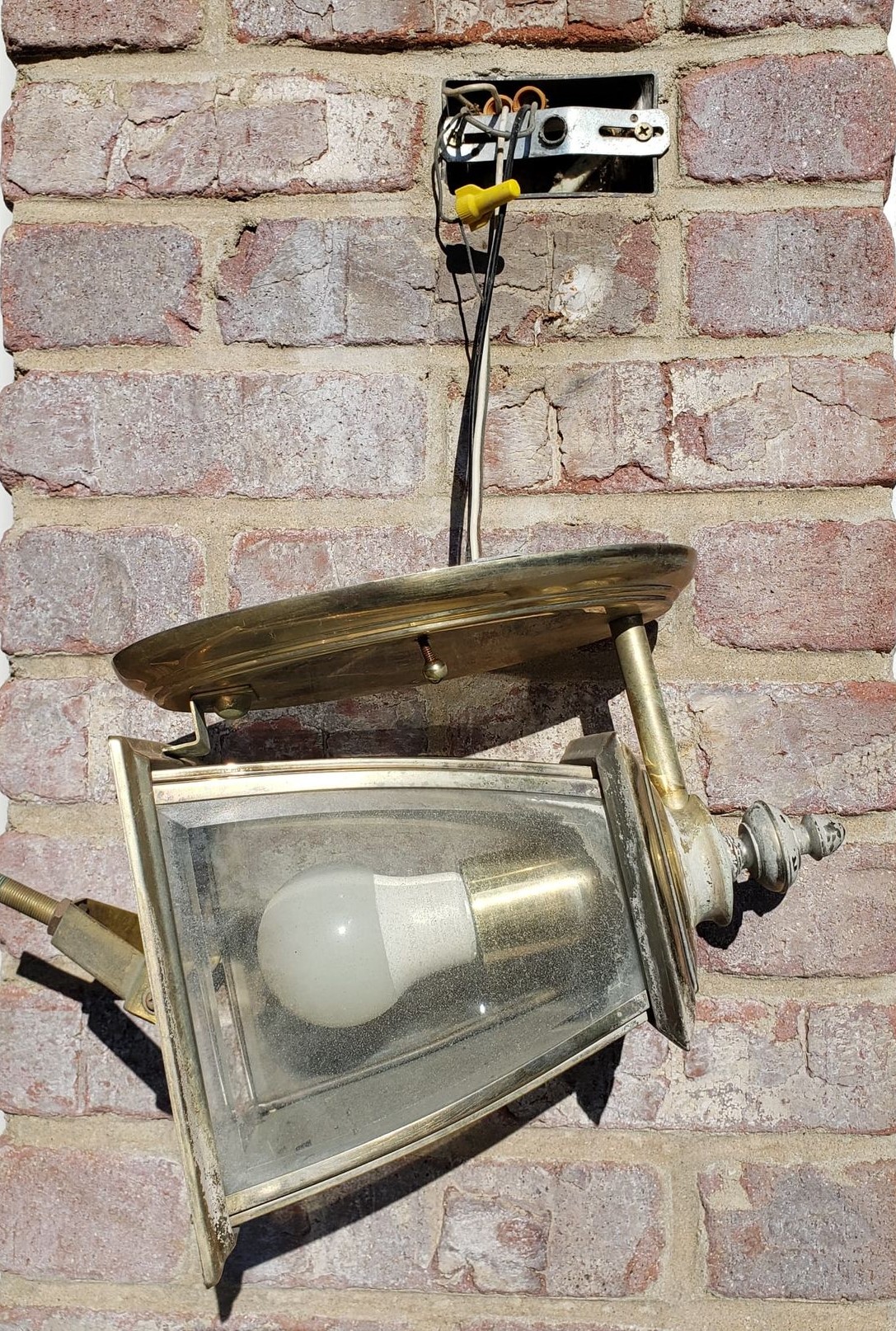


Each prior reunion had been held in the basement great room, but this year Dad had to acknowledge that their first mission reunion since Covid-19 swept the world could not be held downstairs. He confessed to me that in his obsessive deliberations he had even thought of going downstairs by sitting on the top step and “like a baby” sliding down on his butt, one step at a time, to reach the regular basement venue. Several disastrous and humorous images of potential outcomes flashed through my mind, and I acknowledged with a chuckle that this might be possible—but how would we ever get back up those stairs? He certainly could not crawl up them “like a baby.” Sarah and Megan moved the sofas and set up 60 chairs, upstairs—59 people came, beloved friends and former missionaries all. Mom and Dad thrilled to see them again, chatting up a storm, remembering the old memories of Brazil and of trapsing through the big cities and along beaches and on farm country roads, remembering especially the people they taught and loved, and singing the fervent songs—and eating Brazilian food! This twentieth reunion would be a cherished memory. A different and quieter assembly occurred at the house, when Brian brought my new grandson Owen to receive our Church’s traditional “Name and Blessing” ordinance. Normally performed in a church setting, Brian had obtained permission to conduct the simple ceremony at Mom’s and Dad’s house, so that Dad could participate. Brian held Owen inside the circle of family men, four generations of Bakers—Dad had maneuvered his new power wheelchair to join his hands with ours in holding the baby as Brian pronounced the blessing and made official the baby’s name. Of course, we enjoyed good food afterward: my big pot of savory chicken vegetable soup. And a fun and festive gathering transpired on Easter Eve, with Brian’s family serving traditional homemade Polish pierogi, with kielbasa, and with my French purple cabbage (baked with bacon, carrots, onions, tart apples, and sweet spices like cloves and nutmeg). I also boiled a dozen eggs for Lila (3) to dye. She plopped the color tablets into clear plastic cups, and I added first vinegar and then water. I coached her in using the ever-awkward wire egg spoon to dunk each white egg and a few minutes later retrieve magically brightly colored eggs. She called the order of dipping: “red” then “pink” then “green” and so on. Her dexterity impressed me. Tooth stockers and eye stickers and fins—this was a dinosaur egg-dying kit—added to her fun. Mom and Dad watched from the next room and chuckled, remembering their own three-year-old children, and then grandchildren, dying eggs at Easter. She called to me “Love you, Grandpa” as the little family drove away toward home. I love you, too, sweetheart.
Pictured above: One of Lila’s dyed-egg dinosaurs.
Pictured below: Yours truly with Lila and Owen and dyed eggs:


Some mission reunion photos:

“My head hurts,” Dad moaned. As well it should. As well he might. The spot on his head, frozen by the dermatologist, would not heal, and a biopsy found skin cancer. Because I was out of town, our kindly neighbor, Darrell, loaded Dad in the Faithful Suburban—I had coached him in my detailed wheelchair protocol—and drove him and Mom to Dr. Hinckley’s office, where the surgeon excavated the cancerous spot, and found beneath it a more aggressive cancer that had reached its tentacles across Dad’s scalp. The surgeon substantially lengthened the incision, followed and carefully removed each tendril, and stitched up Dad’s scalp. I returned from my Chicago grandson’s exultant first birthday—complete with first steps, family photos, and pudgy little hands digging in his cream covered cake—to find Dad sitting in his recliner with a swollen face and puffy eyes, an enormous bandage covering his head, and pain. The eight prescribed Tramadol pills did not last long, so ibuprofen and acetaminophen are trying to pick up the slack. If not found and excised, that cancer would have killed him. Cancer killed my classmate Kim just last month, and I sat in the funeral service remembering my twelve-year-old crush (she never knew), our five-couple senior prom group, our high school graduation, and how kind she had been to me after my divorce. Her funeral was not the funeral I had expected to attend. Kim visited Dad and me last summer: she had found among her documents a folder of my high school papers, which she had brought home from school for me, because I was out with knee surgery, and had carried with her across exactly forty years a green plastic folder with my senior world lit 2 class papers—ten As, four Bs, and one B minus—papers I am not likely to ever read—and a poem. I have written exactly 531 poems in my life, and I had lost one of my very earliest poems, written in 1982 in my senior world lit 2 class, a poem that expressed newfound deep feelings about my purpose and my way-of-being in life—I had lost that poem, somehow, until I opened the green plastic folder, and there the poem lay, having hidden these forty years. I messaged her my thrill and thanks and the story of my lost poem, and she was so happy. As I read the poem she had saved for me for four decades, I realized it is a terrible poem, full of cliché and cheap rhyme and artificial meter and childish sentimentality. But for all its superficiality, its core idea laid the first stone of my life’s foundation. A few months later, Kim died. Thank you, Kim, for being kind.
(Pictured above: Yours Truly holding my one-year-old grandson on the windy shore of Lake Michigan.)
Two hours before the CNA came, Mom met me at the top of the staircase and motioned for me with her finger. She whispered that the urinal was full to the brim, and she worried that if Dad woke and needed the toilet before the CNA came, the bottle might spill. She asked me to empty it. “I was going to do it myself, but then I saw you and thought, ‘He’s the perfect victim—I’ll ask him to do it.’” Her request touched off an internal mental struggle. One voice chided, If she was going to do it, that means she was capable of doing it, and she should do for herself what she can do, and ask me to do what she cannot do. An opposing voice stepped in with, Wait a minute! I am here to help my father and my mother, to ease the burdens of both. I pushed the selfish voice away and answered, “Sure, I’ll take care of that. I’d be happy to.” And in ten seconds I had emptied and rinsed the urinal and flushed the toilet, all while Dad slumbered. The day was Saturday, and on Saturdays the CNA comes at 9, not the weekday 9:30, always surprising Mom by being “early.” I opened the front door when the doorbell rang, and let the CNA in. “Hi, I’m Jared,” he announced cheerfully. I had never seen Jared before. Mom rode down slowly in the stair lift chair, glaring unhappily at the new face that came at 8:50, ten minutes earlier than “early.” But Jared won her over within those ten minutes, and Mom loved the short obese scraggly-bearded tattooed middle-aged man like a long-lost friend, asking him where he was from, if he had a family, where he went to school, how long he’s been a caregiver. Jared cheerfully answered all her questions, then turned his attention to Dad. Jared being new, Mom and Dad had to explain yet again all the little particularities of how things are best done, with using the walker, showering, dressing, transferring between various sitting surfaces, riding the stair lift (Mom insisted he ride it up the stairs to reach Dad, instead of walking up the stairs and bringing up the chair with the remote), eating his breakfast, taking his pills, and doing his upper-body rubber-band Pilates. While Jared was learning the ropes, I was delving into my transient past, moving out of their hastily stacked places my beds, boxes, artwork, decorations, tools, and books, rearranging them more carefully, efficiently, and accessibly, reminding myself of what I own that I have not seen for 20 months, still finding it strange to have much of my life packed up in boxes. In a shoebox I found old family photos Mom saved and gave to me, including one of me ready to baptize Hyrum, age eight, both of us happy and dressed in white. I scanned and emailed the photograph to Hyrum, now 21, a missionary for his Church in Brazil, teaching the Good News of Christ, inviting others to enter the baptismal font, dressed in white, to be baptized, immersed, symbolically cleansed, to make a covenant with God to keep his commandments, to care for the poor, to mourn with those that mourn—the best kind of promises.
(Pictured above: Yours truly and my son Hyrum, age eight, on his baptism day.)
 Hyrum today, a two-year volunteer missionary for the Church of Jesus Christ of Latter-day Saints, in Brazil.
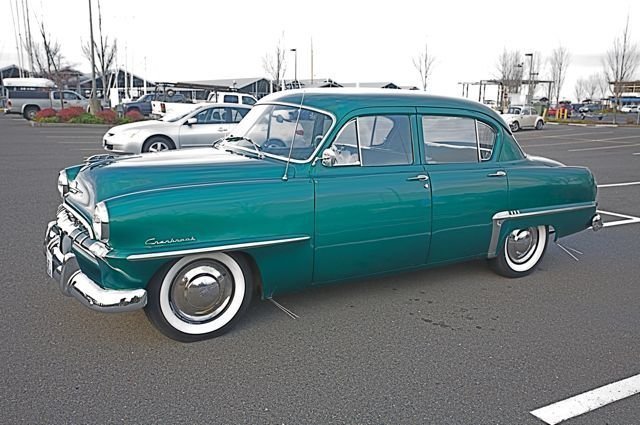


 Rabbit Lane