The law firm had changed names four times in the decade-and-a-half since Mom and Dad retained a friend of a friend to prepare their estate planning documents. But I tracked down the firm and the lawyer, and scheduled to meet. I have felt unprepared to be the personal representative of Mom’s and Dad’s small estate, and had many questions, such as, Do they need to update their documents? How do I handle the cars? Is the deed correct? What is an estate tax credit? Do I need to understand QTIP? (No.) What is the first call I make when the time comes? What is your hourly rate? He told me not to worry, that I was well-prepared, even “light years” ahead of 95% of his clients. I breathed deeply and reassured myself, Maybe I can do this after all. Then I was off to NOMAS’ Thursday evening clinic to help with a U crime-victim visa for a humble hard-working woman whose paramour turned perpetrator, who refused to work or contribute to business and household expenses and who screamed and threatened and hammered, whose trump card in oppressing her with power and control was the threat of deportation if she called the police. But the U visa helps people be in America legally and shelters victims of crime from the further victimization and trauma of deportation for their mere victimhood. I knew how to find the court dockets and case numbers and protective orders that would corroborate her truthfulness and his abuse, and printed them for the file. Driving away from the clinic, I saw some clients walking down the street, laden with foodstuffs from the community pantry, laboring to the bus stop with their sacs and their children, because they cannot afford cars or cannot afford to fix their cars, and thought of my neighbors with their several Porsches and BMWs, and still cannot make sense of the world. I stopped at NY Pizza Patrol for a Brazilian Bahaiana pizza with calabresa sausage and kalamata olives and sliced eggs: I just could not face the kitchen for a 9:00 dinner. The pizza was a rare treat, which Mom and Dad (and I) loved. On Friday evenings in June, I have been trying to make sense of the world, searching for calm and beauty on the calm brown waters of the Jordan River. Dozens of homeless encampments lined the banks of one urban section. A beaver and birds greeted me downstream: black cormorants, Bullock’s orioles, Clark’s grebes, coots, Canada geese, Mallard ducks, avocets, black-necked stilts, Wilson’s phalaropes. I missed seeing my territorial friend the belted kingfisher, and hoped he had not fallen prey to a Swainson’s hawk. With my new and first-ever drybag clipped to the kayak, and my phone hanging safely in its clear pouch around my neck, I lounged in the shade under a willow bush, smelling sweet Russian olive blossoms and arousing yellow iris blooms, when the Messenger alert rang and rang and rang while I fumbled to answer, knowing who it likely was, and, yes, it was William calling me from his high chair where he sat munching on pineapple chunks, with his smiling adoring amazing mother beside, telling me about her day as I floated and rocked on the river, making some sense of the world.
Tag Archives: Poverty
Courage at Twilight: Three on the Tree
Scott came to the house to help Mom and Dad prepare their tax returns. Dad had all their documents ready. Fifty years ago, Scott served as a young missionary in São Paulo, Brazil, for the Church of Jesus Christ of Latter-day Saints. Dad and Mom presided over the mission for three years, becoming much beloved by the 200 missionaries. And here was Scott, five decades later, their bonds of affection intact. From my upstairs office, I could hear the tender tone of their conversation, their occasional laughter, and place names in that most beautiful language of Brazilian Portuguese: Piracicaba, Juiz de Fora, Itapoã, Rio Grande do Sul, Curitiba (some of their fields of labor). They remembered fondly old friends like Helvécio and Saul Messias and Camargo. After an hour, Scott drove away in his black BMW sedan. “That big BMW was part of Scott’s required profile at Price Waterhouse Coopers,” Dad explained. “Now he teaches at the University. It was very nice of him to come see us.” Dad has spoken to me many times about his own “profile” as both an international corporate attorney for Johnson & Johnson, wearing the compulsory navy-blue pinstripe suit, one identical suit for each day of the week, while also being a lay minister for the Church in New Jersey. As part of his ministry, he visited many people in poverty, and he decided his car should be as humble as theirs. He drove to work and to church and on family vacations in a 1970 Dodge Dart, in which I learned to drive, with “three on the tree,” meaning a three-gear manual transmission with the shifting lever on the steering column. That clutch was touchy and stiff, you can take my word for it. But I mastered that clutch, and did not roll back on the hill into the shiny new black Trans Am with red racing flames. Later in his career, Dad upgraded to an Oldsmobile 98 (hardly a luxury Lincoln or Cadillac), which he drove one evening to the projects in New Brunswick to visit a fraught Church member. Upon leaving the squalid high rise, he found a gang surrounding his Olds, the gang leader sitting on the hood. “Hello,” Dad said pleasantly. “Can I help you?” The gang leader sauntered over, opened Dad’s suit, and removed his wallet from the lapel pocket. “Thank you very much,” he sneered and swaggered away. Dad spoke up: “I am a minister. I have just been visiting Sister Morales, who is a member of my Church and my flock. She needs help, and I was seeing what I could do for her and her children.” The gang leader turned, handed back the wallet, and said to Dad, “Have a nice day, Minister. Thanks for coming.”
(Very nice photo of very nice 1970 Dodge Dart courtesy of Hemmings, used pursuant to the Fair Use Doctrine.)
Courage at Twilight: A Can of Stew
Dad’s father, Owen, retired early from Utah Oil Company. He lived in his parents’ home, an old, run down, small shack of a shelter. He paid rent to his siblings. The house had few amenities. It had no water heater, so he bathed in cold water. The stove did not work, so he cooked on a hot plate. Only the top oven element worked, so he baked under the broiler. The toilet water tank was broken, so he flushed by pouring water from a bucket into the bowl. He had no clothes washer or dryer. The heat for the house came from a coal boiler, which worked only after building a fire hot enough to burn the coal—often, the house had no heat. Owen lived alone. He made all his own meals, which included no fresh vegetables or fruits. He washed his underclothing and socks in a bucket of cold sudsy water agitated with a toilet plunger; his shirts he took to the dry cleaner. In his early 20s, Dad visited his father one afternoon, and Owen asked if Dad had any money with him. Yes, Dad said, some. Father asked son to go to Safeway, please, and buy him a can of stew, confessing he had not eaten for three days, for he had no money. He had eaten only oatmeal for days before that, until the oats ran out, and he had not eaten anything since. When he did have money for food, his staple diet consisted of bacon and eggs and canned goods. (Where were Owen’s well-to-do brothers? I wondered with a trace of anger.) As a result of these privations and habits, Owen’s health deteriorated. One afternoon, he called Dad to take him to the hospital—he felt very poorly—where the doctor ordered a chest x-ray. “Take a deep breath and hold,” the radiology nurse instructed. Owen growled back, “What the hell do you think I’m here for?!” He was at the hospital because he could not do exactly what the nurse wanted him to do: breathe deeply. He felt he could hardly breathe at all. Dad got his father settled in the hospital that night, and told him he would be back the next morning to check on him. Ten minutes after arriving at home, the hospital called: his father, Owen, was dead. Owen was only 59. Owen’s father, Nelson, died at age 62, also of heart disease. Dad and his brother Bill sat in the hospital room with their father’s body, late into the evening. They both felt a spirit presence in the room, and commented softly to each other about it—somehow, they knew their father had stayed with them in that room in their grief. In a moment, they sensed that Owen had left to go where the spirits of all good, humble, broken men and women go. After graduate school, Dad took up jogging, and ate nutritious foods, so he would not have to die at age 60 of heart disease. Now, at age 86, he remarked to me sadly, “I feel sorry for my father.” I shudder to remember that I am the same age as Owen when he died. How grateful and fortunate I am to have my father still alive, still a pillar of strength and love for the family.
Pictured above: My grandfather Owen with Dad (b. 1935; this photo c. 1939)
My grandfather Owen Nelson Baker, Sr. (1901-1960)
Courage at Twilight: Meager Meals
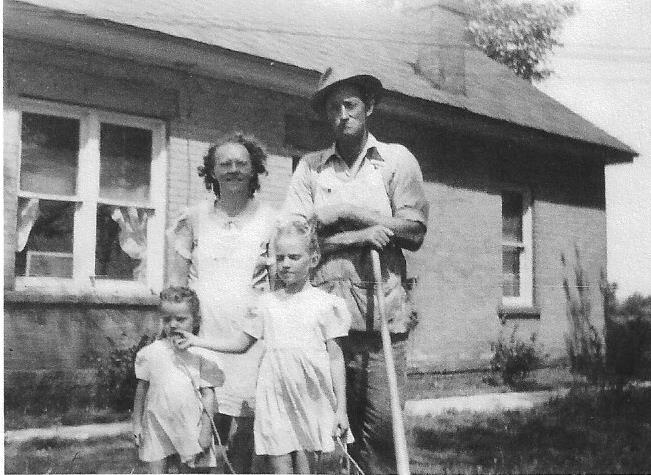
I emerged from my sick room, double masked, to figure out a mid-day meal, and opted for summer sausage slices, gouda cheese cubes, Wheat Thin crackers, and sliced apples. A pleasant snack. Mom commented from her corner recliner, “What a perfect snack! Isn’t it nice to have so many good foods to choose from? I feel so blessed. I feel so grateful. I thank Heavenly Father in my prayers. I was often hungry as a child.” I stood stunned at the thought of my mother being hungry as a child, and asked her about it. She explained that her family had been poor. They ate healthy foods they grew in their own garden, but their meals were meager. She told me about thinning the carrot and beet rows, of squashing the tomato hornworms, of gathering the eggs from protective hens, and of dunking dead chickens in scalding water to pluck their pungent feathers. Her father was a junior high school teacher, and worked odd jobs during the summers, as a milk truck driver, supervisor at a pea vinery, county roads crew member, school bus driver, laborer at a munitions factory, and custodian. He kept taking classes at the University of Utah, and eventually made a better salary as a junior high school guidance counselor. But as a younger child, a skinny, slight child, there were no snacks between small simple meals, and Mom’s stomach often growled as she lay in her bed at night. As I munched my lunch in sick-room isolation, I pondered my mother not having had enough to eat, and likewise thanked my Heavenly Father for our bounty.
Pictured above: Mom with her father, mother, and little sister. Circa 1944.
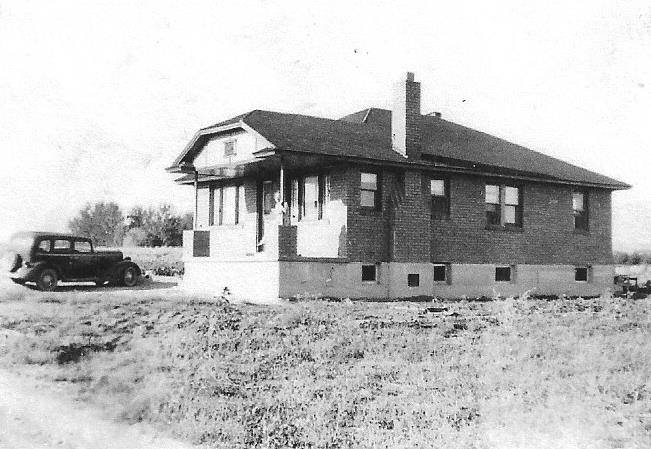
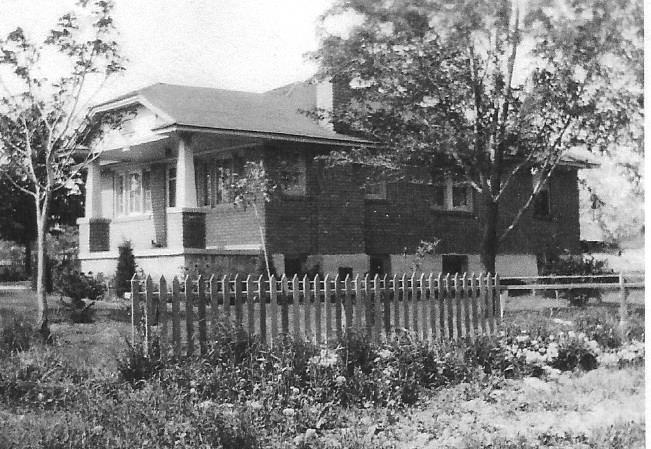
Mom’s house, built in her birth year of 1939.
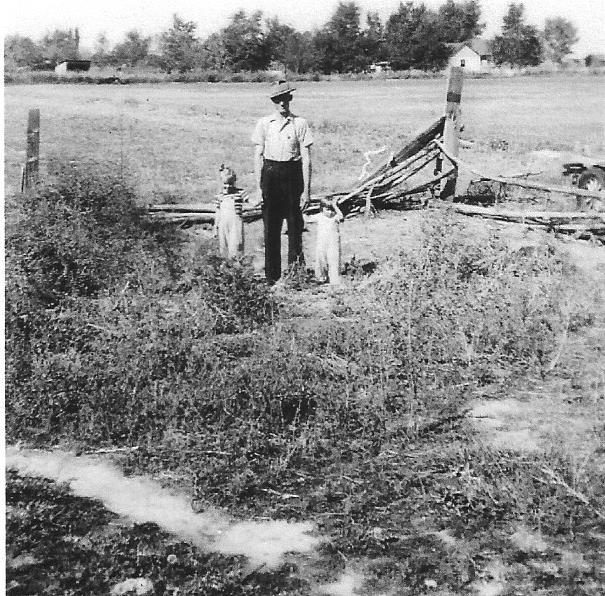
Mom in the family farm fields with her father and little sister. Circa 1942.