Tag Archives: Hospice

Courage at Twilight: The After Words (Privilege)

For every day of this caregiving experience, I have been conscious of the blessings, the resources, the benefits, the privileges that shaped and enabled the experience.  By “privileged” I simply mean to indicate our relative place on that vast spectrum of personal resources, our being somewhere in the in-between of those with tragically few resources and those with unnecessarily huge resources.  My caregiving experience, and my father’s and mother’s experience as the cared-for, undeniable was shaped and even determined by our relative resources.  My father’s pension allowed us to hire private-pay home health care and hospice, which sent aides for two hours a day, seven days a week, including holidays, for the last two years (about $30,000 per year).  To be sure, the costs ate away steadily at my parents’ savings, but the fact remains that they had savings, whereas many do not.  Not having this resource would have made my caregiving experience impossible, at least for me.  Add to our privileges the ability to purchase a $14,000 chair lift for the staircase.  While the lift was a major hit to our budget, we had the budget.  Add the blessings of medical insurance, prescription insurance, and social security.  Include the allowance I was given to work a flexible work schedule, which enabled me to cook healthy from-scratch meals from fresh ingredients.  While I am only a small-town government lawyer, my professional knowledge and social clout did clear obstacles others struggle to break through.  Our relative privileges do nothing to reduce the legitimacy or reality of my experience and my story.  But they do shape that story.  A lack of these resources would have dramatically altered the experience, and dramatically multiplied the stress and trauma, and I acknowledge the difficulties faced by persons with fewer resources.  I am not a community organizer, and offer no social solutions, but I am aware of some of the challenges and struggles faced by many.  It may be a cop out to say I would not have been up to the task without our resources, but I fear I would not have been up to the task.

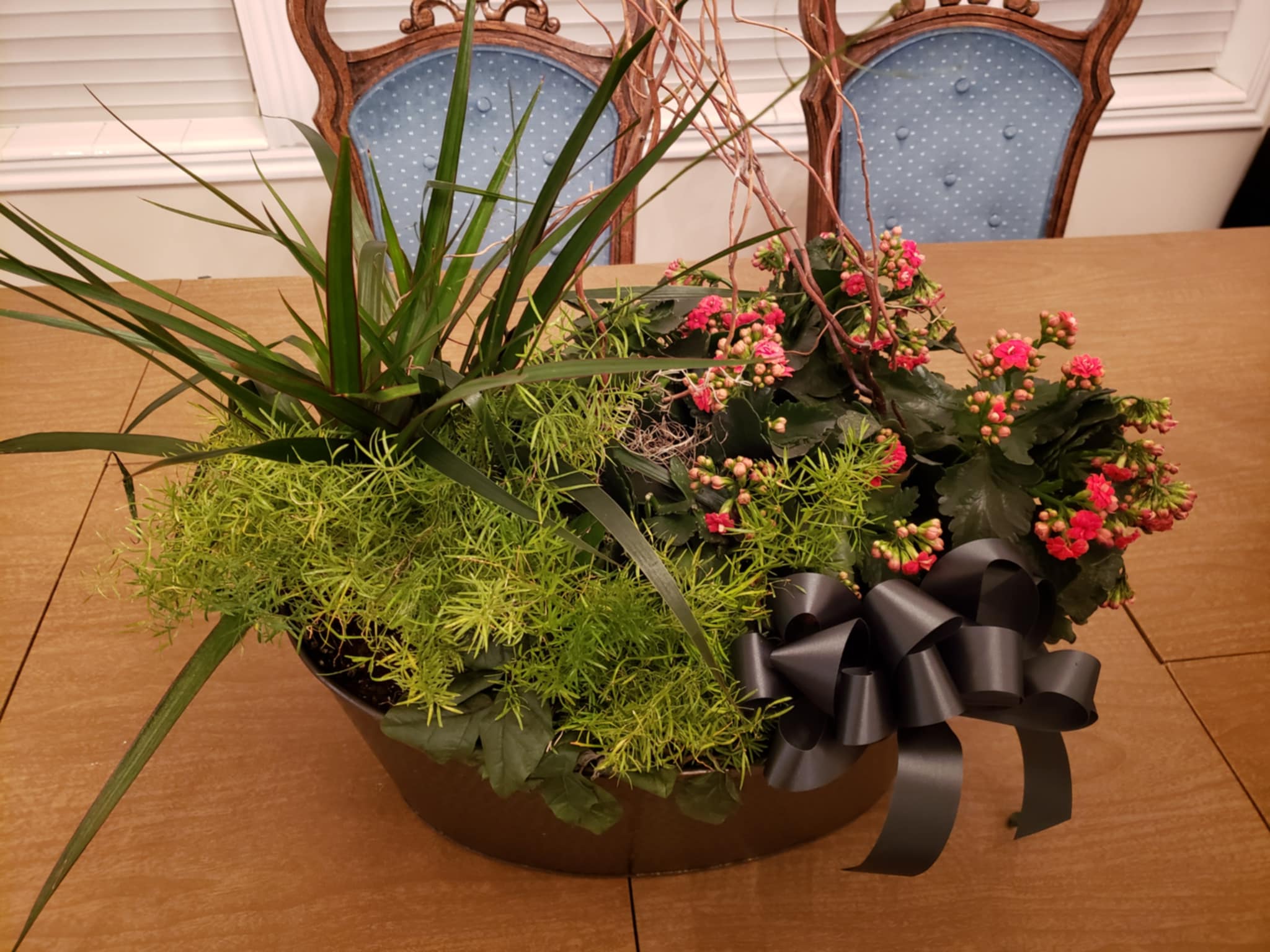
(Pictured: funeral planter from the Tooele City Mayor and City Council.)

Courage at Twilight: A Long-stemmed Rose

We all believed it, my mother and sisters and I, that my father clung to his last heartbeats and breaths until Steven could arrive to bid farewell.  We enthusiastically expressed our belief to Steven and to each other.  Whether factual or no, we wanted to believe it; we wanted this mystic affirmation of a narrow sliver of hope in the midst of death.  Indeed, that Steven arrived before his father’s death seemed miraculous, despite the coma and death rattle.  But I soon discerned the unfairness to Steven of this testimony, which required of him wonder and faith in the face of haggard death, which broached the unanswerable question of why our father’s lucidity could not have been prolonged a mere 36 hours to allow a two-way farewell, which raised the painful reality of this last good-bye.  So, I kept my belief, or my wanting to belief, silent, and sought merely to accept the circumstances we were given and to find satisfaction in having done our best with them.  Steven’s trip was planned months before, but he arrived just prior to our father’s passing and left just following the funeral.  After our father’s passing and our family prayer, when our small assemblage felt ready, I called the on-call hospice nurse, Monica, to report the death: Tuesday January 14 at 11:03 p.m.  The official time of death, however, became the time of her certification of death: Wednesday January 15 at 00:26 a.m.  She performed her coroner’s functions, wasted the remaining morphine (mixing with dish detergent and pouring down the sink drain), and called the funeral home.  At about 2 a.m., the mortician rang the doorbell, bowed at the waste, expressed his condolences for our loss, entered the house, crossed the room to our mother, and delivered to her a very-long-stemmed red rose, bowing again and whispering again his condolences, which he repeated at a higher volume after Mom said, “What’s that?”  After speaking comforts, he and his junior associate, dressed in black suits and burgundy bow ties, shrouded our father in white and transferred him to a wheeled gurney, where they enclosed our father’s body in a blue velvet bag with a sturdy brass zipper, and draped the whole with a blue patchwork quilt, a nice touch I did not anticipate but appreciated.  And then they rolled our father’s body away and out the front door and down my wood ramps and into their Larkin van.

Courage at Twilight: What Will the Morning Bring?

I expected this entry to begin and end with “Dad is dead.”  The night before, I turned off all the lights except for my father’s night light, a small wild-wood lamp made by my son Hyrum, and said good-night to my unconscious father who lay in the lamp’s low glow.  After sunrise, I lay awake in bed with a tired father’s Christmas-like morning mix of anticipation and dread, sneaking down the stairs ahead of the children for one last check on the piles of gifts before the onslaught of squeals and flying paper, in this case ahead of my mother, in this case for one last check on my father, who I anticipated finding cold and dead.  But, again, he defied my expectations of certain life’s end to flicker his eyelids and responded “Hi Rog” to my good-morning greeting.  The vivid yellow urine of yesterday dripped an angry opaque red.  Rosie said the red could be blood from the catheter insertion, but more likely meant failing kidneys.  He drank nothing yesterday, after all.  I swabbed his dry open mouth with a wet sponge-on-a-stick.  I smoothed Vaseline on his flaking lips.  I syringed a small dose of morphine in advance of the CNA roughing him up with rolling and changing and bathing and rubbing.  From the kitchen sink I heard him mumbling, and I hurried back for him to look at me sleepily and exhort me to “Be good, Rog.  Be good.”  I will, father, as if I know to do anything else.  Then I settled in to do what any other normal land-of-the-not-dead person does: I washed last night’s soaking pots and pans, and I set the garbage and recycling cans at the curb.  Mom asked me to pray with her last night, asked me to pray with her every night.  But what she really wanted was to tell me that she wants to stay in the house and not go to an assisted living facility after my father dies.  I told her there was no reason not to stay at home if she were healthy and mobile.  But I told her that I could not be her companion or comforter, that she would mostly be alone.  She liked being alone, she said, doing her simple activities, she said, her needlepointes and word puzzles.  I did not talk with her about what my own life might have in store.  It’s too soon.  The time for that will come, but is not today.

Courage at Twilight: Bedbound

I had hoped Dad’s mental acuity would return after a solid sleep, if not some of his physical strength. But his first utterances upon waking were incoherent nonsensical sentences, spoken with a thick tongue and loose jaw.  His beloved Gloria came to take care of him, the day being Sunday, and he broke her heart calling her Martha and Ana.  “Nelson, I’m Gloria!” she nearly wept.  He strained to sit up so he could pee, but had a distorted sense of himself and his surroundings, holding the urinal absently in one hand while peeing on the bed and on the floor.  She laid him back on the bed and helped him finish, then stripped and remade the bed around him.  He did not want to wear a brief, but we put one on anyway, explaining that it was necessary because he had no strength to use the urinal or the toilet.  Gloria and I sat at the kitchen table and faced the reality that my father and her Nelson was in serious shape, would be permanently bedbound, and we would need to reevaluate the whole procedure for his care.  He adamantly opposed staying in his hospital bed in the corner of his office, so I slid away his recliner and we rolled him in his hospital bed into the recliner space, comforting him that this way he would be with Lucille and listen to her music and watch her TV programs and eat lunch together just like normal.  I reported to Jessica that Dad’s condition had deteriorated quickly and severely, and that he needed a catheter because he could not manage urination in any manner.  She was shocked at his appearance less than 24 hours after her previous visit.  She observed his incoherence, his exhaustion, his inability to swallow a pill, his breathing and speech and loss of appetite and distorted sense of himself and his surroundings.  “I wonder if he had a heart attack yesterday when I was here,” she said.  Even one day before, convincing him to accept a catheter would have been impossible, whereas today he did not resist or complain, and the bag quickly filled.  Though he awoke for an hour as Gloria bathed him and changed his bedding, he had been confused and incoherent, and, with the catheter in place, he now slipped into an all-day sleep.  We tried to feed him pinches of food, but he could not chew or swallow.  When we gave him his pills, he alternately held them in his hand, dropped them into the cup, and chewed them without water.  We gave him water to wash the pills down, but he aspirated and sputtered and coughed and his breathing gurgled during his hours of sleep.  I asked if he were in pain and he shook his head no.  I asked him other questions but he did not respond.  He ate nothing.  He drank nothing.  He took no medications.  After observing him, Jessica thought he would not survive the day, that he was beginning to transition from life to death.  She suggested I call the family and invite them to say their good-byes.

Courage at Twilight: Almost Comical

Jessica, the on-call hospice nurse, arrived just in time to see Dad lurch into an episode of unendurable chest and rib pain. His vitals were good, she said, suggesting the episode was not a heart attack, and authorizing me to give four 0.25 ml morphine syringes, plus a 0.5 lorazepam syringe (“they work better together”).  After an hour, the pain suddenly let up, and he settled into a snoring sleep.  He stirred at intervals, waking slightly, but not fully, mumbling gibberish, making incomprehensible nonsensical conversation.  At bedtime, he could not sit up, let alone stand up, and I could see clearly the impossibility of getting him to bed.  But I needed to get him to bed, to confine the mess, the increase his comfort, and mostly because I suspected that once in bed he might never leave bed again alive, and that if I did not get him into bed this night I would not be able to thereafter because of his utter weakness and my insufficient strength.  He struggled to lean forward, but explained with hand motions the mechanics of how he would simply stand up and turn clockwise to sit on the walker seat, his voice strangely thick and dull and slurred, his self-perception skewed and delusional.  How would I get him up and out of his recliner and convey him to bed? I wondered.  I could not fathom how.  Following our routine–we had to try–I hooked an elbow under his good right shoulder (the left side continued to pain him terribly) and carefully lifted, while mom lifted with her hands under his butt—and all we succeeded in doing was scooting him dangerously close to the edge of the seat, within an inch of sliding irretrievably to the floor.  An idea came, and I hurried to executed it.  Phase 1 involved leaning his torso back, lifting his legs, jamming the walker seat against the recliner seat, holding the walker in place with my foot, and dangling his legs across the walker seat.  With a broad, two-handled sling, I sat him up and shimmied him from the chair and onto the walker seat, bumping his butt over a gap.  The maneuver worked, and he sat nicely on the walker seat.  As I held him upright with the sling, Mom and I managed to roll the walker backwards to the hospital bed, which I lowered as far as it would go.  Phase 2 involved leaning his torso back onto the bed, with the sling behind his back and under his arms.  Mom lifted his feet clear of the walker, and I stood on top of the bed leaning over him, my feet sinking deeply into the mattress.  I heaved with my legs and arms—trying not to strain my back—to slide him in six-inch intervals onto the bed, but perpendicular to the bed, then used the same maneuver to turn him parallel and to slide his head toward the headboard.  With each heave, his head slid backward between my feet as I stood over him on the bed.  At any point, this slapstick performance could have gone terribly wrong, with Dad crashing to the floor, with my desiccated spinal discs shattering, with me tumbling off the bed, with only half of his body in bed and half out….  But for the tragedy of Dad’s situation, and maybe in spite of it, any observer would have laughed hysterically at our antics.  Somehow, with just the right forces and angles and frictions and strengths and moves, we succeeded.  I would not want to have to do it again, and now that Dad was correctly installed in his bed, I likely would never have to.  He had cried out in pain throughout, and he eagerly accepted the morphine he had rejected for the previous 13 months, and quickly settled into sleep, a sleep from which he never fully awoke.

(Photo copywrite by Caleb Baker.)

Courage at Twilight: Unspoken Apology

Before I understood Dad’s pain, he shouted at me as I lifted gently under his left arm to help him stand and turn for bed, and I shouted back at him to not shout at me, making sure to shout louder than he. Lying panting in his bed, he explained the horrible pain he was having in his chest.  Understanding his pain helped me find more compassion and patience, helped reduce my resentment, helped me speak softly and forgivingly, and I thought in the night of the apology I would offer him the next morning.  I’m sorry I shouted at you, Dad.  Can explain something to you?  Just let me get through it, and then you can respond.  I have always felt afraid of you and intimidated by you.  You were always so smart and so strong and so successful, a superstar to so many, and I wanted to be all you are but knew I would never be.  I have always wanted to make you proud, but you never told me you were proud of me.  I have always wanted your love, but you never told me you loved me.  I always felt afraid of your disapproval and disappointment.  And so, I feel destroyed and annihilated when you shout at me or become angry or disappointed with me.  And now, at age 60, I shout back or become defensive, only to stay alive.  Always in my life I have shrunk to be as small as possible, I have shrunk into shame, I have sunk into depression, for I am a man who has depression.  But, I don’t want to die, Dad, and to not die when you are disgusted with me or disappointed with me or angry with me, I fought back.  That’s what is happening.  I’m trying to survive, to stay alive, to not die.  But I can see that you weren’t angry with me last night; you were in severe physical pain, and so I apologize to you for shouting back at you when you shouted at me, because you really weren’t shouting, you were just crying out in pain.  I’m sorry.  But in the morning, I found him too feeble and in pain and ashen-faced and miserable and weakened, and could not bring myself to add to his suffocating burdens.  My apology may have brought understanding, but would have added to his heaviness and suffering.  Instead, I listened to his troubles and called for the hospice nurse to come, on a Sunday, and administered the morphine, and did what I could to safeguard his comfort.

(Pictured: boot hill grave in Peoche NV, the small mining town of my father Nelson’s grandfather Nelson.)

Courage at Twilight: No Saint

Janis says to me every week at church, she says: “You are such a blessing to your parents.  They are so lucky to have you.”  And Stephen, whom I respect, and who knows a lot more about caregiving than I will ever know, told me, “You must have the deepest reservoirs of unconditional love.  If you were Catholic, I’d nominate you for sainthood!”  (Wink-face emoji.)  He’d have to call me the Swearing Saint, I muttered.  And my great and good friend Blake: “You are amazing…you are preparing your place in Heaven with how you are treating your parents.”  Heaven, huh?  Hell, more likely.  Or some other type of purging Purgatory.  Where the angry and resentful and rude go to cool off for a few millennia while awaiting the Final Judgment.  I think I will need every one of those years.  “Help me get to the potty, Lucille,” Dad instructed her.  “I can’t!” she cried, at 85, barely able herself to totter about on stiff knees and hips, let alone support and swivel around his belly and buttocks.  “I’m not strong enough!”  Exactly so: you’re going to get her hurt, Dad, make her fall.  And so I wait—sitting at the piano, standing at the sink, cleaning up the kitchen, decorating the Christmas tree, piecing together a Dowdle puzzle, writing this Courage entry—listening for the effort grunt to become the falling-panic help-me I’m-going-down grunt, waiting for “I don’t know if I can do it” as he pivots from the toilet to the chair, a rotation of 45 miserable impossible degrees.  You shouldn’t be here! I want to scream.  But I never scream; I just seethe.  And at church, Janis rejoices, as if for the first time, as if with a novel thought, as if a newsworthy human-interest story, as if I beamed at her pretentious praise: “You are such a blessing!”  Go to hell.  I am no saint.  No way.  I’m just an angry lonely stressed exhausted resentful empty depressed anxious angry 60-year-old man waiting and waiting and waiting for the little event that will inevitably initiate the cascade toward the big end.  And Stephen, rightly, accurately, justifiably, gently encouraged me to try to be less of a caregiver and more of a son.  Point taken.  Touché.  But…I may have lost them both.

(Pictured: Stream in Little Cottonwood Canyon, Utah.)

Courage at Twilight: Dearest Brother

Hospice nurse Chelsea conducted her weekly visit with precision timing, arriving as Dad sat uncharacteristically pale and panting and nauseated. The e-kit furnished a dose of promethazine, and he stretched out in his recliner, covered in a fleece throw, and settled in for a long sleep.  I left work early so I could be nearby, in my home office, should he need help, should he collapse.  My hair was too long, about a quarter-inch, so I clipped on the No. 1 comb and set about my buzz.  But the chord caught on the countertop and tore the clippers from my hand, and they bounced hard on the toilet lid and into the (dry) enamel bathtub.  I cursed.  Sliding the switch, the normally buzzing clippers sounded like a chainsaw, and I was afraid to put the thing to my head.  Instead, I cursed again and yanked the plug and threw the clippers disgustedly into the garbage can, combs and chord and all.  During dinner, Mom asked me to help Dad organize his tax papers, then started to cry.  “I’m worried about your father,” she choked.  His undiagnosed spells have returned despite the historically-and-mysteriously-effective regimen of gabapentin, and the hospice doctor authorized a significant dosage increase.  Which should help.  Mom and Dad still have their portraits of Sarah lying flat, print-side down.  I don’t blame them.  I have two framed 8×10 prints on my desks at work and at home.  Sometimes I can look at them, appreciate her smile, see her eyes look into mine from every angle, and sometimes I cannot look at them.  The prints seem decidedly too large, almost life-size.  Sometimes I demand of her: “God damn it, Sarah!  Why did you have to go?”  Sometimes I ask her to help me sort things out.  Mostly I look into her eyes, soak up her smile, admire the attractive tilt of her head, and remind myself that she loved me and called me “dearest brother.”

Pictured above: one of dozens of a variety of potted plants sent by caring friends in our grief, this one by Solange and Ana.

Courage at Twilight: Comfort Kit

“How was traffic?” Heavy.  “How were the roads?”  Dry.  “Was it hard to drive in the snow?”  There was no snow, Mom—the roads were dry.  “Did you get to see Paul today?”  Yep—every day.  I work with my close friend the City Engineer every day.  For dinner, I served mini pizzas made from toasted English muffins topped with spaghetti sauce, chopped ham, and shredded Mexican blend cheese—a passable dinner—I have come a long way from my fine French entrees.  Dad has stopped taking the diuretic medicine because he grew tired of having to pee every hour (with the benefit of increased exercise), but his legs look like fleshy tree trunks and his feet like hot water bottles with stubby toes.  Nurse Chanetelle convinced him to wear his calf-length compression socks (he will not even talk about wearing the hip-length ones), and I dug them out of his sock drawer and laid then over the back of his bedroom sofa, where remain two days later.  The Christmas tree came down on New Years Day, leaving a green mess of fake needles, so the vacuum cleaner came out and sucked up the needles and the bits of dried food from Christmas Eve, leaving the food and foot stains behind, so the spot cleaner squirted and the carpet shampooer roared and roamed and sucked up dark water.  I take pride in my work, and left the dining and living rooms with beautiful rows of long triangular shapes, each width equal to the others.  Looks so much better, I thought with tired satisfaction, and while I was stowing the vacuum and shampooer and bottles of carpet soap Mom tottered across the wet carpet with her new dig-your-toes-in gait to put the crystal candlesticks away.  I suppose I am being silly, but I felt like someone had left prints in my new smoothed cement or dragged their fingers across my finished canvas.  No harm done, actually—none to justify my irritation.  Mom dug into the garbage to remove the mug I had thrown away, because the microwaved chocolate cake mix was gross and would take three gallons of water to wash out, and we don’t need another nondescript mug in the cupboards anyway—you see, I did have my justifying reasons for throwing the mug away, and then there are my used Ziploc bags which she pulls out of the garbage to wash with a gallon of water each and to dry over wooden spoon handles lined on the countertop, for recycling, even where they had contained raw chicken or fish—They don’t want our soiled baggies, I wanted to scream.  She has been such a dedicated recycler.  She has been such a dedicated mother.  Her dementia is worsening.  The pharmacy delivered a hospice Comfort Kit (also known as an emergency kit) and nurse Jonathan spread the contents out on the table and explained that the dozen blue oral-solution morphine micro-dose syringes are for pain or distress or discomfort or difficulty breathing (from congestive heart failure) and the dozen green oral-solution lorazepam syringes are for anxiety and distress, and they could be used together.  “I prefer not to take anything habit-forming,” Dad rebuffed, smiling righteously.  I want a Comfort Kit!! I felt like shouting.  I could use a little morphine now and again!  Another form of comfort came in Gaylen the hospice chaplain, who found Dad in great spirits and relatively great shape considering most of the people Gaylen counsels and comforts are days from death and cannot speak and do not know who anyone is and are wasted and broken and ready to go, so he assures them the afterlife is real and they have nothing to fear on the other side, where they will be free of their pains and troubles.  I wouldn’t mind a little of that comfort, too.

(Pictured above: Crossing over the suspension bridge on the Bonneville Shoreline Trail in Draper, Utah.)

Courage at Twilight: Gift Dispenser

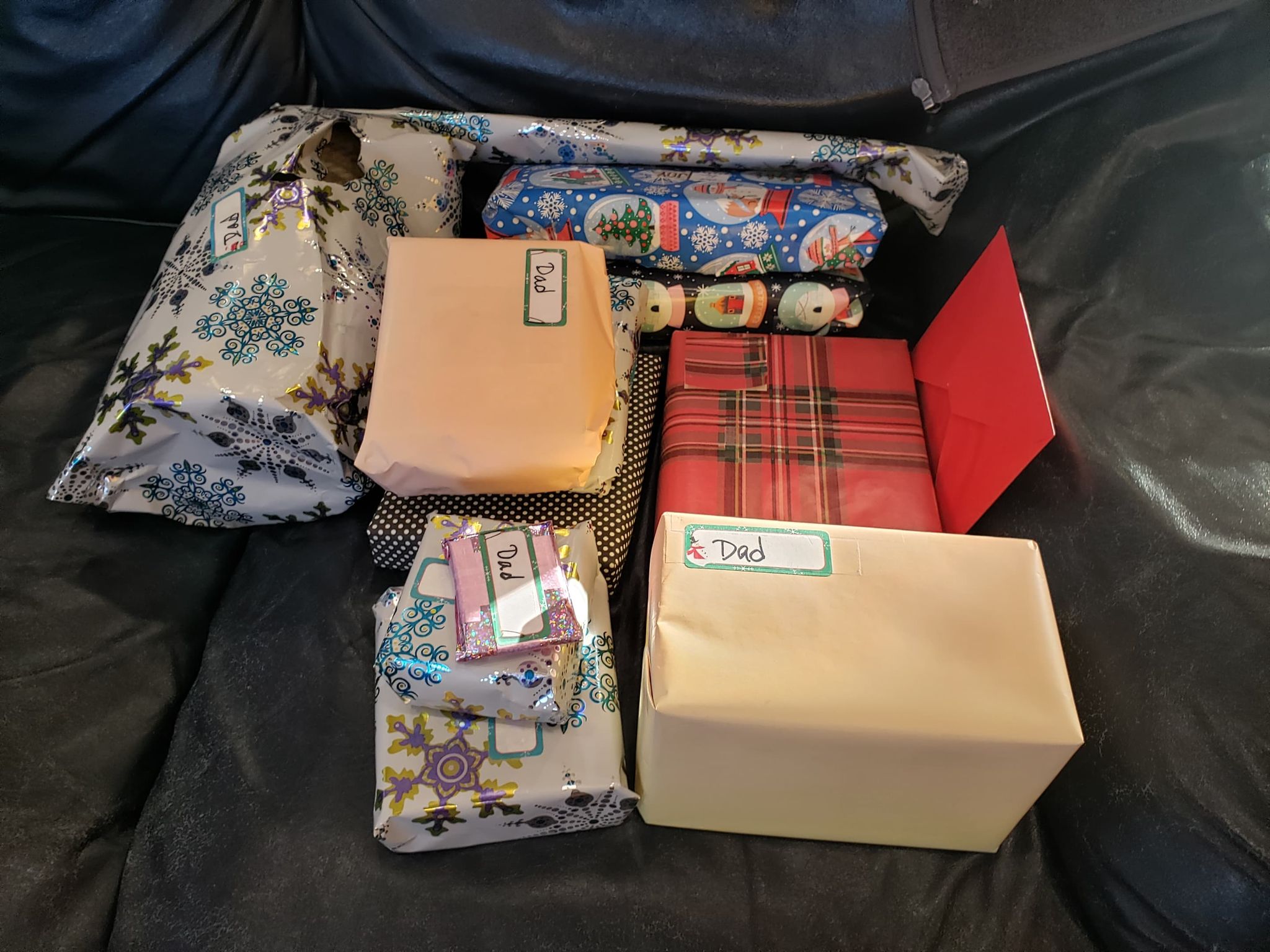
“The doctor wants to see him in person,” the receptionist asserted, and this after Sarah, and then I, more than once each, had explained how delivering Dad to the doctor’s office was not only an impossible physical feat, but also an unsafe one, both for Dad and for me, for the sheer physical strain, and how leaving the doctor’s office after an in-person visit would find Dad worse off than when he arrived, and how is that in the patient’s best interest. She said, again, that she would talk with the doctor, who on the day of the video appointment commented on how well the five-minute visit had gone, and let’s do it again in two weeks to check on the diuretic.  A nurse had come to the house to take Dad’s vital signs (based upon which he is healthier than I am) the mornings of the video appointments.  My goodness—so much happening today.  Cecilia helped Dad for the last time, said she wished we could have worked things out with Arosa, said she might leave Arosa because the new rates are driving patients away and reducing her hours and her pay, said good-bye and said good luck and drove away.  Chantelle and Liz, the hospice nurse and social worker, came for Dad’s hospice intake interview and paperwork.  Dad got stuck on the “blue sheet” and what mechanical measures he did and did not want taken to unnaturally prolong his life if he had a stroke or a heart attack or a bad fall—he wants to live, damn it, not be given up on.  But doctors have explained to him how cardio-pulmonary resuscitation on his 88-year-old frame would leave him crushed and bruised and brain damaged and with a quality of life reduced to an oxymoronic noun (like “shit”) that “quality” would not describe.  Q: How are you feeling?  A: Like great shit.  We will come back to the blue sheet another day.  And we will come back another day to the long medications list, and the question of which prescription drugs he might dispense with in light of the hospice goal to maintain comfort rather than artificially extend life.  Mom and Dad each sat in their recliners during the long interview, and I sat in between them, moderating questions and answers, careful to let them answer what they could before jumping in, careful to quietly correct dementia’s inaccuracies, and a few downright lies, as to dates and weights and numbers and names.  I sat between them, just as I did on Christmas day when they opened the gifts their children had delivered, from where I dispensed one gift to Mom on my right and one gift to Dad on my left, from their respective gift piles, identifying whom the gifts were from, keeping a written list, and moving the unwrapped gifts to new respective piles, gathering and crumpling the wrapping paper after each unveiling.  (Wrapping paper is recyclable, I researched, so long as it stays compressed and crumpled when compressed and crumpled, meaning it is really paper instead of mixed with plastic or metal or cloth fibers.)  Fuzzy slippers, fuzzy socks, biographies of the Fonz and Captain Picard, pounds of chocolates, word puzzle books, Horatio Hornblower DVDs, needlepoint kits, and signed cards.  Mom held up her hands for her gifts, as she does with her dinner plates, like an eager chick.  As the hospice women left, instant new friends, Mom announced they would each receive an Afton hug, a full-bodied arm-wrapping embrace with dancing left and dancing right, named after a beloved granddaughter.  I felt mortified and turned away from the tender bizarre scene, all my inhibitions overwhelmed, but Chantelle and Liz laughed and joined heartily in.

Courage at Twilight: Tasting Sweetness

Grinch Candy Cane Hunt - KC Parent Magazine

Dare I dip my toe again into the dark eddies, and launch into the currents of this memoir of living with the dying?  My resolve to navigate these waters began before I embarked, and the eight hundred and seventy-fourth day is no time to beach.  Arosa raised Dad’s in-home care rates by 75%, charging a “premium” for clients who receive less than four hours of care per day—Dad receives two—but I perceive the premium as a penalty, and the company as preying on the most vulnerable. Continue reading

Courage at Twilight: I Know What I’m Doing

Now remember.  Butt in.  Chest out.  I know how to do it!  Stand up straight, as straight as you can.  I am!  Actually, you’re not standing straight enough to be safe.  I’ll do it my way!  Your way will get you killed, Nelson: you’re too hunched over, and the walker will walk out from under you, and you will fall, and fall hard.  I do it this way all the time!  That’s part of the problem.  You can’t go home until you can get to the bathroom and back without help.  Well, I’ve done that a hundred times since I’ve been here!  Maybe six times.  But I need to be home for Lucille’s birthday on the 14th…for Thanksgiving on the 23rd…next Wednesday the 29th!  You can have a three-hour pass on Thanksgiving.  Just three hours!  Only because you’re not strong enough yet to stay longer.  I’m not staying here until next Friday! That’s December already!  Friday would be best: you’ll have a few more days of therapy, and you’ll be stronger when you go home.  Wednesday!  You really must be able to get around without help: Lucille can’t help you if you fall, and neither can Roger, and they shouldn’t have to.  Now pull your butt in, straighten your knees, and push your chest out.  You’re so bossy!  (“Nelson tells all the staff how bossy you are.”)  If you did what they told you to do, and got safe and strong, I wouldn’t have to be so bossy.  I don’t need anyone’s help!  Oh, yes, you do, you definitely do.  I hate it here!  I’m sure you do.  I can’t stand staring at this ceiling and these walls for another week!  I’m sure it’s lonely and bleak and no fun at all, so work hard and do what they tell you to do so you can leave here and won’t have to come back again.  I guess I’ll just bite my tongue and come home next Friday!  That would be best—it won’t cost you a thing, and you’ll be that much stronger when you get home.  And you won’t be as much of a worry to Roger and Mom—Mom’s too old and frail to take care of you, and Roger works full time and anyway shouldn’t have the stress of picking you up off the floor and changing your soaked and messed clothing and shampooing the carpets every day (sorry to be blunt).  He won’t have to do that!  Wonderful—glad to hear it—Friday it is.  You have to leave already?  So soon?  ***  (Dad sat in his wheelchair before the wide windowpanes, looking out at the parking lot, the new snow covering all of November, the white-dusted mountains rearing up so stupendously high, sat in his wheelchair looking small and sad and far away, and I made sure Mom turned to wave before we drove away.)

Courage at Twilight: Kiss Me, Dear


Columnist David Brooks posits in his Second Mountain that conversation is critically foundational to successful marriage.  If so, I am doomed.  Conversation has always come hard: I expend so much energy measuring my audience and tailoring my comments for self-safety that talking is exhausting.  I did not chat much in marriage, and after eight years living alone, I sometimes wonder if I can converse at all.  Draper Rehab held a resident Thanksgiving dinner. Mom and I were Dad’s guest quota, and we sat quietly at our table watching all the other residents with their respective disabilities and guests, waiting for more than 150 people to be served their turkey and potatoes and stuffing and yams and green beans and gravy, all meted with ice cream scoops.  We had little to say to one another.  Dad drooped and seemed so old.  But we were there, giving quiet loving support.  As I knew he would, Dad eyed my cranberry-sprite cocktail and wondered if he could have some.  Too much sugar, Dad.  But when José brought the cart around, Dad motioned for a cup.  I said nothing.  Various residents rolled by: Mark the mechanic who loves all things cars; Mitch from Brooklyn with whom we felt an affinity as an east coaster; others who could not speak or could not move and had daughters feed them and grandchildren wipe their mouths with white towels.  “The food is wonderful,” I ventured, and I might as well have commented on the weather: rain was in the forecast.  The next day, Mom and I asked Dad for a report on his physical therapy—he had walked “a hundred feet” to the exercise room and practiced standing up and sitting down six times, and was thoroughly wasted.  I showed him how to operate the television remote—hold the remote in your left hand and push the channel up or down button with your right index finger, like this.  We talked about springing powers of attorney and how they needed durable powers of attorney because I did not want to have to testify in Mom’s and Dad’s presence to a doctor about their future incompetence to make decisions for themselves—they agreed.  And I had Dad sign a letter I wrote to Bank of America asking to reverse late fees and interest charged on the same day his payment posted.  “We’ll see you tomorrow, Dad,” I reassured him.  That is the hardest part of living in a rehabilitation center: not the briefs and bed pans, not the food you don’t like, not the lack of interesting television, but the utter loneliness of living alone in viewless room away from your beloved home and sweetheart.  “I’m not leaving without a kiss!” Mom exclaimed, juggling a smile from his smooched face.