Tag Archives: Death

Courage at Twilight: The After Words (Grief)

Three years ago, the thought of my father’s death terrified me.  Today, his death seems natural and necessary.  I feel no grief, only weariness, the fatigue of daily trauma settling deeply in, the after-crisis drain.  The desire to sleep and sleep and never wake up.  I have studied grief, and taught grief, and workshopped grief.  I have grieved my father’s dying for the three-and-a-half years before his death: an anticipatory grief; a preparatory grief; a preemptive grief.  Lorry reminded me, however, that the grief will come, in all its aspects, the anger, the regrets, the deadening sadness, the looking around wondering why he is not in his recliner reading the encyclopedia, the wishing we could talk again and the wondering about why our talking was so hard, reminded me that I need to give myself the permission and the space to feel every part of it.  I am not sure such wrenching grief will come.  For now, I am balancing the compassion fatigue and saturation trauma of caregiving against the fact of loss, wanting just to sleep, and finding a sort of macabre triumph in knowing that I stepped into the battle: I responded to every need, every day, for one thousand two hundred sixty-two days, imperfections and weaknesses and all.  And I am deeply grateful for all of you who helped.

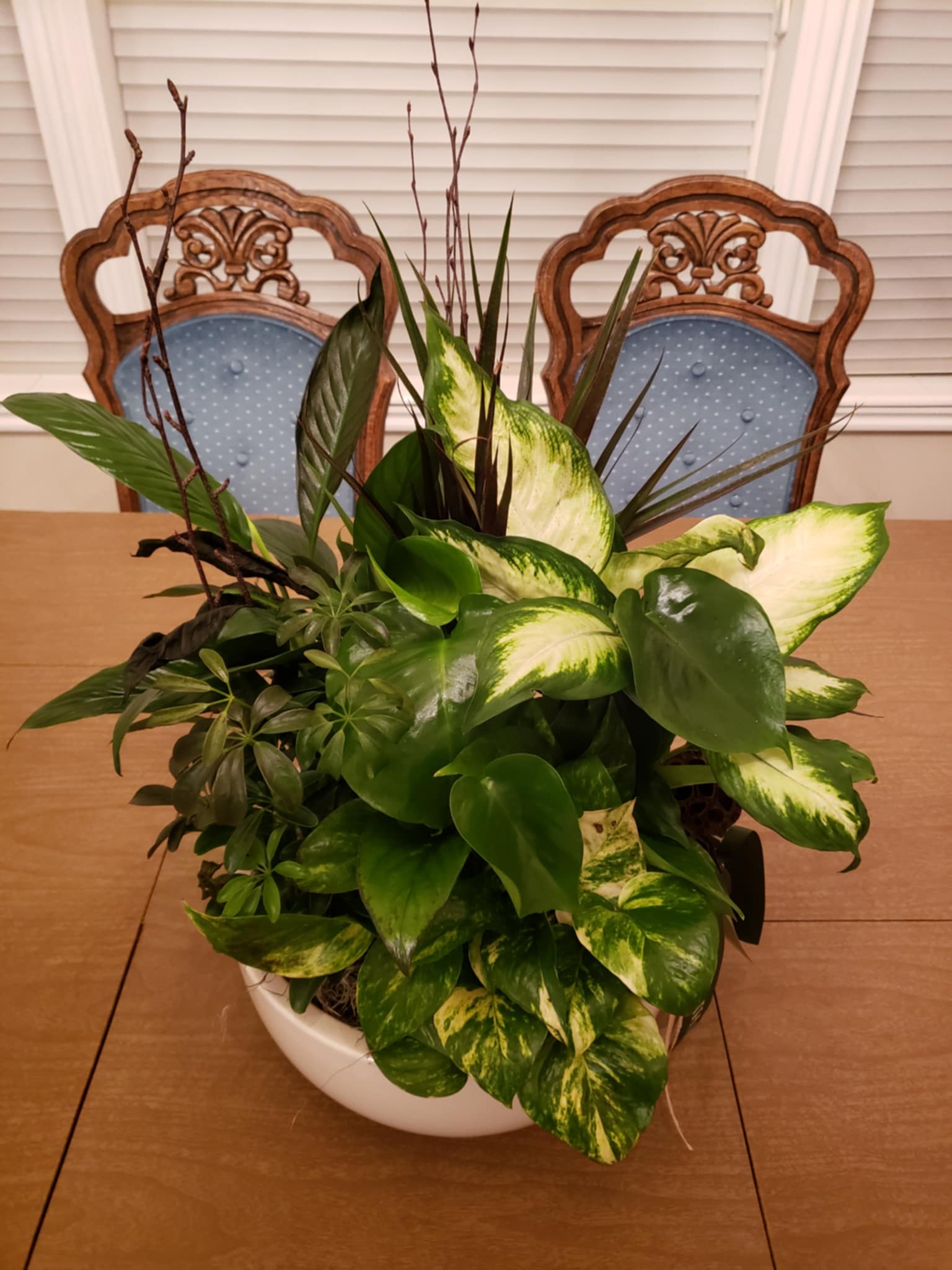
(Pictured: a funeral planter from the church choir.)

Courage at Twilight: A Long-stemmed Rose

We all believed it, my mother and sisters and I, that my father clung to his last heartbeats and breaths until Steven could arrive to bid farewell.  We enthusiastically expressed our belief to Steven and to each other.  Whether factual or no, we wanted to believe it; we wanted this mystic affirmation of a narrow sliver of hope in the midst of death.  Indeed, that Steven arrived before his father’s death seemed miraculous, despite the coma and death rattle.  But I soon discerned the unfairness to Steven of this testimony, which required of him wonder and faith in the face of haggard death, which broached the unanswerable question of why our father’s lucidity could not have been prolonged a mere 36 hours to allow a two-way farewell, which raised the painful reality of this last good-bye.  So, I kept my belief, or my wanting to belief, silent, and sought merely to accept the circumstances we were given and to find satisfaction in having done our best with them.  Steven’s trip was planned months before, but he arrived just prior to our father’s passing and left just following the funeral.  After our father’s passing and our family prayer, when our small assemblage felt ready, I called the on-call hospice nurse, Monica, to report the death: Tuesday January 14 at 11:03 p.m.  The official time of death, however, became the time of her certification of death: Wednesday January 15 at 00:26 a.m.  She performed her coroner’s functions, wasted the remaining morphine (mixing with dish detergent and pouring down the sink drain), and called the funeral home.  At about 2 a.m., the mortician rang the doorbell, bowed at the waste, expressed his condolences for our loss, entered the house, crossed the room to our mother, and delivered to her a very-long-stemmed red rose, bowing again and whispering again his condolences, which he repeated at a higher volume after Mom said, “What’s that?”  After speaking comforts, he and his junior associate, dressed in black suits and burgundy bow ties, shrouded our father in white and transferred him to a wheeled gurney, where they enclosed our father’s body in a blue velvet bag with a sturdy brass zipper, and draped the whole with a blue patchwork quilt, a nice touch I did not anticipate but appreciated.  And then they rolled our father’s body away and out the front door and down my wood ramps and into their Larkin van.

Courage at Twilight: I Will Not Let Him Drown

For two days family members have trickled in to visit with each other and to tell my father they love and admire and appreciate him, and to say good-bye.  Those living farther away video called to do the same.  But my father has been in a coma.  Today he has begun to show the signs of death: a rising core temperature (at times 104 degrees F); cooling extremities; sweating and clamminess; inability to swallow (he has not eaten or drunk for six days); healthy color fading to cadaver gray; producing very little, very dark urine; not registering pain or reacting to any stimuli; gurgling on liquid in his lungs; no bowel movements.  The day was calm and filled with tender expressions, and I imagined he would slip away quietly into death, his body and mind finally shutting down.  The rattling and gurgling in his ragged breathing seemed to worsen.  I learned later this breathing is called the “death rattle.”  Finishing the hundredth phone call of the day, I could hear from across the house a concerning increase in the raggedness of his breathing, and hurried to his side, where I was horrified to find his mouth filled with a thick creamy liquid.  How is he even breathing through all this goo? was my first thought, quickly followed by a frantic He’s going to drown!”  I remembered seeing a rubber bulb used to suck a sick baby’s nose, and ran to retrieve it.  He might be on the verge of death, but he would not meet his death by drowning, not while I was here to do something about it.  Please, God, help me know what to do.  Somehow, my father was managing to convulsively breath despite the liquid, and I set to sucking it out with the bulb, squeezing the contents out onto a sheet.  Please, God, help me to keep him alive until Steven gets here.  Ten panicked squeezes, twenty frantic squeezes, fifty fearful squeezes with the bulb.  My hand began to ache, and the phlegm piled up on the sheet.  His mouth now clear, I called the on-call hospice nurse, who explained the goop was a normal accumulation of mucous in an unconscious person with congestive heart failure who could no longer swallow.  I felt chagrined, that this were so normal, why did a hospice nurse not tell me to watch for it, prepare me to deal with it?  She ordered the delivery of a suction machine.  The motor suction wand helped me remove more mucous, though much of the underwater gurgling lay deeper in his throat where I was afraid to jam the wand.  While he could no longer swallow, he could also no longer gag, and I probed as aggressively as I dared to clear his throat of phlegm.  I did not want to injury him or cause him pain.  My sister Carolyn took over suction duty while I raced to the airport to get my brother Steven, about to arrive from North Carolina on a trip planned months previous.  I apprised him of the condition in which he would see his father, hoping to soften the experience.  He stood over Dad, offering his silent and whispered good-byes.  Carolyn, Steven, and I began to plan the night, resolving on hourly suction shifts.  I would take 11 p.m., midnight, and 1 a.m.; Carolyn would take 2, 3, and 4 a.m.; Steven 5, 6, and 7 a.m.; and I would resume at 8:00.  At 11:01 p.m., as I wrote this entry, pushing one minute past my shift start-time (what harm could one measly minute do?), Carolyn came to my room and whispered that our father’s breathing had changed, had calmed and slowed.  We descended the stairs and found our father not breathing at all.  I cleaned his face of the last thrown-up mucous and felt for breath and stared for a moving chest, but all I saw were slack muscles and a ghostly greening face.  I ran for Steven, and Carolyn ran for Mom, who descended the staircase slowly on the lift in her long white cotton nightgown.  We stood around our father and husband, not quite believing he was gone, his body still hot, his body unmoving, his body covered with a white flannel sheet stenciled with blue sheep.  Peace and tenderness and loss and relief and sadness permeated our own bodies, together with the one last unexpected trauma of preventing his drowning, and we said nothing until I somehow knew I need to say something, not just anything, but something sublime and holy and apropos, so I offered to pray, and I thanked God for this great man, this powerful intellect, this generous heart, thanked God for giving him to us, thanked God for having each other, thanked God for ending my father’s years of daily suffering, thanked God for a family filled with love and devotion for one another.  And we let him go.
Courage at Twilight: What Will the Morning Bring?

I expected this entry to begin and end with “Dad is dead.”  The night before, I turned off all the lights except for my father’s night light, a small wild-wood lamp made by my son Hyrum, and said good-night to my unconscious father who lay in the lamp’s low glow.  After sunrise, I lay awake in bed with a tired father’s Christmas-like morning mix of anticipation and dread, sneaking down the stairs ahead of the children for one last check on the piles of gifts before the onslaught of squeals and flying paper, in this case ahead of my mother, in this case for one last check on my father, who I anticipated finding cold and dead.  But, again, he defied my expectations of certain life’s end to flicker his eyelids and responded “Hi Rog” to my good-morning greeting.  The vivid yellow urine of yesterday dripped an angry opaque red.  Rosie said the red could be blood from the catheter insertion, but more likely meant failing kidneys.  He drank nothing yesterday, after all.  I swabbed his dry open mouth with a wet sponge-on-a-stick.  I smoothed Vaseline on his flaking lips.  I syringed a small dose of morphine in advance of the CNA roughing him up with rolling and changing and bathing and rubbing.  From the kitchen sink I heard him mumbling, and I hurried back for him to look at me sleepily and exhort me to “Be good, Rog.  Be good.”  I will, father, as if I know to do anything else.  Then I settled in to do what any other normal land-of-the-not-dead person does: I washed last night’s soaking pots and pans, and I set the garbage and recycling cans at the curb.  Mom asked me to pray with her last night, asked me to pray with her every night.  But what she really wanted was to tell me that she wants to stay in the house and not go to an assisted living facility after my father dies.  I told her there was no reason not to stay at home if she were healthy and mobile.  But I told her that I could not be her companion or comforter, that she would mostly be alone.  She liked being alone, she said, doing her simple activities, she said, her needlepointes and word puzzles.  I did not talk with her about what my own life might have in store.  It’s too soon.  The time for that will come, but is not today.

Courage at Twilight: Sweet Moments

The family starting calling and coming over, and undeniably sweet moments began to surround Dad and to fill the house.  My sister Megan leaned over him, in tears, and gently wiped his cheeks and chin and brow, talking sweetly to him, and he awoke enough for several lucid minutes of whispered conversation as she related old memories of growing up in New Jersey.  When he slipped back into unconsciousness, she summarized to him some of the more interesting stories in the day’s New York Times.  Niece Afton stood by and rubbed his arms for an hour and sang to him his favorite family song, “Sweetheart of the Rockies.”  My son Caleb spoke out with “Love you, Grandpa!” and Dad’s eyes fluttered and he whispered back, “Love you, too.”  Caleb joined his siblings on a Messenger call, and they all took turns saying good-bye, or to wave and cry.  Rosie and Veronica, two CNAs, deftly rolled him over and back in order to install a draw sheet, disposable chucks (pads), and a new brief, and swabbed his mouth with a wet sponge, and installed pillows beneath his calves to keep his heels off the mattress to avoid pressure sores.  My daughter Erin expressed her love and sadness from the other side of planet Earth, and my sister Jeanette and her husband Craig and Dad’s brother Bill called me to tell me they loved me and appreciated my efforts and pledged their support.  Friends Ana and Solange sang Brazilian lullabies to him, and Ana told me how she had the strongest impression when entering the house that Sarah, who died exactly a year before, was there in the house with us, with Dad, along with other loving spirits—Ana could feel their presence so strongly—and how their presence remained until just after the CNAs had finished caring for Dad and Dad had finished crying out in pain as they rolled him to and fro and we had given him more lorazepam and morphine to ease his pain and anxiety and he slipped into soft snores—then Sarah left.  And I told Ana I was glad she could feel such beautiful mystical things and tell me about them because I am both utterly empty and completely saturated and can feel nothing but only flow from one task to the next to the next—there are so many tasks—and in between I can but withdraw into myself and sit curled up in an emotional corner unable and unwilling and unready to feel.  The last person awake in the house, I looked at Dad in the nightlight glow and knew he was dying and would be dead within hours and saw his passing as just another fact among an infinity of sterile facts, like the ripening of the green bananas, like making mashed potatoes and sausages so I had something useful to do, like the glow of the reading lamp and the squeak of the rocking chair, and Megan’s teary eyes, and Mom’s veneer of cheer thinly covering a universe of grief and fear, and the stars shining coldly in the winter sky.

Courage at Twilight: Bedbound

I had hoped Dad’s mental acuity would return after a solid sleep, if not some of his physical strength. But his first utterances upon waking were incoherent nonsensical sentences, spoken with a thick tongue and loose jaw.  His beloved Gloria came to take care of him, the day being Sunday, and he broke her heart calling her Martha and Ana.  “Nelson, I’m Gloria!” she nearly wept.  He strained to sit up so he could pee, but had a distorted sense of himself and his surroundings, holding the urinal absently in one hand while peeing on the bed and on the floor.  She laid him back on the bed and helped him finish, then stripped and remade the bed around him.  He did not want to wear a brief, but we put one on anyway, explaining that it was necessary because he had no strength to use the urinal or the toilet.  Gloria and I sat at the kitchen table and faced the reality that my father and her Nelson was in serious shape, would be permanently bedbound, and we would need to reevaluate the whole procedure for his care.  He adamantly opposed staying in his hospital bed in the corner of his office, so I slid away his recliner and we rolled him in his hospital bed into the recliner space, comforting him that this way he would be with Lucille and listen to her music and watch her TV programs and eat lunch together just like normal.  I reported to Jessica that Dad’s condition had deteriorated quickly and severely, and that he needed a catheter because he could not manage urination in any manner.  She was shocked at his appearance less than 24 hours after her previous visit.  She observed his incoherence, his exhaustion, his inability to swallow a pill, his breathing and speech and loss of appetite and distorted sense of himself and his surroundings.  “I wonder if he had a heart attack yesterday when I was here,” she said.  Even one day before, convincing him to accept a catheter would have been impossible, whereas today he did not resist or complain, and the bag quickly filled.  Though he awoke for an hour as Gloria bathed him and changed his bedding, he had been confused and incoherent, and, with the catheter in place, he now slipped into an all-day sleep.  We tried to feed him pinches of food, but he could not chew or swallow.  When we gave him his pills, he alternately held them in his hand, dropped them into the cup, and chewed them without water.  We gave him water to wash the pills down, but he aspirated and sputtered and coughed and his breathing gurgled during his hours of sleep.  I asked if he were in pain and he shook his head no.  I asked him other questions but he did not respond.  He ate nothing.  He drank nothing.  He took no medications.  After observing him, Jessica thought he would not survive the day, that he was beginning to transition from life to death.  She suggested I call the family and invite them to say their good-byes.

Courage at Twilight: Our Shattered Hearts

Mom and Dad are suffering.  Quietly.  Since Sarah’s death, Mom whimpers and swallows a red-faced sob whenever Dad complains that his vision is blurry today or that he is weaker than ever today or when he calls her to help him hike his trousers (I spare her when I’m home).  Her anxiety is severe and pent up, seeping out in little choked up whimpers.  She buries herself in her needlepoint: brightly multi-colored tulips in a baby blue background: working it day and night.  Dad reported to me that his two weeks of nightly terror dreams had stopped harassing him for the last two nights—I had known nothing of his nightmares until he told me they had stopped.  He would not tell me what they were, though he remembers them in disturbing detail.  He has boasted for years that he has no idea what pills he takes because Mom sets them out and fills his pill boxes—and he just takes them.  And Mom confessed to me with a worried grin that she had slipped a melatonin tablet into his p.m. pills for the last two nights, no doubt contributing to his less fitful sleep.  And me, I’m just numb, and weary, and worried about many matters large and small, and I try to control what is within my control, and to release what is not, accompanied by my hope and faith and prayers, and labor, for good outcomes.  Whispering “yes” instead of screaming “no” as grace slowly seeps into the spaces of my shattered heart.  (See It’s OK that You’re Not OK, at p.106.)

Courage at Twilight: Keeping Time

My calendar proceeds from Wednesday to Wednesday: City Council meeting day. Sometimes I wish for Friday-to-Friday weeks, marked by rom-com pizza-and-salad nights; or restful Sunday-to-Sunday Sabbaths.  Today, I am thinking, Her funeral was last Saturday, and for a while, at least, I will measure my weeks from Saturday to Saturday.  Wednesdays, however, will continue to dominate, for news of Sarah’s death clobbered me just as City Council meeting began, and I bolted before the pledge of allegiance without offering explanation or excuse.  Now I face the long heavy haul of life without her.  I have moved from feeling sad and tender and loved and lifted by a million prayers to feeling plain pissed off.  “You might as well know,” I told them, “I am so angry she is gone!”  “Me too!” chimed in Mom.  Sarah was my cheerleader!  (She was everyone’s cheerleader.)  She left us!  Anger, too, is part of grief.  For the first time, Dad put his own grief into words: a huge hole; a void; an emptiness; a great longing and loss.  Neither he nor Mom can look at her picture.  Mom begged me to take her for a drive “around the block,” and when we drove out into the sun, she said “Thank you!” and cried.  “I really needed to see the sun!”  After, I hiked five fast miles in icy Dimple Dell, trying to work off my anger and anxiety.  The depth of my grief may be an expression of the depth of my love, but I was just fine loving her here!  Dad has been hopping from one consuming anxiety to another.  We need more flowers for the funeral.  We need to make room for anyone that wants to stay at our house.  We need to send the funeral details to everyone that doesn’t have a Facebook, because not everyone has a Facebook, you know.  We need to make a menu, like spaghetti, or chili, or meatballs, and go shopping for all the family coming.  Roger, you must speak at the funeral.  How will they pay the mortgage, the tuition, the grocery bills, the premiums?  We need to know if there is a will.  We need….  We have reasoned and to reassured, and have tried to preempt his worries with solutions, or at least diligent efforts to find solutions.  Still, he perseverates about everything outside his control, precisely because everything is outside his control.  He has always been the great family patriarch, the fixer, the benefactor, the provider, the safety net.  Now, his physical world has shrunk to a brown corduroy recliner from which he cannot fix anything, and his brain bounces from worry to worry, increasingly muddled by dementia.  The other night he awoke with a great searing pain racing across his brain, left to right: “It felt like a spear had been thrown through my head!”  Since Sarah’s death, and since the great pain, his memory has worsened—even he notices—and he is weaker than ever.

Courage at Twilight: The Long Slog

The Richter 8 that crushed me has stilled, and I have clawed my way back to the dust, just.  The Tsunami that broke me against the rocks has receded, and the dripping blood has dried.  The funeral has passed—she is buried nine feet down.  The bouquets and casseroles and cards have ended, and the hugs and I’m so sorrys, though the looks of concern linger.  Life in this house again is back to just Mom and Dad and me and the occasional visitor.  Now begins the long hard slog through ankle-deep pitch, dragging my feet exhaustedly through my returned routines of emails and deadlines and insoluble problems, and cooking and paying the bills and spending just enough time and energy with people so they know I care for them still, ever hiking with the pack of preemptive grief for losses yet to come.  And all I want is to sleep, to rest my eyes and ears from the blare.  I have entered the stage of grief characterized by an uncontrollable strangling desire to scream.  I am too old and injured to hit the weights or the jogging trail, and movies bring a drug-high that drops abruptly with the credits.  On Death and Dying.  The stages of grief.  Denial—Anger—Bargaining—Depression—Acceptance.  Did you know that Dr. Kubler-Ross did not intend to prescribe a sequential series of steps for normal grieving?  Her studies of grieving people discovered five realms of grief emotion: people grieving death experience denial, anger, and depression, and eventually, one hopes, an integrating acceptance.  Any grieving person may experience any one or more of these emotional realms, sometimes overlapping, or all at once, in comings and goings of degree.  American pop psych culture has twisted her sets of discreet grief emotions into a linear progression of mandatory stages, imposing on 500 million people a “correct” way to grieve.  Bull shit.  Horse hockey.  How absurd to cram the human heart, big as a galaxy, into a soda straw of grief normalcy.  That ain’t how grief works.  And so, Mom and Dad and I muddle through our days of grief, with years still to come, clashing the impossibility with the actuality of what happened, chuckling at life’s banalities while choking on screams of rage at the dirty dish in the sink, laying my exhausted head on my desk at 2 p.m., caring about nothing, throwing a go-to-hell look at the first person who dares to suggest I get to work, looking at Sarah’s smile framed, impossibly, inexorably, on my desk.  I will grieve how I must, not knowing beforehand what it will look like or how it will feel, and I will be kind to myself in grief’s non-formulaic messiness.  In random steps here and there down the road of time, I will find ways to integrate into myself the experience of death and loss, for they are, inseparably, part of my being.

Courage at Twilight: An Enormity of Love

Dad insisted I speak at my sister’s funeral. Logical, of course, but impossible.  I had met her husband at the funeral home, at his invitation, where we spent three numbing hours making impossible decisions about vaults and caskets and flowers, payment plans and printed programs and Zoom links, fingernail polish and lipstick and hairstyle, rings or no rings, makeup to cover her wounds.  Feeling dead ourselves, we wandered through the casket showroom, and slowed before the Virginia Rose maple-wood casket, gently grained and softly carved in roses, lined with Easter pink fabric embroidered with a flower spray.  Tracy looked at me and choked, This is where she wants to rest, and I turned my face to the corner and sobbed and knew he was right.  The viewing became a bizarre reunion of a corpse and family and friends, with hundreds of hugs and thousands of tears.  “How’s Nelson holding up?” an uncle asked Mom.  Pierced.  That is the word she used.  Dad was crushed and broken and pale—and pierced through.  He has whispered revelations of his agony every day: I may not survive this.  I thought I might just go with her.  And he told us all of loved ones he looks forward to meeting on “the other side,” his grandmother Natalia Brighamina, a sweet-hearted Swedish beauty who infused the little boy with love and worth, his grandfather and namesake Nelson who rescued the mine’s company town when he detected the odor of almond in the water, his grandpa William T who lived in an unheated unplumbed shack and taught him to snag trout barehanded from the brook—and Sarah, who beat him there.  Every morning I wonder if Dad has survived the night.  The viewing room was hot and crowded and happy-sad, and I could not face my sister, meaning, I could not go to her and gaze at her and hold her hands or even glimpse her unliving body.  One little boy felt like I did, avoiding her “creepy” “plastic” visage.  I averted my eyes and said good-bye a million times in my heart, resolute on remembering her living laugh and her tight embrace, and her I love you dearest brother.  And the inevitable moment came when they closed the lid and clicked it shut, and I sank clear to the earth’s core.  The utter finality of that muffled click…  Her casket came rolling by, and I touched it, and I turned to the corner and sobbed.  Do I really have to speak?  Can I?  In my terror of the task to talk, a lovely friend eight states away softly suggested: Just speak to her.  And that is what I did: “Sarah, you are beautiful to me.  You share normal human imperfections, but to me you are a perfectly delightful, forgiving, super fun, uber smart, good, kind, hard-working, lovely, and loving woman.  You are one in a billion.  I adore you.  And I will miss you sorely for a long, long time.”  Standing at the congregational pulpit, there was no corner to weep in, but I wept anyway.  And I cannot deny that, in that fiery crucible of grief, I felt an enormity of love, and a universe of prayer, wrapping me warmly and holding me aloft and carrying me gently forward to tomorrow.  I love you dearest sister.


The maple-wood Virginia Rose.

Courage at Twilight: Tending to Grief

Her story was not supposed to end this way. She was supposed to win, to vanquish her adversities, to ride the rising tide of her professional and personal success.  She was not supposed to be taken out by some random tree.  But here we are.  Supposed-to-bes are not realities.  Sarah’s last text to me asked for my reassurance that she was strong enough and brave enough.  I called her and told her she was the strongest bravest woman I know.  My last text to Sarah told her I loved her and wished her a happy birthday, and included a photo of my brother and I hiking in Bell Canyon’s deep snow.  She answered with a red heart emoji.  Sarah’s last words in this life came astride a snowmobile on a mountain top, where she declared, “This is one of the best days of my life!”  Just minutes later, she was gone.  But it was, in fact, one of the best days of her life, perched high upon the planet with the cold clean air on her face and God’s beauty all around.  She loved her work at Draper Rehab, and she loved her coworkers and patients.  She helped lift her facility to be one of the company’s top performers.  It took her months to win over the most reluctant, but she came to be adored and respected for her outsized strength and intelligence and tenacity, and her love.  Her gift was to look into any person and to understand what she saw deep inside, and then to love them.  These people included her sad and lonely big brother, her Black friends struggling in a white-slanted culture, her gay and queer and trans family whom she saw as beautiful champions of love and courage and integrity, her children whom she rightly bragged about for their intelligence and their insistence upon truth and their lovingkindness, her elderly and disabled patients who could not swallow or speak or use their faces or hands to communicate, but she heard them and understood them anyway.  In my kitchen on Saturday January 14, Sarah and Steven and I talked for an hour about the complexities of life, and she declared to us how happy she was.  After wading through 50 years of adversity, she had arrived at the point where she had no fear of the consequences of honesty, truth, accountability, and love.  She would say her truth, come what may.  She had arrived at a point where she had no tolerance for manipulation, anger, dysfunction, lies and half-truths, pride and territoriality.  She had come to the point where her mind and spirit were perfectly aligned with her sense of truth and virtue, and nothing could move her from it.  She had arrived.  And then she was taken.  And we are left broken and grieving.  I have learned that “the way we deal with grief in our culture is broken…”  We see grief “as a kind of malady,” something to get over, to put behind us, something broken to be fixed, a sickness to be healed.  But grief is none of these.  Grief simply reveals the part of me that is hurting and wants to be tended and nurtured, to be held, showing me the new episode of life experience to be integrated into my being.  “All that we love deeply becomes a part of us” (Helen Keller).  Our culture says that “the goal of grief support…is to get out of grief, to stop feeling pain.”  But “there is nothing wrong with grief.”  Grief “is a natural extension of love.  It’s a healthy and sane response to loss.  Grief is part of love.  Love for life, love for self, love for others.”  Love for Sarah.

(Other quotes from It’s OK that You’re Not OK by Megan Devine.)

(Pictured: Yours truly with Sarah and little Gabe camping in June 2023 in the Uinta mountains of Utah.)

Courage at Twilight: Good-bye, Love

The texts tumbled in just as City Council meeting began. “911!  Please call right away!”  “It’s an emergency!”  “Can you excuse yourself?”  I needed to know more before I walked out on the City Council and Mayor, but I got more than I bargained for: “Sarah just died in a snowmobile accident.”  My sister.  My beautiful, energetic, ambitious, kind, and loving sister.  My sister who saw me and loved me just as I am.  “What the hell is going on?” I barked when he answered the phone, barked out of terror, not anger.  Indeed, his wife, my sister, had passed away after a freak accident.  In the previous months, she had led her teams of nursing directors and therapy directors to new levels of excellence, surpassing company aspirations, and the boss had treated them to a mountain lodge retreat where, after the celebratory gathering, the twentyish directors chose between three company-provided activities: snowmobiling, four-wheeling, or massaging.  Sarah chose a massage, then ran to join her boss and co-workers on snowmobiles: why settle for one fun activity when you can cram in two?  She zoomed across snowy trails with her boss and five colleagues.  She missed a turn and flew over an embankment.  She hit a tree.  Her helmet broke open.  She died on impact.  My sister.  Sarah.  My sweet, accepting, no-nonsense, intensely fun, forgiving, and loving sister.  And the bottom of my world abruptly dropped away and I began a freefall of terror and panic and deadening dread.  This could not be!  This was not possible!  Never a crier, I sat at my desk and sobbed.  As the older brother, I knew what I had to do.  I rushed home, had Mom and Dad sit together, and began the impossible: Something terrible has happened.  Something terrible has happened to Sarah.  Through heaving sobs, I related what little I knew.  To my stunned parents.  To my only brother.  To my three weeping sisters.  To my seven adoring children.  To my far-flung nieces and nephews.  One by one.  And with each telling I bawled anew.  I am not a crier, but I cried more during that night than I had in my previous 59 years combined.  This simply could not be!  But it was.  She was gone.  Everyone experiences grief differently, in their own ways and times, and every grieving is genuine.  To Mom (so far), the tragedy seemed like just another random fact, like running out of milk.  Dad moaned for hours: “I don’t know if I can survive this.  Truly.  I’m 88 years old!  I’m already frail, and I can feel what little strength I have left breaking and melting away.”  But with visitors and talking through his shocked incredulity again and again and again he survived the evening and the night and the next day.  I retreated to a dark room and cried in convulsing waves.  Not Sarah!  Her story was not supposed to end this way.

Courage at Twilight: 1920 Model-T

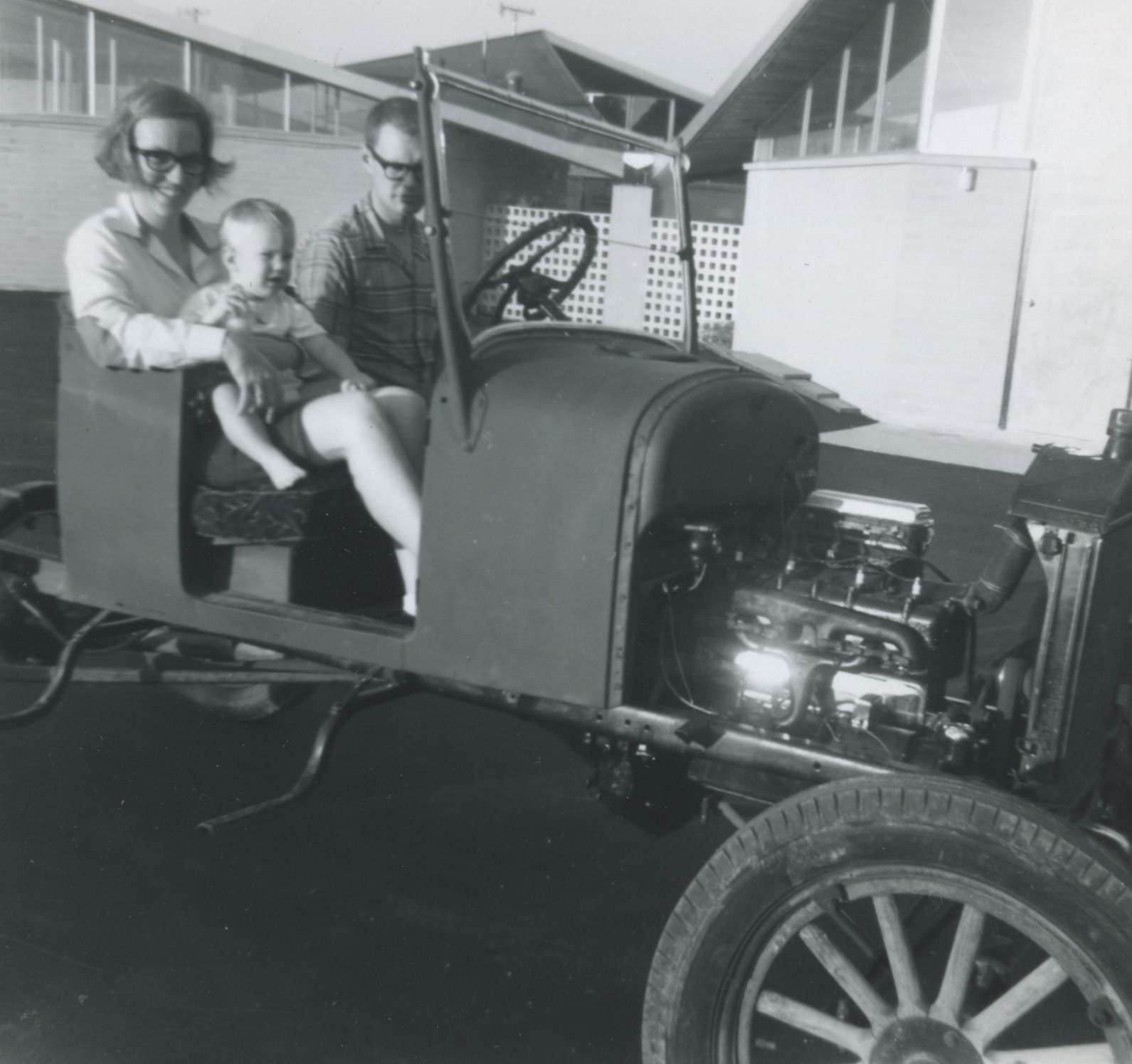
“There’s a hole in my head!” Dad groused, fingering his newly-stitchless scalp.  “Why did Hinckley leave a hole in my head?”  I examined Dad’s new scar, which curved over eight inches of wispy-haired scalp.  The scar centered on a remaining scab, where the initial cancer had been scooped deeply out.  I reassured him that his head looked fine, that there was no open wound, that what he felt as a hole was just a scab.  “Why didn’t he stitch the skin together so there isn’t a hole in my head?”  When the scab falls out, I suggested, I was sure he would see how neatly sutured the whole incision was.  “But there’s a hole in my head.”  Mom scowled and rolled her eyes, and I let the matter go.  I would not be able convince him there was not a hole in his head, and did not want to argue.  Maybe the surgeon did leave a hole in Dad’s head—what could I do about it other than watch for both healing and infection?  Continue reading

Courage at Twilight: Grandpa Darwin

My children’s other grandfather is dying from his fourth attack of cancer. Tumors like softballs stud his chest and torso.  Prior cancers removed his lower jaw and all but a thin fold of vocal cord.  Family group texts to my children kept me informed of his worsening condition and of the many tender family visits from his eight children and thirty-six grandchildren and twenty-eight great-grandchildren.  Though I have not been his son-in-law for six years, I love and respect the man, and I knew it would be right for me to say good-bye.  Sitting at his bedside, we fist-bumped and we talked and reminisced and we shared our hopes for our families’ futures.  He expressed his love and admiration for my seven wonderful children.  I conveyed Mom’s and Dad’s expression of love and admiration and respect—“Right back at ‘em,” he chimed.  He told me stories of his early life, like when he was a little boy and he and his cousins laid on their grandmother’s down-tic mattress listening to her tell stories of their Mormon pioneer ancestors.  “She was barely 4-foot 10-inches tall,” he marveled.  “We loved her.  But you didn’t want to make her mad!” like when the children tried to ride the sheep.  When I asked what he most looked forward to on the other side, he listed reunions with his father, Charles, who died by train in the shunting yard in 1961, and his mother, Jessie, who died of a stroke the year I married (1988), and many other family members, like his brother Kay, who died of the hardships of homelessness.  I told him I felt very sorry that things had not worked out for his daughter and me, but that I loved him.  “You are family,” he assured me in exhausted whispers, “and I love you.”  He squeezed my hand hard, then let me know he was so tired and needed to sleep for a while.  He stopped eating five days ago—he made it to March 1—everyone has said good-bye—I have said good-bye and god speed.

Life and Death (A Matter of)

Life and Death (A Matter of)

Life was about to begin for me when on a TWA jet I poked tentatively at the soft walls of the tight round room of my mother’s womb.  And after quick-passing days she deu à luz (gave the light) to me.  Fifty years later life ended.  Books describe divorce as a kind of death, for its permanence and its depth of loss and grief, and perhaps Continue reading

Chapter 44: Of Death, Swords, and a Bear Hunt

20140330_181224

–Wow, Caleb, you have lots of brains.–
–No, I don’t! I only have one brain!–
–I mean, you have lots of sense.–
— I don’t have any cents, only three pennies.–
(Caleb-3 with Laura)

“I hate it when things die!” Erin (7) sobbed bitterly.

I have tried to teach the children not to hate because hating makes you feel hateful.  But I understood her sentiment: her pet goat had died.  She didn’t want to feel the deep grief of the loss of things loved.

“We never even gave him a name,” she lamented.  “We just named him Goatie.” Continue reading

Silenced

20130724_164623

I found myself the last person in the courtroom, still sitting at counsel table after a rogue jury delivered a $22 million verdict against my client in a $7 million dollar case.  How could this have happened?  It was so wrong.  In this the greatest legal system in the world, truth had not prevailed.  This moment of courtroom despair triggered the still poignant memory of when, 15 years earlier, another jury acquitted the man who had murdered his wife and three children.  I thought of their voices, silenced and unable to tell their story, to speak the truth, to persuade the jury.   I wrote this poem alone in the courtroom to honor their voices and their lives.  It was my 45th birthday.

(This poem relates to the blog post Chapter 28: Away with Murder also found on the Rabbit Lane: Memoir page of this blog.)

SILENCED

She lies, undressed,
on the shining steel table,
her voice mute as the metal,
white skin washed clean of red
blood that once ran warm.
Bloodless wounds tell her story
to the inquiring examiner. But
the story of the living spoke
louder than the tale of the dead,
and the jury acquitted her killer,
the man who once said “I do”
and slipped a gold band on her finger.

Her white flesh lies cold
on the steel, her black hair flowing
over the edge toward the floor,
hair that hides where
the hammer crushed her skull.
Her screams have fled
into walls, into paint and plaster.
Her sobs have dripped, drowning,
into shag, soaked
into plywood and joists.
They would tell her sad story
to any who would listen, but
the living spoke louder than the dead.

Our Pet Goat Died Today

The deaths of dear pets have hurt my children’s tender feelings many times over as many years.  The sad fact is: pets die.  Sometimes from neglect; sometimes from sickness; sometimes from old age.  From tiny hamsters to guinea pigs, and from chickens to full-sized goats, each death raised in the children’s innocent minds anew the questions of why things die, and why did their heart have to hurt so much when saying good-bye to friends.  I grieved for them and with them as they grieved their losses.  The day one of our pet goats died, Erin and Laura cried and cried.  I didn’t know how to comfort them.  But I stayed with them and talked with them and did my best to sooth them.  I wrote this poem about the occasion.  It isn’t a great poem, but it expresses poetically the bitter-sweet experience of losing our pet goat.  You can read more about our pet goats in Chapter 13: Of Goats and a Pot-Bellied Pig post in the Rabbit Lane: Memoir page of this blog.

OUR PET GOAT DIED TODAY

Our pet goat died today.
We noticed he was sick:
gasping for breath;
struggling to raise his head off the ground.
Big hands placed him in the November sun;
little hands rubbed him warm,
coaxed him to suck from the bottle, but he wouldn’t, or he couldn’t.
Then he was dead.
He was our friend, and he was gone.
I held him and gathered my little children close around,
where they wept as death and loss seeped into their reality:
“I don’t want him to die,” they sobbed.
“I’m sad too,” I said.
Daughters chose the burial place,
near Diamond, last Spring’s kitten.
Father and son dug deep in the hard clay.
Old chicken straw made a bed and a pillow and a blanket,
to keep our goat warm and comfortable
in his resting place.
Fall’s last roses placed around his head
would bring him pleasant smells in Winter.
A child’s graveside prayer,
trusting an unseen wonder,
would protect the goat and comfort their sad hearts.
“Daddy, where do goats go when they die?” they asked,
knowing that I would know the answer.
I looked in my heart for sweetness and truth:
“I’m sure God loves goats just like he loves people, so goats must go to heaven.”
Through tears they asked hopefully, “Will we see him again?”
“I hope so,” I said. Then, “Yes, I’m sure we will.”
Worried at the thought of the goat covered with earth, they asked,
“What will happen to his body when he’s buried?”
Searching again:
“This is the goat’s resting place, and you have made it very special
with your flowers and prayers.
He will just rest here awhile.”
One last scratch on his nose to say good-bye.
My son works to fill the hole.
My daughters gently place the reddest rose petals on the mound.
Then they run off to play,
and I hear the scared bleating of a lonely goat.

Chapter 11: Austin

100_1020

–The measure of one’s greatness is one’s goodness.–

Sitting on the porch lacing my boots for a walk on Rabbit Lane, I heard the distant bellowing of a distressed calf.  Something in the bray was not quite right, sounded a little off.  I had heard lost calves calling for their mothers before.  I had heard desperately hungry calves complaining before.  I had heard lonely wiener calves bellowing for their removed mothers before.  This calf call sounded strange; perhaps, I thought, not even a calf at all.  I turned my head to pinpoint the source of the noise.  It came from behind Austin’s house, where there should be no cows and, in fact, were no cows.  An ignorant urgency sent me running through the intervening field to Austin’s back door.  There lay Austin, helpless, in abject distress, fallen across the threshold of his back door and unable to arise, the screen door pressing upon his legs.  He shouted and bellowed with his deep and distressed bass voice.  I wrapped my arms around his prodigious barrel chest and heaved as gently yet as forcefully as I could to raise the big man from the ground. Continue reading