Some people need to talk—a lot. Some people prefer to listen. A match of these two is fortunate. I have already described how Dad talks and tells his stories and expounds upon religion and history and morality and family and the contents of the encyclopedia, and how I am more of a listener who at 60 is weary of listening. Gloria, however is another talker. She cares for Dad several mornings a month, and the conversations begins rapid fire the moment she calls “Good morning!” from the top stair. When Gloria talks, Dad listens. When Dad talks, Gloria listens. Yet, somehow, they both seem to talk continuously. Today I caught snippets about Gloria’s sick cat and how the dry cat food and wet cat food each affect the cat’s weight and health and energy and general demeanor, and how the cat is slowly getting better with good cat food and care. Dad took his turn about the cosmic character of the universe with its gravity and dark matter and fusion and electromagnetic energy and relativity physics vis a vis quantum physics. Both are vaguely sympathetic to what the other is saying, but mostly they each appreciate being able to talk and being listened to. Did you know that a mere 20 years ago, the consensus among cosmologists and xenobiologists was the impossibility of intelligent life anywhere in the universe but on our Goldilocks Zone earth, but that today, with the James Webb telescope’s discoveries, the consensus has shifted to the statistical impossibility that intelligent life does not thrive among the trillions of habitable planets orbiting in the trillions of solar systems orbiting in the trillions of galaxies or our vast universe. Her cat prefers the wet food. We will never know because even light takes one hundred thousand light years to travel to us. The vet’s treatments are helping. Time for your shower, Nelson. I returned from my ten-mile Jordan River paddle long after Gloria had gone for the day. The olive-brown water ran at a 15-year high and swept us pleasantly downriver. The toughest stretch of the paddle was the half-mile portage through head-high thistles with mean mean thorns and willowy willows and sage brush, so aromatic, daisy-chain carrying our kayaks single-file to where we could cross the private hydroelectric dam that also splits the river into two enormous irrigation canals, the river itself suddenly shrinking by two-thirds. Weary and blistered and scratched upon arrival home, Dad called out with his usual cheer: “Roger! Welcome home!” followed by “Sit down and tell us all about it. The people. The river. The wildlife.” And so I told them about the thistles and dams and slow high olive-brown water, and the people, and the birds: the Clark’s grebes, cormorants, pelicans, belted kingfishers, Bullock’s orioles, avocets, ibis, phalaropes, terns, stilts, Canada geese, mallard ducks. I did not tell them how I was so eager in the twilight to show my friend Stephen a beaver and saw one in the shadows and called to Stephen “There! Beaver!” only to have the beaver sprout wings and take flight. “I think that’s a duck,” he dead panned, “or maybe a duck-beaver.”
Tag Archives: Kayaking
Courage at Twilight: Making Some Sense of the World
The law firm had changed names four times in the decade-and-a-half since Mom and Dad retained a friend of a friend to prepare their estate planning documents. But I tracked down the firm and the lawyer, and scheduled to meet. I have felt unprepared to be the personal representative of Mom’s and Dad’s small estate, and had many questions, such as, Do they need to update their documents? How do I handle the cars? Is the deed correct? What is an estate tax credit? Do I need to understand QTIP? (No.) What is the first call I make when the time comes? What is your hourly rate? He told me not to worry, that I was well-prepared, even “light years” ahead of 95% of his clients. I breathed deeply and reassured myself, Maybe I can do this after all. Then I was off to NOMAS’ Thursday evening clinic to help with a U crime-victim visa for a humble hard-working woman whose paramour turned perpetrator, who refused to work or contribute to business and household expenses and who screamed and threatened and hammered, whose trump card in oppressing her with power and control was the threat of deportation if she called the police. But the U visa helps people be in America legally and shelters victims of crime from the further victimization and trauma of deportation for their mere victimhood. I knew how to find the court dockets and case numbers and protective orders that would corroborate her truthfulness and his abuse, and printed them for the file. Driving away from the clinic, I saw some clients walking down the street, laden with foodstuffs from the community pantry, laboring to the bus stop with their sacs and their children, because they cannot afford cars or cannot afford to fix their cars, and thought of my neighbors with their several Porsches and BMWs, and still cannot make sense of the world. I stopped at NY Pizza Patrol for a Brazilian Bahaiana pizza with calabresa sausage and kalamata olives and sliced eggs: I just could not face the kitchen for a 9:00 dinner. The pizza was a rare treat, which Mom and Dad (and I) loved. On Friday evenings in June, I have been trying to make sense of the world, searching for calm and beauty on the calm brown waters of the Jordan River. Dozens of homeless encampments lined the banks of one urban section. A beaver and birds greeted me downstream: black cormorants, Bullock’s orioles, Clark’s grebes, coots, Canada geese, Mallard ducks, avocets, black-necked stilts, Wilson’s phalaropes. I missed seeing my territorial friend the belted kingfisher, and hoped he had not fallen prey to a Swainson’s hawk. With my new and first-ever drybag clipped to the kayak, and my phone hanging safely in its clear pouch around my neck, I lounged in the shade under a willow bush, smelling sweet Russian olive blossoms and arousing yellow iris blooms, when the Messenger alert rang and rang and rang while I fumbled to answer, knowing who it likely was, and, yes, it was William calling me from his high chair where he sat munching on pineapple chunks, with his smiling adoring amazing mother beside, telling me about her day as I floated and rocked on the river, making some sense of the world.
Courage at Twilight: Oh, That Bird!
“Lucille!” I thought perhaps I might have heard from under my cool-morning covers the calling of Mom’s name, but I could not deny even in my profound grogginess the second “Lucille!!” with clearly Nelson-like tones, and I jumped from my bed fully alert and threw on my bathrobe and bolted to Dad’s room. Mom, alerted from downstairs, whence she heard his bellowing even without her hearing aids and even with her ever-present morning music plucking away—this time a harp concerto—raced upstairs, a slow sprint across the house and up on the stair lift in time to hear me call: “Is everything okay, Dad?” Of course, everything is okay, he said, oblivious of our cause for alarm. “When you go to Harmons,” he said cheerily, “if they have fresh cherries, open the bag and squeeze one to make sure they are ripe and not rotten or green, and get two bags, no, three, because John likes them, too, and tap on the watermelon like I showed you to make sure it’s ripe and not overripe or green—of course, you can’t tell the taste by tapping.” Mom sat on her cedar chest crying quietly from fright and relief and frustration, and I could not help remonstrating that I have been sitting on the edge of my metaphorical bed for two years waiting to hear him shout “Lucille!!!” so I could run to his rescue, save him from some crisis, lift him off the floor, and he’s shouting “Lucille!!!!” to make sure we check the ripeness of the cherries at Harmon’s? “Why, yes,” because company was coming, and everything had to be just right, including the tomato bisque, including two loaves of gluten-free bread, and sliced mild cheese, but no meat for the vegetarian melts, and guacamole and salsa and humus and two bags of corn chips, and gluten-free cakes, and just-right cherries and watermelon. “I told you we were shopping at 10!” Mom burst out, “and it’s only 8!” and “why would you shout for me throughout the whole house to tell me to squeeze the cherries!” and she stumbled back to the slow lift down the stairs to her harp music and her soggy breakfast, and I could not be angry because of how comical the whole scene struck and because everything was okay, because he was not dead or on the floor but was okay. “I’m sorry I shouted for Lucille to come,” Dad lamented as I yawned, for my body so ached in the night that I could not sleep and had taken naproxen sodium and half a fluoxetine hydrochloride at one in the morning and had a lovely sleep until I heard “Lucille!!!!!” because 13 miles on the Jordan River down rapids through eddies and mysterious invisible cross currents and from long portages around the dams and with the awkward ins and outs from my kayak on the muddy banks had pulled and twisted and tired me out, but that bird we saw, oh, that bird, that black-crowned night heron that watched me float within ten feet before it flew a hundred feet downstream and watched me again approach until I could see his crimson eye and the long white head feathers streaking loosely down his black back and the hint of yellow on his neck, stretch after hundred-foot stretch, mile after mile, until he flew back up stream back to his territorial stretch to stalk for ducklings and fish. “You can go back to sleep if you want—it’s only 8 o’clock.”
Shwacking
Shwacking
Fear burned in my body as we launched our tiny boats onto the vast fast water, a strong wind whipping up whitecaps and magnifying the rapids. My efforts at control were no match for the frightful power of the deep current, the churning eddies, the rocks and rapids. On a mountain bike, fear skids me out of my flow, and I tense and hit every rock and cut short the curving berms, and feel close to crashing. Now, on this huge current of water, I am stiff and afraid and not having a good time at all. Fear affects the quality of my experience, always. But I remembered the dusty trails and the times I had found the flow and had raced fearless and free and skilled down the mountain. Intense. Joyful. And I relaxed now on the water, feeling my tiny boat in the groove of the current, feeling my tiny boat bob humbly and determinedly through the rapids, feeling the effects of each nuanced paddle stroke. Fear had turned to fun, and John and I called to each other, two men, connected, seeking happiness and truth, one older and the other young, one a father and the other his son, calling excitedly to each other about the water’s power and surprise. Benefitting from a little experience, I settled into competence and enjoyment and the intense focus of joining with the colossal headlong course of the river. We were coming to understand each other now, the malevolence and panic were gone, and neither was a threat to the other—we rushed together toward some distant sea.
An enormous diversion structure seemed to dam the enormous river, straight ahead, and I could imagine getting sucked into some deadly sluice or turbine or chute. That fear again. The structure obscured the river curving invisibly and sharply to the right. My son flipped his boat on the brink of a very shallow spillway that tricked us both into thinking it was the correct river course. I pivoted my kayak to look and paddle upstream, a ridiculous effort in the incontestable current, like whistling in a hurricane. Before it was too late, and I was crushed and drowned in the diversion, I needed to get off the river, now, and found an eddy and a willow bush by the bank. John came carrying his kayak, and I announced that I would not brave what was coming without knowing exactly what I was braving, without studying the thing up close and planning our way through. So, we pushed through thick brush, hundreds of burs sticking to my gloves and pants, thistle spikes stinging my legs—this was what John called shwacking (short for “bushwhacking”; adj. “shwacked”). And, finally, we stood at the point and saw the big harmless diversion structure and studied the frightening current of the river curve with its rapids and lateral waves that gleefully would tip a tiny boat. And we talked through how we would hug the bank to the point and turn the kayaks hard and chute the center of the rapid, away from the capsizing laterals. And we shwacked back to the boats and launched with trepidation but also with the courage born of knowledge and preparation. And we hugged the bank and rounded the bend and ran the rapid and defied the swamping waves and skirted the eddy, and we looked back and at each other with smiles, wondering what all the worry had been about, ready to do it again.
Every day I shwack through politics and arguments and deceits. I shwack through relationships and confrontations and responsibilities. I shwack through court records and divorce decrees and dating apps. And burs weigh me down by the millions and nettles slice my skin and dust reddens my eyes and I bruise my shins on fallen tree trunks as I shwack through to my observation points. The current is compellingly strong. Running the rapid is required. There is no possibility of portage. I must go through to beyond. So, I hug the bank and pivot the stern and slingshot through the rapids. And I make it through.
(Pictured above: Yours Truly with my awesome son John.)
Courage at Twilight: A Turtle and a Grebe
I waltzed up the river with strong strokes. Pull-rest-rest. Pull-rest-rest. The hen and her ducklings huddled tight against the bank looking every bit the bunch of muddy roots. How do ducklings love their father drake? I wonder. He has flown this stretch of river. “Happy Father’s Day, Dad!” came the texts. Is that how it is done, I wonder: four small typed words with a diminutive exclamation mark? I handed Dad a thick old book, yellowed, wrapped in newspaper, in a red paper sack, to thank him for being my father. Fiorello LaGuardia: the Italian Mayor of New York City who took on the Tammany Hall political machine, and won. A black-crowned night heron rose from the riverbank with five-foot wings barred black and white, as silent as my waltzing river pondering. How do his chicks say Happy Father’s Day? I wonder. With urgent shrieks for regurgitated fish, no doubt, and by leaving the nest! What a magnificent beautiful creature. I imagine the carp fingerlings say nothing at all, glad not to be gobbled. And I baked a pesto chicken orzo casserole and a sticky pudding cake full of dates and walnuts dribbled with hot toffee-cream syrup. Oh, and first dibs to Dad on my book by Beryl Markham, an early pilot who flew single-props with open cockpits, who flew so intimately with planet earth, skimming the tall tree tops—she could see the waves and smiles of the farmers and they could see hers. I have reached my three-mile turn-around too soon—I feel I could paddle up this river forever, relaxed and calm, not having the answers, and at peace with that unknowing. My two youngest played cello-piano duets to Mom and Dad and me, moving us with their beauty and the music’s beauty. “Rafting the river . . . I remember you naming every single type of butterfly we saw. You knew everything about them. And the trees and birds and wildflowers, too. You taught me to look for the small and simple things, and remember the value they add to our lives.” Thank you, son. (I’ll have you write my epitaph.) Maybe Bullock’s orioles chitter cheerfully to celebrate their fathers, flashing their oranges blacks and whites in their excitement. I don’t know that little turtles thank their big-shell papas, sunning exclusively on fallen tree trunks, necks and legs stretched out pleasurably, imperiously, a knot of dried algae on one’s back. I sent my sons-turned-fathers a handmade card with a personal note of admiration and encouragement and a token ten-dollar bill. Does that count? Yes, that counts—every sincere expression counts. “Oh, my dear Daddy. How I love and honor you and appreciate with deep gratitude all that you do for me.” Thank you, sweet daughter of mine. A Clark’s grebe with white face and black crown and piercing yellow beak and piercing scarlet eye dove and dove as I approached, then appeared twenty-five yards behind me. What a magnificent beautiful creature! His chicks would easily admire him. “I love you Daddy!” That’s how it’s done: with love. I love you, too.
Pictures above and below: scenes from the Jordan River, in Utah, today.
Courage at Twilight: Jordan River Jaunt
On possibly the last warm day of the quickly-coming winter, the Jordan River tugged at me to bring my kayak and glide. My solitary jaunts on the Jordan have brought a mystical connection with nature. On this paddle, my brother Steven joined me, in town for a visit, and we set off with our boats racked on my green Subaru. Mom and Dad sat in camp chairs in the driveway, wrapped in winter coats, waiving as we pulled away. Continue reading
I Would Love To See the River in that Way
The river pulls me back and back, and I see from the level of the water what I cannot see from the high-bank trail. They look at me wistfully, wanting. They can have it, if they will look. This new poem tells what I saw, and how you can see it, too.
I Would Love To See the River in that Way
a cyclist braked
and waved:
Have you seen anything interesting
on the river
today? Any wild things?
Oh, always . . .
always.
I have to remember: I cannot
make them come. I
allow them, if
they will . . .
heron dropped from the sky, not
beating her wings even once, just
expertly angling, dangling
crooked legs
and five fluffy goslings disappeared
in dive, rising obscured under
dark bank branches
and old red slider slid
from his sunning log
and beaver sat munching
a willow stem straight
on: I could see
chisel teeth, black-bead eyes,
little red hands holding
the bough: he dove
with a splashy slap, more
annoyed than alarmed:
and I felt so happy—
she looked past,
and I began to drift.
I would love to see
the river
in that way.
Roger Baker is a municipal attorney, aspiring poet, and amateur naturalist. Roger is the author of Rabbit Lane: Memoir of a Country Road. The book tells the true life story of an obscure farm road and its power to transform the human heart. The book is available in print and for Kindle at Amazon. See Rabbit Lane reviewed in Words and Pictures.
Who Ever Thought That Old River Could Be So Lovely
I often escape to the canyon for a mountain bike ride or to the Jordan River with a kayak. Both have their attractions. But when I want to be slow and quiet, to see wildlife, and to forget my troubles, there is nothing like a long paddle on the river. Turtles sunning on logs. Mallards flying upstream. Great blue herons and belted kingfishers. And signs of beaver chew. This humble river runs the length of the great Salt Lake Valley, home to 1.2 million people. The river runs mostly unseen and ignored right up the middle of the valley. I am grateful for decades of visionaries who have seen to the river’s cleanup and restoration for people to kayak and canoe, fish, and cycle and walk and run on the riverside trails. I can’t wait for my next glide on the river. In the meantime, this poem distills some of my observations and impressions.
Who Ever Thought That Old River Could Be So Lovely
Paddling is as much pushing as it is pulling, a balance of both with each stroke, to spread the strain and stretch my strength to keep on.
The moment my kayak slips into the dark smooth water I feel free from sticky attachments and my fears float off with clouds of elm seeds.
Today I learn that when a Canada goose flies its elongated neck slightly dips and tremors with each wing beat.
Why would so many hundreds of swallows, swarming around me, glue their mud-daub domiciles under the lip of the rumbling interstate?
I feel a surge of joy just knowing that these new gnawings on elm trunks and new nippings of willow shoots mean that beaver again work the river.
A hen quacks increasing irritation as I keep arriving and she keeps needing to fly off. Her drake makes no protest, and I ask if he is lazy, or unconcerned, or thinks his partner makes sufficient complaint for them both.
My peace is disturbed by the screams of two-cycle engines racing on dirt tracks and spinning up dust: I pick up my paddling pace.
A snipe calls a chiding chirrup as she flushes then flutters on short wings, her beak longer than half her round body.
Squat socks knitted from gray grasses hang by the dozen on the ends of elm boughs: oriole nests: empty and sagging and looking forlorn.
I float close enough to a wide flat turtle sunning on a log to see scarlet stripes on his face and we stare carefully at one other until he slowly slides off and I swear I can hear him sighing, yet another human has interrupted my nap.
Women speed by on the riverside trail and some wave and call out a hello, and I wonder if a man gliding alone on a glassy green river seems romantic.
Young perfume from budding olives embraces me gently with intimate arms, and I know this is where I want to be.
Roger Baker is the author of Rabbit Lane: Memoir of a Country Road. The book tells the true life story of an obscure farm road and its power to transform the human heart. The book is available in print and for Kindle at Amazon. See Rabbit Lane reviewed in Words and Pictures.
Forest Boardwalk
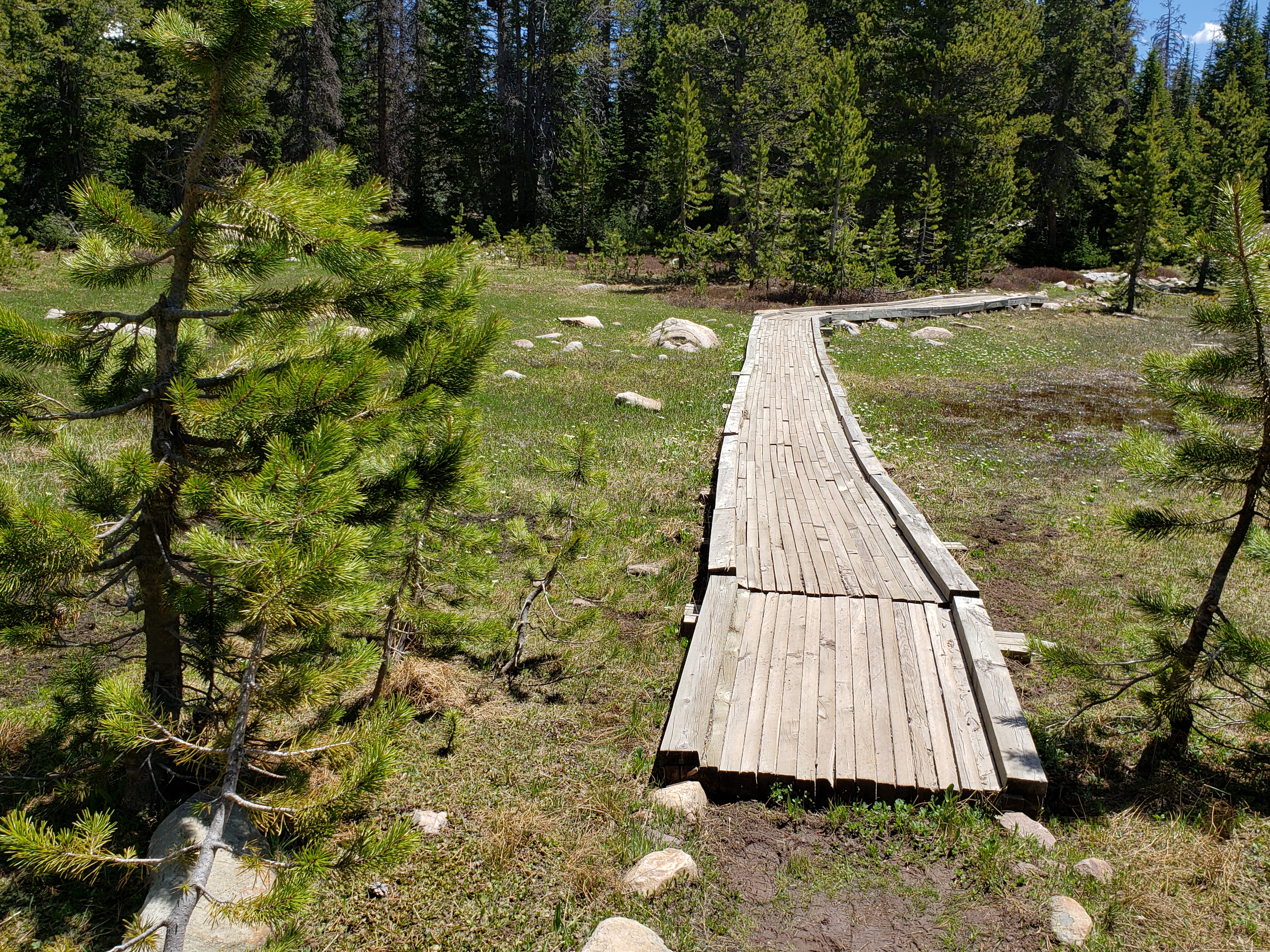
Exploring High Uinta mountain lakes and trails is a favorite family pastime. While the children fish and kayak, I enjoy walking around the lake. Teapot Lake is just my size: not so big I feel it might swallow me up, but small and friendly and pretty, and more than a puddle. I walk around its banks in 20 minutes, despite the north shore trail still being snow-bound in July. Hundreds of frogs croak in swampy bogs. An old boardwalk guides directs the trail across snow melt draining into the lake. Tiny white flowers proliferate.
FOREST BOARDWALK
the boardwalk beckons
a sign of humanity
in my wilderness of fears
easing my way
on the swampy trail
lily pad pools flanking
yellow stars in the green
invisible frogs creaking
a hundred rust-hinged doors
and always the wind
across the lake
Roger is the author of Rabbit Lane: Memoir of a Country Road. The book tells the true life story of an obscure farm road and its power to transform the human spirit. The book is available in print and for Kindle at Amazon. See Rabbit Lane reviewed in Words and Pictures.