Tag Archives: Dentist

Courage at Twilight: Postcards

Steve wrote to Mom on a Banff postcard that they saw lakes and waterfalls and mountains, and elk, and a porcupine, and two bears.  “A porcupine!” Dad laughed.  “If you use its real name porcupine nobody knows you’re talking about a porcupine!”  Mom and I looked askance at one another.  “Um, Dad, could you clarify about porcupines?” I ventured.  “You know,” he explained, “everybody knows what a porky-pine is, but nobody knows what a poor-KYOO-pine is.”  I felt marginally better that his joke’s punchline made some sense.  “Is today a holiday?” Dad asked, and I told him it was Juneteenth.  “Explain to me the significance of Juneteenth,” he inquired sincerely, and I explained that Union armies had arrived in Texas on June 19, 1865, to find that the Black American slaves of Texas did not know that they had been emancipated, two-and-a-half years earlier, on January 1, 1863.  They were the last African-American slaves to join the ranks of the newly free.  This newest federal and Utah state holiday celebrates the end of slavery, Black manumission, and the continued struggle for racial and class equality in America.  “I’m glad we have that holiday,” he said soberly.  An hour later Dad asked me, “Is today a holiday?” and I sighed, discouraged.  I also felt discouraged by the reality of taking Mom and Dad to the dentist on the holiday afternoon.  I kicked irascibly against the brick wall of my duties.  Interrogating myself about my anger, I realized I was not being petty or selfish; instead, I was afraid: afraid of the grueling car and wheelchair routines, afraid of repeating our near falls from the wedding day outing, afraid of so much of what is living life with ancient disabled parents.  I have been sharing with Dad my impressions of Frederick Douglass, John Lewis, Martin Luther King, Jr., and Harriet Tubman, from their biographies.  “So much has changed for Blacks, for the better,” Dad offered as I drove across the Salt Lake valley.   “Much has changed,” I agreed, but expressed my discouragement about my country’s regressions on voting rights.  One hundred years after the first Juneteenth, almost to the month, President Lyndon Baines Johnson maneuvered the Voting Rights Act of 1965 through Congress, riding the spiritual momentum of President John F. Kennedy’s assassination, the unconscionable police brutality at the foot of Selma’s Edmund Pettus Bridge, and the shocking television images of Bull Connor’s squads turning fire hoses and furious dogs upon more than one thousand of Montgomery’s Black school children.  Since its passage, politicians have fought against the Act’s protections, passing many hundreds of laws to restrict the Black vote.  And after 50 years of leveling the voting field, the Act’s key provisions were ruled unconstitutional by the Roberts Court, overturning decades of Supreme Court precedent and Congressional support.  “That is discouraging,” Dad agreed.  We returned home by way of JCW’s for celebratory burgers, Mom and Dad so glad to have their teeth thoroughly cleaned, relieved to have no new cavities or infections, and thrilled to have Mom’s escaped crown glued back on.

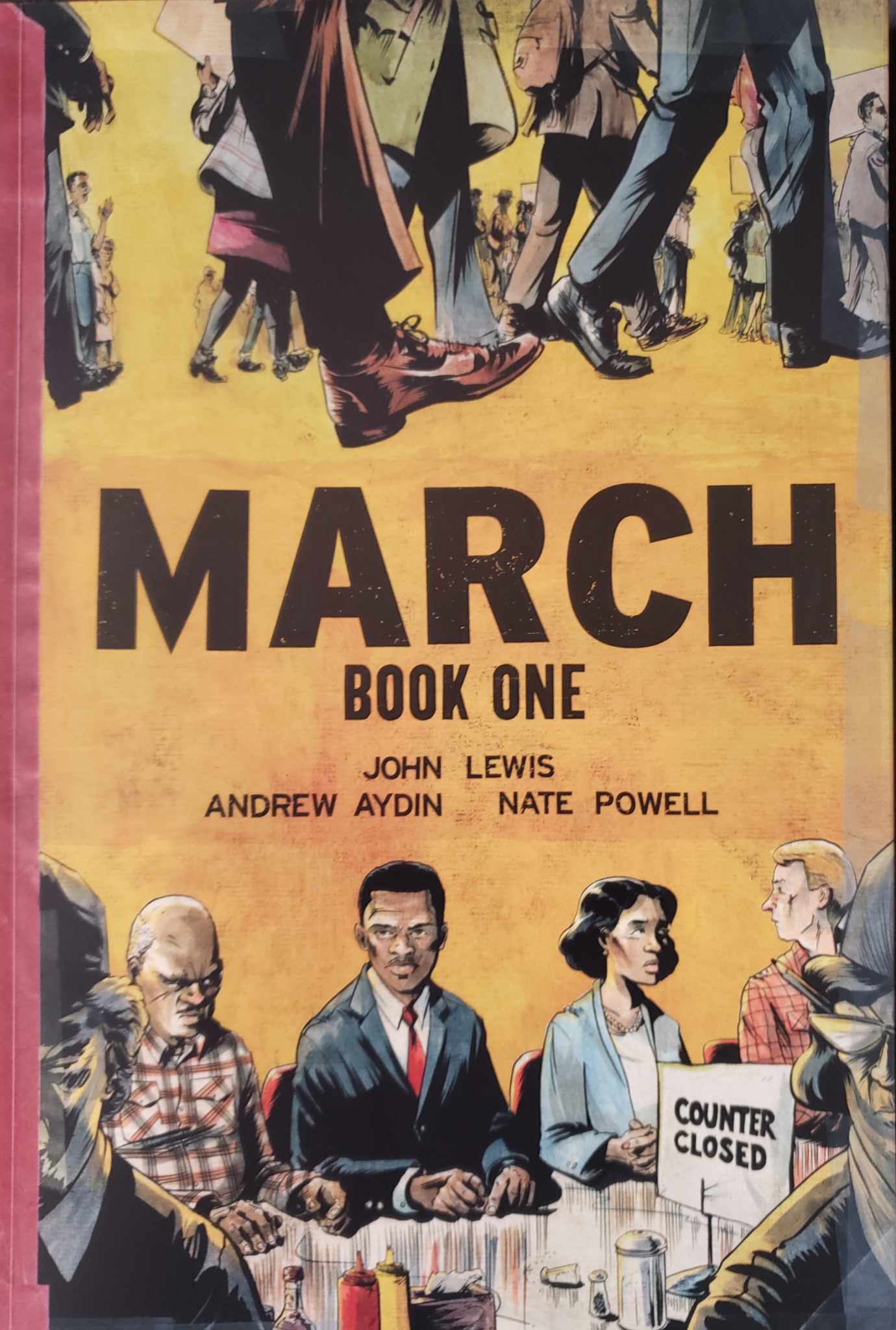
Pictured above: the cover of the late Congressman John Lewis’ award-winning graphic novel March, Book 1.  The book (and its sequels) reawakened interest in the Civil Rights Movement among 21st-Century Black youth.

Courage at Twilight: Pulling Teeth

A young woman has been sitting by a grave every morning at 8:00 as I commute past, and I cannot help wondering about her story, and her grief, and her devotion.  Fresh flowers appear weekly in the vase, this week white and passion purple.  The bright warm colors of the mums I planted have brought me happiness each morning and evening I leave from and return to my parents’ home, which they keep telling me is my home, too.  Color is happiness, I think.  Fushcia.  Yellow cream.  Tangerine.  Scarlet blending to barn red.  Dad effused as I maneuvered his wheelchair for him to see them.  Color is happiness.  And color is grief, and color is comfort.  The hardest aspect of having the basal cell cancer scraped from Dad’s left nasal fold was the effort of the trip with its great strainings into and out of the Faithful Suburban.  Every aspect of the next day’s visit to the dentist, or should I say the oral maxillofacial surgeon, who pulled and yanked and twisted at the infected tooth which finally came forth with it enormous roots half again the size of the tooth, proved arduous.  Mom asked for the tooth.  “I don’t want to see it,” I announced, but at home she wanted to show me anyway.  “Why would I possibly want to see that bloody tooth!” I retorted.  I quease at blood and everything else that belongs on the body’s inside.  Sarah, though, will find it fascinating: she has a strong stomach and an eager medical mind.  Poor Dad had to deal with a bleeding mouth and an anesthetized face and bloody gauze and salt water rinses and feeling beat up.  Waiting for the surgeon, Dad told me had been in lots of fights in high school, but his fights involved stepping in to stop other fights and to rescue the bullied, and his toughness intimidated the tough guys, even though one punch did break his nose, and the doctor rammed two rods up his nostrils and lifted the broken bones and set them back where they belonged.  Despite the tooth extraction trauma, the pain never came, which astonished me for the depth of the abscess and the size of the gape left behind.  Grandpa Wallace had lost all but his front teeth before Mom outgrew girlhood.  She remembers his slightly sunken cheeks, and she remembers standing by his side as the dentist pulled what teeth he had left—she had insisted on being there, a little girl defending her dad.  Dentures followed healing, and Wally was so happy with his full cheeks and full mouth of teeth, for now he could eat everything he loved but had been denied him for years, including apples, carrots, and corn on the cob.  And Mom was happy for his happiness.  The family, as it grew, had no money for dentists.  “Thank God for Harvey!” Mom sighed.  Uncle Harvey had married into the family and become a dentist, and forever after gave the children free dental care, including many fillings.  His jolly laughter resounds in my memory these decades after his death.  This morning the young woman lay in the wet grass wrapped in a blanket against the cold and slept on the grave, and I felt a blend of admiration for her great love and of sadness for her great loss.

Courage at Twilight: Visit to the Dentist

Mom and Dad drove themselves to the dentist office for their annual checkups and cleanings. They came home happy to report that they had no cavities or other problems.  Dad’s first visit to the dentist was at age 15, circa 1951, by which time several teeth were in bad shape.  His mother sent him to the dentist with a $5 bill, which the dentist took, along with four teeth.  “Going to the dentist was a luxury,” he explained, a luxury his single mother, emptying waste baskets at night in the Kearns Building downtown Salt Lake City, could not afford.  More than a decade later, when he had a job and dental insurance, “Doc” Nicholas made bridges to fill the gaps—implants weren’t a thing.  Mom took her first trip to the dentist at age seven, by which time she had several large cavities to be filled.  She remembers the agony of the dentist grinding for what seemed forever with a slow rotary tool, and no Novocain.  She had to just sit there, a prisoner in the chair, and suffer through it—what was the alternative?  Thereafter, Mom was taken to dear Uncle Harvey, a new dentist who always smiled and laughed and made you feel good about life.  Today, Mom and Dad came home cavity-free and in good spirits.  Mom reported how kind the hygienist staff were on this visit.  “Sometimes they just jab you, and it hurts, but my hygienist today was so nice and gentle.”  Next month it is my turn to see the dreaded dentist.  I wish “Doc” were still around.


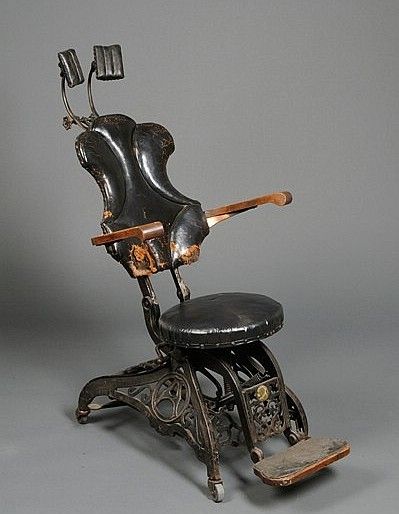
(Image from Pinterest.  Used pursuant to the Fair Use doctrine.)