Tag Archives: Civil Rights Movement

Courage at Twilight: Postcards

Steve wrote to Mom on a Banff postcard that they saw lakes and waterfalls and mountains, and elk, and a porcupine, and two bears.  “A porcupine!” Dad laughed.  “If you use its real name porcupine nobody knows you’re talking about a porcupine!”  Mom and I looked askance at one another.  “Um, Dad, could you clarify about porcupines?” I ventured.  “You know,” he explained, “everybody knows what a porky-pine is, but nobody knows what a poor-KYOO-pine is.”  I felt marginally better that his joke’s punchline made some sense.  “Is today a holiday?” Dad asked, and I told him it was Juneteenth.  “Explain to me the significance of Juneteenth,” he inquired sincerely, and I explained that Union armies had arrived in Texas on June 19, 1865, to find that the Black American slaves of Texas did not know that they had been emancipated, two-and-a-half years earlier, on January 1, 1863.  They were the last African-American slaves to join the ranks of the newly free.  This newest federal and Utah state holiday celebrates the end of slavery, Black manumission, and the continued struggle for racial and class equality in America.  “I’m glad we have that holiday,” he said soberly.  An hour later Dad asked me, “Is today a holiday?” and I sighed, discouraged.  I also felt discouraged by the reality of taking Mom and Dad to the dentist on the holiday afternoon.  I kicked irascibly against the brick wall of my duties.  Interrogating myself about my anger, I realized I was not being petty or selfish; instead, I was afraid: afraid of the grueling car and wheelchair routines, afraid of repeating our near falls from the wedding day outing, afraid of so much of what is living life with ancient disabled parents.  I have been sharing with Dad my impressions of Frederick Douglass, John Lewis, Martin Luther King, Jr., and Harriet Tubman, from their biographies.  “So much has changed for Blacks, for the better,” Dad offered as I drove across the Salt Lake valley.   “Much has changed,” I agreed, but expressed my discouragement about my country’s regressions on voting rights.  One hundred years after the first Juneteenth, almost to the month, President Lyndon Baines Johnson maneuvered the Voting Rights Act of 1965 through Congress, riding the spiritual momentum of President John F. Kennedy’s assassination, the unconscionable police brutality at the foot of Selma’s Edmund Pettus Bridge, and the shocking television images of Bull Connor’s squads turning fire hoses and furious dogs upon more than one thousand of Montgomery’s Black school children.  Since its passage, politicians have fought against the Act’s protections, passing many hundreds of laws to restrict the Black vote.  And after 50 years of leveling the voting field, the Act’s key provisions were ruled unconstitutional by the Roberts Court, overturning decades of Supreme Court precedent and Congressional support.  “That is discouraging,” Dad agreed.  We returned home by way of JCW’s for celebratory burgers, Mom and Dad so glad to have their teeth thoroughly cleaned, relieved to have no new cavities or infections, and thrilled to have Mom’s escaped crown glued back on.

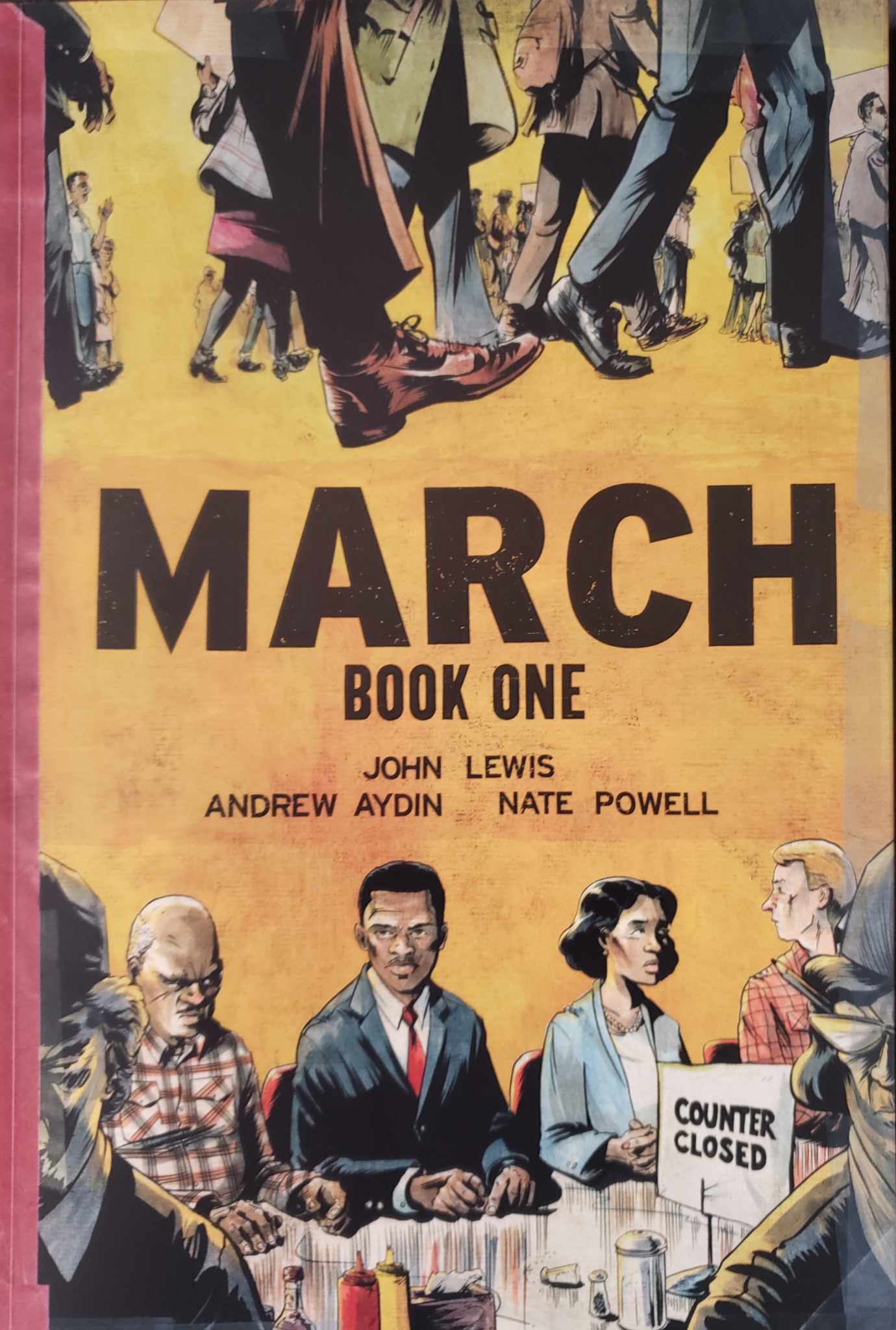
Pictured above: the cover of the late Congressman John Lewis’ award-winning graphic novel March, Book 1.  The book (and its sequels) reawakened interest in the Civil Rights Movement among 21st-Century Black youth.

Courage at Twilight: Give Me a Chance

LEAD Technologies Inc. V1.01

I stumbled through the front door, laden with the burdens of duffel bag, briefcase, and laptop, of weariness from a four-hour Sunday afternoon drive, and of a failed effort at emotional connection. “He doesn’t look very happy to be home,” Mom observed to Quinn in a whisper the whole household could hear.  “Give me a chance!” I growled, shutting the front door behind me and dropping my bags.  I resigned myself to giving the report they would invite before I could pee or unpack or take a deep steeling breath against the resumption of my duties.  Heidi had taught me to play pickleball, I reported, and we beat the opposing couple 14-12, slapping our paddles in smiling congratulations.  Are you sure you’ve never played before? the group had asked me.    Did you know that the four girls in the women’s restroom under the crushing concrete rubble of the Klan bomb at the 16th Street Baptist Church in Birmingham, Alabama on September 15, 1963, were named Denise, Addie, Cynthia, and Carole, I reported, and that the little sister Sarah missed the rubble by inches but lost an eye from shattered glass and later wore a blue glass eye because the standard colors did not include African brown and because her family could not afford a custom glass eye, I reported, and how Martin Luther King, Jr. praised the girls as “unoffending, innocent, and beautiful” victims of hatred and as “martyred heroines of a holy crusade for freedom and human dignity”?  His eulogy moved me to goose bumps.  And I reported that Henry (27 months) and I had sat on the wooden foot bridge and dropped dandelion flowers onto the rippling creek and watched them float away, little petalled suns bobbing and twirling so brightly on the dull water, floating toward other lands, other rivers, other stories, other happy endings or endings not quite so happy, like the flower-stars sucked into circling eddies, though most finally floated onward to grace downstream.  And I threw together something called “dinner” at the late hour of eight on a Sunday afternoon.

(Photo above used with respect under the Fair Use Doctrine.)

I Must . . . Trust

As I have studied African-American history during this celebratory month, I am heartbroken by the stories of human suffering, and lament the cruelty of which we are capable.  I wonder: Can we elevate ourselves?  Can we be better?  Despite our communal history, I believe we can overcome our baser natures to become better, individually and as a world society.  Let us, together, through kindness, fairness, and toughness, coax from ourselves our better selves, demand from our institutions a new way to see and to be.  Let us trust in whatever forces we believe in, above and within, to achieve greater equality and generosity.  And let us not despair, but choose to move forward and upward with strength.

I Must . . . Trust

Every human life is tragic
if one sees it that way
which I do
much of the time

others capture us
sell us off
for a few coins—
and we sell them
in turn

others grin at us
at the tortures they inflict
our weeping wounds—
and we laugh at them
in turn

they must gather wealth
greater wealth than us all
if they can

they must amass power
greater might than us all
if they can

they must be right
righter than everyone
more justified than us all
and they will

and when they cannot
as they know they cannot
then they rage
then they break their teeth with clenched hatred
and you can do nothing for them
nothing with them

then the devil has full sway
to spit in the face of human virtue
the more the better to grind us
beneath the great granite millstone

and new centuries of civility and law and goodness
may not be enough
to right the listing ship
to tip the rusty scales

and I must trust
though a hundred billion have suffered their way to the grave
with too-scant joys

must trust the Invisible Beyond
through all the manipulations and sorceries
imprisonments and abandonments
the utter isolations

must trust the Silence inside
and kindness and gentleness—mocked
and forgiveness and forbearance—mocked

I must . . . trust
or despair
and perhaps
both

(Image provided by Clker-Free-Vector-Images from Pixabay.)

Roger Baker is the author of Rabbit Lane: Memoir of a Country Road.  The book tells the true life story of an obscure farm road and its power to transform the human heart.  The book is available in print and for Kindle at Amazon.  See Rabbit Lane reviewed in Words and Pictures.