Tag Archives: Caregiver Burnout

The Dementia Dossier: I’ll Miss You

“See you in a bit, Mom,” I waved as I walked toward the front door on my way to run an errand.  “Okay.  I’ll miss you.  I’ll be lonely.”  I ground my teeth and glowered.  The more I pull away, the more attached she wants to be, and in turn the greater my desire to turn away, and the greater her loneliness.  I’m not here to hold your hand and keep you company all day. I wanted to tell her.  I’m here to call 9-1-1 when you fall.  I’m here to feed you one good meal a day.  I’m here to keep you safe in your home until you die.  I never say any of these things, of course.  I’m too afraid to hurt her feelings, feelings which she cannot control or even be aware of in her dementia.

The Dementia Dossier: Nothing’s On

As I cleaned up the kitchen after dinner, Mom surfed the cable channels (access to 100+).  She pressed the “channel up” button one at a time, roaming slowly through each of the channels.  The process seemed to take forever.  After surfing past baseball games, basketball games, news programs, a dozen movies, a tennis match, nature and history documentaries, and even her beloved crime show reruns, she turned the television off and pronounced with some disgust, “There’s nothing on.”

The Dementia Dossier: The Old Wallet

For decades I had admired Dad’s black leather wallet: not a bi-fold or tri-fold, but a full-length wallet holding his ID cards and credit cards and unfolded cash.  A real man’s professional wallet, I fancied as his worshipper and shadow follower for years.  A sophisticated man’s wallet.  The wallet of an intellectual.  When Dad died, I secreted the wallet, with his cards and cash, in my bedroom, knowing where it was if it were needed.  Out of loyalty and transparency with Mom (and the estate), I told her that I had the wallet, what was in the wallet, and where I had hidden the wallet in my bedroom.  Dad had another wallet, at least one that had been given to him, but never used: a nylon and Velcro camouflage tri-fold.  Mom asked every member of the family who came into her orbit if they wanted Dad’s camo wallet.  The stiff, green, empty thing had no meaning to anyone, and no one wanted it.  But Mom really wanted someone to have “Dad’s wallet.”  My lovely sister, Jeanette, also did not connect with the camo, but mentioned offhandedly to Mom how she much had admired Dad’s black leather wallet.  Sometime later—how long I don’t know—I went to the hiding place to retrieve Dad’s wallet, for his social security card.  Instead of the black leather wallet, I found the plastic camo wallet, complete with all Dad’s cards and cash neatly cached.  The implications of what had occurred crashed in around me: Mom had snuck into my room, had opened my drawers, had rummaged through my things, and had snuck the old wallet out, replacing it with the cheap camo, and transferring all the contents.  I could almost hear her thinking, I’ll move everything into the plastic wallet, so it’s okay.  I approached Mom with the camo wallet raised, and said to her evenly, “Mom, I’m going to try very hard to be calm as I talk to you,” and then proceeded very uncalmly to ask her, “What is this!”  She seemed befuddled, and offered that she could ask Jeanette to return the leather wallet.  “It’s not about the wallet,” I responded.  “It’s about you sneaking into my room and getting into my stuff.  Stop sneaking around!”  I left her in tears as I stormed from the room.  Oy vey.  Jeanette felt terrible when I told her the story, and offered to return the wallet.  Among other things, I told her I was very happy for her to have Dad’s wallet as a family keepsake—and I meant it.  My feelings weren’t about the wallet.

The Dementia Dossier: Lights Blazing 2

The chandelier was on again, all 16 incandescent bulbs, for the third time that day. I had turned it off twice already.  And now it was blazing again.  “Alright Mom.  I give up.  I have turned the chandelier off twice today, and it’s on again.  You win.”  She looked crushed.  “I went to sit on the front porch.  I forgot to turn it off when I came back in.”  Exactly! I wanted to say.  Mom is incapable of passing a light switch without flipping it up and turning on some light or other.  Her morning pathway includes the 16-bulb chandelier, two hall ceiling lights, five table lamps, and 25 recessed bulbs.  Conversely, she seems incapable of flipping a light switch off on her return trip.  Having not said “Exactly!” but having said “You win,” I left the lights on all day, despite my acute and painful awareness of my expanding carbon footprint, which I imagined to be the size of the Great Salt Lake.  The next morning, in advance of her descending the stairs via the chair lift, I turned on the chandelier, the hall lights, the lamps, and the recessed lights.  I decided to preempt (but not disrupt) her blazing lights routine, adopting it as my own (for today, anyway), refusing to engage in a petty power struggle (for which I am partly responsible, especially the petty part).  I know I won’t be able to hold out, perhaps not even for a day, and will surreptitiously here and there follow after her, turning lights off.

The Dementia Dossier: Rigid Dementia Routines

A month after my involuntary retirement, and the illness that followed, I finally found the mental energy to map out a new routine for my daily life. My routine involved time for reading scripture, exercising, new writing projects, painting lessons, low-bono work with an immigration non-profit, and yard and house projects.  I also built in time to take Mom for her necessary errands, like the post office or the pharmacy.  Since Mom is so routine-bound in her dementia, Jeanette suggested Mom would benefit greatly from seeing my schedule, knowing my routine, and knowing that she was a part of it.  I printed the schedule, and Mom taped it to the lamp next to her recliner, where she could always see it.  I knew a routine would need to be flexible.  Without flexibility, the routine would cease to be the servant and become the master.  Instead of the routine serving my purpose, I could become a slave to the routine.  That flexibility proved necessary as I succumbed to sinus and bronchial infections that laid me flat for much of eight weeks and dragged me through two ten-day microbiome-depleting rounds of antibiotics.  The illness destroyed my routine.  But every day near 2:00 p.m., Mom asked—according to my routine—to be taken to Help U Mail or Walgreen’s or out for a drive: Ahhh! Just look at the beautiful blue sky!  I began to roil with increasing resentment, and biting my tongue and clenching my teeth, I evenly uttered, “Mom, I don’t think you have a sense of reality right now about what I can do.  I had just enough strength to watch Jeopardy with you for half-an-hour.  I’m not up to an outing.”  After more than two months, I am nearly recovered, but my routine remains in a shambles.  Returning from an appointment at 4:00 p.m., I asked Mom how her afternoon had gone.  “Quiet,” she answered, and continued under her breath: “I guess I’m stuck in the house today.”  “Stuck?” I answered.  She thinks she’s stuck in her recliner, I thought.  She thinks I’m responsible for her getting unstuck.  “You’re not stuck,” I challenged.  “You can get up from your recliner and sit in a chair on the front porch and look at the blue sky, the clouds, the endless airplanes, the cars driving by.  You can sit on the back porch and look the mountains with their maples turning red and the dustings of snow on the peaks.  You can use your walker on the sidewalk for a quick walk.”  And then I saw it.  When I began my new retirement routine, I had made time for her in my daily schedule.  My  My schedule.  She had taped my schedule to her lamp.  And with that bit of adhesive tape, I became part of her routine and her schedule.  I had been sucked in even further by her consuming dementia.  I was now another symptom of her slavery to dementia routines.  The next morning, I pulled the paper from her lamp and crumpled it into the trash.

The Dementia Dossier: A Lecture

On my filing cabinet sit two framed copper sheets into which a Greenwich Village street artist pressed my parents’ portraits in 1963. They capture my father and my mother at the apex of their young lives: newly arrived in New York City from their rural Utah roots, a graduate student and his pretty young wife, no children, no debt, the future at their fingertips.  I love the pressings and am so pleased my parents gifted them to me years ago.  This morning, though, they were gone.  On opening the top filing cabinet drawer in search of a file, I found the frames hidden in the drawer.  I marched to my mother and asked angrily if she knew anything about the portraits being moved to the drawer.  “They are ugly,” she announced.  “I was sitting in your chair waiting for the laundry and just couldn’t stand to look at them anymore.”  Well, I spat, these portraits are mine, and I love them, and I love them where they are.  And that is my chair and my private space you have been sitting in and messing with.  And you are not allowed to sit in my space and touch my things and move my things around, whether you like them or not.  If you see something of mine you don’t like, you are allowed to talk to me about it or to leave my room and sit somewhere else while you wait for your laundry.  But you are not allowed to be in my private space or to touch and move my special things.  Of course, she cried.  But I was too piously put out to care.  I felt justified in drawing an immediate and clear boundary, one she should have already been fully aware of without my emotional explanation.  And of course, it was stupid and mean of me to do anything other than kindly and patiently explain appropriate boundaries to my old mother who has lost her husband of 62 years and who can’t stand to see herself and her handsome young husband in the beautiful prime of long-lost youth.

Courage at Twilight: Caregiver Blues

Despite my instructions, the new hospice nurse revealed to Dad that his gift, and my reporting of the gift, got his old nurse fired.  I called Kourtney and expressed my utter dismay at being put at this new squeezing fulcrum point, this point of carbon-to-diamond pressure, and I demanded (or desperately requested) that she visit Mom and Dad and explain—before I arrived home—to them how the termination was not Dad’s fault, how the nurse accepting the gift violated all federal, state, and company rules and ethics, and especially how the termination was not “Roger’s fault” for having done right to report a wrong, and I needed to arrive home to a place of relative safety instead of a place of shaming accusation and recrimination.  After the hour-long visit, she assured me he understood and was sufficiently calm.  Indeed, I found him calm, yet eager and accusing.  She was fired, Roger, because you reported the gift.  (I.e., you snitched.)  I stiffened myself against shame, a little boy standing up to an angry giant of a man, and immediately interrupted the lie.  “That is not true,” I shot back.  Your nurse was fired because she played on your sympathies and committed a crime, not because I reported the crime.  That the company did not know about its employee accepting an illegal gift does not excuse her and does not condemn me.  But he would not relent, and I would not be shamed, and in my momentary rage I thought, You are not my father.  You are the man who even on his death bed needs to be right and will tell me how I am wrong and how I am at fault even though I do the good and right thing, the hard thing, because it is good and right.  You are the man who belittles his son rather than acknowledging his own shortcomings, instead of thanking his son for his courage and his ethics and his advocacy for truth and right.  And, I am afraid to say, I continued spinning my mental yarn of hurt and justification.  You are the man whom I have always wanted to please but could not, from whose lips I craved but never heard “I love you” and for whom my saying “I love you” feels like chewing glass.  My own fears and frustrations and guilts and inadequacies continued to pour through my thoughts.  You are the man around whom I strapped a gate belt and lifted with all my decrepit might to raise you from the floor and onto your chair and into your bed and who complained about how I had hurt you, instead of thanking me for saving your life, again.  You are the man to whom I wanted to be a beloved son but to whom I instead became a resented caregiver, or a toxic mix of both.  Leaving him to watch Dr. Poll alone, I resolved again never to live with my children in my future decrepitude.

(Pictured: Chicago Ivy #3.)

Courage at Twilight: No Saint

Janis says to me every week at church, she says: “You are such a blessing to your parents.  They are so lucky to have you.”  And Stephen, whom I respect, and who knows a lot more about caregiving than I will ever know, told me, “You must have the deepest reservoirs of unconditional love.  If you were Catholic, I’d nominate you for sainthood!”  (Wink-face emoji.)  He’d have to call me the Swearing Saint, I muttered.  And my great and good friend Blake: “You are amazing…you are preparing your place in Heaven with how you are treating your parents.”  Heaven, huh?  Hell, more likely.  Or some other type of purging Purgatory.  Where the angry and resentful and rude go to cool off for a few millennia while awaiting the Final Judgment.  I think I will need every one of those years.  “Help me get to the potty, Lucille,” Dad instructed her.  “I can’t!” she cried, at 85, barely able herself to totter about on stiff knees and hips, let alone support and swivel around his belly and buttocks.  “I’m not strong enough!”  Exactly so: you’re going to get her hurt, Dad, make her fall.  And so I wait—sitting at the piano, standing at the sink, cleaning up the kitchen, decorating the Christmas tree, piecing together a Dowdle puzzle, writing this Courage entry—listening for the effort grunt to become the falling-panic help-me I’m-going-down grunt, waiting for “I don’t know if I can do it” as he pivots from the toilet to the chair, a rotation of 45 miserable impossible degrees.  You shouldn’t be here! I want to scream.  But I never scream; I just seethe.  And at church, Janis rejoices, as if for the first time, as if with a novel thought, as if a newsworthy human-interest story, as if I beamed at her pretentious praise: “You are such a blessing!”  Go to hell.  I am no saint.  No way.  I’m just an angry lonely stressed exhausted resentful empty depressed anxious angry 60-year-old man waiting and waiting and waiting for the little event that will inevitably initiate the cascade toward the big end.  And Stephen, rightly, accurately, justifiably, gently encouraged me to try to be less of a caregiver and more of a son.  Point taken.  Touché.  But…I may have lost them both.

(Pictured: Stream in Little Cottonwood Canyon, Utah.)

Courage at Twilight: Greetings and Good-byes

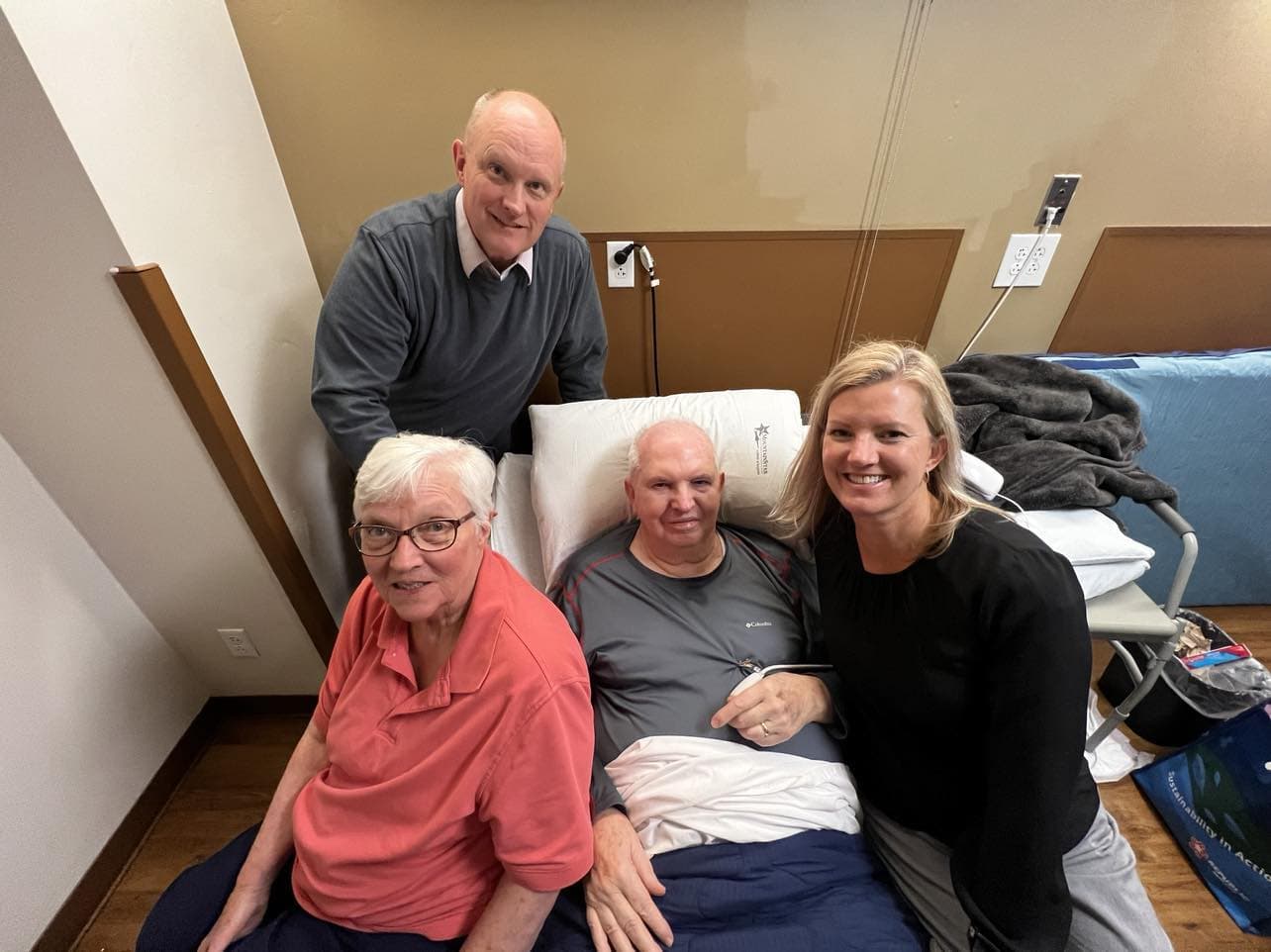
The needling traumas of covid and ambulance and hospital and worry and the prolonged proximity of death have sapped away my strength.  I mope around feeling weak and muddy, freeze dried and vacuum packed.  The numbing emptiness is syncopated with gun shots of rage, often over nothing, like a spot of greasy mayonnaise oozing from the jar rim to the butter knife to my clean fingers.  When I spilled a tall glass of chocolate milk on the shag, the explosion lasted more than a mere moment, but there was nothing for it but to fill the tank with soap and hot water and shampoo the spot 613 times until it was cleaner than clean.  Mom watched me from her recliner, mute, helpless to comfort.  Dad has phoned her several times a day from his rehab room the next town over.  “Hello, good lookin’!” she cheers.  He complains to her about his lumpy hot cereal, the maddening miserable itching from his Grover’s disease, how he simply can’t do what the physical therapists are working with him to do—knees straight! butt in! chest out! you can do it! one more step!—what we keep telling him he must be able to do if he is to return home.  He tells her how lonely and bored he is, with little to do and no one to see, and how badly he just wants to come home.  At 87, he is again the neglected little boy wanting to be comforted, by his 63-year sweetheart, his darling girl.  “Well, you just have to do it,” she chastened.  There is little comfort in chastening, and little progress in coddling.  I have nothing for him, no words of compassion or encouragement, no enthusiasm, no “You can do it!”  Dad wants more than anything to be independent, and he wants to be tended and nursed.  He is desperate to go where he feels safe and loved, to go home, but he knows he cannot go to that blessed place in his condition—and changing his condition may require more strength of mind and body than he can muster.  We brought a bit of home to him, in his room, with yellow balloons, with vases of flowers, with wrapped gifts from her children, with pizza and salad and fruit and German chocolate cake, celebrating Mom’s 84th birthday with him, and we ate and sang and opened gifts and cheered and took pictures.  And then we said good-bye and left, because that is how life goes.  Every party ends, and every good-bye looks forward to the next getting-together.