A month after my involuntary retirement, and the illness that followed, I finally found the mental energy to map out a new routine for my daily life. My routine involved time for reading scripture, exercising, new writing projects, painting lessons, low-bono work with an immigration non-profit, and yard and house projects. I also built in time to take Mom for her necessary errands, like the post office or the pharmacy. Since Mom is so routine-bound in her dementia, Jeanette suggested Mom would benefit greatly from seeing my schedule, knowing my routine, and knowing that she was a part of it. I printed the schedule, and Mom taped it to the lamp next to her recliner, where she could always see it. I knew a routine would need to be flexible. Without flexibility, the routine would cease to be the servant and become the master. Instead of the routine serving my purpose, I could become a slave to the routine. That flexibility proved necessary as I succumbed to sinus and bronchial infections that laid me flat for much of eight weeks and dragged me through two ten-day microbiome-depleting rounds of antibiotics. The illness destroyed my routine. But every day near 2:00 p.m., Mom asked—according to my routine—to be taken to Help U Mail or Walgreen’s or out for a drive: Ahhh! Just look at the beautiful blue sky! I began to roil with increasing resentment, and biting my tongue and clenching my teeth, I evenly uttered, “Mom, I don’t think you have a sense of reality right now about what I can do. I had just enough strength to watch Jeopardy with you for half-an-hour. I’m not up to an outing.” After more than two months, I am nearly recovered, but my routine remains in a shambles. Returning from an appointment at 4:00 p.m., I asked Mom how her afternoon had gone. “Quiet,” she answered, and continued under her breath: “I guess I’m stuck in the house today.” “Stuck?” I answered. She thinks she’s stuck in her recliner, I thought. She thinks I’m responsible for her getting unstuck. “You’re not stuck,” I challenged. “You can get up from your recliner and sit in a chair on the front porch and look at the blue sky, the clouds, the endless airplanes, the cars driving by. You can sit on the back porch and look the mountains with their maples turning red and the dustings of snow on the peaks. You can use your walker on the sidewalk for a quick walk.” And then I saw it. When I began my new retirement routine, I had made time for her in my daily schedule. My My schedule. She had taped my schedule to her lamp. And with that bit of adhesive tape, I became part of her routine and her schedule. I had been sucked in even further by her consuming dementia. I was now another symptom of her slavery to dementia routines. The next morning, I pulled the paper from her lamp and crumpled it into the trash.

Category Archives: Caregiving
Courage at Twilight: The After Words (Forgiveness)
My final (and 500th) entry in Courage at Twilight touches on forgiveness, which I hold to be the most powerful transformative life force in the universe. As awesome as are the creative cosmological forces of nature, like black holes and supernovae and spiraling galaxies and evolution, the force of forgiveness is what exalts the human soul, both in the giving and in the receiving. Living 1,262 days with caregiving and hospice provided ample opportunities for hurt and misunderstanding all around, and hence for forgiveness. My siblings have been extraordinarily kind and forgiving as I have cared sincerely but imperfectly for their beloved father and mother. They love and accept me even in the midst of my missteps. They forgive. My mother forgives me when I lose patience with her deafness and confusion, seeing me always as her darling boy. In my father’s new life sphere, he understands me fully and pierces the mists of my depression and fear: he forgives me all my trespasses. For you to whom I have been insensitive and for whom I have not been fully present in love, I desire your forgiveness. This life is not designed for perfection, but for struggle and growth. In any event, perfection I cannot do. But I can do the work of life, and I will, forgiving myself along the way.
(Pictured: flower meadow beneath Mount Timponogos, Utah, a favorite hike of Dad’s and of his children and grandchildren.)
Courage at Twilight: The After Words (Privilege)
For every day of this caregiving experience, I have been conscious of the blessings, the resources, the benefits, the privileges that shaped and enabled the experience. By “privileged” I simply mean to indicate our relative place on that vast spectrum of personal resources, our being somewhere in the in-between of those with tragically few resources and those with unnecessarily huge resources. My caregiving experience, and my father’s and mother’s experience as the cared-for, undeniable was shaped and even determined by our relative resources. My father’s pension allowed us to hire private-pay home health care and hospice, which sent aides for two hours a day, seven days a week, including holidays, for the last two years (about $30,000 per year). To be sure, the costs ate away steadily at my parents’ savings, but the fact remains that they had savings, whereas many do not. Not having this resource would have made my caregiving experience impossible, at least for me. Add to our privileges the ability to purchase a $14,000 chair lift for the staircase. While the lift was a major hit to our budget, we had the budget. Add the blessings of medical insurance, prescription insurance, and social security. Include the allowance I was given to work a flexible work schedule, which enabled me to cook healthy from-scratch meals from fresh ingredients. While I am only a small-town government lawyer, my professional knowledge and social clout did clear obstacles others struggle to break through. Our relative privileges do nothing to reduce the legitimacy or reality of my experience and my story. But they do shape that story. A lack of these resources would have dramatically altered the experience, and dramatically multiplied the stress and trauma, and I acknowledge the difficulties faced by persons with fewer resources. I am not a community organizer, and offer no social solutions, but I am aware of some of the challenges and struggles faced by many. It may be a cop out to say I would not have been up to the task without our resources, but I fear I would not have been up to the task.
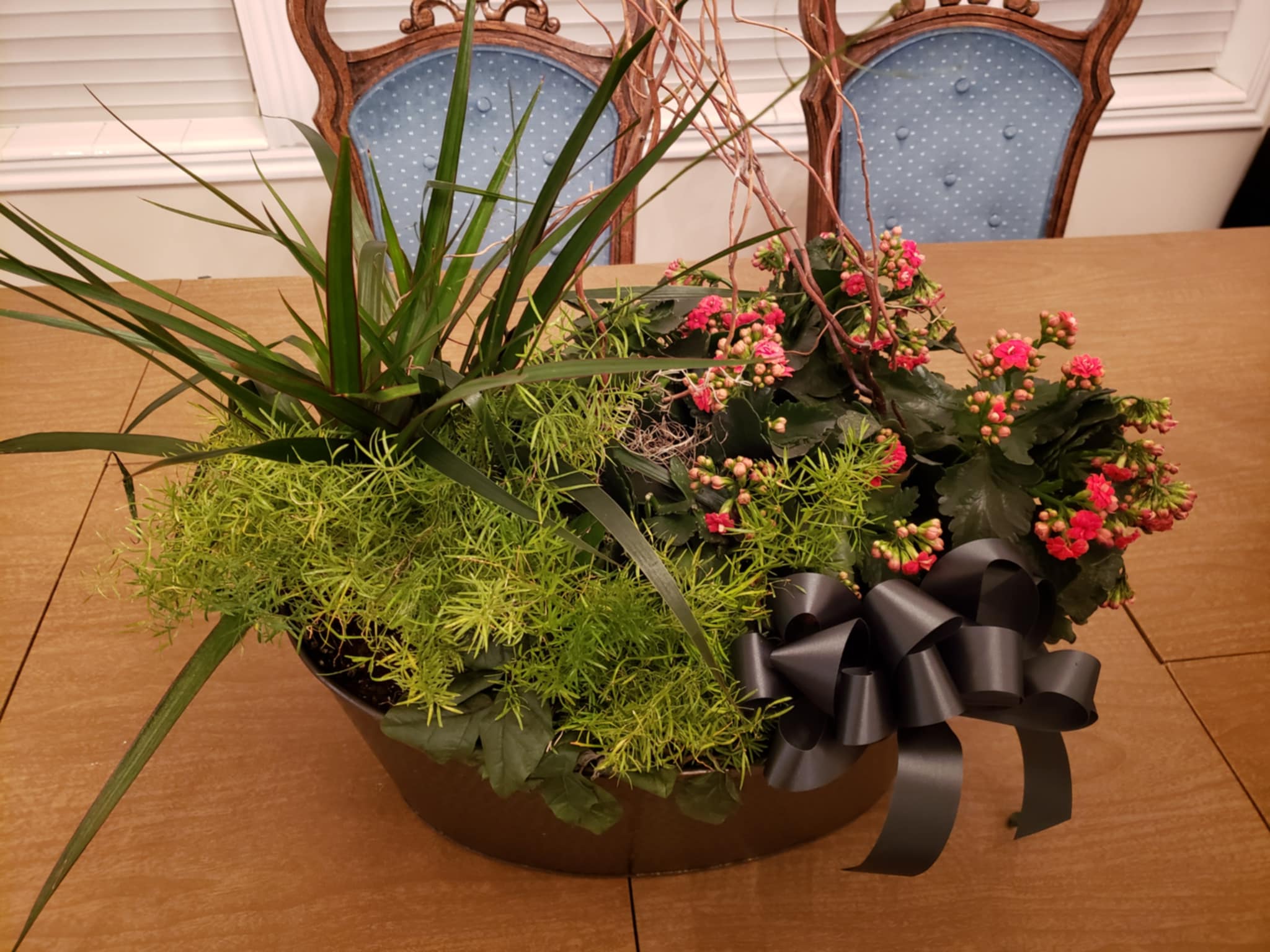
(Pictured: funeral planter from the Tooele City Mayor and City Council.)
Courage at Twilight: The After Words (Grief)
Three years ago, the thought of my father’s death terrified me. Today, his death seems natural and necessary. I feel no grief, only weariness, the fatigue of daily trauma settling deeply in, the after-crisis drain. The desire to sleep and sleep and never wake up. I have studied grief, and taught grief, and workshopped grief. I have grieved my father’s dying for the three-and-a-half years before his death: an anticipatory grief; a preparatory grief; a preemptive grief. Lorry reminded me, however, that the grief will come, in all its aspects, the anger, the regrets, the deadening sadness, the looking around wondering why he is not in his recliner reading the encyclopedia, the wishing we could talk again and the wondering about why our talking was so hard, reminded me that I need to give myself the permission and the space to feel every part of it. I am not sure such wrenching grief will come. For now, I am balancing the compassion fatigue and saturation trauma of caregiving against the fact of loss, wanting just to sleep, and finding a sort of macabre triumph in knowing that I stepped into the battle: I responded to every need, every day, for one thousand two hundred sixty-two days, imperfections and weaknesses and all. And I am deeply grateful for all of you who helped.
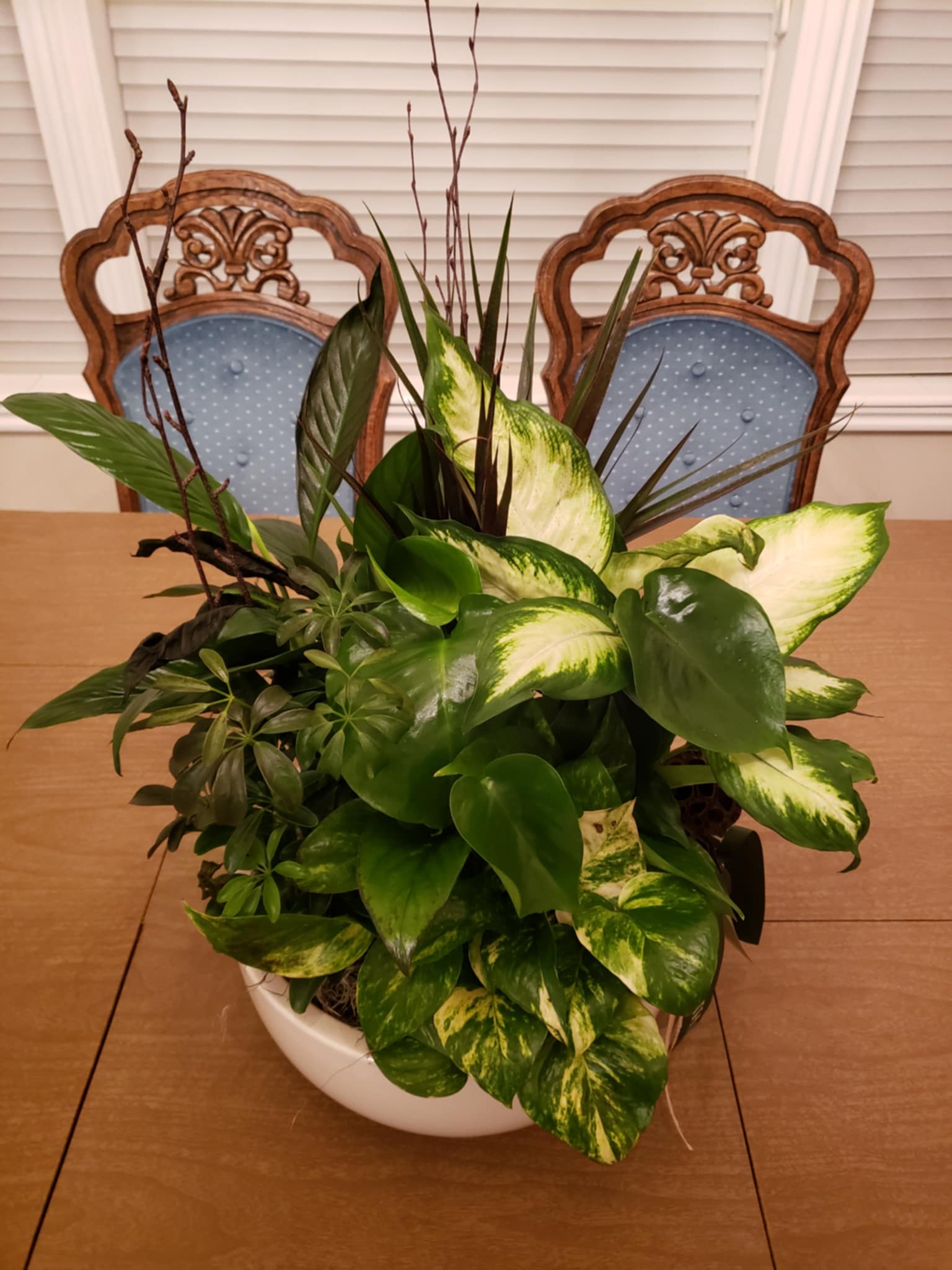
(Pictured: a funeral planter from the church choir.)
Courage at Twilight: The After Words (Guilt)
I feel no guilt in the enormous relief I find in being freed from witnessing and absorbing the accumulated daily traumas of Dad’s last three years of life with paralysis and pain. My struggle with guilt will settle in, however, as I contemplate my struggles to be happy and cheerful—and failing—in my care responsibilities, in my silences and avoidances, in my angry and impatient outbursts and imperfect sensitivities. My resentments, certainly, were not Dad’s fault, but rather haunt me as beacons of my own depression and selfishness and lack of resilience. Still, I am determined to not be sucked into to the vortex of guilt, the shamefaced guilt which will come if I measure my imperfections instead of honor my humanness. The facts remain that I offered to the endeavor all my energies, gave all my love and found a little more, persisted through the difficulties, and prevailed. Our objective was for Dad to live and die in his own house, comfortably, happily, well-fed, in good company, with his books, with his wife and sweetheart. And we did it. We overcame. We prevailed. We protected. We cared. We endured. We loved. For Dad. For Mom. For family.
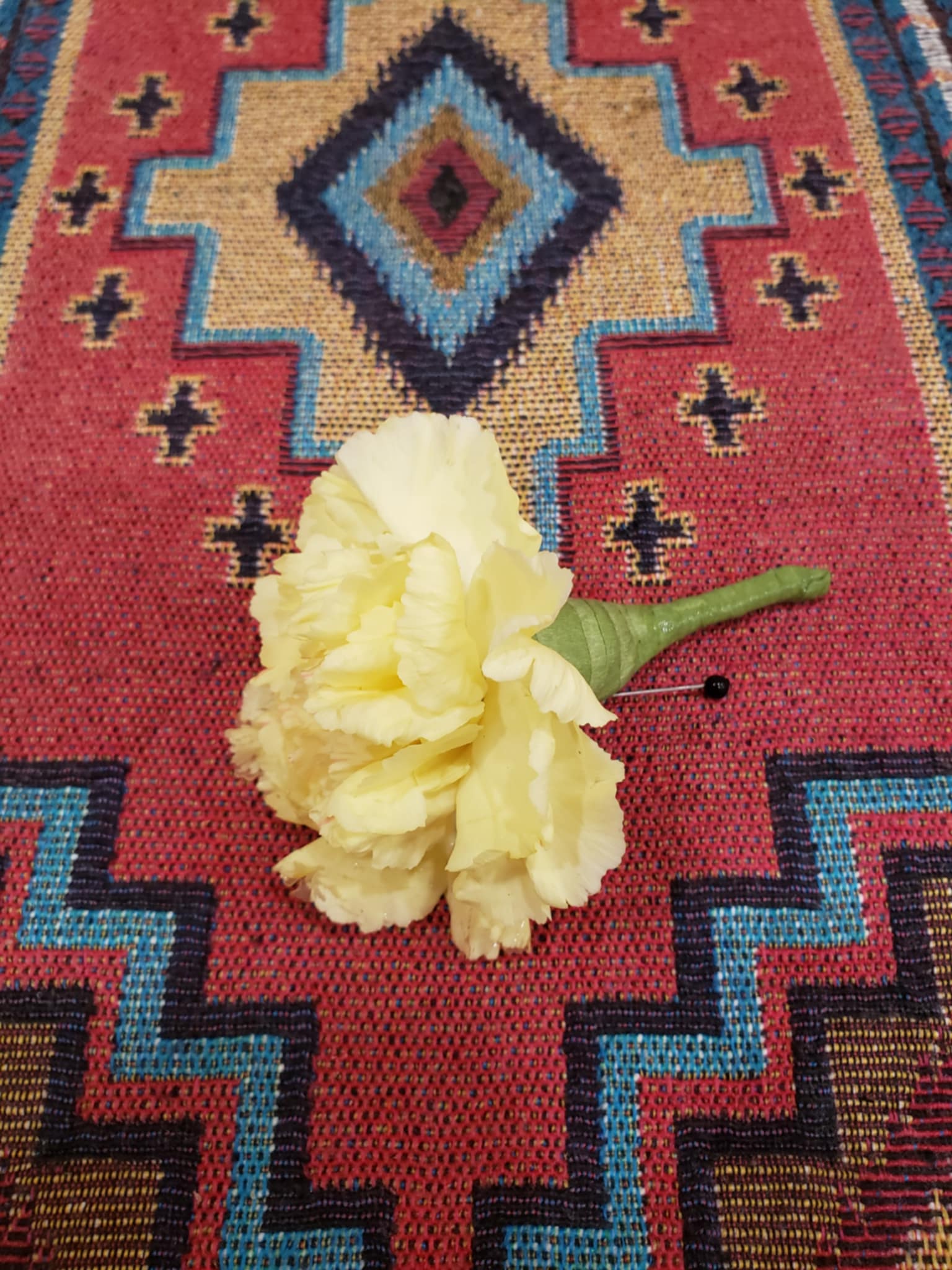
(Pictured: the funeral boutonniere.)
Courage at Twilight: The After Words (Loneliness)
We, my brother and sisters and I, navigated a week of days too filled with tasks to feel much grief—writing an obituary that attempted to summarize in two pages the long life of a great man—preparing a funeral program involving dozens of family members—writing a funeral talk I did not want to write—the mortuary checklists—settling affairs of estate—hundreds of texts and emails and messages to and from those who knew and loved him—the trickles and gushes of people through the house—all the standard tasks, which we were determined to perform in an exceptional manner. Mom will be lonelier now, without her husband and friend of 65 years. She will not hear him say as she sidles past his hospital bed, “You’re just the most wonderful wife, Lucille. I love you. We’ve been married 62 years. When you walk by, I’ll give you a hug.” I will not hear him exclaim “Roger! Welcome home!” and “What a gorgeous dinner, Rog! I just love steamed vechtables!” Walking the grocery store aisles, I passed the zero sugar mint patties, the deluxe mixed nuts, the lidocaine foot lotion, the Brussels sprouts (Mom hates them), and no longer put them in the cart. And, I felt the wrench of good-byes anew when I handed to the thrift store attendant the bags stuffed full of shoes and socks and shirts and sweats and suit coats and hoodies. But our grinding struggle is over, and Mom will experience her widow’s aloneness with a new measure of calm. A neighbor asked Mom how she was feeling, and she declared, “I’m so happy for my husband. He’s not paralyzed or sick anymore. He can run and jump and play. He’s with Sarah, and with his mother, his father, his sister Louise, and all the rest.”
Courage at Twilight: Military Honors
Christine chauffeured us in Larkin’s heated limousine to the cemetery. My brothers and sons and nephews and I grasped the handles as pallbearers and carried the casket to the open grave, stepping to the bagpiper’s I’ll Go Where You Want Me To Go, the last notes croaking to a close in the 19 degree F chill. I thanked our missionary friend for his touching musical contribution. The Air Force color guard stood graveside, their long coats, hats, and gloves inadequate for the cold. From a distance, an airman played a moving Taps on his silver horn. Two airmen floated an American flag above the casket, and one began to fold the flag in precise, crisp triangular movements, each fold finished with a deft creasing ceremonial swipe of the hand. Few knew that Dad had served in the U.S. armed forces, for he rarely mentioned his service. His orders kept him stateside as an interrogator, linguist (Romanian), intelligence officer, and airman second class, serving eight years in the Army and Air Force reserves and the Utah Army National Guard. Completing the last fold of the flag, and tucking the borders into the folds, an airman knelt in the ice and snow on one knee before Mom, held out to her the folded flag, and whispered solemnly to her, “On behalf of the President of the United States of America, I thank you for your husband’s service to his country, and present to you this American flag.” The moment for departure came, and we turned to walk away from the icy grave and the casket, covered in the most beautiful multicolored flowers.
Courage at Twilight: Missionary Choir
How different this funeral from the funeral of our father’s daughter 370 before, a funeral marked by tragedy and despair and anger, the wrongness of it all bound up in rightness of faith and family love. Now, we basked in the power of our father’s life and legacy, trusting in our convictions about the goodness of this life and reality and betterness of the life to come. We retold old stories, and told new stories, unknown to most, stories of love and service and faith. And we wept. In a powerful funerial moment, Mom called to the front of the chapel all of Dad’s former missionaries from Brazil. These 30 men and women, all in their early 20s during their missionary service with Dad, now brought their 70-something gray hair and aching knees and backs to the front, and sang Israel, Israel God Is Calling, in parts, in Portuguese: Israel Jesus Te Chama. My Portuguese-speaking sons and I joined the choir, and we felt the power of love and conviction and camaraderie echo within the chapel walls.
Courage at Twilight: A Long-stemmed Rose
We all believed it, my mother and sisters and I, that my father clung to his last heartbeats and breaths until Steven could arrive to bid farewell. We enthusiastically expressed our belief to Steven and to each other. Whether factual or no, we wanted to believe it; we wanted this mystic affirmation of a narrow sliver of hope in the midst of death. Indeed, that Steven arrived before his father’s death seemed miraculous, despite the coma and death rattle. But I soon discerned the unfairness to Steven of this testimony, which required of him wonder and faith in the face of haggard death, which broached the unanswerable question of why our father’s lucidity could not have been prolonged a mere 36 hours to allow a two-way farewell, which raised the painful reality of this last good-bye. So, I kept my belief, or my wanting to belief, silent, and sought merely to accept the circumstances we were given and to find satisfaction in having done our best with them. Steven’s trip was planned months before, but he arrived just prior to our father’s passing and left just following the funeral. After our father’s passing and our family prayer, when our small assemblage felt ready, I called the on-call hospice nurse, Monica, to report the death: Tuesday January 14 at 11:03 p.m. The official time of death, however, became the time of her certification of death: Wednesday January 15 at 00:26 a.m. She performed her coroner’s functions, wasted the remaining morphine (mixing with dish detergent and pouring down the sink drain), and called the funeral home. At about 2 a.m., the mortician rang the doorbell, bowed at the waste, expressed his condolences for our loss, entered the house, crossed the room to our mother, and delivered to her a very-long-stemmed red rose, bowing again and whispering again his condolences, which he repeated at a higher volume after Mom said, “What’s that?” After speaking comforts, he and his junior associate, dressed in black suits and burgundy bow ties, shrouded our father in white and transferred him to a wheeled gurney, where they enclosed our father’s body in a blue velvet bag with a sturdy brass zipper, and draped the whole with a blue patchwork quilt, a nice touch I did not anticipate but appreciated. And then they rolled our father’s body away and out the front door and down my wood ramps and into their Larkin van.
Courage at Twilight: I Will Not Let Him Drown
For two days family members have trickled in to visit with each other and to tell my father they love and admire and appreciate him, and to say good-bye. Those living farther away video called to do the same. But my father has been in a coma. Today he has begun to show the signs of death: a rising core temperature (at times 104 degrees F); cooling extremities; sweating and clamminess; inability to swallow (he has not eaten or drunk for six days); healthy color fading to cadaver gray; producing very little, very dark urine; not registering pain or reacting to any stimuli; gurgling on liquid in his lungs; no bowel movements. The day was calm and filled with tender expressions, and I imagined he would slip away quietly into death, his body and mind finally shutting down. The rattling and gurgling in his ragged breathing seemed to worsen. I learned later this breathing is called the “death rattle.” Finishing the hundredth phone call of the day, I could hear from across the house a concerning increase in the raggedness of his breathing, and hurried to his side, where I was horrified to find his mouth filled with a thick creamy liquid. How is he even breathing through all this goo? was my first thought, quickly followed by a frantic He’s going to drown!” I remembered seeing a rubber bulb used to suck a sick baby’s nose, and ran to retrieve it. He might be on the verge of death, but he would not meet his death by drowning, not while I was here to do something about it. Please, God, help me know what to do. Somehow, my father was managing to convulsively breath despite the liquid, and I set to sucking it out with the bulb, squeezing the contents out onto a sheet. Please, God, help me to keep him alive until Steven gets here. Ten panicked squeezes, twenty frantic squeezes, fifty fearful squeezes with the bulb. My hand began to ache, and the phlegm piled up on the sheet. His mouth now clear, I called the on-call hospice nurse, who explained the goop was a normal accumulation of mucous in an unconscious person with congestive heart failure who could no longer swallow. I felt chagrined, that this were so normal, why did a hospice nurse not tell me to watch for it, prepare me to deal with it? She ordered the delivery of a suction machine. The motor suction wand helped me remove more mucous, though much of the underwater gurgling lay deeper in his throat where I was afraid to jam the wand. While he could no longer swallow, he could also no longer gag, and I probed as aggressively as I dared to clear his throat of phlegm. I did not want to injury him or cause him pain. My sister Carolyn took over suction duty while I raced to the airport to get my brother Steven, about to arrive from North Carolina on a trip planned months previous. I apprised him of the condition in which he would see his father, hoping to soften the experience. He stood over Dad, offering his silent and whispered good-byes. Carolyn, Steven, and I began to plan the night, resolving on hourly suction shifts. I would take 11 p.m., midnight, and 1 a.m.; Carolyn would take 2, 3, and 4 a.m.; Steven 5, 6, and 7 a.m.; and I would resume at 8:00. At 11:01 p.m., as I wrote this entry, pushing one minute past my shift start-time (what harm could one measly minute do?), Carolyn came to my room and whispered that our father’s breathing had changed, had calmed and slowed. We descended the stairs and found our father not breathing at all. I cleaned his face of the last thrown-up mucous and felt for breath and stared for a moving chest, but all I saw were slack muscles and a ghostly greening face. I ran for Steven, and Carolyn ran for Mom, who descended the staircase slowly on the lift in her long white cotton nightgown. We stood around our father and husband, not quite believing he was gone, his body still hot, his body unmoving, his body covered with a white flannel sheet stenciled with blue sheep. Peace and tenderness and loss and relief and sadness permeated our own bodies, together with the one last unexpected trauma of preventing his drowning, and we said nothing until I somehow knew I need to say something, not just anything, but something sublime and holy and apropos, so I offered to pray, and I thanked God for this great man, this powerful intellect, this generous heart, thanked God for giving him to us, thanked God for having each other, thanked God for ending my father’s years of daily suffering, thanked God for a family filled with love and devotion for one another. And we let him go.
Courage at Twilight: What Will the Morning Bring?
I expected this entry to begin and end with “Dad is dead.” The night before, I turned off all the lights except for my father’s night light, a small wild-wood lamp made by my son Hyrum, and said good-night to my unconscious father who lay in the lamp’s low glow. After sunrise, I lay awake in bed with a tired father’s Christmas-like morning mix of anticipation and dread, sneaking down the stairs ahead of the children for one last check on the piles of gifts before the onslaught of squeals and flying paper, in this case ahead of my mother, in this case for one last check on my father, who I anticipated finding cold and dead. But, again, he defied my expectations of certain life’s end to flicker his eyelids and responded “Hi Rog” to my good-morning greeting. The vivid yellow urine of yesterday dripped an angry opaque red. Rosie said the red could be blood from the catheter insertion, but more likely meant failing kidneys. He drank nothing yesterday, after all. I swabbed his dry open mouth with a wet sponge-on-a-stick. I smoothed Vaseline on his flaking lips. I syringed a small dose of morphine in advance of the CNA roughing him up with rolling and changing and bathing and rubbing. From the kitchen sink I heard him mumbling, and I hurried back for him to look at me sleepily and exhort me to “Be good, Rog. Be good.” I will, father, as if I know to do anything else. Then I settled in to do what any other normal land-of-the-not-dead person does: I washed last night’s soaking pots and pans, and I set the garbage and recycling cans at the curb. Mom asked me to pray with her last night, asked me to pray with her every night. But what she really wanted was to tell me that she wants to stay in the house and not go to an assisted living facility after my father dies. I told her there was no reason not to stay at home if she were healthy and mobile. But I told her that I could not be her companion or comforter, that she would mostly be alone. She liked being alone, she said, doing her simple activities, she said, her needlepointes and word puzzles. I did not talk with her about what my own life might have in store. It’s too soon. The time for that will come, but is not today.
Courage at Twilight: Sweet Moments
The family starting calling and coming over, and undeniably sweet moments began to surround Dad and to fill the house. My sister Megan leaned over him, in tears, and gently wiped his cheeks and chin and brow, talking sweetly to him, and he awoke enough for several lucid minutes of whispered conversation as she related old memories of growing up in New Jersey. When he slipped back into unconsciousness, she summarized to him some of the more interesting stories in the day’s New York Times. Niece Afton stood by and rubbed his arms for an hour and sang to him his favorite family song, “Sweetheart of the Rockies.” My son Caleb spoke out with “Love you, Grandpa!” and Dad’s eyes fluttered and he whispered back, “Love you, too.” Caleb joined his siblings on a Messenger call, and they all took turns saying good-bye, or to wave and cry. Rosie and Veronica, two CNAs, deftly rolled him over and back in order to install a draw sheet, disposable chucks (pads), and a new brief, and swabbed his mouth with a wet sponge, and installed pillows beneath his calves to keep his heels off the mattress to avoid pressure sores. My daughter Erin expressed her love and sadness from the other side of planet Earth, and my sister Jeanette and her husband Craig and Dad’s brother Bill called me to tell me they loved me and appreciated my efforts and pledged their support. Friends Ana and Solange sang Brazilian lullabies to him, and Ana told me how she had the strongest impression when entering the house that Sarah, who died exactly a year before, was there in the house with us, with Dad, along with other loving spirits—Ana could feel their presence so strongly—and how their presence remained until just after the CNAs had finished caring for Dad and Dad had finished crying out in pain as they rolled him to and fro and we had given him more lorazepam and morphine to ease his pain and anxiety and he slipped into soft snores—then Sarah left. And I told Ana I was glad she could feel such beautiful mystical things and tell me about them because I am both utterly empty and completely saturated and can feel nothing but only flow from one task to the next to the next—there are so many tasks—and in between I can but withdraw into myself and sit curled up in an emotional corner unable and unwilling and unready to feel. The last person awake in the house, I looked at Dad in the nightlight glow and knew he was dying and would be dead within hours and saw his passing as just another fact among an infinity of sterile facts, like the ripening of the green bananas, like making mashed potatoes and sausages so I had something useful to do, like the glow of the reading lamp and the squeak of the rocking chair, and Megan’s teary eyes, and Mom’s veneer of cheer thinly covering a universe of grief and fear, and the stars shining coldly in the winter sky.
Courage at Twilight: Bedbound
I had hoped Dad’s mental acuity would return after a solid sleep, if not some of his physical strength. But his first utterances upon waking were incoherent nonsensical sentences, spoken with a thick tongue and loose jaw. His beloved Gloria came to take care of him, the day being Sunday, and he broke her heart calling her Martha and Ana. “Nelson, I’m Gloria!” she nearly wept. He strained to sit up so he could pee, but had a distorted sense of himself and his surroundings, holding the urinal absently in one hand while peeing on the bed and on the floor. She laid him back on the bed and helped him finish, then stripped and remade the bed around him. He did not want to wear a brief, but we put one on anyway, explaining that it was necessary because he had no strength to use the urinal or the toilet. Gloria and I sat at the kitchen table and faced the reality that my father and her Nelson was in serious shape, would be permanently bedbound, and we would need to reevaluate the whole procedure for his care. He adamantly opposed staying in his hospital bed in the corner of his office, so I slid away his recliner and we rolled him in his hospital bed into the recliner space, comforting him that this way he would be with Lucille and listen to her music and watch her TV programs and eat lunch together just like normal. I reported to Jessica that Dad’s condition had deteriorated quickly and severely, and that he needed a catheter because he could not manage urination in any manner. She was shocked at his appearance less than 24 hours after her previous visit. She observed his incoherence, his exhaustion, his inability to swallow a pill, his breathing and speech and loss of appetite and distorted sense of himself and his surroundings. “I wonder if he had a heart attack yesterday when I was here,” she said. Even one day before, convincing him to accept a catheter would have been impossible, whereas today he did not resist or complain, and the bag quickly filled. Though he awoke for an hour as Gloria bathed him and changed his bedding, he had been confused and incoherent, and, with the catheter in place, he now slipped into an all-day sleep. We tried to feed him pinches of food, but he could not chew or swallow. When we gave him his pills, he alternately held them in his hand, dropped them into the cup, and chewed them without water. We gave him water to wash the pills down, but he aspirated and sputtered and coughed and his breathing gurgled during his hours of sleep. I asked if he were in pain and he shook his head no. I asked him other questions but he did not respond. He ate nothing. He drank nothing. He took no medications. After observing him, Jessica thought he would not survive the day, that he was beginning to transition from life to death. She suggested I call the family and invite them to say their good-byes.
Courage at Twilight: Almost Comical
Jessica, the on-call hospice nurse, arrived just in time to see Dad lurch into an episode of unendurable chest and rib pain. His vitals were good, she said, suggesting the episode was not a heart attack, and authorizing me to give four 0.25 ml morphine syringes, plus a 0.5 lorazepam syringe (“they work better together”). After an hour, the pain suddenly let up, and he settled into a snoring sleep. He stirred at intervals, waking slightly, but not fully, mumbling gibberish, making incomprehensible nonsensical conversation. At bedtime, he could not sit up, let alone stand up, and I could see clearly the impossibility of getting him to bed. But I needed to get him to bed, to confine the mess, the increase his comfort, and mostly because I suspected that once in bed he might never leave bed again alive, and that if I did not get him into bed this night I would not be able to thereafter because of his utter weakness and my insufficient strength. He struggled to lean forward, but explained with hand motions the mechanics of how he would simply stand up and turn clockwise to sit on the walker seat, his voice strangely thick and dull and slurred, his self-perception skewed and delusional. How would I get him up and out of his recliner and convey him to bed? I wondered. I could not fathom how. Following our routine–we had to try–I hooked an elbow under his good right shoulder (the left side continued to pain him terribly) and carefully lifted, while mom lifted with her hands under his butt—and all we succeeded in doing was scooting him dangerously close to the edge of the seat, within an inch of sliding irretrievably to the floor. An idea came, and I hurried to executed it. Phase 1 involved leaning his torso back, lifting his legs, jamming the walker seat against the recliner seat, holding the walker in place with my foot, and dangling his legs across the walker seat. With a broad, two-handled sling, I sat him up and shimmied him from the chair and onto the walker seat, bumping his butt over a gap. The maneuver worked, and he sat nicely on the walker seat. As I held him upright with the sling, Mom and I managed to roll the walker backwards to the hospital bed, which I lowered as far as it would go. Phase 2 involved leaning his torso back onto the bed, with the sling behind his back and under his arms. Mom lifted his feet clear of the walker, and I stood on top of the bed leaning over him, my feet sinking deeply into the mattress. I heaved with my legs and arms—trying not to strain my back—to slide him in six-inch intervals onto the bed, but perpendicular to the bed, then used the same maneuver to turn him parallel and to slide his head toward the headboard. With each heave, his head slid backward between my feet as I stood over him on the bed. At any point, this slapstick performance could have gone terribly wrong, with Dad crashing to the floor, with my desiccated spinal discs shattering, with me tumbling off the bed, with only half of his body in bed and half out…. But for the tragedy of Dad’s situation, and maybe in spite of it, any observer would have laughed hysterically at our antics. Somehow, with just the right forces and angles and frictions and strengths and moves, we succeeded. I would not want to have to do it again, and now that Dad was correctly installed in his bed, I likely would never have to. He had cried out in pain throughout, and he eagerly accepted the morphine he had rejected for the previous 13 months, and quickly settled into sleep, a sleep from which he never fully awoke.
(Photo copywrite by Caleb Baker.)
Courage at Twilight: Unspoken Apology
Before I understood Dad’s pain, he shouted at me as I lifted gently under his left arm to help him stand and turn for bed, and I shouted back at him to not shout at me, making sure to shout louder than he. Lying panting in his bed, he explained the horrible pain he was having in his chest. Understanding his pain helped me find more compassion and patience, helped reduce my resentment, helped me speak softly and forgivingly, and I thought in the night of the apology I would offer him the next morning. I’m sorry I shouted at you, Dad. Can explain something to you? Just let me get through it, and then you can respond. I have always felt afraid of you and intimidated by you. You were always so smart and so strong and so successful, a superstar to so many, and I wanted to be all you are but knew I would never be. I have always wanted to make you proud, but you never told me you were proud of me. I have always wanted your love, but you never told me you loved me. I always felt afraid of your disapproval and disappointment. And so, I feel destroyed and annihilated when you shout at me or become angry or disappointed with me. And now, at age 60, I shout back or become defensive, only to stay alive. Always in my life I have shrunk to be as small as possible, I have shrunk into shame, I have sunk into depression, for I am a man who has depression. But, I don’t want to die, Dad, and to not die when you are disgusted with me or disappointed with me or angry with me, I fought back. That’s what is happening. I’m trying to survive, to stay alive, to not die. But I can see that you weren’t angry with me last night; you were in severe physical pain, and so I apologize to you for shouting back at you when you shouted at me, because you really weren’t shouting, you were just crying out in pain. I’m sorry. But in the morning, I found him too feeble and in pain and ashen-faced and miserable and weakened, and could not bring myself to add to his suffocating burdens. My apology may have brought understanding, but would have added to his heaviness and suffering. Instead, I listened to his troubles and called for the hospice nurse to come, on a Sunday, and administered the morphine, and did what I could to safeguard his comfort.
(Pictured: boot hill grave in Peoche NV, the small mining town of my father Nelson’s grandfather Nelson.)
Courage at Twilight: Cracked Ribs?
Wishing Dad good luck for a good sleep did not work. He awoke with pains that seared and branded and made him cry out when he adjusted in bed, pains that worsened over the next day, pains he hissed ashen-faced that he could not deal with, pains that made him cry out and shout when helping him move to the toilet or to bed. He thinks he cracked a rib when I used the gate belt after he fell, to bring him his hands and knees, and then up to the toilet seat. Jessica, the on-call hospice nurse, tells me over the phone to give him a 0.25 ml oral morphine syringe from his E-kit to see if it helps with his pain, and then another syringe if it does not. I will do that, I say, and I ask her to come to the house anyway, on a Saturday, to hear directly from him what he is experiencing so I do not bear the burden of correct translation. We could take him to the hospital for an x-ray, but the experience of pain and exhaustion of getting him there and undergoing the procedure would bring no gain: there is no treatment for a cracked rib but weeks of rest and pain management. I cracked four ribs several years ago in a mountain biking crash, and I well remember the weeks of agonizing searing pain, and how grateful I was for oxycodone, without which I would not have slept, the more so because a week after my wreck I camped for three weeks with 34 boy scouts at the National Jamboree, a trip two years in the making. So, he will try the morphine. And he reported that the 0.25 ml dose did dull his pain, but was bitter-tasting, made him drowsy, made his body tingle, and caused some nausea. But it did dull his pain. This dosage, or even double, he can safely take for pain every hour, says Jessica. She will have a fresh supply of morphine sent over, which is much easier to obtain for a patient on hospice than not, she says. I felt relieved the low dosage helped. He, too, felt relieved, from the worst of the pain, and was grateful.
(Pictured: Boot Hill grave marker in Peoche NV, the mining town of my father’s grandfather.)
Courage at Twilight: Caregiver Blues
Despite my instructions, the new hospice nurse revealed to Dad that his gift, and my reporting of the gift, got his old nurse fired. I called Kourtney and expressed my utter dismay at being put at this new squeezing fulcrum point, this point of carbon-to-diamond pressure, and I demanded (or desperately requested) that she visit Mom and Dad and explain—before I arrived home—to them how the termination was not Dad’s fault, how the nurse accepting the gift violated all federal, state, and company rules and ethics, and especially how the termination was not “Roger’s fault” for having done right to report a wrong, and I needed to arrive home to a place of relative safety instead of a place of shaming accusation and recrimination. After the hour-long visit, she assured me he understood and was sufficiently calm. Indeed, I found him calm, yet eager and accusing. She was fired, Roger, because you reported the gift. (I.e., you snitched.) I stiffened myself against shame, a little boy standing up to an angry giant of a man, and immediately interrupted the lie. “That is not true,” I shot back. Your nurse was fired because she played on your sympathies and committed a crime, not because I reported the crime. That the company did not know about its employee accepting an illegal gift does not excuse her and does not condemn me. But he would not relent, and I would not be shamed, and in my momentary rage I thought, You are not my father. You are the man who even on his death bed needs to be right and will tell me how I am wrong and how I am at fault even though I do the good and right thing, the hard thing, because it is good and right. You are the man who belittles his son rather than acknowledging his own shortcomings, instead of thanking his son for his courage and his ethics and his advocacy for truth and right. And, I am afraid to say, I continued spinning my mental yarn of hurt and justification. You are the man whom I have always wanted to please but could not, from whose lips I craved but never heard “I love you” and for whom my saying “I love you” feels like chewing glass. My own fears and frustrations and guilts and inadequacies continued to pour through my thoughts. You are the man around whom I strapped a gate belt and lifted with all my decrepit might to raise you from the floor and onto your chair and into your bed and who complained about how I had hurt you, instead of thanking me for saving your life, again. You are the man to whom I wanted to be a beloved son but to whom I instead became a resented caregiver, or a toxic mix of both. Leaving him to watch Dr. Poll alone, I resolved again never to live with my children in my future decrepitude.
(Pictured: Chicago Ivy #3.)
Courage at Twilight: A Closing Universe
“In what universe do you think this is sustainable!” I want to scream at him. Dad is lying naked on the floor, having collapsed on his one-step voyage to the portable potty. Mom had screamed “I need help with your dad!” from downstairs, and I knew before launching to the rescue that Dad was on the floor. All I can do is stare grudgingly at him, this man for whom my responsibility is to do the impossible: get him up off the floor and onto the toilet seat. “In what universe do you think we can keep doing this!” I choke back the words. Mom begs me to call this neighbor and that neighbor, and I shoot back that if I call anyone it will not be the poor neighbors, but the paramedics. His walker lies, folded, on the floor across the room to where it rolled, and from it I retrieve the gate belt sewn with four helpful handles. The first impossible part of the impossible hoisting procedure is to pass the buckle and strap under his chest, and I jam the buckle under him and haul on his shoulder and hip to roll him over enough to pull the strap through and cinch it tight around his slack once-muscled chest and above his now bulging belly. On the count of three I heave from the handles and Mom lifts and Dad pushes, and we, as a team, we manage to raise him to his hands and knees, upending my predictions. But there is no resting position for him, only multiple collapsing positions, so we move quickly into the next phase, in which he grasps the potty handles and somehow I lift his bulk enough for him to lift his knees and I wrestle his backside onto the potty seat. My silent screaming continues, now about how much I hate this experience! But I do not scream. I never scream. I never chastise or berate. I never shout. Except that one time he condescended to me for installing a wider bathroom door without his permission on the eve of his return home from the nursing home, and I instantly boiled over from quiet to rage bursting from its cage of lifelong inhibition and I pounded on the kitchen counter and I thought I had broken my hand on the stone kitchen counter, the time Sarah was a living witness, a breathing comfort to me. And now he is moving his bowels and is bossing Mom to bring him his walker because he can’t, he says, do anything without his walker right in front of him, and the bossiness is a cover for his embarrassment and powerlessness and fear. “I’m trembling, Rog. I’m so weak and shaky.” No shit, I retorted in silent and staring thought, trembling myself. I muscle him from the potty to the walker and muscle him from the walker to the bed, using hands and arms and knees, maneuvering methodically to leverage every opportunity to inch by inch transfer his bulk to his bed. The crisis is over, and I announce that I’m going to bed, and I wish him good luck for a good night’s sleep, and I take a sleeping pill.
(Pictured: ivy on my Chicago daughter’s wall.)
Courage at Twilight: I Haven’t Lost My Mind
Dad asked me to make an entry in his check registry, in which he keeps a scrawled and unnumbered untallied record of his checks. And that is where I discovered the $500 check made out to his dear hospice nurse. The image of the entry bounced erratically around my brain for hours, seeking but finding no possibility of legitimacy. I asked Mom and Dad if I could discuss something with them (“Certainly!”), explained about finding the registry entry, and asked what they could tell me anything about it. Dad offhanded the check as a simple Christmas gift, and turned back to his book. I pressed him about why this gift in this amount to this person. “I just thought she needed it,” he demurred, not looking up. I pressed further: but what did she say that led you to believe she needed money? He mumbled something about hard times and her husband being out of work, with Christmas coming. I launched, carefully, into a lecture about his days of monetary magnanimity being over, that his bank balance was low and diminishing, that giving his money away sabotaged my ability to take care of him, that my fiduciary duty to him required me to raise the subject of financial irregularities with him, and that, besides all these, his hospice nurse playing on his sympathies and accepting a gift violated hospice company policies, Medicare hospice licensure rules, and nursing ethics. What’s more, for a person in a position of trust and confidence (like a hospice nurse) with a vulnerable adult (like him) to obtain that vulnerable adult’s funds (like a $500 check), constitutes the crime of exploitation of a vulnerable adult. But I asked her if there were any rules that prevented her from accepting a gift, and she said no. Just a week earlier, Jeanette had warned Dad about another exploitative person who might ask him for money, and he had retorted that he could “recognize a con.” And yet here he had been conned. “I haven’t lost my mind,” he insisted to me, but he could see now he had been played, and he felt embarrassed. “I won’t do that again,” he promised. He looked to Mom, “We won’t do that again.” Lying in bed pondering the bizarre situation, I realized I possessed a new power, namely, the power to get the nurse fired: a power I did not want. We liked this nurse; we trusted her; she is a nice woman and a good nurse; and I did not relish reporting her and causing her pain. And that is part of the con. My sympathies were being played, too. So, I used the power I had been given: I called my contact at the hospice company and reported the occurrence of the gift. The same afternoon the company director called to tell me the gift had been investigated and confirmed, the nurse had been fired, the nurse would be referred to the Board of Nursing, and the $500 would be reimbursed. Thank you so much for calling. Sudden and severe, but not surprising. I fought to not feel responsible for the devastation just wrought in the life of the nurse and her family, due to my report, urging my brain to believe the truth that these were direct and terrible consequences of her actions, not mine. But I will not tell Dad that I reported the nurse and that she was fired, because his brain would lose the battle, and he would berate himself for giving the forbidden gift and destroying the gifted.
(Pictured: brick wall, with ivy, surrounding my daughter’s Chicago apartment back patio.)
Courage at Twilight: Nobody Cares
Ten p.m. The hated hour. The impossible hour. The hour of transfer from recliner to walker seat. The hour of rolling dragging backward to the bedroom. The hour of transfer to the edge of the bed, to enough of the edge to stay on and scoot farther in, and hopefully enough not to slide off and fall to the floor. The impossible hated hour. He doesn’t want me here, Dad doesn’t. He knows he’s poised on a precipice: “I don’t know if I can do it.” He knows some unseen stress is getting to me, that I am on edge and irritable, and has no idea it has to do with him. “Where’s Lucille?” he demanded, looking to her to lift his butt, though she can’t, pretending he doesn’t need me, though he does. “I won’t do it without Lucille.” On this night, gripping the armrests to make the impossible effort, he looked up at me in his nakedness and remarked how sixty years ago he was a student in Brazil, and I was a baby, and I dutifully observed in return what a long time ago that was. But he persisted and began rehearsing to me one of his many mystical stories, this one about being assigned to visit ten families who no longer came to church, ten families who had no phones or cars (neither did he), ten families who lived far from the church building and from each other and from him, families whom he visited every month for the school year he was there, riding buses in the vast internecines of São Paulo, urging them to Christ, inviting them to church, making the last visit as my first birthday neared, and hearing the voice of his Savior assuring him that his offering of service to the ten families had been seen and accepted. But as he began the old story, looking into my face with the earnestness of someone having something of utter importance to say that had never been said or heard in the long history of the world, I walked away, having absolutely desiccated internal emotional reserves, muttering that I had something in the oven that needed tending, and indeed I did have something in the oven, for the second time, because I had baked the miniature mincemeat pies for the first time on the wrong temperature and now I hoped to salvage them for an office party the next day. “Never mind,” he said, and he looked up at Mom imploringly: “This is important. And nobody cares.” Back from the oven, my own heat rising, I rebutted with how unfair that was to me, and how of course I cared, and how I have heard the story a dozen times and did not need to hear it again, and how I had something in the oven that needed tending, and how I had a lot going on in that moment, and how I was tired and wanted to go to bed. Another painful barefoot moment on the razor’s edge of being needed but not wanted passed, and I hung back in offering a steadying arm under his armpit until the moment just preceding a would-be fall. Somehow he made it to the edge of the bed. “Good-night, Mom and Dad.” From where I sat in the living room, piecing together the faces of angels and shepherds and sheep, I listening to his gravelly petition to his Heavenly Father, praying for me, praying that I will not be angry, that I will be blessed in my hardships, that He will be with me, totally unaware of the cause of my feelings. Placing the Jesus piece in the Nativity puzzle, I breathed, “Blessed Jesus, let me not do this to my children.” Let me leave this planet before this, knowing they will weep for a day and then get on with their joyful challenging bitter hopeful grinding lives, with me a happy memory instead of an angry silence or an endlessly repeating story of a glorious romantic mystical reinvented past.
(Pictured: my own brickwork in an antique-themed writing studio within my old chicken coop.)
Courage at Twilight: I’m Worried
Mom served Dad his can-of-soup lunch at 2:53 p.m., and he said hopefully that he hoped they didn’t have to watch the last seven minutes of Family Feud. “I don’t care what you want!” she snarled, hoping precisely to watch the last seven minutes of Family Feud. At the kitchen sink, I turned to look at her in disbelief, raising my shoulders and hands in a What was that? gesture of irritated incomprehension. None of us said a word, but she had seen me, and turned on Dr. Pol. I guess she is done being bossed by the boss, the man of the house. And now she possesses the marvelous power of the TV remote. That morning, I had driven to a temple of the Church of Jesus Christ of Latter-day Saints, a beautiful edifice, a place apart from the cares and worries of the world, where we dress in the symbolic equality and purity of all-white, and learn about God’s plan for humanity and about our place in the vast universe, our origin and destiny, and we make promises to be good and chaste and generous and faithful to the faith and to the Church and to our God and to each other. In the temples, we act as proxies for the departed, being baptized on their behalf, and linking them together for eternity (if they wish it) in their mortal family units as couples and as parents and children. I had come for peace, for inspiration, for answers, for a settling of the spirit. But sitting in the bright room with chiseled carpets and gold leaf wall accents and gorgeously upholstered chairs and elegant inlaid wood tables and brilliantly colored stained glass and tinkling sparkling crystal chandeliers, sitting and seeking some peace, all I could hear in my head was Dad repeating his ruminations: “I’m worried about…” (insert the name of any one of his two dozen grandchildren, of any one of his dozen CNAs, of any one of his six children, etc.) hour after hour after day after week after month, endless cogitations about endless worries, repeated to me daily, and I let his rueful expression worm into my head and crowd my heart, and I let all the worries follow me into that quiet holy place, unworthy stowaways into the temple, to churn and swirl and tense my neck and back and distract me from the hopeful joyous prayers and promises, and fill me instead with dread and angst. And when I came home and he began again with “I’m worried about…” I changed the subject, I interrupted, I dodged and demurred, I pretended I had not heard him, and I launched into another subject, a small subject, a brief subject, then made the excuse of having work to do upstairs.
(Pictured: mountain stream in Little Cottonwood Canyon, Utah.)
Courage at Twilight: No Saint
Janis says to me every week at church, she says: “You are such a blessing to your parents. They are so lucky to have you.” And Stephen, whom I respect, and who knows a lot more about caregiving than I will ever know, told me, “You must have the deepest reservoirs of unconditional love. If you were Catholic, I’d nominate you for sainthood!” (Wink-face emoji.) He’d have to call me the Swearing Saint, I muttered. And my great and good friend Blake: “You are amazing…you are preparing your place in Heaven with how you are treating your parents.” Heaven, huh? Hell, more likely. Or some other type of purging Purgatory. Where the angry and resentful and rude go to cool off for a few millennia while awaiting the Final Judgment. I think I will need every one of those years. “Help me get to the potty, Lucille,” Dad instructed her. “I can’t!” she cried, at 85, barely able herself to totter about on stiff knees and hips, let alone support and swivel around his belly and buttocks. “I’m not strong enough!” Exactly so: you’re going to get her hurt, Dad, make her fall. And so I wait—sitting at the piano, standing at the sink, cleaning up the kitchen, decorating the Christmas tree, piecing together a Dowdle puzzle, writing this Courage entry—listening for the effort grunt to become the falling-panic help-me I’m-going-down grunt, waiting for “I don’t know if I can do it” as he pivots from the toilet to the chair, a rotation of 45 miserable impossible degrees. You shouldn’t be here! I want to scream. But I never scream; I just seethe. And at church, Janis rejoices, as if for the first time, as if with a novel thought, as if a newsworthy human-interest story, as if I beamed at her pretentious praise: “You are such a blessing!” Go to hell. I am no saint. No way. I’m just an angry lonely stressed exhausted resentful empty depressed anxious angry 60-year-old man waiting and waiting and waiting for the little event that will inevitably initiate the cascade toward the big end. And Stephen, rightly, accurately, justifiably, gently encouraged me to try to be less of a caregiver and more of a son. Point taken. Touché. But…I may have lost them both.
(Pictured: Stream in Little Cottonwood Canyon, Utah.)
Courage at Twilight: Television Tyrant
“Is this asparagus?” Dad called out after I served him his dinner plate. “It tastes like a stick.” The only words my mind would form were profane, and I clenched my jaw against their audible escape. Perhaps he was trying to be funny? Or, perhaps his dementia really is that bad? The asparagus was very skinny, after all. But mighty tastily cooked. After the dinner-time Next Generation rerun, I retrieved the empty dinner plates—all the sticks on his plate were gone—and Mom began surfing the channels. Oh, the power. “We could watch ‘Superman’,” he suggested, catching a glimpse of the name on the screen. “No.” Mom answered simply. “We could watch ‘Pirates of the Caribbean’,” he ventured again. “NO!” she hollered. She was in total control. He was helpless, defeated, and he knew it. I fled the kitchen, weary of the too-frequent tyrannical television exchange. At 10:00 p.m., when I wanted to be in bed, I descended the stairs to the family room, the scene of a terrible nightly struggle. Dad’s task was simply to stand, to hang onto the walker handles while he turned, and to sit his bare bottom on the towel-covered walker seat. No steps required. A good thing, since he has no steps in him to take. He pushes, and he rocks, and he pushes, and he trembles, and he slowly rises from his recliner, his body bobbing convulsively from arms and legs that will no longer bear his bulk. His swollen feet shift an inch or two at a time in the 120-degree pivot. And there it was—I could see it: he was going down, and once he went down there would be nothing I could do but dial 9-1-1 and be up half the night with adrenaline and worry. So, I pressed a fist into his hip and shoved, and he groaned and slumped precisely into position and exploded angrily, “DON’T PUSH ME!” I had no patience for the petty power posturing, as if he could have positioned himself. I recognized that he was reacting to my maneuvering with the only power he had left: the attack. But I was having none of it. “DON’T YELL AT ME!” I retorted. “If it weren’t for me, you’d be on the floor!” I pulled the walker, Dad’s back toward the direction of travel, to his bedroom, his feet dragging uselessly behind, swollen and deformed. I will not give him the meager dignity of pushing the walker with him face-forward, not because I am spiteful, but because of his difficulty in inching his feet forward and my difficulty in not running over his hideous toes. So, I drag him. And I position him facing the bed for the last agonizing transfer of the day. “I don’t want any help, because I can do it myself, even though I’m slow.” Be my guest. I must be there anyway, just in case, and to spare Mom the labor and worry. And, somehow, every night, he pivots just enough to land his butt on the edge of the bed, barely. But I want to scream at him that he shouldn’t be here, at home, scaring everyone and bossing everyone and narrating the news in real time, a delayed echo competing with David Muir at volume 45, and complaining about eating sticks for dinner, and making Mom lift his butt. But, of course, he should be here: that is the whole purpose in my being here, so that he can be here, until his end. Though not wanting him to die, that purpose has exhausted me and left me angry and resentful despite my every effort to be the good, dutiful, patient, faithful son. At the Thanksgiving dinner table two days before, we sang one of our favorite family songs, “Swing Low, Sweet Chariot,” and Dad explained how it was an old slave song, the enslaved Black Americans supplicating God to send his fiery chariot to end their suffering and convey them to a merciful heaven. We have sung that song since I was a little boy, at home, around the campfire, at reunions. “One day, soon, that chariot will swing low for me,” he sighed.
(Pictured: fall leaves on an arched wooden bridge over a dry creek in Dimple Dell, Sandy, Utah.)
Courage at Twilight: Please Press Mute

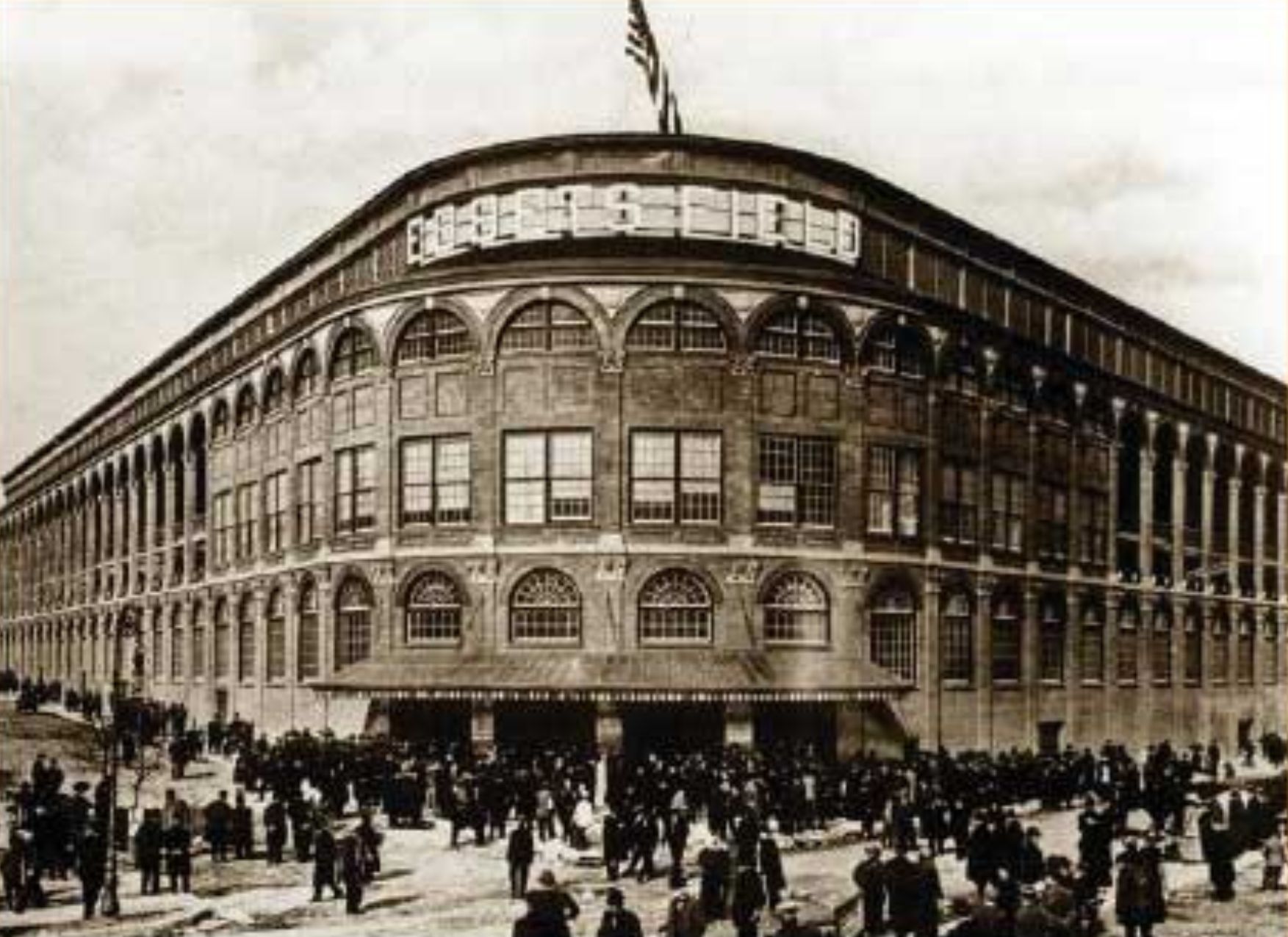
Jackie Robinson joined the Dodgers in 1947, played at the old Ebbets Field, and retired to see his team, Branch Rickie’s team, move with O’Malley to Los Angeles. The Yankees remained, to dominate. And in 2024 the two historic New York rivals faced each other, for the 12th time, in baseball’s World Series. Mom cranked the volume to jet-engine level, and the crowd’s roaring me pained my ears. Dad began to talk, and I could hear neither him nor the announcer, so I waved for Mom to mute the barrage. The TV remote has grown old, and certain buttons respond only to forceful fat-finger pressing, not that her fingers, or mine, are fat, but the buttons are so small as to defy precision pressure. She gives the mute button a focused, two-handed effort, leaning forward and stretching her sweatered arms toward the television: surely the closer the remote is to the appliance, the better the remote will work. “That pitch was a ball. It was low, and outside. And he swung at it, and he missed.” I nodded dully at this intelligence, already two batters old, and waved for Mom to reengage the decibels. The mute button shows signs of extreme wear, and, again, she strained to shorten the distance those struggling radio waves had to travel. It seemed to work. Dad soon began to comment again, this time on a base hit, adding his indecipherable garbling to the crowd’s screaming, and on an unexpressed pretext I exited to the kitchen, perhaps for ice cream. At the commercial break, when Mom mercifully mutes the aural chaos, I announce how tired I felt, and that I thought I would go to bed. It was the top of the ninth inning, in game 5, with the score 6-5. I still don’t know who won the game, or the series. Evenings are a bit quiet now. A bit.
(Photo from Wikipedia, used under the Fair Use Doctrine.)
Courage at Twilight: You Don’t Answer
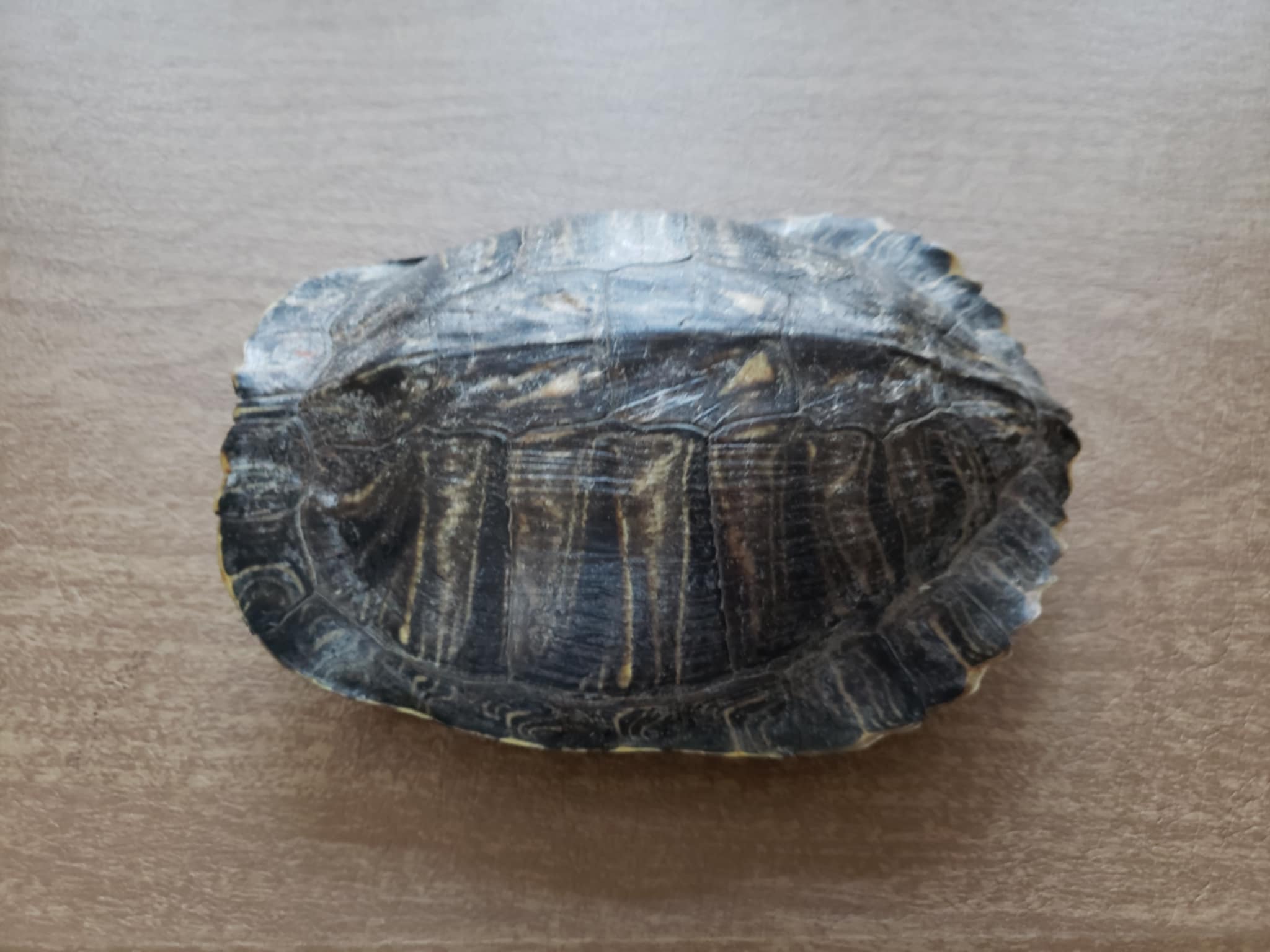
Mom came home with a dead turtle. A cleaned and varnished carapace. Barbara had taken her for an outing to the Native American Trading Post on Redwood Road, a favorite haunt. I myself have enjoyed browsing there, bringing back southwest-themed pottery, woven wool blankets, and the heavy sense of vast peoples’ loss and pain. On this particular day, Mom struggled to choose an object of interest, bringing home the turtle shell. She placed it on the dining room table. Sarah’s headstone has been ordered, the spot marked by a temporary plaque, and I am still pissed (as in the American angry, not the British drunk). The stone will be a burgundy marble. Pissed, and attempting to carry a heavy unwieldly sense of loss and pain. Guilt compelled me to invite Mom and Dad on a walk, not having done so since Dad collapsed a month ago and lost all ability to walk. I aided him in his struggle to stand enough to transfer his weight to his walker and then to the seat of his power wheelchair, taking nary a step, his entire mortal energies consumed, burned up, in a hunching stationary pivot. I threw a towel under his bare bottom and tucked a blanket under every inch of buttocks and legs to shield his nakedness from the wider world. Now I can boast that my dad took a walk in the nude around the block. Back at home, he received the driver license division supervisor with his usual cheer. A DLD letter had arrived advising Dad to appear in person to renew his driver license. I called the DLD office and explained that Dad did not need to renew his driver license, and could not have come to the office even had he needed a driver license, but that nonetheless he would appreciate an official Utah ID card, and what could they do to help. The supervisor and a clerk came to the house with their computers and cameras and cords and got the job done. “Don’t tell anyone,” they enjoined. “People will take advantage—everyone will want us to come to their house just because they don’t feel like coming in.” We assured them their secret was safe with us. That evening, Mom sat by Dad’s hospital bed where he lay, undressed for the hassle of clothing twisting around his torso and obstructing the urinal and generally keeping him uncomfortable and frustrated and awake. Sleeping naked is simply easier. They held hands in the glow of Hyrum’s homemade wooden night light as Dad began his long gravelly prayer. “Dear Father,” he began as usual. Then my faith-filled mystic of a father surprised me. I have heard him tell dozens of stories of having heard and felt and seen the voice of his Lord instructing him on whom to bless and how. Now, he plied his God: “Father, it is strange: You tell us to pray. And You promise to answer. But You don’t answer.” He went on a long while, praying anyway for the family’s needs, but I did not stay to listen—what was the point? This is the day of Dad’s endurance. Enduring a collapsing body. Enduring a dementing mind. Enduring the aloofness of his Invisible Divine. My own faith urges upon me a mythology of God’s ever-active love and nurturing, a faith that They undergird and protect and teach and strengthen in all moments of endless time, all moments, though Their reality is inscrutable and undiscernible and vague. Ultimately, I choose to believe They exist and care—infinitely—because the alternative is insuperably sad. And I do not want to be always pissed off. The dead turtle watches over us stolidly from the dining room table.
(Pictured: Hyrum’s little wooden lamp named Joia (gem or jewel, in Portuguese), which Dad uses for a night light in his downstairs hospital bed office/bedroom.)
Courage at Twilight: Night Lights and Shadows
“Help him pull up his pants,” Mom instructed. I responded that I would help Dad if Dad needed help, but I wasn’t going to stand there waiting for him to need me, standing and waiting for something bad to happen. “I can’t just stand there waiting to see if he needs me, hovering, waiting, waiting, worrying for the next hard thing to happen. I can’t do it anymore. I can’t.” Twenty minutes later, Dad finally needed help pulling up his pants, and I was there to help. But I hadn’t hovered and waited and worried and worn myself out over it. I have to say, I don’t care, which, of course, means I care a great deal, but am weary of the worry of caring. After three accidents the next day, Dad admitted to me that he might have to start wearing a brief. The only way he will wear a brief is if the brief idea is his idea. I don’t bother suggesting. “Whatever you think you need, Dad.” So tired, I’m often in bed by 10 p.m., and often wake up at 11 or 12 feeling hungry, or I awaken for no apparent reason. To get past the master bedroom, I must traverse the light field cast by the outlet night light, sending daddy-long-legs shadows into their room, and as Dad lies in bed rehearsing to Mom the family’s challenges and blessing, he never fails to detect my quick passage, calling out without fail, “There goes Roger down the stairs to get a snack,” and I roll my eyes in the dark. Some nights I stand at light’s edge, wondering if the snack is worth being discovered and commented on, again. This morning, Dad rose from bed and strained to stand at his walker, at 8:30, and he immediately collapsed to the floor, too weak to move. Mom was in the shower. When she discovered him lying on the floor, she put a blanket over him and waited for an hour for the CNA to arrive. She phoned no one, not even me—she said Dad would not let her call. Instead, she sat in her chair watching her husband immobile and paralyzed on the bedroom floor. At 11 a neighbor texted me, “Hi, my wife mentioned that she saw some activity at your house this morning.” Some activity? What the hell did “some activity” mean? “Some activity” meant an ambulance and a fire truck pulled up to the house with flashing lights. The paramedics and firefighters—it took five of them—managed to hoist Dad off the floor. Dad will sleep is his recliner tonight. He is too weak to get himself to the chair lift. I have set him up with large absorptive pads underneath him and on the floor, with a urinal, with a portable toilet that he likely is too weak to reach, with blankets, with his feet raised and his body laid back, and with the very real question in his mind of how he will get through the night. Well, I can’t piss for him, or stand up for him, or walk for him. I can just give him what he needs, or try to, and respond to whatever happens.
Courage at Twilight: Garden Dreams
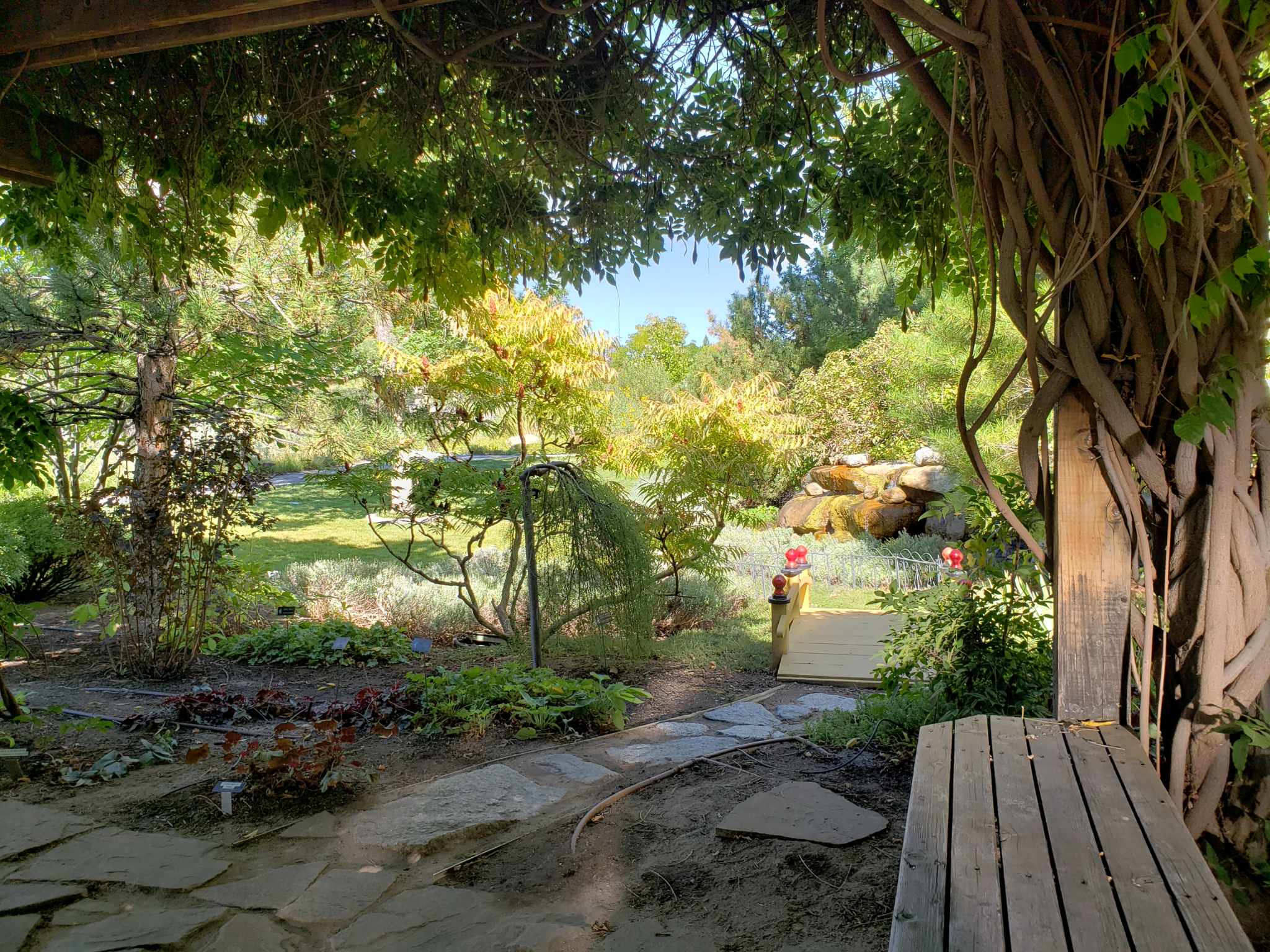
The Facebook event, I found out, showed the wrong address and the wrong map for the tree planting activity. I searched for over an hour, growing furiously upset to an extent unusual even for me and out of proportion to the circumstance. All my focused mental strength brought me slowly to self-talk and deep breathing and prayer, and the dissipation of rage, and acceptance of the disappointment and failure. Driving home from being lost, I saw a sign for Sego Lily Gardens, and pulled in. Decorative rock covered an enormous round buried drinking water reservoir, and the waste strips and corners had been turned by the city into pleasantly meandering paths within groves of pines, and grassy gardens with blooming flowers, and creeping groundcovers. A downy woodpecker did not mind me standing only three feet beneath his piney perch as he pecked. This sudden immersion into quiet living beauty counterbalanced my earlier distress, and I felt almost grateful at having gotten lost. In these gardens, my dreams reawakened, of a pollinator garden buzzing with bees and graced by lilting butterflies, birds singing overhead, flagstone paths winding among tangled native flowers, a bench here and there. I love the beauty of Dad’s and Mom’s manicured yards and turf lawn, and I work hard to keep them immaculate. But I yearn for more natural surroundings, unmanicured and authentic, not forced into shape, but emerging from evolution’s own DNA, with some gentle shaping of garden form from me. A week later I brought Mom to the garden, and pushed her in her wheelchair around the garden paths, twice. We soaked in this suburban jewel, unknown to us before, touched by it now, feeling for the moment blessed and graced and whole.
Courage at Twilight: Noises in the Night
Bowing to the carpet—to investigate the yellow streak. I have come to hate the stench of urine. I don’t judge or malign the fact of urine—I hold no personal grudge. Urine is universal. But I loathe the smell. And entering the house today, acrid yellow vapors rushed up my nose. I hurried to mitigate the offensive odor by filling the carpet shampooer with soap and hot water and getting to work. The shampooer stands ready in its convenient corner for tomorrow’s use, for I will need it tomorrow, and the next day, etc. Noises, too, are triggering panicky heart beats and sweats. The squeals of school children running to the bus stop seem the screams of my mother in distress. The “thunk” of Mom’s magnetic shower door becomes the thud of my father falling. This morning’s Tchaikovsky bass drum booming might be, I wondered weirdly, Mom’s grief reaction to finding Dad dead in his recliner. Getting Dad situated in his new hospital bed, I felt zero confidence he could navigate the urinal in the night. I keep my bedroom door open at night now, listening for sounds I hope not to hear, lying awake in the quiet.
Courage at Twilight: A Heel and A Moron
Mom startled me with a sharp rap-rap on the door of my home office, where I sat focused on my laptop screen, lost in classic rock. She cried and squeaked out her Sunday afternoon plea for me to push her for a walk around the block. I detest being started, and reacted involuntarily harshly. “I don’t think it will rain,” she hoped. Thunderclouds thickened and lighting sheeted over the neighborhood—and the rain began to fall. With each passing car, I thought, They must think I’m such a moron for taking my parents in their wheelchairs in the rain. But we actually loved the gentle shower. Mom tilted her head back and spread her arms wide to the sky. All three of us wondered if I would be struck by lightning. In the moment, I didn’t care. Returning home, I saw that the porch lights were on, three hours before sundown. With such irritation, I have been snapping the porch lights off, for months. Why does she turn the lights on so early every day, I finally asked her. “I turn them on for you, to welcome you home from work.” Finally I saw the early-afternoon porch lights for what they were: a mother’s welcome home to her little boy who has been away all day. I such a heel, I thought. A moron and a heel. Before situating Dad back into his recliner, I studied the multicompartmentalized cushion he sits on, designed to avoid pressure sores. The cushion had flattened over the months. Mom watched me intently as I tried and failed to use the tire pump, the bike pump, and the ball pump, struggling to inflate the cushion. The stem closed with clockwise turn, but by the time I quickly closed the stem, the cushion had lost all my hard-blown air. I sat on a stool with the stem between my teeth, still blowing, and spinning the cushion around to close the stem. “Thanks for doing that, Roger. I have a pressure sore on my butt, and a full cushion should help.”
Courage at Twilight: Family Reunion
Dad’s brothers and sister decided to host a family reunion, the first in perhaps 20 years. I barely had energy to show up for the event. But I love my Baker-Formisano aunts and uncles: Bill, Louise (deceased), Howard, and Helene. I warmed to the occasion, happy to see my cousins and their families after so many years. One cousin I once knew well approached me and hesitated, “Now…you’re….” In fairness to him, I had a full head of hair the last time he saw me. When it came Dad’s turn to speak to the assembled hundred family members, I winced at the incoherent story-ramble that might emerge. Perhaps that was unfair of me, because he delivered a string of delightful stories about his direct ancestors, starting with Niels Bertelsen. Niels was a Danish fisherman who converted to our Church in the 1850s, a scant two decades after its founding in Palmyra, New York. The Bertelsens had no money to emigrate as a family, so Niels and ___ sent their children across the Atlantic Ocean, across the North American continent, one child at a time, without chaperone, as they could afford. Nicolena, only 10 years old, crossed the ocean without family, and worked as a maid in New York City for two years, without a family, until she had enough money to join a company of Church members walking the thousand miles west to Utah Territory. Needing to support herself in Richfield, a married Lena opened a store selling beautiful dresses she sewed. Her son Nelson became the engineer and foreman of the Prince silver mine in Pioche, Nevada. Nelson’s mining machinery manufactured steam, and he invented a clothes-washing system attached to the machinery, washing all the family’s laundry. His wife Natalia Brighamina, from Sweden, baked bread weekly, and fried sugar doughnuts from the extra dough for the mining town’s children. Natalia was Dad’s grandmother, and he knew her and loved her. She played a pump organ and sang the old cowboy songs with the family. Her doughnuts, her organ, and her lovingkindness made her popular and well-liked by the community. As a small child, Dad whispered to her one day that he was hungry and would like a slice of bread with jam. “Speak up, Sonny,” his father mocked, embarrassing the boy. “We can’t hear you, and we all want know what you have to say.” Natalia stood up her full 5-foot 2-inches and said sternly to her son, “I heard him perfectly well,” and led little Dad into the kitchen for his bread and jam.
Courage at Twilight: Block Party Four
Darrel and Mary Ann brought the half-page flier to the house, inviting us to “please come” to their annual block party. This would be my fourth since moving here. Why not roll the wheelchairs over? I thought. I could push Mom’s, and Dad could roll his own. Dad almost agreed to go, but an urgent and unpredictable bladder discouraged him and convinced him to stay home. But Mom rolled eagerly in front of me to the back-yard dinner party. I know her tastes, and served her a hot dog with ketchup, dobs of rotini salad and coleslaw, a triangle of watermelon, and a chocolate chip cookie. She gabbed happily with the neighbors, old and new, each so friendly. “Where does the name of Hughes come from,” she asked one neighbor, then launched into a discussion of her own ancestry. Still in my shirt sleeves and tie from work, the new neighbor asked me if I were just coming from work, or my formal business attire was “just how you roll.” I felt accepted either way. An evening breeze tempered the September heat as the sun set again over the Great Salt Lake, mirrored in the water, early enough to feel like fall. This is nice. I thought. I made Dad’s plate and set it in a mixing bowl: burger patty with melted Havarti, a fried egg, bacon slices, a tomato slice, and the house mayonnaise-ketchup-mustard sauce, with dog in mustard on the side. Mom carried the bowl on her lap as she rolled happily home. “Is that for me?” Dad enthused, accepting the mixing bowl and launching into the burger. The homemade chocolate chip cookies were to die for, and I brought home three for myself.
Courage at Twilight: Blocking Pucks
After dinner, I showed Dad the conference program from Utah League of Cities and Towns convention, an annual gathering of elected municipal mayors and city councils and their appointed senior staffs (e.g., me). I told him how much I enjoyed the keynote presenter, the goalkeeper from the 1980 U.S. Olympic gold-medal ice hockey team, which defeated the Soviet team for the first time ever—the “miracle” team—and who translated the principles of his athletic success to management. On the rink, he had blocked 63 puck shots with his body armor and stick, allowing only two goals. Dad perused the program and asked, “Did any of these classes have to do with your job?” What I heard him say was, You didn’t belong there. It was a feel-good waste. You should have been in your office working, not out hob-knobbing at some irrelevant conference. Perhaps that was not fair of me to mind read in this manner. But I have worked as the Tooele City Attorney for more than 30 years. I know my job. And I don’t need his approbation to go to this or that class or conference. I decided to answer his paternalistic question with my own humiliating fealty: “Of course, they have to do with my job, or I would not have gone to them” and by identifying the law-related sessions (which was all of them) and reminding him of the importance of making myself a valued member of a municipal team which includes six elected officials, all of whom rely on me, all of whom expect me to be the smartest person in the room, and all of whom can fire me. I felt annoyed with myself at having answered him at all, when what I really wanted to do was say Whatever.
Courage at Twilight: In the Mirror
Puzzling over the contents of the deep freeze, fridge, and pantry, I announced to Mom and Dad, “I think I’ll bake your favorite crispy butterfly shrimp tonight. Okay?” Mom nodded her smile. “Yes!” Dad exclaimed. “With rice!” I had thought to steam cabbage and slice cucumbers, I told him, and he called back, “Whatever.” What does “whatever” even mean? His “whatever” sounded to me like a passive-aggressive wishing for rice, which I would feel guilty for not cooking, and would, of course, now cook. But what did I care what “whatever” meant? I cooked his rice and steamed cabbage and soaked cucumber slices in salted vinegar. Dad met his plate with his standard sincerity, “What a beautiful-looking dinner, Roger!” When I arrived home from work at 7:00 p.m. that evening, he held a personal mirror in one hand and a tiny scissor in the other. As I cooked his rice, I heard him inform Mom, “I can’t see any more nose hairs in the mirror,” indicating he thought he was done. “Well, they’re there!” Mom called back gruffly, indicating she thought he was not. He guessed he would have to look again, he confessed meekly. I did not want to know about his nose hairs. Whatever.
Courage at Twilight: I Don’t Need You
Difficult conversations targeting personal inadequacies and vulnerabilities seem to lodge choking in my throat for days, or weeks, or years, and sometimes forever. But my distress pushed me into a chair to try. I began by telling Mom and Dad how my physical health has been in decline, with the nurses recording my blood pressure—four times—at 200/100, thinking, surely, there must be a mistake with the cuff. Google announced I was at risk of death, and ordered me to proceed immediately to the emergency room. And then there is the exhaustion, feeling too tired to sit upright in a chair, and curling up on the concrete floor of my office every day, behind my closed door, waking always to the timer I set for 20 minutes. Next, I recounted my worsening mental health, the depression, the mental fatigue, the hopelessness, feeling trapped and stuck, feeling the pressure every day of Mom’s and Dad’s conditions, of their very lives and deaths, waiting every moment for the next fall, cleaning up the messes in the kitchen and bathrooms, shampooing the carpets, the rusty weight of 100 things needing doing daily for their comfort and safety. The third anniversary of my moving in with my parents, on August 1, has just passed. The journey has been long and traumatic and exhausting, and I have felt desperate for a change. But I am caught in this in-between world, living for them instead of progressing in my own life. That change may be moving them to an assisted living facility and me finding a place to live, creating time and space to pursue my own dreams, to get married, to retire, to travel, to visit my children and cuddle their children. For this particular difficult conversation, it seems, I chose the wrong approach. They would hear nothing of it. “You do nothing for me,” Dad declared. I am doing just fine by myself. The CNAs come every morning to bathe me and dress me and feed me and settle me for the day in my recliner. Your mother applies the creams and powders at night for infection and fungus and pain. I brush my teeth and use the bathroom by myself. True. All true. “I don’t need you to do anything for me,” he said with iron will, becoming again the heavyweight fighter, the champion, pummeling every challenger. Feebly, I jabbed back with a dozen or two tasks I do for him regularly, and he left-hooked and upper-cut each one. Unfairly, perhaps, and desperately, I quoted Sarah, who told me before she died that Dad would have been in a nursing home two years ago if not for me. “Sarah was wrong!” he denounced. “I do not need to be in a nursing home, and I’m not going!” And in a rib-cracker he told me I had manufactured all these pressures in my own mind, that they were fake. “If you think you would be happier on your own, then move out.” But you will find yourself more alone than ever, he said. The only reason you’re alone here is that you retreat to your room. You could socialize with us if you wanted, but you don’t want to socialize with us. You run off to be alone in your room.
Courage at Twilight: Giving a Tug
“I want to go by the bushes and trees,” Dad insisted at the end of a wheelchair walk around the block. “Put on your list, for whenever you get around to it , to trim the junipers back from the sidewalk.” I was reluctant to do so, I said, worried I would cut off all the green and leave only the bare ugly inside sticks. “Do it anyway,” he said imperiously, admitting no discussion. And I bit out a stiff, “Yes, Sir.” Mom invited her doctor (and neighbor) over to see her needlepoints that adorn every wall. He politely wandered the house, exclaiming, “Oh my gosh!” at each frame, and she beamed. Quinn quizzed Dad from a paralegal coursebook. As 9:30 p.m. came, and Quinn asked Dad if he wanted to discuss another legal scenario, I bristled at the late hour and Dad’s flagging energy, but Dad answered “Absolutely!” and they kept at it, Dad’s legal mind as sharp as ever. I fled the house for a Saturday hike, a long hike, the longer away the better, and before the midpoint my phone dew-dropped with Mom’s text: Will you be home soon? I need you to take me on an errand. I responded, No, I will not be home soon. No, I will not be home, ever, I wanted to type. As I nursed my bottle of Gatorade after the hard hike, Dad randomly asked if I knew a particular song, and began croaking out “Sunny Side of the Street.” One of my favorite Frank Sinatra covers. Mom soon added her higher-pitched screech, and the melody flattened into a gravelly two-tone monotone. After the song, Dad struggled and shook to stand tall enough to push his walker toward the bathroom, dribbling along the way, muttering desperately, “Oh, God. Help me, Abba!” and cursing his routine “Damn!” as he worked to coordinate the walker, the door, the handrails, his pivot to sit down, and pushing down his sweat pants. “Rog, give my pants a tug,” he called on his journey back to his recliner. “I couldn’t pull them up by myself.” Yes, Sir. Oh, God. Help me, Abba.
Courage at Twilight: A Sort of Ending
At almost 89 years, Dad just keeps waking up every morning, day after day after day. His t-shirt garment tops are too tight around the neck and try to strangle him in his sleep, so he sleeps without a top now, or a bottom. Life is simpler that way. Mom pulls the shower door closed regularly at 8:00 AM with a bang which I have learned is not a body falling to the floor. This morning, I needed to escape the comfortable incarceration of home to seek beauty on nature’s trails. That seems to be my life’s aspirational pursuit: finding beauty. The twisted canyon where two glaciers once ground away at each other seemed unusually lush. On their steep meadows, cut gently by a meandering snowmelt stream, the wildflowers grew in excess of three feet tall, all of them: yellow-flowered strawberry, white columbine, lavender lupine, sticky geranium, both the pink and the white, firecracker penstemon, powdery blue bells, the unfortunately named beard tongue, larkspur, paintbrush, sweet pea, catnip, purple and yellow daisies, and blue flax. On this day’s journey to Desolation Lake, I climbed one slow step after another, steady. One just keeps going, on and on, up and up. Pretty middle-aged faces passed me, in both directions, and I said Hello to each, and each became the last in a long, knotted thread of lost opportunities to connect with another human being, for my lack of skill and courage. At the lake, feeling very tired, I stopped and sat on a log, for there is nothing wrong with stopping to rest on one’s journey. A small flock of hairy woodpeckers, almost a foot long each, graced me by landing in the ponderosa pines and quaking aspens, very near to me—one of them looked over at me, I am sure—and hammered at the trunks in rapid staccato. I wondered if the dasher’s one-hundredth-of-a-second stopwatch would still tick too slowly to measure the motions of these birds. They flew off, and I moved on to the mountain’s descent, not without growing pain from a swelling Achilles tendon. Never without pain on these trails, never without loss, and grief, all wrapped up in tenderness and love and the beauty of wildflowers and butterfly wings and birdsong and the burbling of water over rocks. Mr. Rogers and Kermit the Frog both have taught me that every ending is a new beginning, that every good-bye points to the next reunion. Forever. When does a story find its end? How does a writer know when to put down the pen? When, perhaps, it is springtime in the Rockies, and the swallowtails fly very close and bob their hello, and the stands of bluebells and columbines waive their petals against the canvas, and a bird I have not met sends her voice to echo through the trees with the loose embouchure air of a reedy flute.
Courage at Twilight: Holes
Prone in the dentist chair, Dad held up four fingers: “The last time I was here,” he misremembered, “the dentist pulled four teeth. Four!” The experience had been traumatic for him, and the pulling of two teeth may have indeed felt like four. Both yanked from the right side of his mouth, one was an old implant connected by a bridge to an artificial tooth, so the number of new holes felt like three. Dad winced as the hygienist cleaned the empty gums where a year ago had been teeth. “Is that sensitive?” she asked with unrhetorical kindness. “Uh-huh,” he managed. She explained that the empty pockets where the teeth had been can capture bits of food, and encouraged him to focus his water pick in those areas. The cleaning completed, and waiting for the cursory dentist check, Dad remembered how he had approached his mother repeatedly about the unbearable pain in his mouth, and how she finally took him to a dentist, and how his molars were full of decay, and how the dental solution of the mid-1950s was simply to pull the 14-year-old’s teeth: four of them. “I really felt violated,” he said sadly, looking far off into memory, a tinge of feal resentment still lingering these 75 years later. “Four teeth,” he lamented. Fourteen years after, “Doc” Nicholas constructed and implanted the bridge that would span the next 60 years until infection abscessed into the anchoring bone. My own mouth contains Doc’s excellent work from when I was 14 with decaying molars. Back at home, I invited Dad to coach me from his power wheelchair as I used his DeWalt trimmer to shape his three dozen bushes. “Do you want them flat-topped or rounded?” I asked, knowing already he would say “Rounded.” I paused frequently with the questions, Is this okay? and How’s that? A smile and a “perfect” were his consistent answers. The bushes had merged with spring growth, and I carefully reasserted the separations needed for the individual bushes to manifest, not unlike a row of clean but crooked teeth. Perfect. We both sat exhausted in the family room after our exertions. I commented again how glad I was he enjoyed the framed photo of Sarah surrounded by her nieces and nephews. “Yes,” he said, slipping into sadness. “I still feel some painful hole inside me that won’t be filled.” I feel that hole, too, Dad. He wrote to one grandson this week, “I still cannot cope with Sarah’s death, that she is gone. When I think about it, I feel overwhelmed with some dread feeling. I do not know what to call it, but ‘sadness’ is not enough.” He went on to write that he is by nature a happy man, blessed in many ways, and expressed his determined belief that we create our own happiness when we follow the principles of happiness, the greatest being love.
Courage at Twilight: Postcards
Steve wrote to Mom on a Banff postcard that they saw lakes and waterfalls and mountains, and elk, and a porcupine, and two bears. “A porcupine!” Dad laughed. “If you use its real name porcupine nobody knows you’re talking about a porcupine!” Mom and I looked askance at one another. “Um, Dad, could you clarify about porcupines?” I ventured. “You know,” he explained, “everybody knows what a porky-pine is, but nobody knows what a poor-KYOO-pine is.” I felt marginally better that his joke’s punchline made some sense. “Is today a holiday?” Dad asked, and I told him it was Juneteenth. “Explain to me the significance of Juneteenth,” he inquired sincerely, and I explained that Union armies had arrived in Texas on June 19, 1865, to find that the Black American slaves of Texas did not know that they had been emancipated, two-and-a-half years earlier, on January 1, 1863. They were the last African-American slaves to join the ranks of the newly free. This newest federal and Utah state holiday celebrates the end of slavery, Black manumission, and the continued struggle for racial and class equality in America. “I’m glad we have that holiday,” he said soberly. An hour later Dad asked me, “Is today a holiday?” and I sighed, discouraged. I also felt discouraged by the reality of taking Mom and Dad to the dentist on the holiday afternoon. I kicked irascibly against the brick wall of my duties. Interrogating myself about my anger, I realized I was not being petty or selfish; instead, I was afraid: afraid of the grueling car and wheelchair routines, afraid of repeating our near falls from the wedding day outing, afraid of so much of what is living life with ancient disabled parents. I have been sharing with Dad my impressions of Frederick Douglass, John Lewis, Martin Luther King, Jr., and Harriet Tubman, from their biographies. “So much has changed for Blacks, for the better,” Dad offered as I drove across the Salt Lake valley. “Much has changed,” I agreed, but expressed my discouragement about my country’s regressions on voting rights. One hundred years after the first Juneteenth, almost to the month, President Lyndon Baines Johnson maneuvered the Voting Rights Act of 1965 through Congress, riding the spiritual momentum of President John F. Kennedy’s assassination, the unconscionable police brutality at the foot of Selma’s Edmund Pettus Bridge, and the shocking television images of Bull Connor’s squads turning fire hoses and furious dogs upon more than one thousand of Montgomery’s Black school children. Since its passage, politicians have fought against the Act’s protections, passing many hundreds of laws to restrict the Black vote. And after 50 years of leveling the voting field, the Act’s key provisions were ruled unconstitutional by the Roberts Court, overturning decades of Supreme Court precedent and Congressional support. “That is discouraging,” Dad agreed. We returned home by way of JCW’s for celebratory burgers, Mom and Dad so glad to have their teeth thoroughly cleaned, relieved to have no new cavities or infections, and thrilled to have Mom’s escaped crown glued back on.
Pictured above: the cover of the late Congressman John Lewis’ award-winning graphic novel March, Book 1. The book (and its sequels) reawakened interest in the Civil Rights Movement among 21st-Century Black youth.
Courage at Twilight: Living Through Me
Some people need to talk—a lot. Some people prefer to listen. A match of these two is fortunate. I have already described how Dad talks and tells his stories and expounds upon religion and history and morality and family and the contents of the encyclopedia, and how I am more of a listener who at 60 is weary of listening. Gloria, however is another talker. She cares for Dad several mornings a month, and the conversations begins rapid fire the moment she calls “Good morning!” from the top stair. When Gloria talks, Dad listens. When Dad talks, Gloria listens. Yet, somehow, they both seem to talk continuously. Today I caught snippets about Gloria’s sick cat and how the dry cat food and wet cat food each affect the cat’s weight and health and energy and general demeanor, and how the cat is slowly getting better with good cat food and care. Dad took his turn about the cosmic character of the universe with its gravity and dark matter and fusion and electromagnetic energy and relativity physics vis a vis quantum physics. Both are vaguely sympathetic to what the other is saying, but mostly they each appreciate being able to talk and being listened to. Did you know that a mere 20 years ago, the consensus among cosmologists and xenobiologists was the impossibility of intelligent life anywhere in the universe but on our Goldilocks Zone earth, but that today, with the James Webb telescope’s discoveries, the consensus has shifted to the statistical impossibility that intelligent life does not thrive among the trillions of habitable planets orbiting in the trillions of solar systems orbiting in the trillions of galaxies or our vast universe. Her cat prefers the wet food. We will never know because even light takes one hundred thousand light years to travel to us. The vet’s treatments are helping. Time for your shower, Nelson. I returned from my ten-mile Jordan River paddle long after Gloria had gone for the day. The olive-brown water ran at a 15-year high and swept us pleasantly downriver. The toughest stretch of the paddle was the half-mile portage through head-high thistles with mean mean thorns and willowy willows and sage brush, so aromatic, daisy-chain carrying our kayaks single-file to where we could cross the private hydroelectric dam that also splits the river into two enormous irrigation canals, the river itself suddenly shrinking by two-thirds. Weary and blistered and scratched upon arrival home, Dad called out with his usual cheer: “Roger! Welcome home!” followed by “Sit down and tell us all about it. The people. The river. The wildlife.” And so I told them about the thistles and dams and slow high olive-brown water, and the people, and the birds: the Clark’s grebes, cormorants, pelicans, belted kingfishers, Bullock’s orioles, avocets, ibis, phalaropes, terns, stilts, Canada geese, mallard ducks. I did not tell them how I was so eager in the twilight to show my friend Stephen a beaver and saw one in the shadows and called to Stephen “There! Beaver!” only to have the beaver sprout wings and take flight. “I think that’s a duck,” he dead panned, “or maybe a duck-beaver.”
Courage at Twilight: Fiercely Red

Mom stood. Up from her recliner. During a commercial break. “Are you going to the bathroom?” Dad asked with a touch of accusing panic, for the urge had struck, and he gets so little notice, and every second counts on the 12-foot journey. “Yes,” she spat. “Don’t worry, Dad,” I assured him, “she’ll be out by the time you’re up.” Dad sat, stymied. Sunk in his recliner. During the commercial break. He still had not stood when Mom came wandering into the kitchen, her business done, to check on my cooking. The Jeopardy buzzers buzzed. “Are you finished, Lucille?” Dad barked after the commercial break. “Yes,” she called. “Why didn’t you tell me?” he lobbed, struggling and shaking to stand and stoop over the walker, his time perilously past. “I’M FINISHED!” she hissed. “Didn’t you hear the flush?” A streak of white flashed in my periphery and something bounced hard against the kitchen window, two feet from me. I knew, of course, what it was, sort of, a bird, but my heart pounded anyway. We hustled outside to find the bird sitting in the dirt, a gray falcon or hawk of some kind, sitting awkwardly, wings askew, head rocked back on its neck. Its red eyes glared fiercely at us, and it panted rapidly with parted beak. Well, that’s the end of this bird. Its neck is broke. Such a startling beautiful creature. I was powerless to make a difference for the hawk, and let it be, returning sadly to my cooking. The children and grandchildren remained, marveling and sad. Then Lila screamed, and Brian poked his head through the door to tell me the bird had stood up and pushed off in flight. Well, I’m sure glad to be wrong. Audubon informed me the bird was a Northern Goshawk. The kitchen window had vinyl grids that I thought would have averted the bird. But from its vantage point outside, I could see the window was filled with a glare reflecting the mountains and trees and sky behind. And the goshawk had been flying like a line-drive baseball after a sparrow. Days and weeks later, the goshawk’s scarlet boring ferocity still flashed in memory. The bird had dared me to underestimate her, and had defied the neck-breaking brick and glass of humanity, and had flown off above the house and trees and everything into its freedom sky. The red-headed house finch was not so fortunate. She landed on the arborvitae, on the bird netting wrapped around, and became irretrievably enmeshed, dying before I knew, before I could scoop her out and set her free.
(Photo from Flickr.com and used pursuant to the fair use doctrine.)
Courage at Twilight: Many Firsts
March 31: the first Easter since Sarah died. May 12: the first Mother’s Day since Sarah died. May 27: the first Memorial Day since Sarah died, and a visit to clean and decorate the grave. June 5: a first birthday with no air-gasping hug from my sister. The firsts will continue to come: Tracy’s birthday, sons’ and daughters’ and grandchildren’s birthdays, Independence Day bar-b-q, Thanksgiving dinner, Dad’s 89th birthday, Christmas with its matching pajamas and Lego sets, banging on dented New Year pans with dented ladles, Sarah’s 52nd And January 17: the first anniversary of her death. I have felt dissatisfied with how the cemetery workers filled her grave, leaving large low spots and rocky grassless patches. Tracy and Gabe (5) met me graveside, where we filled the low spots with new soil and sprinkled fescue and rye grass seed, and decorated the grave with American flags and plastic flowers, and a border garland of red, white, and blue stars. Gabe hefted the watering can and moistened the new grass and soil, refilling from the five-gallon bucket I held. After finishing our work, we sat on a blanket, at first saying nothing, then describing matter-of-factly how Sarah was buried nine feet down, and how someday Tracy would be buried above her, and how when it was his turn to go, Gabe would be buried in the adjacent grave, possibly with me nine feet deep and him above me, since I am 55 years older than he. The conversation felt natural and comfortable, like assigning seats at the Sunday dinner table, or dividing up the new batch of steaming chocolate-chip cookies amongst the children. I had assumed Mom would want to come to the grave with me, as she had done before, but she flatly declared, I’m not going. I offered to take Dad, despite the difficulties of transporting him, and he echoed sadly, I’m not going. He has not seen Sarah’s grave yet, and may never, and I respect his feelings of preferring to see the framed print of his living smiling daughter. No matter: when I returned, spent, I cast the photos to their old TV, and they were glad. “That was a good thing you did, Rog,” said Dad. And I thought I guessed it was.
Courage at Twilight: Give Me a Chance
I stumbled through the front door, laden with the burdens of duffel bag, briefcase, and laptop, of weariness from a four-hour Sunday afternoon drive, and of a failed effort at emotional connection. “He doesn’t look very happy to be home,” Mom observed to Quinn in a whisper the whole household could hear. “Give me a chance!” I growled, shutting the front door behind me and dropping my bags. I resigned myself to giving the report they would invite before I could pee or unpack or take a deep steeling breath against the resumption of my duties. Heidi had taught me to play pickleball, I reported, and we beat the opposing couple 14-12, slapping our paddles in smiling congratulations. Are you sure you’ve never played before? the group had asked me. Did you know that the four girls in the women’s restroom under the crushing concrete rubble of the Klan bomb at the 16th Street Baptist Church in Birmingham, Alabama on September 15, 1963, were named Denise, Addie, Cynthia, and Carole, I reported, and that the little sister Sarah missed the rubble by inches but lost an eye from shattered glass and later wore a blue glass eye because the standard colors did not include African brown and because her family could not afford a custom glass eye, I reported, and how Martin Luther King, Jr. praised the girls as “unoffending, innocent, and beautiful” victims of hatred and as “martyred heroines of a holy crusade for freedom and human dignity”? His eulogy moved me to goose bumps. And I reported that Henry (27 months) and I had sat on the wooden foot bridge and dropped dandelion flowers onto the rippling creek and watched them float away, little petalled suns bobbing and twirling so brightly on the dull water, floating toward other lands, other rivers, other stories, other happy endings or endings not quite so happy, like the flower-stars sucked into circling eddies, though most finally floated onward to grace downstream. And I threw together something called “dinner” at the late hour of eight on a Sunday afternoon.
(Photo above used with respect under the Fair Use Doctrine.)
Courage at Twilight: Do I?
“Close these blinds, will you?” Mom asked. Her habit has always been to stand, lean over her recliner, and push the slats closed with an old wooden yardstick. But now she waits for me to stand up from the couch or to enter the room, and asks me to do little things she no longer feels like doing. “Bring your Dad’s medicine, will you?” “Put your Dad’s checkbook in his office, will you?” My opinion is that I should not being doing for her things she is perfectly capable of doing for herself. Do I draw that boundary and risk hurting her feelings? No, I guess not, at least not tonight. Dad takes his turn, too: “Lucille, would you get my checkbook from my office?” I interpret “Lucille” as meaning “Lucille, Roger, anyone?” It is true that Dad obtaining the checkbook (or anything else) for himself is nearly impossible. “Your hair is beautiful,” Mom called to me after I delivered the checkbook to Dad. “That’s not possible, Mom,” I hissed. “I don’t have any hair.” She guffawed, “Yes, you do! And anyway, it’s the shape of your head that’s beautiful. I just love the shape of your head.” She cannot see my eyes rolling inside that beautiful hairless head, or my jaw muscles working in my face, or the energy it takes for me not to growl and bark. More and more I’m her perfect first-begotten bald baby boy in some weird Benjamin Button skit. On the counter lay a bag of moldy bread, which I threw into the kitchen garbage can. Throwing something else away later in the evening, I noticed the moldy loaf but not the plastic bag. Mom had salvaged the bread bag to recycle at Smith’s grocery with the blue newspaper bags and the brown shopping sacs and packing bubble-wrap and various other bits of bag plastic. Another day I discarded several mold farms growing on the forgotten cheese inside quart-size baggies hiding at the bottom of the cheese bin. And again I later found the molding cheese swimming bagless in the garbage can. Do I tell her how insulting it feels to have an old lady following after me and digging in my garbage, implying I should not have thrown this and that away, that I ought to be a more diligent recycler, that I should do things differently? Do I tell her Smith’s grocery does not want our moldy bread and cheese bags, our greasy leftover pizza zip-locks, our frozen vegetable bags? Do I point out how many gallons of heated treated water she uses to wash the bags out with dish detergent, the cost of the water far outweighing the damage of a sandwich baggie in the city dump? Do I tell her how annoying it is having all these wet washed baggies doing their damn best to dry scattered on the kitchen counters? Do I tell her the moldy cheese bag was in the garbage because I wanted it in the garbage, not because I’m lazy or apathetic or belligerent? I guess not. It should be easy for me to swallow that much pride, to let an old lady have her little quirks, for Mom to be cheered at the thought of helping to rescue the planet from plastic. I have drawn the line, however, at the gallon-size baggies that held raw chicken and raw fish and raw beef. “Mom. It’s just not possible to sanitize them,” I insisted. “Smith’s doesn’t want our raw-meat bags. Nobody wants them. And we might kill some innocent store clerk with salmonella-infested bags.” She reluctantly agreed to leave the raw meat bags where they belong, in the trash can, her feelings mostly intact.
Courage at Twilight: I Do
The gurgling in my intestines sounded underwater like wall hangings clanging to the floor and wandering off wounded. Lying sick in the tiny tub, my legs stood straight up against the tiled wall. Only half of my body fits in the tub at one time. My head underwater but for my nose, I relaxed into the soft heat of the Epsom water cradling my face and head, awash in the experiences of yesterday. Dad wanted to attend the wedding, and I agreed: the three of us should go. I have avoided taking Dad anywhere, for the strain on us both, but loading him into the high front seat of the Mighty V8 proved a simple execution of our detailed loading routine. I guess we could do this more often, after all, I mused. Turning the key brought only the click click click of a failed starter. “Not to worry!” I preempted Mom’s panic. “I’ll have us jumped and on the way in five minutes!” And it was so. But I did not tell Mom and Dad how when I jump start a car battery I am terrified of blowing up the cars and killing everyone within a city block. Perhaps with good reason: I read the instructions three times and still connected the cables backwards. A lurking dyslexia? We rejoiced to see my cousin David and his wonderful family at his son McKay’s wedding. The officiator was a tall slender fetching tatted woman in a sleeveless summer dress, her hair a pleasing mess of multi-colored dreads running four feet down her back. The men read their vows, both sweet, and the colorful woman pronounced them “Husband and Husband,” words I had not heard before. I always feel happy and wistful when two people find love and each other in this vast complicated world. It is quite a miracle, really. May their loving union long endure. Leaving the venue, I helped raise Dad from his wheelchair. Weak and shaky after three hours in his chair, he grasped the handholds and struggled to straighten. But his left foot was positioned under the running board, and his right foot too close to the left, and his feet stuck to the asphalt as if with buckets of cured epoxy. He could not lift his legs to shift his feet, and hung grunting from the handholds, his whole body trembling. I could not move his feet either: all my effort was devoted to keeping him from collapsing to the parking lot. Dad surprised me with a move he had never made before: “Help me lift my right leg!” I capitulated, to tired to argue, but his right foot on the running board created an impossible tangle of legs and feet and hanging arms and belly and arthritic artificial knees that wouldn’t bend but were bending anyway to his howls. In a last desperate move with my remaining ounce of energy, I pulled the chair to him with my left hand and yanked him backwards by the waistband with my right. With some luck, backside and seat met squarely. Parched and panting and sick, I pulled David and Jason from the wedding lunch with a plea for help, and with four strong arms and legs they hoisted Dad handily into his seat like he were a feather duster. Relieved to be on our way to the sanctuary of home, I turned the key and heard only a click click click.
Courage at Twilight: Spring Rolls
“Will I see you tomorrow?” Mom asked as I turned toward the stairs and bed. I stared at her, uncomprehending. “You see me—every day—after work,” I finally stammered out, and she could tell from my tone I thought she had done something bad, though she could not fathom what and muttered I’m sorry, and I felt bad that she felt bad that I might be annoyed, and assured her I would see her tomorrow. When I brought vegetable spring rolls home from Costco, she cheered with both arms raised, “Spring Rolls!” and Dad quipped pleasantly, “Spring rolls is her middle name.” Dorothy Lucille Spring Roll Baker, I thought with a chuckle, and then said the name aloud: “Dorothy Lucille Spring Roll Baker. Has a nice ring.” She laughed nervously, not sure if I were making fun, but hoping I wasn’t, and thinking I probably wasn’t, because I never do. After displaying the various prepared meals I had purchased for those days I do not feel like cooking, I stacked the boxes and headed for the basement stairs and fridge. “Don’t fall down the stairs,” Dad called after me, and I stopped in my tracks, uncomprehending. Not wanting to challenge or enjoin or even demure, I called back cheerfully, “Thanks Dad. I won’t fall down the stairs.” My reaction was less humoring when, attending an out-of-town conference, I received an email from Mom, “Hi dear Roger, Your dad wanted me to email you that he is afraid for you to go hiking somewhere where you could fall over the edge of the trail. He wants you to be careful to not go where the trail might be high up and too close to the edge of a cliff where you might fall. He was worried about you and wanted me to tell you that immediately!” I scowled at the computer screen and email after a long walk on a flat paved urban trail, uncomprehending. And I sighed. Like I often do when dinner is almost cooked after an hour in the kitchen: a long loud sigh. Dad’s hearing is deteriorating. I visited Erek the audiologist to have Dad’s hearing aids checked—they were working fine—and he offered kindly to come to the house to clean Dad’s ears and check his hearing. I gawked, astonished and uncomprehending, as Erek slowly pulled a three-inch string of wax from one ear, certain what I was seeing was impossible. No wonder Dad could not hear. The hearing test confirmed that Dad had “severe hearing loss,” no doubt due to his early unprotected years working the house-size ore tumblers at the Utah Copper smelter. Erek offered to purchase a pair of high-quality hearing aids for a reasonable price, through his physician’s group manufacturer discount. “You will hear lightyears better,” Erek promised, and my brain strained at applying a photonic analogy to ears and hearing. I decided “lightyears” simply meant “lots and lots,” and let the teaser go. Though Dad cannot hear me from three feet away, he can hear me sighing from thirty feet away, and without fail calls out to me, in a kindly tone, “How are you doing, Rog?” And he praises the meal as a “once in a lifetime best in the universe dinner.” I will keep shouting until his AGX Omnia 7s arrive, after which Dad should hear my conversational tone. I hope so. “Good-night Mom and Dad,” I yelled. “Knock if you need anything. See you tomorrow.”
(Pictured above, a view of Snow Canyon, Utah, one of my favorite beautiful places in the world.)
Courage at Twilight: What a Reunion
Fifty years. These men and women, all in their 70s now, graying and wrinkling, limping and slowing, still loving and laughing, traveled in their 20s to Brazil, sent by their Church to be proselyting missionaries, to share a gospel message of love and spirit and Christ, of pure living and eternal families and love of God, with the people of 1970s Brazil. Dad began his three-year unpaid tour of duty as their 36-year-old leader, mentor, and president, Mom by his side, their oldest child (me) only eight, with Sarah’s infant arrival imminent. Now these mature men and women gathered at Mom’s and Dad’s house, sixty of them, seated in tight rows and listening, and Dad did not disappoint them. I sat in the back with Megan, with my head in my hands, weary from the day’s setting-up, listening to all his old stories for the three-dozenth time, and looked up to see his audience enrapt, admiring, joyful, reliving the old stories, which are true, after all: the story of Maria who during World War II kept her tithing in a glass jar buried in her back yard, delivering the coins to Dad, himself a young missionary in 1957, and receiving from him a receipt for her widow’s mites; the story of Dad translating for a living prophet of God who greeted, became acquainted with, prayed for, laid his hands gently upon, and quietly healed each of the twenty sick and distressed Church members, one at a time, who awaited with faith his blessing; the story of Dad’s impression that all persons he contacted on this particular street would answer, “Yes—please come back and share your message with my family,” and they did; the story of priests who had Dad arrested in 1958, and through the iron bars his cell Dad told the prison guard he had arrested a minister of Christ, and the guard growled, “Prove it,” and Dad replied, “Pull up a chair,” and preached of Christ and his ancient Church restored in our day, with living prophets and apostles, preached for three hours until the prison guard had to confess Dad was, indeed, a minister, and released him from his cell, and committed to reading holy modern scripture; another story of Maria, who cooked in an outdoor oven made of loose bricks and sheet metal, feeding the fire with straw, her thermometer the back of her hand, Maria who baked a cake for the missionaries on the first day of every month, and invited them to visit on that first day if they wanted a fresh cake, or later in the month if freshness was not a priority; the story of a second arrest, Dad again behind bars, the prisoner in the adjoining cell screaming as the guard wacked him with a rubber hose, and the voice of God whispering to Dad, Do and say exactly as I instruct, and you will be safe and let go. This is not a joke, and Dad followed that voice and demanded to see the warden and instructed the warden on the doctrine of Christ and on his calling as a missionary ambassador of Jesus, instructed further on unlawful imprisonment and bad press and police duty until the warden relented and released him and promised him the police would not harass the young missionaries again; and the story of persons who dreamt of church buildings they had never seen until accompanying Dad and his missionaries to Sunday services in the very church buildings of their dreams, be they a rented room or a remodeled house or a regular Church meetinghouse; the story of Arthur, an Italian giant, whose hard heart softened from flint to flesh over Dad’s fifteen years of gentle shepherding until Arthur finally went grudgingly to a Church meeting and cried like a baby and demanded baptism, now, not in two weeks—tomorrow—and who remained a meek and faithful Jesus disciple to the last of his long days. Though I had heard these stories many times, Dad’s retelling was expert and touching, compelling even, as if this mission reunion might be his last, his final tender testimony of God’s miracles and of Christ growing his latter-day Church and changing hearts and lives. Sixty sets of eyes moist with memories and the love of God and the love of sisterhood and brotherhood and Christ community. I led the group in Dorival Caymmi’s classic 1956 swinging hit “Maracangalha” ending with “…eu vou só, eu vou só, sem Anália, mas eu vou…” The reunion ended with plates of coxinha chicken croquettes and kibe beef croquettes and pão de queijo cheesy bread balls and bom-bom candies and cups of cold guaraná soda and catching up on grandchildren and jobs and health and passings away and sufferings and joys and handshakes and backclaps, visiting until near midnight, the happiest of gatherings.
(Yours truly with my dear sister Megan)
Courage at Twilight: The Standard Four
Just before midnight came Mom’s anxious rapping at my bedroom door. “Can you help us? The lift won’t work, and Dad’s stuck downstairs in the chair.” Worry dripped from her sagging face. I knew instantly the trouble. Little Owen, 18 months, carries around an irresistible curiosity about buttons and switches and the wondrous things that happen when he pushes them. His favorite is the light button on my Aero Garden: he taps it rapidly and repeatedly to make the bright multi-colored LEDs flicker off and on and off and on and off and on. A toddler’s delight! A close second is the illuminated cherry red switch on the back of the stair lift chair, installed at perfect toddler height and with just the right color to attract his attention. Owen and Lila, his four-and-a-half-year-old big sister, two of my six prodigious precocious grandchildren (number seven arrives in May!), had joined Mom and Dad and me for an Easter Eve dinner of traditional Polish pirogi, homemade potato cheese dumplings, expertly fashioned by their generous mother. Lila’s first and familiar impulse was to pull out the old wooden blocks Mom and Dad brought back from Brazil, dump out the box of dominoes, lay out Connect Four, and spill the enormous tote of Legos, the standard four go-to great-grandchildren games, which she invited me irresistibly to play with her. Dinner segued into the hunt for plastic eggs filled with chocolate eggs and jelly bean eggs and malt ball eggs. At age four, Lila knew exactly what to do, and chased out the not-so-inconspicuous bright ovals. Owen, at just one, gripped one colorful egg in each hand, dancing thrilled and contended with his prizes. Mom and Dad watched on from their respective arm chair and wheelchair, wearing the peaceful smiles of the gentle joy of young posterity. “We just love having you here, Brian,” Dad called as the little family bundled out the door at evening’s end for the long drive to Stockton. And sure enough, Owen’s last curious-child deed was to switch the red toggle to “off.” Mom had completely forgotten her panic of a month ago when the lift would not work, from precisely the same guileless cause. I flipped the red switch, and, with Mom feeling much relieved, up Dad rode to his bed.
Courage at Twilight: Lithium-ion
As I walked through the front door after work, Mom approached me with a written list of five things she needed help with. 1a) Dad’s printer would not work. She was right. I unplugged it and re-plugged it in, and it worked, but she had clicked the “Print” icon so many times that the resulting print jobs drained the ink dry. 1b) Replace the ink in Dad’s printer. 2) Dad’s gabapentin was about to run out, with no refills, so would I call the prescribing doctor to renew the prescription. I texted the hospice nurse, who had the medicine delivered to the house. 3) Dad’s glucometer stopped working, so would I go to Walgreens or somewhere and buy him another one—suddenly, after years of not testing his blood glucose levels, he wants to start testing his blood glucose levels, at age 88. I plugged the glucometer into my computer to recharge the battery as I wrote, and announced heroically that we would not need to buy a new one. “It has rechargeable batteries! Isn’t that amazing?” 4) Review the list of distributees for Sarah’s tribute book, which at 52 pages, including 12 color pages, would cost $12.25 a book to copy and bind. We cut the list of essential persons “who would still want to have the book in 50 years” (I suggested to him that no one would still want the book, or perhaps even be alive, in 50 years) from 60 copies to 40 copies, with the reassurance we could print more, if needed. 5) Write on the calendar the coming weekend’s activities. As Mom confronted me with the list, I asked a bit testily if I could pee first, because I had drunk too much passion-fruit-flavored ice water before leaving the office, and peeing was my first priority. Relieved, I set about the tasks, still in my hat and tie. Mom invited me to look in Dad’s office at how she had rearranged Dad’s power tool batteries and their chargers. Dad had kept her awake the night before repeating suddenly anxious expressions about the lithium-ion batteries shelved in his office closet—shelved by me, already responding to his anxieties about the batteries touching each other or their chargers and starting a 1200-degree F fire that would burn the house down, shelved by me alternating the chargers and the batteries, nothing touching anything else, with the tools far away in the garage. But he had forgotten, and had begun to panic again about lithium-ion infernos, and after midnight had sent Mom downstairs in her nightgown to redistribute the chargers and batteries more safely, so there was no chance they would touch. My completed or in motion, I examine with some confusion the closet shelf, now bare of batteries, and looked toward Dad’s L-shaped desks to see the chargers and batteries spaced there at distances of three feet each from the other. “Looks great, Mom. They’re certainly not touching each other. Nothing to worry about.”
Courage at Twilight: Welcome Home, Roger
Though Dad often cannot hear me shouting to him across the living room, he manages to hear the key turn the dead bolt, and before I have finished latching and locking the door, he is calling out to me, so cheerfully, “Rog! Welcome home, Roger! It’s good to have you home!” I’m not the brightest bulb in the box, but I’m pretty good at the light going on and showing me patterns and changes. Dad has always welcomed me pleasantly home, but his greetings have cheered and lengthened noticeable almost three years into this caregiving experience. And it is just like me to worry about the cause, and the meaning. Might he be sensing the nearing of his end, and be making an extra effort to be kind and close and grateful? Or is that just my mild paranoia? On a Saturday morning, ratchet set in hand, I set about checking all the stair lift bolts for tightness; the bolts securing the brackets to the lift structure were tight, but the bolts anchoring the same brackets to the stairs were appallingly loose, and the sound of my ratchet doubling them down reached Dad’s ears. What reached my ears was his worried complaint, “I hope he doesn’t break the lift.” Poor Mom walked into the trap as she tottered over to me and reported, “Your dad wants you to know he’s worried you’re going to break the lift,” and I barked back at her, “I don’t care. I know exactly what I’m doing.” In tears she returned to Dad and ordered him to shut up, reminding him that I was a “big boy” and knew exactly what I was doing. Of course, I soon apologized to her for barking at her, gnashing at the guileless messenger. She smiled and teared and invited me to bark at her anytime I pleased (sweet thing), to which I retorted, “Never! You deserve better.” During dinner I explained to Dad what I had done to the lift, and he smiled weakly and seemed unconcerned, and he thanked me for dinner: “Roger, we are so lucky to have you make us such beautiful, delicious food for our dinners.” All smoothed over, I guess. My New Jersey friend Bruce was his mother’s caregiver for the better part of a decade, running up the stairs at her beckoning or at the slightest unusual sound. He knows the life of sleeping with one eye and one ear open for anything out of the ordinary that might signal a need or a fall or a crisis or… My eyes feel particularly tired this evening, and I think I’ll shut them early, though part of me will be on the alert until Mom and Dad are safely in their bed after midnight. I am not a skilled caregiver, but I do live here with them and do cook and clean and fix and answer to their needful beckonings as best I can, and enjoy being welcomed home by my old mom and dad: “I’m sure glad you’re home, Roger.”
Courage at Twilight: Cousin Party
Jeanette has come to visit. She came to lighten my load. She came to visit and to love and to talk with her beloved ancient parents. She came to lift and be lifted. Before she came, she organized a cousins party. “Come on Friday March 15 for pizza and brownies and lots and lots of games!” And they came: the autistic, the trans, the straight, the atheist and the priest, the gluten-free and the vegan and the red-meaters, the married and the single and the living-together—they all came, and demolished five extra-large Costco pizzas and devoured an enormous platter of raw vegetables and cleaned off three heaping plates of frosted brownies, and they told stories and played a game matching clever memes with ridiculous photos and laughed and laughed and laughed, red-faced and crying and together, a group of cousins with several things in common, like the presence of their aunt Jeanette, and the absence of their aunt Sarah, and their love for one another. One hermit-like cousin commented for only me to hear, “It’s so nice to be with people I actually like.” Jeanette’s energy was electrically ebullient and conductively contagious, at the center of the circle, catalyzing their inertia into uproarious fun. As the older uncle, I stood back and observed and rejoiced quietly in the transpiring of this knitting together of this grief-split generation. I felt keenly the sting-throb of Sarah’s violent departure. I saw no defect in the power of Jeanette’s presence, but merely the soft hole of Sarah’s absence. The gathering, happy and healthy and hilarious, nonetheless occupied the crystalline comet-tail haze of Sarah’s gone-ness. Dad motored into the room to bask in his posterity’s energy and mirth, but could not hear or understand the pop-culture drollery, and retreated to his recliner to rest and create his own quiet humor with Rumple of the Bailey and the Reign of Terror. I followed, to help his rise and pivot and point and fall, hearing loud echoes of hilarity from across the house. I felt sad for him, and I think he felt sad and lonely and resigned, but family is to him life’s great mandate, and I knew he felt mostly joy at the loving laughter of twenty cousins. Mom accompanied Jeanette to pick up the pizzas, giving directions as she had done (without need) a hundred times, but this time Mom could not remember how to get there, and led Jeanette the wrong way, and the Costco was no longer in its tried and true location, and Jeanette showed her the map, and Mom looked up and cried because she could remember no longer that which she always has known, and she knew she was old and she knew she was losing her faculties, and there was nothing she could do about it. We did find Sarah’s grave, though, and left in a crease of winter grass a brilliant bejeweled owlet with a poem inside, declaring “Do not look for me here. I am not dead.” Yes, actually she is. But her essence, indeed, is not there buried under nine feet of dirt, but in my heart and my hope and my faith, and I will believe—tell me, why shouldn’t I?—that she sees and hears and cares and will welcome me that day when my turn comes.